
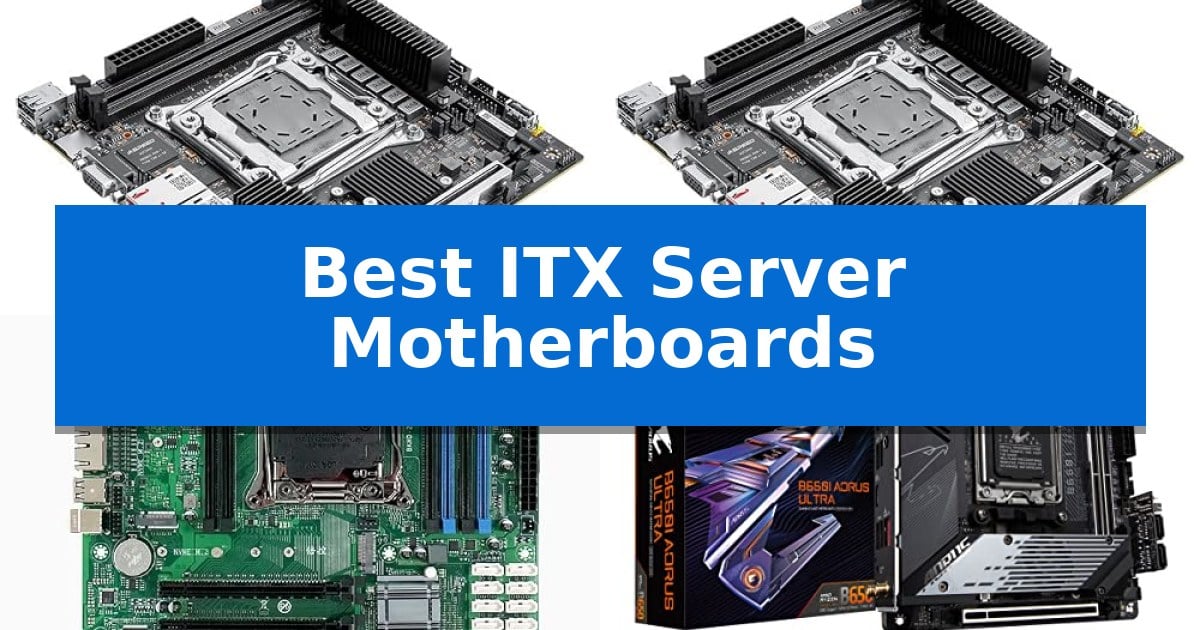
Building a compact server requires balancing raw processing power with strict physical space constraints. Whether you are assembling a home lab, a dedicated NAS, or a high-performance network router, selecting the right foundation is critical to ensuring your system remains stable under heavy, 24/7 workloads.
Finding the Best ITX Server Motherboards involves evaluating specific socket compatibility, storage expansion options, and network throughput capabilities. We have analyzed the latest offerings to help you identify which board provides the necessary connectivity and thermal management for your specific small-form-factor project.
Best ITX Server Motherboards in 2026: High-Density NAS and Routing
Quick Comparison
| Product | Best For | Key Strength | Score |
|---|---|---|---|
| Montvfieto NAS-C612 ITX Motherboard | Best Overall | Dual 10Gb RJ45 ports for high-speed networking. | 4.9 |
| Oaknode C612 ITX Server Motherboard | Compact Build for Network Routing | Dual 10Gbps RJ45 LAN ports for high-speed network throughput. | 4.3 |
| HKUXZR C612 NAS Motherboard | Multi-Port Connectivity for Servers | Quad 2.5GbE LAN ports for high-speed network traffic. | 4.4 |
| Gigabyte B650I AORUS Ultra Motherboard | Modern Performance for Compact Builds | Direct 8+2+1 Phases Digital VRM for stable power delivery. | 4.3 |
| MSI PRO H810I WiFi Motherboard | Latest Intel Core Ultra Support | Advanced connectivity with Wi-Fi 7 and 2.5G LAN. | 4.5 |
How We Chose
- Socket and CPU compatibility for specialized server processors.
- Network interface throughput, including 10GbE and multi-port configurations.
- Storage expansion capabilities, specifically SFF-8643 and M.2 NVMe support.
- Memory support, emphasizing ECC REG compatibility for data integrity.
- Form factor adherence to ensure compatibility with compact server chassis.
1 Montvfieto NAS-C612 ITX Motherboard — Dual 10GbE for High-Speed NAS
The Montvfieto NAS-C612 ITX Motherboard is engineered for space-constrained environments that require high-performance server capabilities, featuring an LGA2011-3 socket compatible with Xeon E5 V3 and V4 processors. This compact board provides the necessary multi-core processing power for virtual machines, network storage, and demanding homelab workloads.
Connectivity is a primary focus, highlighted by onboard dual 10Gb RJ45 network ports that facilitate high-speed data transmission. This configuration is specifically suited for users constructing NAS storage servers, network firewalls, or soft routing systems where bandwidth is critical.
Storage flexibility is managed through four SFF-8643 interfaces that support protocol switching, allowing for diverse NVMe SSD or SATA hard drive configurations. The board also includes dual M.2 NVMe slots to further expand storage capacity within the ITX form factor.
Memory support is robust, with dual DDR4 memory slots capable of handling both standard DDR4 and server-grade ECC/REG memory. Each slot supports up to 64GB, providing a total capacity of 128GB to ensure stability under heavy, sustained loads.
Designed for headless operation, the motherboard includes a built-in VGA display controller, ensuring compatibility with processors lacking integrated graphics. It supports a variety of operating systems, including Windows and mainstream open-source NAS or Linux distributions, for versatile deployment.
Best for: Users building high-performance, compact NAS or virtualization servers who require 10GbE connectivity and ECC memory support.
Skip if: Users who require modern consumer-grade CPU sockets or integrated graphics output beyond basic VGA for desktop-style usage.
PROS
- Dual 10Gb RJ45 ports for high-speed networking.
- Support for ECC/REG memory to ensure data stability.
- Four SFF-8643 interfaces for flexible storage expansion.
- Compact ITX form factor suitable for small server builds.
CONS
- VGA-only display output limits monitor compatibility.
- Requires LGA2011-3 processors which are legacy server hardware.
2 Oaknode C612 ITX Server Motherboard — Compact Build for Network Routing
The Oaknode C612 ITX Server Motherboard provides a specialized foundation for compact server builds by integrating the Intel C612 chipset and LGA2011-3 socket, ensuring compatibility with Intel Xeon E5 V3 and V4 processors. Its design centers on a standard 175x175mm Mini ITX form factor, making it suitable for space-constrained environments such as home NAS systems, firewalls, or industrial control setups.
Connectivity is a primary focus for this board, featuring dual 10 Gigabit RJ45 LAN ports driven by the Intel X550-T2 controller. This configuration supports high-bandwidth requirements for soft routers and large file transfers. For storage, the board includes two M.2 NVMe PCIe 3.0 slots and four SFF-8643 ports, allowing for a dense array of SSD and SATA storage options within a small footprint.
System flexibility is maintained through a PCIe 3.0 x16 expansion slot that supports multiple split modes, facilitating additional hardware integration. The board is designed for 24/7 operation and supports DDR4 REG ECC memory, which is essential for stable virtualization and data integrity tasks. Integrated features such as VGA output, USB 3.0/2.0 ports, and a TF slot simplify debugging and peripheral management without requiring a dedicated GPU.
Compatibility extends across Windows, Linux, and various mainstream NAS operating systems, providing versatility for different server roles. By combining server-grade chipset architecture with a compact ITX layout, this motherboard serves as a practical choice for users who need high-speed networking and significant storage expansion in a small-form-factor build.
Best for: Users building compact, high-performance home or enterprise servers that require 10GbE networking and extensive NVMe/SATA storage.
Skip if: Users who require modern consumer-grade CPU sockets or those who do not have a specific use case for dual 10GbE networking and ECC memory support.
PROS
- Dual 10Gbps RJ45 LAN ports for high-speed network throughput.
- Extensive storage options including 2 M.2 NVMe slots and 4 SFF-8643 ports.
- Server-grade stability with Intel C612 chipset and DDR4 ECC memory support.
- Compact 175x175mm Mini ITX form factor suitable for small cases.
CONS
- LGA2011-3 socket limits CPU choices to older Intel Xeon E5 V3/V4 generations.
- Requires specific SFF-8643 cabling for full storage connectivity.
3 HKUXZR C612 NAS Motherboard — Multi-Port Connectivity for Servers
The HKUXZR C612 NAS Motherboard provides a specialized foundation for compact server builds by integrating four Intel i226-V 2.5GbE LAN ports directly onto an ITX form factor. This high-density networking configuration is designed for users building professional network security firewalls, high-bandwidth NAS systems, or enterprise-grade server applications where space is at a premium.
Built around the LGA2011-3 socket, this board supports Intel Xeon E5-V3/V4 series processors, as well as Core i7 and i9 series chips. The layout maximizes the 24x24cm footprint by including six DDR4 DIMM slots, which support up to 384GB of total memory at 2400MHz, ensuring substantial capacity for virtualization and multi-core processing tasks.
Storage and expansion capabilities are extensive for an ITX board, featuring 10 SATA 6.0 Gbps ports and two M.2 NVMe slots compatible with 2210, 2240, and 2280 form factors. System expansion is handled by two PCIe x16 Gen3 slots and one PCIe x8 Gen3 slot, allowing for the integration of RAID cards, additional network adapters, or GPUs.
The I/O panel includes a VGA port driven by an onboard display chip, two USB 3.0 ports, two USB 2.0 ports, and a Realtek ALC897 audio interface. Internal connectivity is rounded out by USB 2.0 and 3.0 headers and a Type-E port. Users should note that the board requires both 24-pin and 8-pin power connections and may require a few minutes for initial memory training upon the first boot.
Best for: The HKUXZR C612 NAS Motherboard is best for users building high-density, compact server or firewall appliances that require multiple 2.5GbE network connections and large memory capacity.
Skip if: Skip this motherboard if you require a modern consumer-grade CPU socket or if your chassis cannot accommodate the specific 24x24cm ITX dimensions and dual-power connector requirements.
PROS
- Quad 2.5GbE LAN ports for high-speed network traffic.
- Extensive storage support with 10 SATA ports and dual M.2 NVMe slots.
- High memory capacity supporting up to 384GB of DDR4 RAM.
- Versatile expansion via multiple PCIe Gen3 slots.
CONS
- Requires specific power configuration using both 24-pin and 8-pin connectors.
- Initial boot delay due to required memory training process.
4 Gigabyte B650I AORUS Ultra Motherboard — Modern Performance for Compact Builds
Building a compact server requires a foundation that balances high-speed data throughput with efficient thermal management. The Gigabyte B650I AORUS Ultra Motherboard provides this balance through a robust Direct 8+2+1 Phases Digital VRM Solution and a 12-layer 2X Copper PCB, ensuring stable power delivery for high-core-count processors in a space-constrained ITX form factor.
Connectivity is a primary focus for this board, featuring PCIe 5.0 support for next-generation storage and expansion. The inclusion of USB 3.2 Gen 2 Type-C with DP-Alt mode allows for versatile peripheral and display connections, while the integrated WIFI 6E and 2.5GbE networking provide the high-bandwidth foundation necessary for server-side tasks.
Thermal control is managed by an extended VRM heatsink with heatpipe and fully covered MOSFET heatsinks, which are essential for maintaining performance during sustained workloads. The M.2 Thermal Guard III with active cooling further protects high-speed storage, ensuring that your NVMe drives maintain consistent read and write speeds without thermal throttling.
Ease of assembly is addressed through the EZ-Latch design and Q-Flash functionality, which simplify component installation and BIOS updates. These features reduce the complexity of building within the tight confines of an ITX chassis, making the board a practical choice for those prioritizing a streamlined setup process.
Best for: Users building a high-performance, compact server who require PCIe 5.0 support and robust thermal management in an ITX form factor.
Skip if: Users who require more than two DIMM slots or additional PCIe expansion slots beyond what the ITX form factor provides.
PROS
- Direct 8+2+1 Phases Digital VRM for stable power delivery.
- PCIe 5.0 support for future-proof storage and expansion.
- Active cooling on the M.2 Thermal Guard III.
- EZ-Latch and Q-Flash for simplified installation and maintenance.
CONS
- ITX form factor limits total RAM capacity and expansion slots.
5 MSI PRO H810I WiFi Motherboard — Latest Intel Core Ultra Support
Building a high-performance, compact system requires a foundation that balances modern processing power with space-saving design. The MSI PRO H810I WiFi Motherboard is engineered for this specific challenge, featuring support for the latest Intel Core Ultra Processors (Series 2) on the LGA1851 socket. Its ITX form factor is designed to fit into small-chassis builds without sacrificing the connectivity or thermal management necessary for intensive computing tasks.
At the heart of its performance architecture is a Direct 6 Phase (55A DrMOS) VRM paired with Core Boost technology, ensuring stable power delivery to the processor. To manage heat in confined spaces, the board utilizes Frozr Guard cooling, which includes an extended heatsink, a dedicated chipset heatsink, and 7W/mK MOSFET thermal pads. An M.2 Shield Frozr is also integrated to maintain optimal operating temperatures for high-speed storage.
The board provides a robust platform for data and graphics, featuring a PCIe 5.0 x16 slot reinforced with Steel Armor to support modern, heavy graphics cards. Memory performance is prioritized through two DDR5 DIMM SMT slots, capable of reaching overclocking speeds up to 7200 MT/s. For storage, it includes a Gen4 M.2 connector providing up to 64Gbps of bandwidth.
Connectivity is a standout feature, highlighted by an integrated Wi-Fi 7 module with Bluetooth 5.4 and a 2.5Gbps LAN port for high-speed networking. The rear I/O panel includes a USB 20Gbps Type-C port that supports display output, alongside 7.1 HD Audio with Audio Boost, making it a versatile choice for users who need a compact yet fully capable server or workstation foundation.
Best for: Users building a high-performance, compact ITX server or workstation that requires the latest Intel Core Ultra processor support and high-speed DDR5 memory.
Skip if: Users who require more than one M.2 storage slot or additional PCIe expansion slots beyond the single x16 interface.
PROS
- Advanced connectivity with Wi-Fi 7 and 2.5G LAN.
- High-speed memory support up to 7200 MT/s.
- Robust thermal management via Frozr Guard and M.2 Shield Frozr.
- PCIe 5.0 x16 Steel Armor slot for heavy-duty GPU support.
CONS
- Limited storage expansion with only one M.2 Gen4 slot.
- Compact ITX form factor restricts total expansion capabilities.
Best ITX Server Motherboards Buying Guide
Socket and Processor Compatibility
The processor socket defines the entire architecture of your server build. Many server-focused ITX boards utilize the LGA2011-3 socket to support Xeon E5 V3 and V4 series processors, which are favored for their high core counts and multi-threaded performance in virtualization tasks.
Conversely, modern desktop-derived ITX boards often support current-generation sockets like AM5 or LGA1851. These are better suited for applications requiring high single-core clock speeds or the latest instruction sets, rather than the massive multi-core throughput of older Xeon platforms.
Storage Expansion and Connectivity
For NAS builders, the number and type of storage headers are paramount. Look for boards that offer SFF-8643 connectors, which allow for high-density cabling to multiple SATA or NVMe drives without cluttering the small ITX interior.
M.2 NVMe slots are increasingly standard, providing a fast boot drive or cache layer. Ensure the board supports the specific protocol switching required if you intend to mix different types of storage media within a single array.
Network Throughput
A server is only as useful as its network connection. For high-bandwidth tasks like file serving or acting as a soft router, dual 10GbE RJ45 ports are a significant advantage, reducing bottlenecks during large file transfers.
If you are building a firewall or a complex network appliance, look for boards featuring multiple 2.5GbE ports. These provide the necessary physical separation for different network segments while maintaining high throughput for modern internet connections.
Memory and ECC Support
Data integrity is non-negotiable in server environments. Boards that support ECC (Error Correction Code) REG memory are essential for preventing data corruption during long-term operations or heavy computational loads.
Check the total RAM capacity supported by the DIMM slots. While ITX boards are limited by physical space, many server-grade models support up to 64GB per slot, allowing for substantial memory headroom in a very small package.
Thermal Management and Power
Compact builds suffer from limited airflow. High-quality VRM cooling and efficient power delivery are necessary to prevent thermal throttling during sustained high-load scenarios.
Always verify the power connector requirements. Some server-grade ITX boards require specific 24-pin and 8-pin configurations to ensure stable power delivery to the CPU and expansion slots, which may differ from standard consumer power supply setups.
Frequently Asked Questions
Can I use a standard desktop CPU in a server ITX motherboard?
It depends on the socket. Server-grade boards often require specific Xeon processors, while consumer-focused ITX boards support standard desktop CPUs. Always verify the CPU support list for the specific motherboard model.
Why is ECC memory recommended for servers?
ECC memory can detect and fix common data corruption errors, which is critical for maintaining system stability and data integrity during 24/7 operation.
Do all ITX server boards have integrated graphics?
No. Many server-grade boards include an onboard VGA controller to allow for display output without a dedicated GPU, but you should verify if your specific board requires a CPU with integrated graphics.
How do I connect multiple hard drives to an ITX board?
Look for boards with SFF-8643 connectors or multiple SATA ports. You can also use PCIe expansion cards if the board has an available PCIe slot.
What is the benefit of 10GbE ports?
10GbE ports provide significantly higher data transfer speeds than standard 1GbE ports, which is essential for NAS systems and high-traffic network routing.
Conclusion: Our Top Pick
Choosing the right hardware for a compact server requires careful attention to connectivity and stability. For users prioritizing high-speed storage and virtualization, the Montvfieto NAS-C612 ITX Motherboard stands out as the most capable option due to its dual 10GbE ports and robust support for ECC REG memory.
While other boards offer modern performance for different use cases, this model provides the specific I/O density needed for a professional-grade NAS or home lab in a minimal footprint. Ensure your power supply and cooling solution are adequate to handle the sustained performance demands of this platform.