
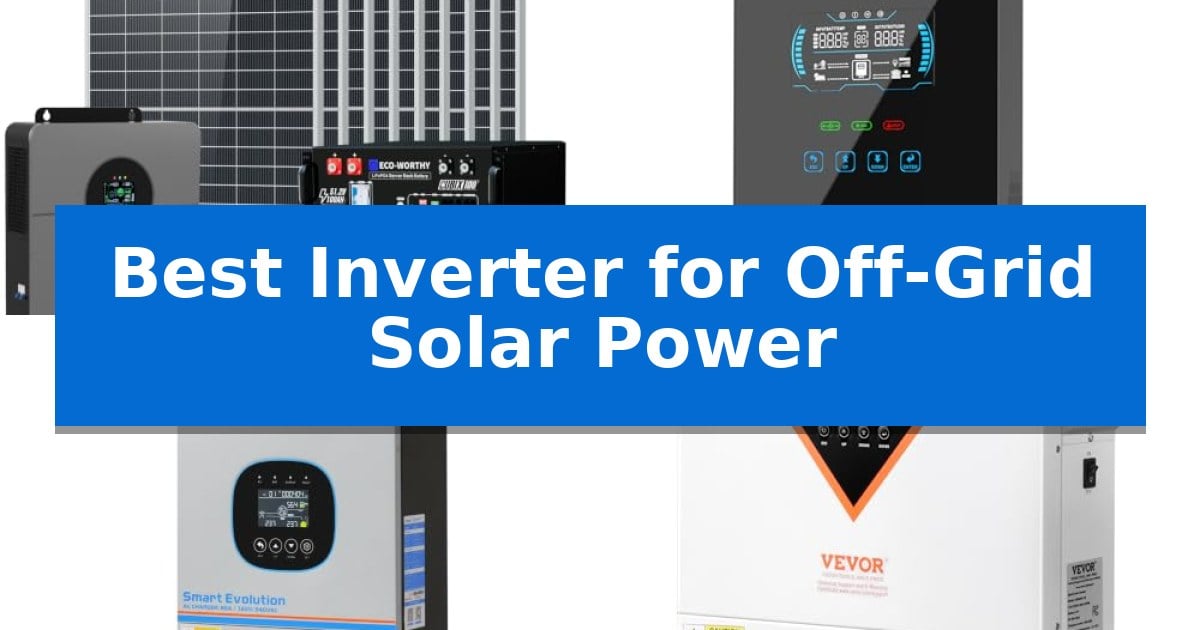
Transitioning to an independent energy setup requires a robust foundation, and choosing the Best Inverter for Off-Grid Solar Power is the most critical step. This device acts as the heart of your system, converting captured DC energy into usable AC power for your home or mobile setup.
Whether you are planning a full-scale residential installation or a compact mobile power station, selecting the right unit ensures your appliances run safely and efficiently. We have analyzed the latest market offerings to help you navigate the complexities of power output, battery compatibility, and system scalability.
Best Inverter for Off-Grid Solar Power in 2026
Quick Comparison
| Product | Best For | Key Strength | Score |
|---|---|---|---|
| ECO-WORTHY 10KW Off-Grid Solar System | Best Overall | High-capacity 20.48kWh storage using reliable LiFePO4 battery technology. | 4.9 |
| SUMRY Hybrid Solar Inverter | Versatile Battery-Optional Operation | Battery-optional operation allows for direct solar-to-load power usage during daylight. | 4.4 |
| OAE 6000W Low Frequency Solar Inverter | Scalable for Large Energy Needs | 6-Unit Parallel Expansion allows for scaling up to 36,000W total output. | 4.7 |
| VEVOR Hybrid Solar Inverter | Smart Remote Monitoring Capabilities | 2-in-1 design combines inverter and 100A MPPT controller | 4.6 |
| BELTTT 3000W Pure Sine Wave Inverter | Reliable Power for Mobile Setups | Pure sine wave output protects sensitive electronic equipment. | 4.3 |
How We Chose
- Continuous power output and peak surge capacity for heavy-duty appliances.
- Compatibility with diverse battery chemistries including LiFePO4 and lead-acid.
- Efficiency ratings and the inclusion of advanced MPPT charge controllers.
- System scalability through parallel connection support and remote monitoring features.
- Safety certifications and built-in protection mechanisms against electrical faults.
1 ECO-WORTHY 10KW Off-Grid Solar System — Complete High-Capacity Home Power
Transitioning to a self-sufficient energy setup requires a robust foundation, and the ECO-WORTHY 10KW Off-Grid Solar System provides a comprehensive solution by integrating high-capacity storage with a powerful split-phase inverter. This all-in-one package centers on a 10kW inverter capable of delivering 120V/240V output, ensuring compatibility with standard household appliances while managing significant power loads.
The system is built for high-demand environments, featuring 9 monocrystalline 590W solar panels that offer 23.23% efficiency and a bifacial design to maximize energy harvest. This array feeds into a substantial 20.48kWh energy storage bank composed of four 48V 100Ah LiFePO4 batteries. These batteries utilize a 3U server rack design and include a 100A BMS with a 125A circuit breaker to maintain operational safety.
Usability is enhanced through integrated technology, including built-in WiFi for real-time monitoring and CAN/RS485 communication for seamless inverter integration. The system supports parallel expansion of up to six units, allowing for scalable power growth. Given the complexity of the 10kW output and the physical requirements of the heavy-duty panels, professional installation is strongly recommended to ensure safety and optimal performance.
While this system offers a complete pathway to energy independence, it requires significant space and technical oversight. The inclusion of dual MPPT controllers and time-slot energy management provides users with granular control over their power consumption, making it a sophisticated choice for those committed to off-grid living.
Best for: Homeowners seeking a high-capacity, scalable, and all-in-one solar solution for powering standard household appliances off-grid.
Skip if: Users with limited installation space or those who prefer a modular, component-by-component solar build rather than an all-in-one kit.
PROS
- High-capacity 20.48kWh storage using reliable LiFePO4 battery technology.
- 10kW continuous power output with flexible 120V/240V split-phase support.
- Bifacial 590W solar panels that enhance energy harvest by up to 25%.
- Comprehensive safety features including UL 1973/9540A certification and integrated BMS.
CONS
- Requires professional installation due to the complexity and weight of the components.
- Large physical footprint necessitated by the nine high-power solar panels and rack-mounted batteries.
2 SUMRY Hybrid Solar Inverter — Versatile Battery-Optional Operation
The SUMRY Hybrid Solar Inverter distinguishes itself with a unique tempered glass upper cover and a large 6.25-inch LCD display, providing a high-transparency interface for monitoring real-time system data through touchable buttons. This unit is engineered to manage off-grid power needs with a 4000W rated output and an 8000W peak output, making it capable of handling various household loads.
Designed for versatility, this hybrid inverter features a built-in 140A MPPT charge controller that supports a maximum PV input of 5600W at 350VDC, achieving a maximum conversion efficiency of 98%. The system produces a pure sine wave output, which is essential for preventing interference and extending the operational lifespan of sensitive inductive appliances.
A key operational advantage is the ability to function with or without a battery. During daylight hours, the unit can utilize PV DC current directly to power loads, provided the input voltage exceeds 120V and the grid is disconnected. For those seeking to minimize grid dependency, it supports integration with various 24V battery types, including AGM, Gel, Lead-acid, Lithium-ion, and LiFePO4.
Safety and reliability are addressed through the inclusion of three cooling fans and integrated protections against overload, overheat, over-current, and short circuits. Users can manage energy priorities between solar panels, batteries, and utility power via the intuitive control panel, which also allows for the adjustment of battery charging parameters and system status monitoring.
Best for: Off-grid users who require a flexible, battery-optional solar power system capable of handling high-wattage loads with pure sine wave stability.
Skip if: Users who require a grid-tied system with specific net-metering certifications or those who need a higher DC voltage input than the 24V architecture supports.
PROS
- Battery-optional operation allows for direct solar-to-load power usage during daylight.
- Pure sine wave output ensures compatibility with sensitive electronic devices.
- High-efficiency 140A MPPT controller maximizes solar energy harvest up to 98%.
- Integrated glass-top LCD interface provides clear, accessible real-time system monitoring.
CONS
- Requires specific PV input voltage (exceeding 120V) to operate without a connected battery.
- Grid power consumption may occur if the battery is not connected and solar input is insufficient.
3 OAE 6000W Low Frequency Solar Inverter — Scalable for Large Energy Needs
The OAE 6000W Low Frequency Solar Inverter provides a robust foundation for off-grid energy systems by integrating an inverter, an 80A smart battery charger, and an AC auto-transfer switch into a single 3-in-1 unit. This design simplifies installation while maintaining over 90% transfer efficiency, ensuring reliable power delivery for homes, RVs, or trucks.
Engineered for scalability, this system supports parallel connection of up to 6 units, allowing users to expand total output from 6000W to 36,000W as energy demands increase. The inverter features three distinct working modes—AC priority, battery priority, and ECO—providing flexibility to manage power sources based on current availability and needs.
Compatibility is a core strength, as the unit supports various battery types including SLA, AGM, GEL, and Li-ion, with specific support for LiFePO4 chemistry. Users can monitor system status and perform remote firmware upgrades via a built-in WiFi module and smartphone app, ensuring the hardware remains current with the latest performance improvements.
Operational safety is maintained through comprehensive protections, including low and high voltage alarms, over-temperature, overload, and short-circuit safeguards. The unit also utilizes smart temperature-controlled fans to minimize noise, making it suitable for residential environments where quiet operation is preferred.
Best for: Homeowners and off-grid enthusiasts requiring a scalable, high-capacity power system that integrates charging and switching in one unit.
Skip if: Users with limited space or those requiring a lightweight, portable power station, as this unit weighs 68.34 pounds and is designed for stationary, high-output installations.
PROS
- 6-Unit Parallel Expansion allows for scaling up to 36,000W total output.
- 3-in-1 Integrated Design combines inverter, charger, and transfer switch for simplified setup.
- Broad Battery Compatibility supports LiFePO4, Gel, AGM, and Flooded Lithium batteries.
- Remote Monitoring via WiFi module and smartphone app.
CONS
- Heavyweight construction at 68.34 pounds limits portability.
- Large physical footprint requires dedicated installation space.
4 VEVOR Hybrid Solar Inverter — Smart Remote Monitoring Capabilities
Managing off-grid energy requires a reliable conversion system, and the VEVOR Hybrid Solar Inverter integrates both an inverter and a charge controller into a single 3000W unit. This device provides a pure sine wave output at 110/120V AC, ensuring stable power for sensitive electronics in home or office environments.
The system features an advanced MPPT solar charge controller capable of handling up to 100A charging current. With a solar input range of 60V to 500V DC and a maximum power capacity of 4000W, it offers flexibility for various solar array configurations while maintaining an energy conversion efficiency of 90%.
Compatibility is a core design focus, as the unit supports 24V battery systems including lithium, lead-acid, and custom battery types. It includes a specific activation function for lithium batteries to help optimize performance. Users can manage the system through multiple output modes—UTL, SOL, SBU, and SUB—which allow for tailored power distribution between solar, mains, and battery sources.
For system oversight, the VEVOR Hybrid Solar Inverter includes a built-in WiFi module for remote monitoring. While data updates occur every 5 minutes rather than in real-time, it provides necessary visibility into system status. The unit also incorporates comprehensive safety measures, including over-temperature, over-current, over-voltage, under-voltage, short-circuit, and overload protection to safeguard the connected power source and circuits.
Best for: Off-grid solar setups requiring a 3000W pure sine wave output and integrated MPPT charging for 24V battery systems.
Skip if: Users requiring real-time, second-by-second data monitoring or those operating on battery systems other than 24V.
PROS
- 2-in-1 design combines inverter and 100A MPPT controller
- Pure sine wave output for sensitive device compatibility
- Versatile battery support including lithium and lead-acid
- Integrated WiFi for remote system monitoring
CONS
- Non-real-time monitoring with 5-minute data intervals
- Fixed 24V system requirement limits battery bank flexibility
5 BELTTT 3000W Pure Sine Wave Inverter — Reliable Power for Mobile Setups
Maintaining reliable power in remote locations requires equipment capable of handling sensitive electronics while managing high-draw appliances. The BELTTT 3000W Pure Sine Wave Inverter provides a consistent AC waveform equivalent to utility grid power, making it a suitable choice for powering home theaters, televisions, and other inductive or capacitive loads without risking equipment failure.
Engineered for high-capacity demands, this unit delivers 3000W of continuous power with a 6000W peak surge capability to handle startup loads. It maintains a conversion efficiency greater than 93%, which helps minimize energy waste during off-grid operation. The inclusion of an intelligent LCD display allows users to monitor input and output voltages, battery status, and load conditions in real-time, facilitating proactive troubleshooting.
The device is built for versatility in mobile setups, featuring dual AC sockets, a 20A outlet, a hardwire port, and a 5V 2.1A USB port. For added convenience, it includes a 23-foot wired remote controller, allowing for operation even when the inverter is mounted in a storage compartment or utility bay. The housing is constructed from aluminum and sturdy plastic to support long-term use in rugged environments.
Safety is integrated through comprehensive protection systems, including undervoltage, overvoltage, overload, and over-temperature protection, as well as short circuit and reverse connection safeguards. These features ensure the unit remains protected during the fluctuations common in solar and battery-based power systems.
Best for: Off-grid users and RV owners requiring high-wattage, clean power for sensitive electronics and heavy-duty appliances.
Skip if: Users with small-scale power needs or limited battery banks may find this 3000W unit oversized and inefficient for light-duty applications.
PROS
- Pure sine wave output protects sensitive electronic equipment.
- High conversion efficiency exceeding 93% for better energy management.
- Comprehensive safety suite including reverse connection and overload protection.
- Remote control functionality with a 23-foot cable for flexible installation.
CONS
- Large physical footprint may be difficult to accommodate in compact spaces.
- High continuous power rating requires a robust battery bank to avoid rapid discharge.
Best Inverter for Off-Grid Solar Power Buying Guide
Understanding Power Capacity
The continuous power rating determines the total wattage your inverter can handle simultaneously. It is essential to calculate the sum of all appliances you intend to run at once, including high-draw items like refrigerators or pumps, to ensure the inverter does not trip under load.
Additionally, consider the peak surge capacity. Many motors and compressors require a temporary burst of power to start, often double or triple their running wattage. A high-quality inverter must accommodate these spikes without shutting down.
Inverter Types and Waveforms
For off-grid living, a pure sine wave inverter is non-negotiable. Unlike modified sine wave units, these produce a clean electrical current identical to utility grid power, which is vital for protecting sensitive electronics like laptops, medical equipment, and modern appliances.
Low-frequency inverters are generally heavier and more robust, making them ideal for inductive loads, while high-frequency hybrid models offer better efficiency and compact footprints for space-constrained installations.
Battery and Solar Integration
Modern hybrid solar inverters often include built-in MPPT charge controllers, which optimize the energy harvest from your solar panels. This integration simplifies wiring and reduces the need for external components, streamlining your overall system design.
Ensure your chosen inverter is compatible with your specific battery chemistry. Whether you use lithium iron phosphate (LiFePO4) or traditional AGM batteries, the inverter must support the correct charging profiles to maximize battery longevity and safety.
Scalability and Monitoring
If your energy needs are likely to grow, look for units that support parallel expansion. This allows you to connect multiple inverters together to increase your total output, providing a future-proof path for expanding your solar array.
Real-time monitoring via WiFi or Bluetooth apps is a significant advantage. These features allow you to track energy production, battery status, and load consumption remotely, enabling you to troubleshoot issues before they lead to power loss.
Safety and Protection Features
Off-grid systems must include comprehensive safety protections. Look for units that feature built-in safeguards against short circuits, over-temperature, over-voltage, and under-voltage conditions to protect both your equipment and your home.
Certifications such as UL 1973 or UL 9540A provide external validation that the components meet rigorous electrical and thermal safety standards, which is particularly important for high-capacity battery storage systems.
Frequently Asked Questions
Can I run my inverter without a battery?
Some hybrid inverters support battery-less operation using solar PV input during daylight hours. However, for a stable off-grid experience, connecting a battery is highly recommended to bridge gaps during cloudy weather or at night.
What is the difference between 120V and 240V output?
120V is standard for most small household appliances in North America. 240V split-phase output is necessary for heavy-duty appliances like electric dryers, well pumps, or large HVAC systems.
How do I calculate the right inverter size?
Add up the total wattage of all devices you plan to power simultaneously. Add a 20-30% buffer to this total to account for efficiency losses and potential surge requirements.
Is remote monitoring necessary?
While not strictly required, remote monitoring is extremely helpful for off-grid systems. It provides visibility into your energy usage and alerts you to potential system errors, which is crucial when you are your own utility provider.
Can I connect different brands of inverters in parallel?
Generally, no. Parallel expansion usually requires identical units from the same manufacturer to ensure they communicate correctly and share the load evenly.
Conclusion: Our Top Pick
Selecting the right equipment is the most important decision for your energy independence. For those seeking a comprehensive, high-capacity solution, the ECO-WORTHY 10KW Off-Grid Solar System stands out as our top recommendation. Its ability to handle 120V/240V split-phase power and its integrated 20.48kWh storage capacity make it a versatile choice for powering an entire home.
While this system offers excellent performance, remember that professional installation is recommended to ensure safety and optimal efficiency. By choosing a robust, scalable unit, you ensure your off-grid setup remains reliable for years to come.