
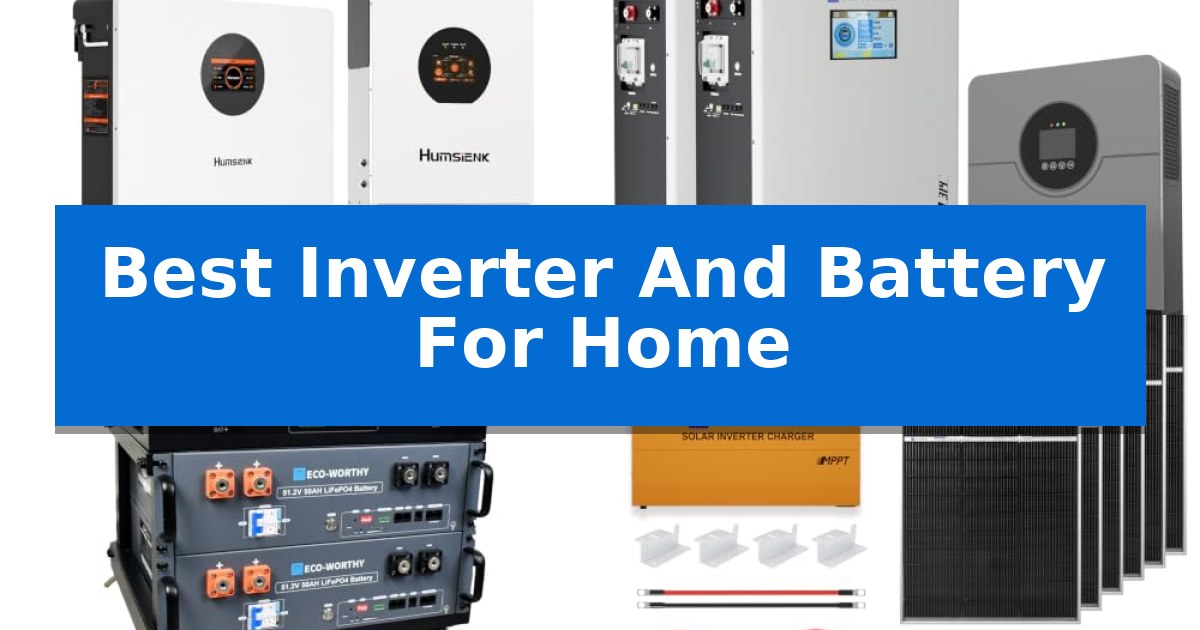
Finding the Best Inverter And Battery For Home requires balancing your specific power needs with the scalability of the system. Whether you are looking to mitigate the impact of grid outages or transition to a fully off-grid lifestyle, the right combination of storage capacity and inverter output is critical for keeping your essential appliances running smoothly.
Our analysis focuses on systems that offer robust, long-term energy solutions, prioritizing factors like cycle life, inverter surge capacity, and ease of installation. By examining these integrated kits, you can identify the setup that best aligns with your household's energy consumption patterns and long-term backup goals.
Best Inverter And Battery For Home in 2026: Reliable Off-Grid Energy
Quick Comparison
| Product | Best For | Key Strength | Score |
|---|---|---|---|
| HumsiENK 5.12kWh Home Backup System | Best Overall | High-capacity storage with 6,000+ cycle lifespan using Grade A+ LiFePO₄ cells. | 4.9 |
| ECO-WORTHY Powermega 30kWh Backup System | Highest Capacity for Off-Grid | 30kWh+ usable energy capacity for extended backup duration. | 4.8 |
| ECO-WORTHY SL3500 Stackable Power Station | Modular Design for Easy Expansion | Modular expandability up to 15.36KWH and 7000W output. | 4.9 |
| ECO-WORTHY 4.68KWH Solar Power Kit | Complete Solar-Ready Solution | High-efficiency 195W N-type bifacial panels with 25% conversion efficiency. | 4.5 |
| LANDERPOW 4000W Hybrid Solar Inverter | Flexible Off-Grid Power Management | All-in-one design integrates inverter, solar charger, and utility input. | 4.9 |
How We Chose
- Usable energy capacity and expansion potential for growing household needs.
- Inverter output stability, including surge capacity for high-draw appliances.
- Battery chemistry and cycle life, focusing on long-term durability and safety.
- System integration, including MPPT efficiency and smart monitoring capabilities.
- Installation complexity and physical footprint for residential utility spaces.
1 HumsiENK 5.12kWh Home Backup System — Best for Whole-Home Backup
Maintaining power during grid instability requires a robust solution that balances storage capacity with high-output delivery. The HumsiENK 5.12kWh Home Backup System provides a comprehensive approach by pairing a 5.12kWh LiFePO₄ battery with an 8000W hybrid split-phase inverter, designed to keep essential appliances like well pumps, refrigerators, and medical devices operational.
Engineered for longevity, the system utilizes premium Grade A+ LiFePO₄ prismatic cells capable of over 6,000 deep cycles. The integrated 100A BMS features 3A active balancing to maintain consistent cell health, while the IP54-rated all-metal housing ensures the unit remains protected in utility rooms or garages. Its wall-mount design measures 21.65" x 19.09" x 7.28", offering a space-efficient footprint that is significantly smaller than traditional lead-acid setups.
The included 8000W inverter delivers a pure sine wave output with native 120/240V split-phase capability, eliminating the need for external transformers. With a ≤10ms automatic transfer switching time, the system functions as a reliable UPS for sensitive electronics. The unit also integrates a 10000W MPPT solar charge controller, allowing for off-grid expansion and flexible charging options.
Scalability is a core feature of this system. While a single battery supports most household loads, the architecture allows for expansion up to 76.8kWh using 15 parallel batteries and 48kW via 6 parallel inverters. Users can monitor real-time voltage and capacity through the LCD touchscreen or the dedicated Bluetooth app, which supports programmable time-of-use scheduling for optimized energy management.
Best for: Homeowners seeking a scalable, wall-mounted energy storage solution for whole-home backup and off-grid solar integration.
Skip if: Users requiring sustained power for heavy-duty loads exceeding 5,500W simultaneously without the addition of a second battery unit.
PROS
- High-capacity storage with 6,000+ cycle lifespan using Grade A+ LiFePO₄ cells.
- Native 120/240V split-phase output eliminates the need for external transformers.
- Scalable architecture allows for up to 15 batteries in parallel.
- Compact wall-mount design saves floor space in utility areas.
CONS
- Limited sustained output for heavy loads above 5,500W without adding a second battery.
2 ECO-WORTHY Powermega 30kWh Backup System — Highest Capacity for Off-Grid
Managing energy independence requires a robust foundation, and the ECO-WORTHY Powermega 30kWh Backup System provides a comprehensive solution by integrating a 10kW hybrid inverter with two high-capacity 48V 314Ah LiFePO4 batteries. This system is engineered for versatility, supporting both 120V single-phase and 240V split-phase output to accommodate diverse residential electrical setups.
At the core of this unit is a focus on longevity and safety, featuring batteries rated for 9000+ cycles at 80% DoD. The system incorporates an Active Balancing Smart BMS alongside integrated circuit breakers and aerosol fire suppression, providing multiple layers of protection against common electrical faults like over-current and short circuits.
Monitoring and management are streamlined through built-in Bluetooth and WiFi connectivity, allowing users to track voltage, state of charge, and system cycles directly via an app. The inverter further enhances efficiency with 99.9% MPPT tracking, ensuring that solar energy capture is optimized for off-grid or backup applications.
Installation is designed for practicality, with the battery units featuring 100kg-capacity wheels to assist in positioning the heavy components. The system utilizes a plug-and-play approach, though users should note that the unit may arrive in multiple shipments to ensure safe transit.
Best for: Homeowners seeking a high-capacity, integrated energy storage solution for off-grid living or comprehensive emergency backup.
Skip if: Users with limited floor space or those requiring a lightweight, portable power station for camping or temporary mobile use.
PROS
- 30kWh+ usable energy capacity for extended backup duration.
- 9000+ cycle life ensures long-term durability.
- Integrated smart monitoring via Bluetooth and WiFi.
- Comprehensive safety suite including aerosol fire suppression.
CONS
- Heavy physical footprint requires dedicated space.
- Multi-package shipping may result in staggered delivery times.
3 ECO-WORTHY SL3500 Stackable Power Station — Modular Design for Easy Expansion
Reliable home energy management requires a system that scales with your needs, and the ECO-WORTHY SL3500 Stackable Power Station offers a modular approach to residential backup. By utilizing a 3500W AC output with a 6000W surge capacity, this unit provides the necessary power to handle essential home appliances during outages.
The system is built around a 5.12KWH LiFePO4 battery architecture, which includes a built-in 50A BMS to manage safety protocols such as over-discharge, short-circuit, and high-temperature protection. Its design features a flat shape with side-mounted screws, allowing users to stack units vertically to expand capacity up to 15.36KWH and output to 7000W.
Portability is addressed through a dedicated mobile trolley stand constructed from iron, which includes a telescopic handle and supports up to 150 kilograms. This allows the heavy battery modules to be moved or repositioned within a home or courtyard setting with relative ease.
For integration into a home setup, the 3500W inverter/controller supports parallel and phase-separated configurations. It accommodates a maximum photovoltaic input of 4400W, making it compatible with solar arrays for off-grid or emergency charging. The unit also functions as a 20ms UPS, ensuring a transition to battery power during grid failures.
The complete kit includes the inverter, base stand, and two 48V 50AH batteries. Because the system arrives in multiple packages, assembly is required upon delivery. The manufacturer provides a 3-year warranty to support the hardware, which is housed in a fire and explosion-proof metal case.
Best for: Homeowners seeking a modular, expandable solar-ready power backup system that can be scaled to meet increasing energy demands.
Skip if: Users requiring a single, lightweight, all-in-one portable power station that does not require assembly or manual stacking of multiple heavy battery modules.
PROS
- Modular expandability up to 15.36KWH and 7000W output.
- Integrated 20ms UPS functionality for seamless power transition.
- Durable metal case design with built-in 50A BMS for safety.
- Mobile trolley stand included for easier transport of heavy components.
CONS
- Multi-package delivery requires assembly before the system is operational.
- Heavy physical footprint necessitates dedicated space for stacking.
4 ECO-WORTHY 4.68KWH Solar Power Kit — Complete Solar-Ready Solution
Reliable off-grid power requires a system that balances energy generation with storage capacity, and the ECO-WORTHY 4.68KWH Solar Power Complete Kit provides a comprehensive solution for home, cabin, or shed applications. By combining six high-efficiency 195W N-Type bifacial solar panels with a robust 48V 50Ah LiFePO4 battery, this kit is engineered to generate approximately 4.68KWh per day under optimal sunlight conditions.
At the heart of the system is an upgraded 3500W solar charger inverter that converts 48VDC to 110/120VAC. This unit supports a 7000W surge power capacity and features 20ms UPS switching, ensuring stable power delivery for essential appliances like refrigerators, televisions, and microwaves. Users can manage the system remotely through integrated WiFi monitoring and control capabilities.
The included 48V 50Ah lithium battery utilizes Grade A LiFePO4 cells, offering a significant weight advantage at just 58.4 lbs—roughly one-third the weight of comparable lead-acid alternatives. These cells are rated for over 4000 cycles, providing long-term durability. The system is designed for operational flexibility, supporting discharge temperatures as low as -4℉ and charging at 32℉.
Installation is streamlined by the inclusion of all necessary accessories, though users should verify receipt of all components across multiple packages. The system's modular nature allows for parallel connection of up to 6 units, enabling a total capacity of 21kW for those requiring expanded power needs. This versatility makes it a practical choice for scaling energy independence.
Best for: Homeowners or cabin dwellers seeking a complete, scalable off-grid solar power system with integrated battery storage and remote monitoring.
Skip if: Users who require a simple plug-and-play portable power station, as this kit involves a more involved installation process and fixed panel mounting.
PROS
- High-efficiency 195W N-type bifacial panels with 25% conversion efficiency.
- Long-cycle life with over 4000 charge cycles from the LiFePO4 battery.
- Scalable design supporting parallel connection of up to 6 units for 21kW total capacity.
- Integrated WiFi monitoring for remote system control and management.
CONS
- Requires installation and assembly, unlike all-in-one portable power stations.
- Multiple package delivery requires careful verification of all included components upon arrival.
5 LANDERPOW 4000W Hybrid Solar Inverter — Flexible Off-Grid Power Management
Managing off-grid energy requires a versatile solution that can handle varying power sources and load demands. The LANDERPOW 4000W Hybrid Solar Inverter simplifies this by integrating an inverter, solar charger, and utility AC input into one compact unit, capable of delivering 4000W continuous power and 8000W surge power to support essential household appliances.
This system is engineered for flexibility, featuring a built-in 140A MPPT solar charging controller that supports up to 5600W of PV input. It allows users to prioritize power from solar panels, battery banks, or utility grids. For those who need a reliable setup, the unit includes an automatic transfer switch (ATS), which manages power source switching without the need for additional external hardware.
Designed for diverse environments, the inverter supports 24V battery systems including AGM, Gel, and LiFePO4. It offers a batteryless operation mode during the day when solar input is sufficient, though a battery bank is recommended for stable nighttime or cloudy-day performance. The unit is kept cool during heavy use by three integrated cooling fans, ensuring stable operation for refrigerators, pumps, and power tools.
The user interface features an LCD display and touch buttons, allowing for precise configuration of charging priorities and output settings. With multi-protection design against overload and overheating, this inverter is a practical choice for those building a robust off-grid solar power system or a dedicated home backup solution.
Best for: Users building a 24V off-grid solar system or home backup setup who need an all-in-one inverter with MPPT charging and automatic source switching.
Skip if: Users with 12V or 48V battery banks, as this unit is specifically designed for 24V systems.
PROS
- All-in-one design integrates inverter, solar charger, and utility input.
- High power output with 4000W continuous and 8000W surge capacity.
- Built-in 140A MPPT controller eliminates the need for a separate solar charger.
- Automatic transfer switch simplifies installation by managing power sources internally.
CONS
- 24V battery requirement limits compatibility with other voltage-based battery banks.
- Requires specific installation indoors or in a dry, well-ventilated area to maintain cooling efficiency.
Best Inverter And Battery For Home Buying Guide
Understanding Energy Capacity
The total capacity, measured in kilowatt-hours (kWh), determines how long your home can run on stored power. A system with higher capacity is essential for whole-home backup, while smaller, modular units may suffice for critical circuits like refrigerators and lighting.
Consider your daily energy consumption and the duration of typical outages in your area. Scaling your system with parallel batteries allows you to increase your storage capacity over time as your energy requirements evolve.
Inverter Output and Surge Requirements
The inverter is the heart of your system, converting stored DC power into usable AC power. You must ensure the continuous wattage rating meets your total load, while the surge rating handles the initial power spike required by motors in appliances like well pumps or central air conditioners.
Look for systems that offer pure sine wave output, which is necessary for sensitive electronics. A split-phase inverter is often required to power 240V appliances, providing a more versatile solution for standard residential electrical panels.
Battery Chemistry and Longevity
LiFePO4 (Lithium Iron Phosphate) is the current standard for home energy storage due to its safety profile and long cycle life. These batteries are designed to handle thousands of charge-discharge cycles, often lasting over a decade with proper maintenance.
Active balancing and integrated Battery Management Systems (BMS) are vital features. They protect against common electrical hazards like over-discharge and temperature extremes, ensuring consistent performance across all cells in the battery bank.
Installation and Space Considerations
Wall-mount designs are ideal for saving floor space in garages or utility rooms. These units are generally more compact and easier to install than traditional lead-acid battery banks, which are significantly heavier and bulkier.
Always verify the physical dimensions and weight of the units before purchase. Ensure your installation area has adequate ventilation and meets the manufacturer's environmental requirements for optimal battery health.
Smart Monitoring and Connectivity
Modern energy systems often include Bluetooth or WiFi connectivity, allowing you to track your energy usage, battery state-of-charge, and system health via a smartphone app. This transparency is crucial for managing your power consumption effectively.
Programmable features, such as time-of-use scheduling, enable you to optimize your system based on utility rates or solar production cycles, further increasing the value of your energy investment.
Frequently Asked Questions
Can I expand my battery storage later?
Most modern lithium home backup systems are modular, allowing you to add more battery units in parallel to increase your total storage capacity as needed.
What is the difference between continuous and surge power?
Continuous power is what the inverter can handle indefinitely, while surge power is the temporary, higher wattage capacity needed to start appliances with motors, such as refrigerators or pumps.
Do I need a professional for installation?
While many kits are designed for easier assembly, high-voltage electrical work should be performed by a qualified electrician to ensure safety and compliance with local building codes.
How long will a LiFePO4 battery last?
LiFePO4 batteries typically offer 4,000 to 9,000 cycles at 80% depth of discharge, which often translates to 10 or more years of reliable service in a typical home backup application.
What does split-phase output mean?
Split-phase output provides both 120V and 240V, which is necessary to run standard household appliances and larger equipment like electric ovens or central air conditioning units.
Conclusion: Our Top Pick
For those seeking a reliable, high-performance solution, the HumsiENK 5.12kWh Home Backup System stands out as our top recommendation. Its combination of a high-power 8000W hybrid inverter and a durable 5.12kWh LiFePO4 battery provides a versatile foundation that can be easily scaled to meet the needs of most households.
While this system is excellent for most residential applications, remember that sustained high-load usage exceeding 5,500W may require the addition of a second battery in parallel. By starting with this robust base, you gain a flexible, future-proof energy solution that balances power, safety, and ease of installation.