
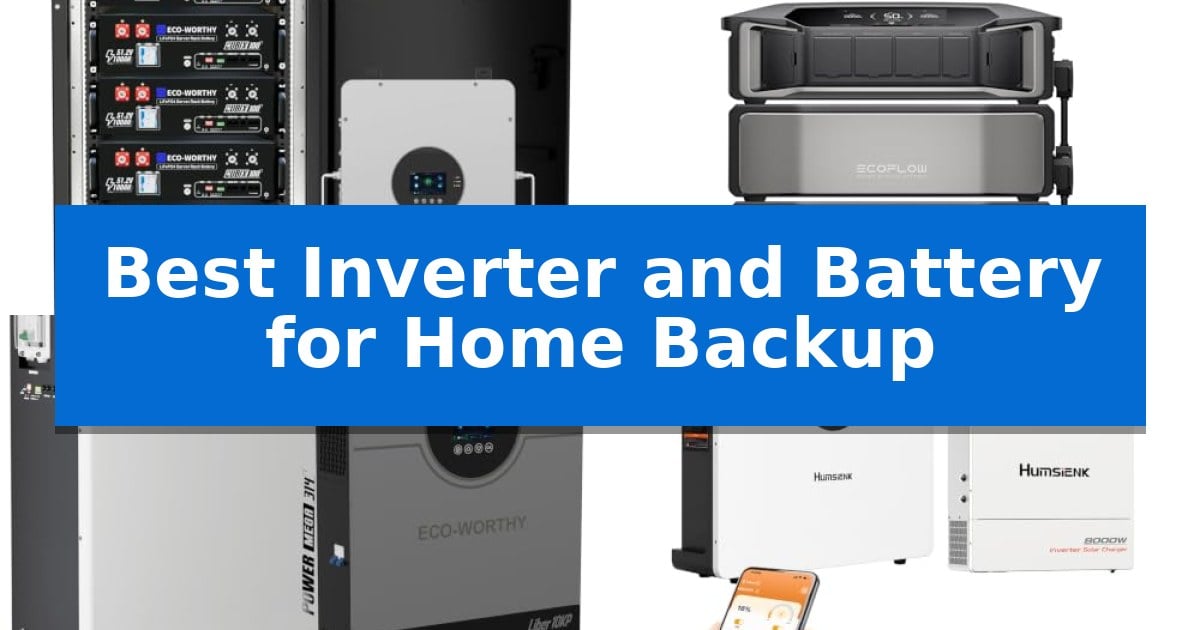
Power outages can disrupt your daily life, leaving your home without essential electricity for lighting, refrigeration, or climate control. Finding the Best Inverter and Battery for Home Backup requires balancing your household's total energy demand with the reliability of the storage system during grid failures.
Whether you are looking to run heavy appliances or simply keep critical electronics online, selecting the right combination of inverter output and battery capacity is vital. This guide evaluates top-tier energy storage systems to help you achieve long-term energy independence and peace of mind.
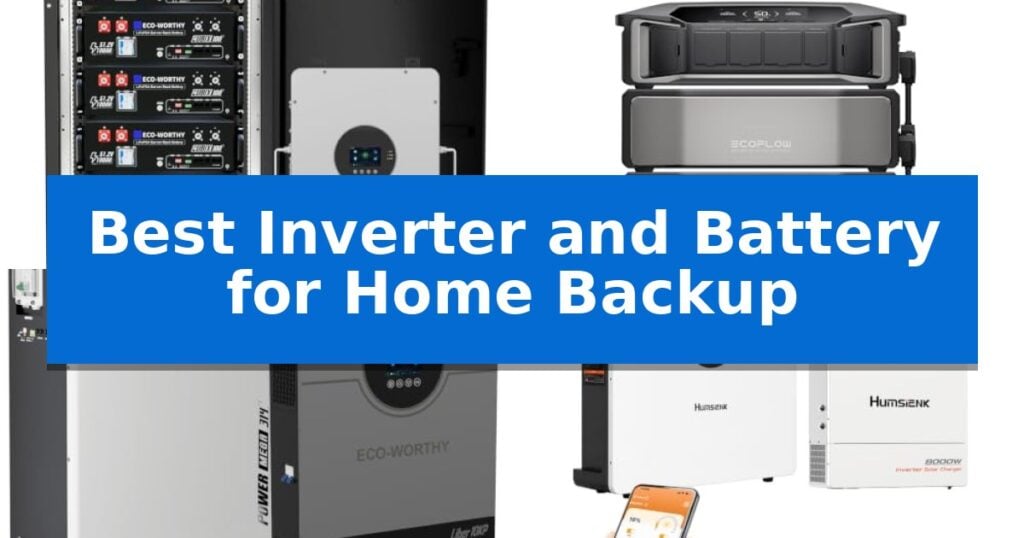
Best Inverter and Battery for Home Backup in 2026
Quick Comparison
| Product | Best For | Key Strength | Score |
|---|---|---|---|
| ECO-WORTHY Cubix100 Home Backup System | Best Overall | High-capacity 30.72KWh storage with modular expansion up to 163.84kWh. | 4.9 |
| EF ECOFLOW DELTA Pro Ultra | Fastest Recharge for Essential Power | High power output of 7200W capable of running heavy appliances. | 4.4 |
| ECO-WORTHY Powermega Energy Storage System | High-Capacity Off-Grid Energy Storage | High-capacity 16.1kWh storage with 9,000+ cycle life | 4.3 |
| HumsiENK Wall-Mount Home Backup | Space-Saving Design for Utility Rooms | High-capacity storage with 6,000+ cycle lifespan using Grade A+ LiFePO₄ cells. | 4.6 |
| ECO-WORTHY 48V Home Backup Power | Expandable Capacity for Growing Needs | High-capacity 10240Wh storage with Grade A LiFePO4 cells. | 4.5 |
How We Chose
- Total energy capacity measured in kilowatt-hours (kWh) to determine backup duration.
- Inverter power output (watts) to assess the ability to run heavy-duty household appliances.
- Safety certifications such as UL9540 and UL1741 to ensure compliance with North American electrical standards.
- System expandability options for users who may need to increase their storage capacity over time.
- Communication protocols and monitoring capabilities for real-time system management via mobile applications.
1 ECO-WORTHY Cubix100 Home Backup System — Whole-Home Power for Large Households
Reliable energy independence during grid instability requires a robust, high-capacity solution, and the ECO-WORTHY Cubix100 Home Backup System provides a comprehensive answer with its 30.72KWh total storage capacity. This system integrates six 51.2V 100Ah LiFePO4 batteries with a 12000W MPPT hybrid inverter, engineered to maintain power for high-demand appliances like air conditioners and refrigerators.
Safety and compliance are central to this design, as the system has achieved UL9540 and UL1741 certifications through Intertek, ensuring it meets rigorous North American electrical and thermal management standards. The included 3-in-1 inverter supports 120V/240V split-phase or 120V/208V three-phase output, offering a maximum peak power of 24000W to handle heavy startup loads.
Usability is enhanced through closed-loop communication via CAN/RS485 interfaces, allowing the battery to interact intelligently with the inverter. Users can monitor system status in real-time using built-in Bluetooth and WiFi connectivity through the ECO-WORTHY app. The manufacturer also simplifies the deployment process by offering installation support, coordinating with professional installers to manage the setup from start to final sign-off.
For households requiring even greater energy security, the system features ultra-expansion capability. Up to six hybrid inverters can be paralleled for a 72kW output, while the battery bank can scale up to 163.84kWh. The inverter also allows for direct generator integration, providing a secondary backup source during extended periods of low solar input.
Best for: Large households seeking a scalable, certified whole-home backup solution capable of powering high-draw appliances.
Skip if: Users living in small spaces or those who do not require high-capacity, multi-battery storage systems will find this modular rack-mount setup unnecessarily large and complex.
PROS
- High-capacity 30.72KWh storage with modular expansion up to 163.84kWh.
- UL9540 and UL1741 certified for enhanced electrical and thermal safety.
- Comprehensive installation support provided by the manufacturer.
- Versatile 12000W hybrid inverter with split-phase and three-phase output options.
CONS
- Large physical footprint requiring dedicated space for the 6-layer battery cabinet.
- Complex shipping process as components are delivered separately.
2 EF ECOFLOW DELTA Pro Ultra — Fastest Recharge for Essential Power
Maintaining power during an outage requires a robust solution capable of handling heavy household loads, and the EF ECOFLOW DELTA Pro Ultra is engineered for this exact purpose. This system integrates an inverter and a battery to provide a 7200W output, which is sufficient to power demanding appliances like a 3-ton central air conditioner. By scaling the system, users can reach up to 90kWh of energy, potentially securing over 30 days of essential power for a standard North American household.
The system offers significant flexibility through its online UPS with 0-ms transfer time, ensuring that sensitive electronics remain protected from grid failures or disturbances. For those who prioritize a quiet environment, the unit operates in absolute silence for the first 30 minutes when outputting up to 2000W. Users can manage their energy consumption via the EcoFlow app, which allows for the prioritization of specific home circuits and the intelligent analysis of power usage to offset peak rates.
Charging efficiency is a core component of this setup, with a single 6144Wh battery capable of a full recharge in just 2 hours. The system supports multiple input methods, including solar, wall outlets, electric vehicle piles, and outdoor generators. The EF ECOFLOW DELTA Pro Ultra is designed for modularity, allowing users to start with one battery and expand as their energy needs grow, though it is important to note that the inverter and battery components arrive in separate packages.
Best for: Homeowners seeking a high-capacity, scalable backup power system capable of running heavy appliances and sensitive electronics during extended outages.
Skip if: Users living in small apartments or those who require a portable, lightweight power station for camping or mobile use will find the size and weight of this system excessive.
PROS
- High power output of 7200W capable of running heavy appliances.
- Scalable energy capacity up to 90kWh for long-term backup.
- Fast 2-hour recharge time for the 6144Wh battery.
- 0-ms transfer time for uninterrupted power to sensitive devices.
CONS
- Large physical footprint and heavy weight (293.6 lbs) limit portability.
- Separate shipping of the inverter and battery units.
3 ECO-WORTHY Powermega Energy Storage System — High-Capacity Off-Grid Energy Storage
The ECO-WORTHY Powermega Energy Storage System provides a centralized power solution by pairing a 10kW hybrid inverter with a 48V 314Ah LiFePO4 battery, delivering 16.1kWh of usable energy. This system is engineered for home backup, off-grid cabins, and emergency power, utilizing a UL 1973-certified battery chemistry designed for long-term reliability.
Performance is managed through an Active Balancing Smart BMS that includes a built-in circuit breaker, aerosol fire suppression, and buzzer alarms for multi-layer safety. The system supports split-phase 240V and single-phase 120V output, offering flexible installation options for various household electrical setups. The inverter achieves up to 99.9% MPPT efficiency, which helps maximize energy harvest from solar arrays.
Monitoring and communication are integrated directly into the hardware. The battery features RS485, CAN, and RS232 communication ports for broad inverter compatibility, while built-in WiFi and Bluetooth connectivity allow for mobile app monitoring. Users can also view real-time data on the battery's integrated LCD screen.
Designed for durability, the battery is rated for 9,000+ cycles at 80% DoD, supporting over 10 years of service. The unit includes reinforced casters to assist with positioning, though the system's significant weight requires delivery via truck freight. This comprehensive package provides a robust, high-capacity foundation for residential energy independence.
Best for: Homeowners seeking a high-capacity, integrated 16.1kWh energy storage solution for off-grid or emergency backup applications.
Skip if: Users with limited space or those unable to accommodate large-scale truck freight deliveries for heavy, palletized equipment.
PROS
- High-capacity 16.1kWh storage with 9,000+ cycle life
- Integrated safety suite including aerosol fire suppression and active BMS
- Flexible connectivity via WiFi, Bluetooth, and multiple communication protocols
- High-efficiency 10kW hybrid inverter with 99.9% MPPT
CONS
- Heavy shipping requirements necessitating truck freight delivery
- Large physical footprint requiring dedicated installation space
4 HumsiENK Wall-Mount Home Backup — Space-Saving Design for Utility Rooms
Maintaining power during grid instability requires a robust solution that balances storage capacity with high-output delivery. The HumsiENK Wall-Mount Home Backup addresses this by pairing a 5.12kWh LiFePO₄ battery with an 8000W hybrid split-phase inverter, providing a centralized system capable of supporting essential household appliances like refrigerators, well pumps, and lighting.
Engineered for longevity, the system utilizes Grade A+ LiFePO₄ prismatic cells rated for over 6,000 deep cycles at 80% depth of discharge. This chemistry is supported by an integrated 100A Battery Management System (BMS) featuring 3A active balancing, which works to maintain consistent cell performance and protect against common electrical hazards like short-circuits and temperature extremes.
The included 8000W inverter delivers a pure sine wave with native 120/240V split-phase output, eliminating the need for external transformers. It functions as a 3-in-1 unit, incorporating a 10000W MPPT solar charge controller and a 160A battery charger. With a transfer switching time of ≤10ms, the system is designed to keep sensitive electronics, such as routers and medical devices, operational during power interruptions.
Installation is streamlined by a space-saving wall-mount design that measures 21.65" × 19.09" × 7.28", allowing the unit to be mounted flush in utility rooms or garages. The system is also highly scalable; users can expand capacity to 76.8kWh by connecting up to 15 batteries in parallel or increase power output by linking up to 6 inverters, making it a flexible choice for growing energy needs.
Best for: Homeowners seeking a scalable, wall-mounted energy storage system for critical load backup and off-grid solar integration.
Skip if: Users requiring sustained power for heavy-duty industrial machinery or simultaneous high-draw appliances exceeding 5,500W without adding additional battery units.
PROS
- High-capacity storage with 6,000+ cycle lifespan using Grade A+ LiFePO₄ cells.
- Native 120/240V split-phase output eliminates the need for additional transformers.
- Scalable architecture allows for up to 15 batteries and 6 inverters in parallel.
- Fast ≤10ms transfer time ensures minimal disruption for sensitive electronics.
CONS
- Single battery limitation requires additional units for sustained loads exceeding 5,500W.
- Wall-mount installation requires adequate structural support due to the weight of the battery and inverter components.
5 ECO-WORTHY 48V Home Backup Power — Expandable Capacity for Growing Needs
The ECO-WORTHY 48V Home Backup Power system provides a robust foundation for residential energy independence by combining a 10000W pure sine wave inverter with a substantial 10240Wh battery capacity. This kit is engineered for versatility, supporting both 120V single-phase and 240V split-phase output to accommodate a wide range of household appliances during outages.
Safety and reliability are central to this design, as both the battery and inverter have passed UL1973 & UL1741 testing by Intertek. The system utilizes long-lasting Grade A LiFePO4 cells, which are managed through integrated CAN/RS485 communication protocols. Users can monitor the system status in real-time via the ECO-WORTHY APP using the built-in Bluetooth and WiFi functionality.
The 3-in-1 inverter features two independent MPPT controllers and supports a maximum charging current of 200A. This hardware is built for scalability; owners can connect up to 6 inverters in parallel for a total of 60kW AC output, or expand storage by linking up to 32 batteries to reach a massive 163.84kWh capacity.
Installation and maintenance are supported by the inclusion of an RSD button and necessary accessories. Because the kit components are shipped separately for safety, the manufacturer provides tracking numbers for each item to ensure a coordinated arrival of the full power station setup.
Best for: Homeowners seeking a scalable, safety-certified power backup solution that can be expanded to meet growing energy demands.
Skip if: Users requiring a portable, all-in-one power station for camping or mobile use will find this stationary, rack-mounted system too heavy and complex for their needs.
PROS
- High-capacity 10240Wh storage with Grade A LiFePO4 cells.
- UL1973 & UL1741 safety certifications for reliable operation.
- Extensive scalability supporting up to 60kW output and 163.84kWh storage.
- Integrated smart monitoring via Bluetooth and WiFi app connectivity.
CONS
- Separate shipping of components requires coordination of multiple packages.
- Stationary design is not intended for mobile or portable applications.
Best Inverter and Battery for Home Backup Buying Guide
Understanding Energy Capacity and Output
The total energy capacity of your system, measured in kilowatt-hours (kWh), dictates how long you can power your home during an outage. A system with higher capacity allows for longer runtimes, but it is essential to match this with your specific daily consumption needs.
Equally important is the inverter output, which determines the maximum load your system can handle at once. If you intend to run high-draw appliances like central air conditioners or electric ovens, you must ensure your inverter has a high continuous wattage rating to avoid system shutdowns.
Safety and Compliance Standards
When integrating a battery system into your home, safety certifications are non-negotiable. Look for systems that have passed rigorous testing such as UL9540 and UL1741, which verify the electrical safety, thermal management, and fire protection of the equipment.
These standards ensure that the hardware is designed to handle the stresses of residential power cycles. Prioritizing certified equipment reduces the risk of thermal runaway and ensures that your installation meets local building codes.
Scalability for Future Needs
Many homeowners start with a modest backup system, only to realize later that they need more power. Expandable systems allow you to add more battery modules in parallel, effectively increasing your total storage capacity without needing to replace the entire inverter setup.
Check the manufacturer's specifications for the maximum number of batteries that can be connected. This flexibility is a key advantage for growing households or those planning to add more solar panels in the future.
Smart Monitoring and Integration
Modern home backup systems often include integrated communication protocols like CAN or RS485. These allow the battery and inverter to "talk" to each other, optimizing charging and discharging cycles for maximum efficiency.
Features like built-in Bluetooth or WiFi enable you to monitor your system's health, state of charge, and power consumption directly from a smartphone app. This transparency is crucial for managing your energy usage during extended outages.
Installation and Maintenance
The complexity of installing a home backup system varies by model. Some systems are designed for wall-mount installation to save floor space, while others utilize server-rack cabinets that may require more dedicated space in a utility room or garage.
Consider whether the manufacturer provides installation support or if the system is intended for professional installation. Proper setup is essential for the longevity of your lithium-ion cells and the overall performance of the power station.
Frequently Asked Questions
What is the difference between a hybrid inverter and a standard inverter?
A hybrid inverter can manage power from multiple sources, such as the grid, solar panels, and batteries, simultaneously. It is essential for home backup systems that aim to utilize solar energy while maintaining a connection to the grid.
How long will a 10kWh battery last during an outage?
The duration depends entirely on your consumption. A 10kWh battery can power essential items like lights, a refrigerator, and a router for a significant period, but heavy appliances like air conditioners will deplete it much faster.
Can I install these systems myself?
While some systems are marketed as user-friendly, high-capacity home backup systems involve high-voltage electrical work. It is highly recommended to consult with a professional installer to ensure safety and code compliance.
What does LiFePO4 mean for battery safety?
LiFePO4 (Lithium Iron Phosphate) is a type of lithium battery known for its high thermal stability and long cycle life. It is generally considered safer and more durable for stationary home energy storage than other lithium-ion chemistries.
Do I need to maintain the battery regularly?
Most modern LiFePO4 systems are maintenance-free. However, you should periodically check the system's monitoring app to ensure the battery health is optimal and that all firmware is up to date.
Conclusion: Our Top Pick
Choosing the right backup power solution depends on your household's specific energy demands and your long-term goals for energy independence. For most homeowners seeking a robust, high-capacity solution, the ECO-WORTHY Cubix100 Home Backup System stands out as a top choice due to its massive 30.72KWh capacity and its ability to support whole-home power for large households.
While the system offers significant power, ensure your home's electrical panel is compatible with the unit's output specifications. By investing in a system with certified safety standards and expansion capabilities, you can ensure your home remains powered through unexpected grid failures for years to come.