
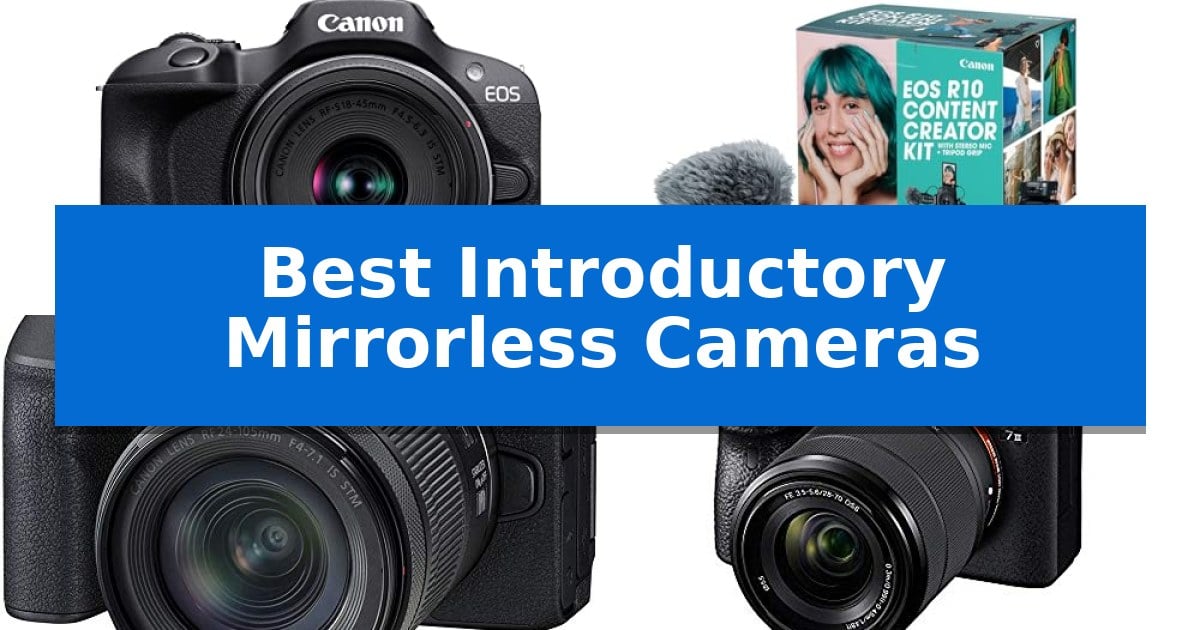
Stepping into the world of photography can feel overwhelming with the sheer variety of hardware available. Finding the Best Introductory Mirrorless Cameras requires balancing ease of use with the technical depth needed to grow your skills as a creator.
Whether you are looking to capture high-resolution stills or transition into professional-grade video, selecting the right body and lens ecosystem is the most critical first step. We have analyzed current market offerings to highlight which models provide the most intuitive experience for those just starting out.
Best Introductory Mirrorless Cameras in 2026
Quick Comparison
| Product | Best For | Key Strength | Score |
|---|---|---|---|
| Canon EOS R100 Mirrorless Camera | Best Overall | Extremely compact and lightweight body for maximum portability. | 4.9 |
| Canon EOS R10 Mirrorless Camera | Best for Aspiring Creators | Comprehensive creator kit includes essential vlogging accessories like a tripod grip and stereo microp… | 4.4 |
| Canon EOS RP Mirrorless Camera | Affordable Full-Frame Gateway | Compact and lightweight design ideal for travel. | 4.4 |
| Sony Alpha a7 III Mirrorless Camera | Versatile Full-Frame Performance | Advanced 24.2MP BSI Full-frame sensor for high-resolution imaging. | 4.9 |
| Sony Alpha a6000 Mirrorless Camera | Compact Classic for Beginners | 24 MP APS-C CMOS sensor for high-detail imagery. | 4.4 |
How We Chose
- Sensor size and resolution for image clarity
- Autofocus speed and subject tracking capabilities
- Video recording resolution and frame rate options
- Physical size, weight, and ergonomic design
- Lens mount compatibility and ecosystem expansion
1 Canon EOS R100 Mirrorless Camera — Most Accessible Entry Point
Transitioning from smartphone photography to a dedicated camera requires a balance of portability and image control. The Canon EOS R100 Mirrorless Camera addresses this by integrating a 24.1 megapixel CMOS (APS-C) sensor into the smallest and lightest body within the EOS R series, providing a significant step up in image clarity and natural bokeh compared to mobile sensors.
Designed for those new to interchangeable lens systems, the camera utilizes the DIGIC 8 image processor to manage high-speed operations. This internal hardware enables versatile recording options, including 4K video at up to 24 fps and high-frame-rate HD video at 120 fps, catering to both aspiring photographers and content creators.
Focus accuracy is managed through Dual Pixel CMOS AF, which offers coverage across 143 zones. This system includes human face and eye detection, as well as animal and vehicle tracking, ensuring that subjects remain sharp during both still photography and video recording. The system supports a continuous shooting rate of up to 6.5 shots per second when using One-Shot AF.
While the compact form factor prioritizes mobility, it maintains the flexibility of the RF-S lens mount. This allows users to expand their kit as their skills grow, making it a sustainable starting point for those entering the mirrorless ecosystem without the bulk of traditional DSLR designs.
Best for: Beginners and content creators seeking a highly portable, lightweight entry point into the Canon EOS R mirrorless system with interchangeable lens capability.
Skip if: Users who require advanced professional features like in-body image stabilization, high-speed 4K/60p video, or a fully articulating touchscreen for complex vlogging angles.
PROS
- Extremely compact and lightweight body for maximum portability.
- Dual Pixel CMOS AF provides reliable subject tracking for faces and eyes.
- High-frame-rate HD video (120 fps) for creative slow-motion effects.
- APS-C sensor delivers superior depth-of-field control and image detail.
CONS
- Limited 4K frame rate (max 24 fps) restricts high-resolution motion capture.
- Fixed screen design lacks the versatility of articulating displays for self-recording.
2 Canon EOS R10 Mirrorless Camera — Best for Aspiring Creators
Equipped with a dedicated tripod grip and stereo microphone, the Canon EOS R10 Content Creator Kit is designed to streamline the production process for those moving into dedicated video content creation. This mirrorless system centers on a 24.2-megapixel CMOS sensor and the DIGIC X image processor, providing a foundation for high-resolution imagery and continuous 4K video recording without the typical 30-minute clip limit.
The camera features an advanced Dual Pixel CMOS AF system that inherits subject detection capabilities from higher-end models, allowing for precise tracking of people, animals, and vehicles. For those capturing fast-paced action, the device supports a 15 fps mechanical shutter and a 30 fps electronic shutter, complemented by a RAW Burst Mode that includes a 1/2-second pre-shooting buffer to ensure no moment is missed.
Designed for portability, the Canon EOS R10 Mirrorless Camera maintains a compact, lightweight form factor with a firm grip for stable handheld operation. The kit includes the versatile RF-S18-150mm F3.5-6.3 IS STM lens, though the system remains compatible with the broader ecosystem of RF-S, RF, EF, and EF-S mount lenses, offering significant flexibility for future expansion.
While the included accessories like the wind screen and wireless remote control enhance the vlogging experience, the camera's primary strength lies in its balance of high-speed performance and ease of use. It serves as a capable entry point for creators who require professional-grade autofocus and video-optimized features in a package that fits easily into a standard camera bag.
Best for: Aspiring content creators and vloggers who need an all-in-one kit with advanced autofocus and flexible lens compatibility.
Skip if: Users who require full-frame sensor performance or those who do not need the included vlogging accessories like the tripod grip and microphone.
PROS
- Comprehensive creator kit includes essential vlogging accessories like a tripod grip and stereo microphone.
- Advanced Dual Pixel CMOS AF provides reliable subject tracking for people, animals, and vehicles.
- High-speed shooting capabilities with up to 30 fps electronic shutter and RAW burst functionality.
- Broad lens compatibility across RF-S, RF, EF, and EF-S mounts.
CONS
- APS-C sensor size may not meet the needs of users specifically seeking full-frame image characteristics.
- Kit-dependent value might be less ideal for photographers who already own specialized lenses or audio equipment.
3 Canon EOS RP Mirrorless Camera — Affordable Full-Frame Gateway
Stepping into full-frame photography often requires a significant investment, but the Canon EOS RP Mirrorless Camera provides an accessible entry point by balancing a compact, lightweight body with a high-quality sensor. This camera is designed for those who want to transition from smaller sensors without carrying heavy, cumbersome gear, making it a practical companion for travel and daily documentation.
The included RF24-105mm lens offers a versatile zoom range, supported by Optical Image Stabilization that provides up to 5 stops of shake correction. This stabilization is particularly beneficial for handheld shooting, helping to maintain clarity across various focal lengths. For those interested in macro work, the system supports a maximum magnification of 0.4x in autofocus, with a specialized center focus macro mode that achieves up to 0.5x magnification at a minimum distance of 0.43 feet.
Beyond still photography, the camera adapts to modern content creation needs by supporting 4K UHD 2160p video capture. Users can integrate the device into their digital workflow using the EOS Utility Webcam Beta Software or by utilizing the clean HDMI output to connect to external capture devices, effectively turning the camera into a high-quality webcam for streaming or video conferencing.
The physical design emphasizes portability, measuring approximately 5.2 inches in width and 3.3 inches in height, with a weight of about one pound. This form factor ensures that the camera remains manageable during long days of shooting or vlogging, fitting comfortably into a travel kit while still providing the benefits of an interchangeable lens system.
Best for: Photographers and content creators seeking a lightweight, portable entry into the full-frame mirrorless ecosystem.
Skip if: Users who require professional-grade high-speed burst shooting or specialized cinema-focused video features may find this entry-level model limiting.
PROS
- Compact and lightweight design ideal for travel.
- Versatile RF24-105mm lens included for varied shooting scenarios.
- Integrated Optical Image Stabilization for steadier handheld shots.
- Flexible webcam functionality via software or HDMI output.
CONS
- Limited specialized video features compared to dedicated cinema cameras.
- Form factor may feel small for users accustomed to larger DSLR grips.
4 Sony Alpha a7 III Mirrorless Camera — Versatile Full-Frame Performance
Stepping into the world of interchangeable lenses requires a foundation that balances professional-grade imaging with intuitive handling. The Sony Alpha a7 III Mirrorless Camera provides this balance through its 24.2MP Back-Illuminated 35mm Full-frame Image Sensor, which utilizes an advanced design to maximize light collection and detail capture.
Performance is driven by a high-speed readout architecture that supports up to 10fps shooting with full AE/AF tracking, ensuring that fast-moving subjects remain sharp. The autofocus system is particularly robust, featuring 693 phase-detection points and 425 contrast AF points that cover approximately 93% of the image area, allowing for precise focus placement even near the edges of the frame.
Versatility is a core design philosophy for this model, evidenced by its wide ISO range of 50 to 204,800 and 15-stop dynamic range. These specifications enable photographers to maintain image quality across varying lighting conditions, from bright daylight to challenging low-light environments, while capturing 14-bit uncompressed RAW files for flexible post-processing.
The camera comes equipped with a 28-70mm lens, offering a practical focal range for everyday photography right out of the box. Its compact form factor, weighing approximately 1.75 pounds, ensures that the system remains manageable for extended shooting sessions while providing the depth and clarity associated with full-frame sensor technology.
Best for: Photographers transitioning to full-frame systems who require a versatile, high-speed autofocus platform for both stills and varied lighting conditions.
Skip if: Users who prioritize a lightweight, pocketable camera body or those who do not require the specific depth and light-gathering capabilities of a full-frame sensor.
PROS
- Advanced 24.2MP BSI Full-frame sensor for high-resolution imaging.
- Extensive autofocus coverage with 693 phase-detection points.
- High-speed 10fps continuous shooting with tracking.
- Broad ISO range for low-light versatility.
CONS
- Larger physical footprint compared to APS-C or Micro Four Thirds mirrorless systems.
5 Sony Alpha a6000 Mirrorless Camera — Compact Classic for Beginners
Stepping into photography often requires a balance between portability and advanced imaging capabilities, and the Sony Alpha a6000 Mirrorless Camera addresses this by packing a 24 MP APS-C CMOS sensor into a frame that weighs less than one pound. This design choice allows beginners to access high-resolution imaging without the bulk typically associated with traditional DSLR systems.
The camera utilizes a Hybrid AF system featuring 179-point focal plane phase-detection and 25 contrast detect points, which assists in maintaining focus accuracy. For those interested in action or candid photography, the device supports up to 11 FPS continuous shooting, providing a significant buffer for capturing fleeting moments.
Composing shots is handled through either the OLED electronic viewfinder with 100% coverage or the 3-inch tilting LCD screen. The versatile E-mount interchangeable lens system ensures that as your photography skills grow, you can expand your kit with various lenses to suit different subjects.
Connectivity is integrated through Wi-Fi and NFC one-touch functionality, allowing for streamlined image transfer. The camera also supports downloadable Camera Apps, which can add specific features to the device's existing interface, making it a flexible choice for those just starting their journey into mirrorless photography.
Best for: Beginners seeking a compact, high-resolution mirrorless system with fast autofocus capabilities for versatile shooting.
Skip if: Users who require an integrated flash or advanced video-centric features like 4K recording, as this model focuses on stills and portability.
PROS
- 24 MP APS-C CMOS sensor for high-detail imagery.
- 11 FPS continuous shooting for action photography.
- Hybrid AF system with 179 phase-detection points.
- Compact, lightweight body for easy portability.
CONS
- No 4K video recording capability.
- Tilting LCD is not a fully articulating screen.
Best Introductory Mirrorless Cameras Buying Guide
Understanding Sensor Sizes
The sensor is the heart of your camera, determining how much light it captures and the overall quality of your images. Most entry-level models feature an APS-C sensor, which offers a great balance between physical size and image performance.
For those seeking a more professional look, full-frame sensors provide superior low-light performance and a shallower depth of field. However, these bodies are often larger and require more expensive, heavier lenses.
The Importance of Autofocus
Modern autofocus systems are essential for beginners, as they allow you to focus on composition rather than manual adjustments. Look for cameras that feature human, animal, or vehicle detection to ensure your subjects remain sharp.
Dual Pixel CMOS AF and similar technologies provide smooth, continuous tracking, which is particularly beneficial when recording video or capturing fast-moving subjects.
Video Capabilities and Frame Rates
If you plan to create content, prioritize cameras that offer 4K video recording. The ability to shoot at higher frame rates, such as 60 fps or 120 fps, allows for smooth slow-motion footage during post-production.
Check for features like subject tracking in video mode, which helps maintain focus even when your subject moves toward or away from the camera.
Ergonomics and Portability
A camera you enjoy holding is a camera you will use more often. Consider the weight and grip design of the body, especially if you plan to carry it while traveling or vlogging.
Compact bodies are excellent for mobility, but ensure they still provide enough physical buttons and dials to allow for quick adjustments to your ISO, aperture, and shutter speed.
Lens Ecosystem Compatibility
Your camera body is only as good as the glass attached to it. Before buying, research the available lens mounts and whether the manufacturer offers a wide range of affordable, high-quality lenses.
Some systems allow for the use of adapters, which can expand your options by letting you use older, legacy lenses with your new mirrorless body.
Frequently Asked Questions
What is the main advantage of a mirrorless camera over a DSLR?
Mirrorless cameras are generally more compact and lightweight because they lack the complex mirror mechanism found in DSLRs. They also provide a live preview of your exposure through the electronic viewfinder.
Is a full-frame camera necessary for a beginner?
Not necessarily. While full-frame sensors offer better low-light performance, APS-C sensors are more than capable of producing professional-quality images and are often more affordable and portable for beginners.
Can I use my old lenses on a new mirrorless camera?
Often, yes. Many manufacturers provide lens adapters that allow you to mount older DSLR lenses onto modern mirrorless bodies, though you should check specific compatibility for your brand.
What does '4K' mean for video quality?
4K refers to the resolution of the video, which is approximately four times the detail of standard 1080p Full HD. This provides sharper, more detailed footage that holds up well on modern screens.
How important is in-body image stabilization?
It is very helpful for handheld shooting, as it compensates for small shakes in your hands. This results in clearer photos at slower shutter speeds and smoother video footage.
Conclusion: Our Top Pick
Choosing the right camera is a personal decision that depends on your specific goals, whether you are interested in street photography, vlogging, or learning the fundamentals of exposure.
For most users starting their journey, the Canon EOS R100 Mirrorless Camera stands out as the most balanced option. It offers a high-resolution sensor and a compact, lightweight design that makes it easy to carry anywhere, while its intuitive interface helps beginners master manual controls without the complexity found in higher-end professional models.