
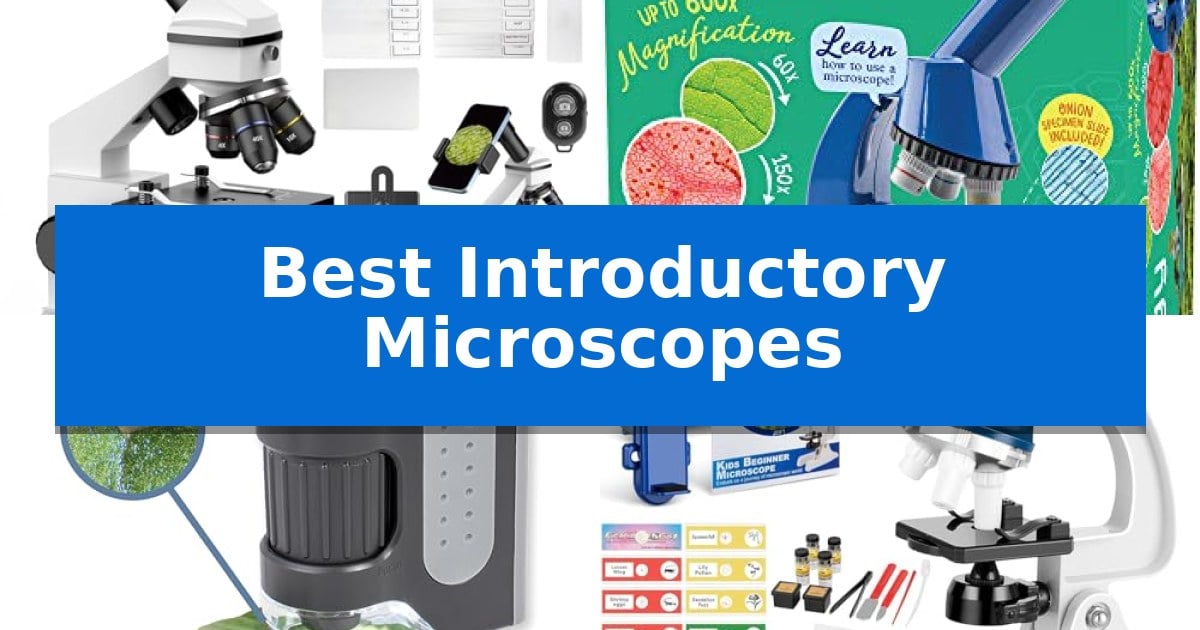
Stepping into the world of microscopic observation requires a tool that balances ease of use with enough clarity to make discovery engaging. Whether you are a student exploring biological cells or a hobbyist examining the intricate details of coins and electronics, finding the right equipment is essential for a rewarding experience.
Our guide highlights the Best Introductory Microscopes available, focusing on models that bridge the gap between simple toys and complex laboratory gear. By evaluating magnification capabilities, illumination systems, and ease of operation, we help you select a device that fits your specific scientific interests and skill level.
Best Introductory Microscopes in 2026
Quick Comparison
| Product | Best For | Key Strength | Score |
|---|---|---|---|
| PalliPartners Compound Microscope | Best Overall | Versatile magnification range from 100X to 2000X. | 4.9 |
| Thames & Kosmos Biology Lab Microscope | Durable Kit for Young Biologists | Complete kit includes slides, specimens, and preparation guidance. | 4.4 |
| Carson MicroBrite Plus Microscope | Portable Pocket-Sized Exploration | Versatile 60x-120x magnification range for diverse specimen viewing. | 4.5 |
| Uarzt Kids Microscope Kit | Complete Set for Hands-On Learning | 58-piece complete set includes prepared and blank slides for immediate use. | 4.9 |
| TOMLOV DM9 Digital Microscope | Clear Screen for Detailed Inspection | 7-inch LCD screen for comfortable, shared viewing | 4.3 |
How We Chose
- Magnification range and optical clarity for viewing diverse specimen types.
- Illumination versatility, including top and bottom lighting options for opaque or translucent samples.
- Ease of focus and mechanical stability for consistent, sharp observations.
- Inclusion of essential starter accessories like prepared slides, tools, and digital adapters.
- Age-appropriate design and safety certifications for younger users.
1 PalliPartners Compound Microscope — Versatile Zoom for Biological Study
The PalliPartners Compound Microscope offers a high-power optical range from 100X up to 2000X, utilizing 4X, 10X, and 40X objective lenses paired with a WF25X eyepiece and a 2X magnification lens. This configuration provides a versatile zoom capability that allows users to examine biological cells, micro-organisms, and plant tissues with high contrast.
Designed for both educational and hobbyist use, this microscope features a dual LED illumination system. The top light is intended for opaque solid specimens, while the bottom light is optimized for translucent biological samples. Sharp focus is managed through coaxial coarse and fine adjustment knobs, which offer more precise control than standard monocular or binocular entry-level models.
The kit is supplied as an all-in-one package, including 10 pre-prepared specimen slides and 18 blank slides for custom samples. To facilitate digital documentation, it includes a universal phone clip adapter and a Bluetooth remote camera shutter. The unit is SGS certified for safety, utilizing non-toxic materials and reliable electrical components suitable for students aged 8 to 18.
This model bridges the gap between basic toy microscopes and professional laboratory equipment. Its compact dimensions of 9.84 inches in height and 3.94 inches in width make it a practical choice for home education, classroom settings, or entry-level research projects.
Best for: Students and hobbyists aged 8-18 who require a versatile, all-in-one kit for biological exploration and digital imaging.
Skip if: Professional researchers requiring specialized optics or advanced features beyond the scope of an entry-level biological compound microscope.
PROS
- Versatile magnification range from 100X to 2000X.
- Dual LED illumination for both opaque and translucent specimens.
- Comprehensive kit includes slides, phone adapter, and Bluetooth shutter.
- SGS safety certified for educational use.
CONS
- Manual focus adjustment requires steady handling for high-magnification clarity.
2 Thames & Kosmos Biology Lab Microscope — Durable Kit for Young Biologists
The Thames & Kosmos Kids First Biology Lab Introductory Microscope Kit serves as a foundational instrument for young biologists-in-training, providing a specialized platform to explore the microscopic world. Its durable plastic body is engineered to withstand the rigors of early scientific exploration, ensuring the device remains stable during observation sessions while being lightweight enough for home or classroom use.
This kit offers versatile magnification capabilities, utilizing 4x, 10x, and 40x objective lenses paired with a 15x ocular lens to achieve a total magnification of up to 600x. This range allows students to examine a variety of specimens with varying levels of detail. To ensure clear visibility, the microscope includes battery-powered LED illumination, which provides consistent lighting for the stage, making it easy to view samples without needing to be tethered to a power outlet.
Designed as a complete package, the kit includes pre-prepared slides and specimens, alongside guidance to help users learn the process of preparing their own samples for study. Measuring 12.5 inches in height and weighing approximately 1.41 pounds, the unit is sized specifically for younger users. It provides a practical entry point for those beginning their journey into biological sciences by balancing ease of use with essential observational features.
Best for: Young students and beginners seeking a comprehensive, durable, and ready-to-use kit for introductory biological studies.
Skip if: Advanced users or researchers requiring high-resolution optics, metal construction, or precise mechanical stage adjustments will find this plastic-bodied model insufficient for professional or academic needs.
PROS
- Complete kit includes slides, specimens, and preparation guidance.
- Versatile magnification up to 600x using multiple objective lenses.
- Long-lasting LED illumination powered by batteries for portable use.
- Durable plastic construction specifically designed for younger users.
CONS
- Plastic build may lack the precision and longevity of professional metal-frame microscopes.
3 Carson MicroBrite Plus Microscope — Portable Pocket-Sized Exploration
The Carson MicroBrite Plus Microscope offers a compact, handheld solution for those seeking to explore the microscopic world without the bulk of a traditional laboratory setup. Measuring just 3.7 inches in height, this device is engineered for portability, allowing users to conduct field observations or classroom experiments with ease.
Equipped with a versatile 60x to 120x optical zoom, the microscope adapts to various viewing needs, from examining prepared slides to inspecting everyday objects. The integration of an advanced LED light system ensures that specimens are evenly illuminated, providing the clarity required for accurate observations during hands-on exploration.
Designed as a durable STEM tool, the unit is built to withstand the rigors of frequent use in educational environments. Its lightweight construction makes it an accessible choice for students and hobbyists who require a reliable, portable instrument that fits directly into a pocket or field kit.
The Carson MicroBrite Plus Microscope provides a straightforward approach to magnification, focusing on ease of use and portability. While it excels in field settings and quick inspections, users should note that as a handheld, non-stationary device, it lacks the stability and fine-adjustment features found in larger, benchtop compound microscopes.
Best for: Students and hobbyists who need a highly portable, handheld microscope for field exploration and quick scientific observation.
Skip if: Users requiring high-stability, stationary observation or advanced laboratory features like mechanical stages and fine-focus knobs will find this handheld model insufficient.
PROS
- Versatile 60x-120x magnification range for diverse specimen viewing.
- Compact and lightweight design ideal for field use.
- Advanced LED illumination provides clear, even lighting.
- Limited Lifetime Warranty for long-term reliability.
CONS
- Handheld design lacks the stability of a stationary base.
- Manual focus may be less precise than professional laboratory equipment.
4 Uarzt Kids Microscope Kit — Complete Set for Hands-On Learning
The Uarzt Kids Microscope Kit simplifies early scientific discovery by providing a comprehensive, 58-piece set designed specifically for beginners. Measuring 4.6"L x 2.75"W x 8.15"H, this compact optical tool allows young explorers to examine plants, insects, and everyday objects with a hands-on approach that emphasizes basic microscope parts and observation skills.
This all-in-one kit is ready for immediate use, featuring 13 prepared slides and 31 blank slides for DIY experiments. To support the learning process, it includes essential lab tools such as tweezers, a dropper, and a scalpel. The unit requires 2 AA batteries to operate, providing a portable solution for home or classroom environments.
Organization is a key design feature, as the set includes a dedicated carrying case to keep the microscope and its accessories secure between sessions. This focus on storage makes it practical for families or educators who need to move the equipment between different learning spaces or store it neatly after use.
While this microscope is an effective introductory tool for children ages 5-12, it is intended for educational exploration rather than professional laboratory work. By combining a guided learning experience with a complete set of accessories, it offers a structured way for children to engage with STEM concepts in a screen-free format.
Best for: Young children ages 5-12 interested in hands-on STEM exploration and introductory science observation.
Skip if: Users requiring professional-grade laboratory equipment or high-magnification capabilities for advanced research.
PROS
- 58-piece complete set includes prepared and blank slides for immediate use.
- Includes a carrying case for organized storage and portability.
- Designed specifically for beginner STEM learning with a detailed guide.
- Compact dimensions suitable for home or classroom desks.
CONS
- Batteries are not included and must be purchased separately.
- Not intended for professional laboratory use.
5 TOMLOV DM9 Digital Microscope — Clear Screen for Detailed Inspection
The TOMLOV DM9 Digital Microscope simplifies close-up inspection by featuring a large 7-inch LCD screen, which eliminates the need to squint into traditional eyepieces. This design choice makes it a practical tool for coin collectors, hobbyists, and electronics enthusiasts who require a clear, shared view of tiny details like mint marks, surface textures, or solder joints.
Equipped with 1200X magnification and a 12MP camera, this device allows users to capture high-resolution photos and 1080P video of their findings. The system includes a 16GB memory card, providing immediate storage for documentation, project records, or sharing discoveries. For those needing a larger display, the microscope connects directly to a Windows or Mac computer.
The hardware is built for stability, utilizing a solid metal base and 8.5-inch metal stand that minimizes shaking during delicate work. The height is adjustable, allowing users to change the viewing range as needed. To ensure optimal visibility, the unit features 8 built-in LED lights combined with two flexible gooseneck lights, which can be positioned to reduce shadows and glare on reflective surfaces.
This microscope is a versatile choice for anyone moving beyond basic magnification tools. While it excels at coin and PCB inspection, the inclusion of a wired remote control and a light barrier enhances usability during extended observation sessions. It offers a balance of digital convenience and physical stability for detailed, hands-on projects.
Best for: Coin collectors and hobbyists who need a stable, screen-based platform for inspecting and documenting small objects.
Skip if: Users who require high-power biological magnification for laboratory-grade cellular study or those needing a portable, handheld device.
PROS
- 7-inch LCD screen for comfortable, shared viewing
- Stable metal base and stand for reduced vibration
- Dual lighting system with 8 LEDs and flexible goosenecks
- 16GB storage included for immediate photo and video capture
CONS
- Stationary design requires a flat surface for operation
- Wired remote adds an extra component to manage during use
Best Introductory Microscopes Buying Guide
Understanding Magnification Needs
Magnification is often the first specification buyers look at, but higher numbers do not always mean better results. For biological study, a range between 100X and 1000X is typically sufficient to view cell structures, while lower magnification is better for larger, opaque objects like coins or insect wings.
Consider whether you need a compound microscope for translucent slides or a digital microscope for surface inspection. A versatile model often provides a range of objective lenses to adapt to different observation requirements.
The Importance of Illumination
Lighting is critical for image quality. Look for models with dual LED illumination, which allows you to switch between bottom light for slides and top light for solid objects. This flexibility significantly expands the types of specimens you can examine.
Adjustable brightness is another key feature, as it helps reduce glare and prevents overexposure when viewing highly reflective or dense samples.
Ease of Use and Focus Controls
For beginners, the ability to focus quickly is vital to maintaining interest. Coaxial coarse and fine focus knobs provide the precision needed to sharpen images without losing track of the specimen.
If you are choosing a microscope for a child, look for a sturdy, stable base that minimizes shaking. A heavy-duty build ensures the device remains steady during hands-on adjustments.
Digital Integration and Documentation
Many modern introductory microscopes include phone adapters or built-in screens to facilitate digital viewing. These features are excellent for documenting findings, sharing discoveries with others, or recording videos for school projects.
Check if the model allows for a PC connection, which can provide a larger viewing area and make it easier to demonstrate details to a group or document collections over time.
Safety and Durability
When purchasing for younger researchers, prioritize models with SGS safety certifications or non-toxic materials. A durable, well-constructed body is also important to withstand the rigors of frequent use in a home or classroom setting.
Consider the inclusion of a carrying case or organized storage, which helps keep delicate slides and tools protected and makes it easier to transport the kit between learning spaces.
Frequently Asked Questions
What is the difference between a compound and a digital microscope?
A compound microscope uses glass lenses and an eyepiece for traditional viewing of translucent slides, while a digital microscope uses a camera sensor to display images directly on a screen or computer.
Can I use these microscopes for coin collecting?
Yes, digital microscopes with top-down lighting and adjustable stands are ideal for inspecting coins, mint marks, and surface textures.
Are these microscopes suitable for middle school science projects?
Many models are specifically designed for students aged 8-18 and meet the requirements for basic to intermediate biology experiments in school labs.
Do I need to buy extra slides for these kits?
Most kits come with a set of pre-prepared and blank slides, but you can purchase additional blank slides separately to create your own DIY samples.
How do I clean the lenses?
Always use specialized lens cleaning paper or a soft, lint-free microfiber cloth to avoid scratching the delicate glass optics.
Conclusion: Our Top Pick
Selecting the right tool depends on whether your primary interest lies in biological cell study or surface inspection. For those seeking a versatile, high-performance option that handles both biological slides and solid objects with ease, the PalliPartners Compound Microscope stands out as a comprehensive choice.
This model provides the necessary magnification range and dual illumination to support a wide variety of experiments, making it a reliable investment for students and hobbyists alike. While other options like the portable Carson MicroBrite or the digital-focused TOMLOV DM9 excel in specific niches, the PalliPartners unit offers the best overall balance of features for general introductory exploration.