
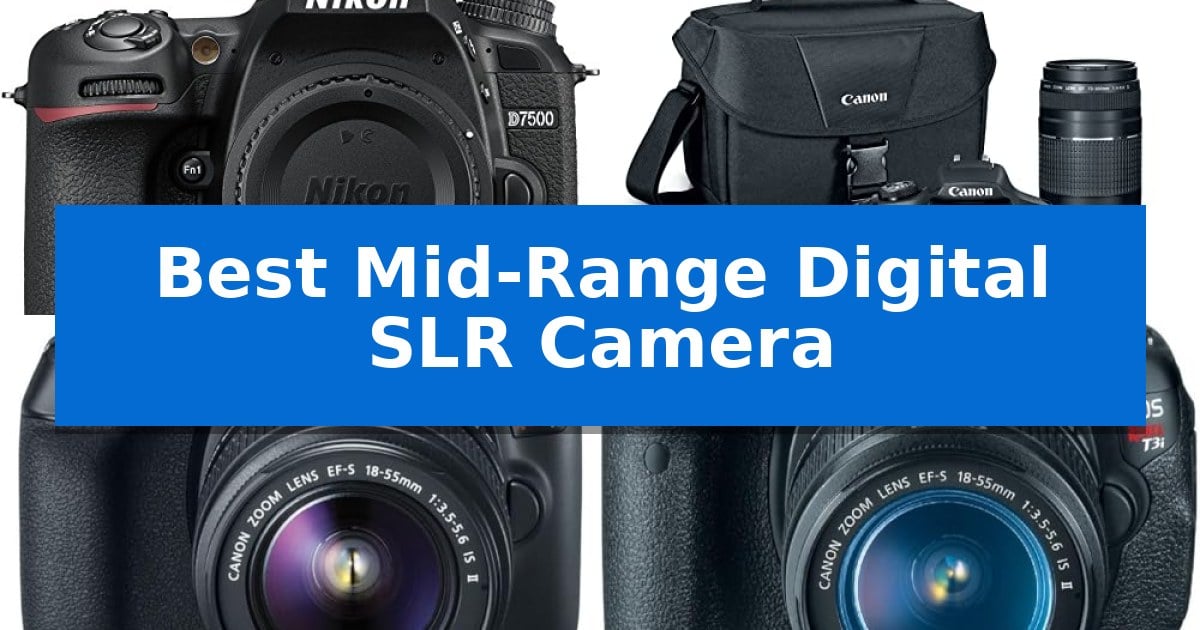
Finding the right camera involves balancing technical capability with your specific shooting style. Whether you are upgrading from a smartphone or transitioning from an entry-level body, selecting the Best Mid-Range Digital SLR Camera requires a clear understanding of how sensor size, autofocus systems, and lens availability impact your final images.
Our analysis focuses on the practical trade-offs between these models, helping you identify which features—such as high-speed continuous shooting, video resolution, or ergonomic controls—will best support your creative goals. We have examined the current market to provide a clear comparison of these versatile tools.
You may also want to compare Best Mid-Range Digital Multimeter, Best Mid-Range Digital Cameras, and Best Mid-Range Desktop PCs.
Best Mid-Range Digital SLR Camera
Quick Comparison
| Product | Best For | Key Strength | Score |
|---|---|---|---|
| Nikon D7500 Digital SLR Camera | Best Overall | 51-point AF system with 15 cross-type sensors for precise subject tracking. | 4.9 |
| Canon EOS Rebel T7 DSLR Camera | Balanced Features for Developing Skills | Dual-lens kit provides immediate versatility for wide and telephoto shots. | 4.4 |
| Canon EOS Rebel T6 Digital SLR Camera | Reliable Entry to DSLR Photography | Optical viewfinder provides a clear, real-time view of the subject. | 4.7 |
| Canon EOS Rebel T3i Digital SLR Camera | Classic Versatility for Creative Control | 18MP APS-C CMOS sensor for detailed image capture | 4.6 |
| Canon EOS Rebel T3 Digital SLR Camera | Simple Introduction to Manual Shooting | Basic+ control menu simplifies manual exposure adjustments for beginners. | 4.7 |
How We Chose
- Sensor performance and image processing capabilities.
- Autofocus system speed, point count, and tracking reliability.
- Video resolution options and available manual controls.
- Ergonomics, including screen articulation and physical interface.
- Connectivity standards for wireless image transfer.
1 Nikon D7500 Digital SLR Camera — Advanced Performance for Enthusiasts
The Nikon D7500 DX-Format Digital SLR Body centers its design around a high-performance 51-point AF system, featuring 15 cross-type sensors and group area AF that supports up to 8 fps continuous shooting. This configuration provides the speed and precision necessary for capturing dynamic subjects, making it a compelling choice for enthusiasts who require reliable tracking capabilities in a mid-range body.
Beyond its autofocus capabilities, the camera delivers image quality, ISO range, and metering performance equivalent to the professional-grade D500. This ensures that users benefit from advanced image processing in a more accessible form factor. The inclusion of a 3.2-inch 922k-dot tilting LCD screen with touch functionality adds practical utility for composing shots from difficult angles or navigating menus efficiently.
For those interested in multimedia production, the device supports 4K Ultra HD and 1080p Full HD video recording. It includes advanced features such as power aperture control, auto ISO, and 4K UHD time-lapse capabilities, providing creators with a robust toolset for video projects. Integrated Wi-Fi and Bluetooth connectivity, compatible with the Nikon SnapBridge app, facilitate straightforward image transfer and remote control.
The camera is built to operate within a temperature range of 0°C to 40°C and humidity levels of 85% or less, ensuring durability in varied shooting environments. Weighing 1.66 pounds with dimensions of 5.4 x 4.1 x 2.9 inches, it maintains a balance between a substantial grip and portability for field use.
Best for: Enthusiasts who need high-speed autofocus and professional-grade image processing in a versatile, mid-range DSLR body.
Skip if: Users who prioritize a lightweight, mirrorless form factor or those who do not require the specific optical viewfinder and physical handling of a traditional DSLR.
PROS
- 51-point AF system with 15 cross-type sensors for precise subject tracking.
- 8 fps continuous shooting capability for fast-action photography.
- 4K Ultra HD video recording with advanced power aperture control.
- Tilting 3.2-inch touchscreen for flexible composition and intuitive navigation.
CONS
- DSLR form factor may be heavier and bulkier than modern mirrorless alternatives.
2 Canon EOS Rebel T7 DSLR Camera — Balanced Features for Developing Skills
Transitioning from smartphone photography to a dedicated system requires a balance of manual control and accessible technology. The Canon EOS Rebel T7 DSLR Camera addresses this by pairing a 24.1 Megapixel CMOS (APS-C) sensor with an optical viewfinder, providing a tactile shooting experience that helps beginners understand the fundamentals of light and exposure.
This kit is designed for versatility, including both an EF-S 18-55mm and an EF 75-300mm lens, allowing users to capture everything from wide-angle landscapes to distant subjects. The integration of a 9-Point AF system with AI Servo AF assists in maintaining focus on moving subjects, while the improved Dual Pixel CMOS AF and eye detection AF offer reliable performance for portraiture.
Beyond still photography, the camera supports FHD 1080p video capture. For those looking to integrate their gear into a modern workflow, the EOS Utility Webcam Beta Software allows the camera to function as a high-quality webcam for Mac and Windows, extending its utility beyond traditional field use.
Connectivity is streamlined through built-in Wi-Fi and NFC technology, facilitating easier image transfers to compatible devices. While the optical viewfinder provides approximately 95% viewing coverage, users should note the operational temperature range of 32-104°F, which is a standard consideration for outdoor photography in varied climates.
Best for: Beginner photographers seeking a comprehensive, dual-lens system to learn manual controls and expand their creative range.
Skip if: Users requiring high-speed burst shooting or advanced 4K video capabilities will find the feature set of this entry-level model limiting.
PROS
- Dual-lens kit provides immediate versatility for wide and telephoto shots.
- 24.1 Megapixel sensor delivers high-resolution images suitable for prints.
- Built-in Wi-Fi and NFC simplify the process of transferring photos to mobile devices.
- Webcam compatibility via EOS Utility software adds value for content creators.
CONS
- 95% viewfinder coverage means the final image may capture slightly more than what is seen in the frame.
- 1080p video resolution lacks the detail of modern 4K standards.
3 Canon EOS Rebel T6 Digital SLR Camera — Reliable Entry to DSLR Photography
Capturing clear images with a dedicated optical viewfinder is a hallmark of the Canon EOS Rebel T6 Digital SLR Camera, a device engineered to bridge the gap between casual snapshots and intentional photography. This model centers on an 18.0 MP APS-C CMOS Sensor paired with the DIGIC 4+ Image Processor, providing the foundational hardware necessary for high-resolution stills and consistent color reproduction.
For those transitioning from mobile devices, the inclusion of a high-performance optical viewfinder offers a direct, lag-free way to frame subjects, which is particularly useful in bright outdoor conditions where LCD screens may struggle. The camera features a 9-point autofocus system with a center cross-type point, designed to improve focus accuracy on subjects positioned in the middle of the frame.
Versatility is supported by an ISO range of 100-6400, expandable to 12800, allowing for adjustments when moving between bright daylight and dimmer indoor environments. Beyond still photography, the unit supports Full HD 1080p video recording at 30 fps, providing a functional entry point for those interested in capturing motion alongside their static images.
Connectivity is integrated through built-in Wi-Fi and NFC, enabling easier transfer of files to compatible mobile devices. The Scene Intelligent Auto Mode simplifies operation for beginners by automatically analyzing the scene and adjusting camera settings, while the 3.0-inch 920k-dot LCD monitor serves as a clear interface for menu navigation and image review.
Best for: Entry-level photographers seeking a dedicated optical viewfinder and manual control options to learn the fundamentals of DSLR photography.
Skip if: Users who prioritize a compact, pocketable form factor or those requiring advanced 4K video capabilities and high-speed burst shooting.
PROS
- Optical viewfinder provides a clear, real-time view of the subject.
- Built-in Wi-Fi and NFC for convenient wireless image transfer.
- Scene Intelligent Auto Mode assists beginners in achieving balanced exposures.
- 18.0 MP APS-C sensor delivers high-resolution image quality.
CONS
- Limited burst rate of 3 fps may struggle with fast-moving action.
- Fixed LCD screen lacks the flexibility of articulating or touchscreen displays.
4 Canon EOS Rebel T3i Digital SLR Camera — Classic Versatility for Creative Control
The Canon EOS Rebel T3i Digital SLR Camera offers a foundational entry point into interchangeable lens photography, centered around an 18MP APS-C CMOS sensor. This model provides the essential manual controls required for those transitioning from fixed-lens cameras to a system that allows for greater creative influence over depth of field and exposure.
Designed for versatility, the camera features a 9-point AF system to assist with subject tracking and focus acquisition. Users can capture action with a continuous shooting speed of 3.7 frames per second, making it suitable for general photography needs. The native ISO range of 100-6400, which is expandable to 12800, provides flexibility when shooting in varying lighting conditions.
Beyond still photography, the device supports 1080p HD video recording. The inclusion of manual controls during video capture allows users to adjust settings to suit specific lighting environments or aesthetic preferences, a feature often sought by those exploring videography alongside their photography practice.
The camera comes paired with an EF-S 18-55mm f/3.5-5.6 IS lens, providing a standard focal length range suitable for a variety of everyday subjects. Its compact form factor, measuring approximately 5.24 inches in length and weighing 1.26 pounds, balances portability with the ergonomic benefits of a traditional DSLR grip.
Best for: Aspiring photographers seeking a dedicated DSLR system with manual controls and an included versatile kit lens.
Skip if: Users who require high-speed burst shooting for professional sports or those who prefer the compact, mirrorless form factor.
PROS
- 18MP APS-C CMOS sensor for detailed image capture
- Manual controls for both still and video modes
- Includes EF-S 18-55mm IS lens for immediate use
- Expandable ISO up to 12800 for low-light flexibility
CONS
- 3.7 fps continuous shooting is limited for fast-action subjects
- 9-point AF system is basic compared to modern high-density arrays
5 Canon EOS Rebel T3 Digital SLR Camera — Simple Introduction to Manual Shooting
Transitioning from basic point-and-shoot photography to manual control requires a platform that balances accessibility with the depth needed to learn exposure settings. The Canon EOS Rebel T3 Digital SLR Camera serves this purpose by integrating a 12MP APS-C CMOS sensor with a dedicated Basic+ control menu, allowing users to adjust image ambiance and lighting effects without navigating complex sub-menus.
The camera features a 9-point AF system designed to provide reliable focus tracking for stationary or slow-moving subjects. With a continuous shooting capability of up to 3 frames per second, it captures essential moments during casual outings or family events. The inclusion of ISO 100-6400 sensitivity allows for flexibility when shooting in varying light conditions, from bright daylight to dimly lit indoor environments.
For those looking to integrate their workflow with modern devices, the system supports Eye-fi wireless SD card compatibility, enabling easier transfer of files. The rear 2.7-inch LCD screen provides a clear interface for reviewing shots and navigating the camera's settings. Additionally, the 720p HD video recording capability offers a straightforward way to capture motion, making it a versatile tool for those starting their journey into interchangeable lens photography.
The kit comes equipped with an EF-S 18-55mm f/3.5-5.6 III lens, providing a standard focal range suitable for landscapes and portraits. Its design prioritizes ease of use, making it a practical choice for photographers who want to focus on composition and technique rather than complex hardware configurations.
Best for: Beginners seeking a dedicated, intuitive platform to learn manual exposure settings and interchangeable lens photography.
Skip if: Users requiring high-speed burst rates, 4K video resolution, or advanced weather-sealing for demanding outdoor environments.
PROS
- Basic+ control menu simplifies manual exposure adjustments for beginners.
- 12MP APS-C CMOS sensor provides a solid foundation for high-quality image capture.
- Eye-fi wireless SD card compatibility streamlines the file transfer process.
- 9-point AF system offers reliable focusing for standard photography tasks.
CONS
- 720p HD video resolution is limited compared to modern standards.
- 3 frames per second burst rate is not suited for fast-action sports or wildlife.
Best Mid-Range Digital SLR Camera Buying Guide
Understanding Sensor Formats
Most mid-range cameras utilize an APS-C sensor, which offers a balance between physical size and image quality. This format provides a "crop factor" that effectively increases the reach of your lenses, making it particularly useful for wildlife and sports photography where extra magnification is beneficial.
When comparing sensors, look beyond the megapixel count. The image processor and ISO range are critical for determining how well the camera handles low-light environments and produces clean, noise-free images at higher sensitivity settings.
Autofocus and Performance
The autofocus system is the engine of your photography. A higher number of cross-type sensors generally leads to more accurate and faster focusing, especially when tracking moving subjects. This is a vital consideration if you plan to shoot action or candid portraits.
Continuous shooting speed, measured in frames per second (fps), dictates how many images you can capture in a rapid burst. Enthusiasts should prioritize models that offer a robust buffer and high fps to ensure they do not miss critical moments during fast-paced sequences.
Video Capabilities
Modern photography often overlaps with videography. If you intend to record video, look for 4K Ultra HD or high-quality 1080p Full HD recording options. Features like stereo sound input and manual aperture control provide greater flexibility for creative filmmaking.
Consider whether the camera offers time-lapse functionality or specialized video modes. These built-in tools can simplify complex workflows, allowing you to produce high-quality video content directly in-camera without extensive post-processing.
Ergonomics and Interface
A camera's physical design determines how intuitive it feels to use. A tilting LCD screen with touch functionality can significantly improve your ability to shoot from difficult angles, such as ground-level or overhead perspectives.
Check the layout of physical buttons and dials. Having dedicated controls for common settings like ISO, shutter speed, and aperture allows for faster adjustments, which is essential when you need to react quickly to changing light or subject movement.
Connectivity and Ecosystem
Built-in Wi-Fi and Bluetooth connectivity have become standard, allowing for seamless image transfer to mobile devices via companion apps. This is a major convenience for sharing your work quickly or using your smartphone as a remote shutter.
Finally, consider the lens mount ecosystem. Choosing a camera brand with a wide variety of available lenses ensures that you can expand your kit as your skills grow, providing access to specialized glass for macro, ultra-wide, or telephoto photography.
Frequently Asked Questions
What is the main benefit of an APS-C sensor?
An APS-C sensor provides a smaller physical footprint than full-frame sensors while maintaining high image quality. It also offers a crop factor that gives your lenses more reach, which is ideal for telephoto applications.
How important is the number of autofocus points?
A higher number of autofocus points, particularly cross-type sensors, allows for more precise subject tracking and faster focus acquisition across a larger portion of the frame.
Can I use my existing lenses with a new DSLR?
Compatibility depends on the lens mount. If you stay within the same brand ecosystem, many lenses are often compatible, but you should always verify the specific mount type (e.g., EF-S or DX) to ensure a proper fit.
Why does the LCD screen matter?
A tilting or articulating screen allows you to compose shots from awkward angles without needing to lie on the ground or hold the camera above your head. Touch functionality further speeds up menu navigation and focus point selection.
Is 4K video necessary for a photography-focused camera?
While 4K is not required for still photography, it provides significantly more detail for video projects and allows for cropping during editing while maintaining high resolution.
Conclusion: Our Top Pick
For photographers seeking a balance of high-end performance and versatile features, the Nikon D7500 Digital SLR Camera stands out as the most capable option. Its combination of a 51-point AF system, 8 fps continuous shooting, and 4K UHD video capability makes it a robust tool for a wide range of shooting scenarios.
While other models offer excellent entry points for developing skills, the Nikon D7500 provides the advanced metering and image processing power necessary to support long-term growth in your photography journey. Its tilting touchscreen and integrated connectivity ensure that it remains a practical and efficient choice for modern enthusiasts.