
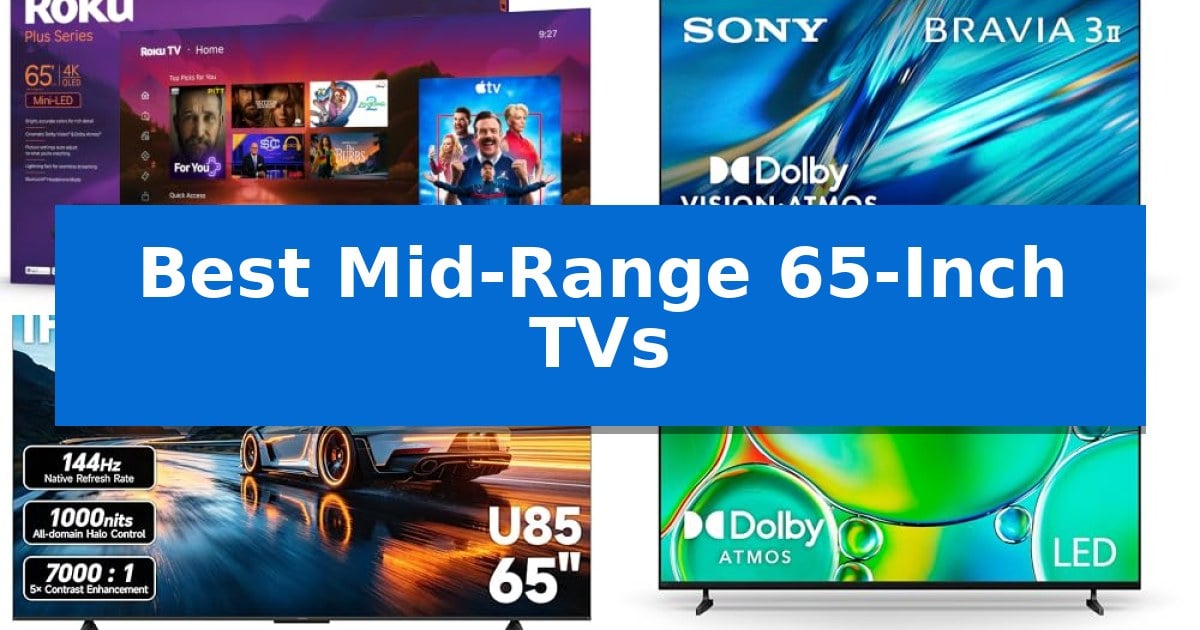
Selecting a new television often feels like navigating a maze of technical jargon and conflicting specifications. When you are looking for the Best Mid-Range 65-Inch TVs, the goal is to find a display that balances high-end visual fidelity with practical everyday usability without the premium cost of flagship models.
Our guide focuses on identifying which features—such as panel technology, refresh rates, and smart ecosystem compatibility—actually improve your viewing experience. By examining the specific strengths of these five models, we help you determine which television aligns best with your specific entertainment habits and home setup.
You may also want to compare Best Mid-Range 65-Inch TV, Best Mid-Range 65-Inch 4K TV, and Best Mid-Range 55-Inch TVs.
Best Mid-Range 65-Inch TVs
Quick Comparison
| Product | Best For | Key Strength | Score |
|---|---|---|---|
| Roku Plus Series Smart TV | Best Overall | Mini-LED backlighting provides superior contrast and brightness control. | 4.9 |
| Sony BRAVIA 3 II Smart TV | Cinematic AI-Enhanced Picture | Anti-Glare Screen technology minimizes distractions from ambient lighting. | 4.3 |
| iFFALCON U85 MiniLED Smart TV | High-Refresh Gaming Performance | Native 144Hz panel with up to 288Hz VRR for fluid motion. | 4.4 |
| Sony BRAVIA 2 II Smart TV | Optimized for PlayStation 5 | Exclusive PlayStation 5 integration with Auto HDR Tone Mapping. | 4.4 |
| Amazon Ember QLED Smart TV | Responsive Smart Home Integration | Omnisense technology for automated wake and display functionality. | 4.4 |
How We Chose
- Display technology and backlighting precision for contrast and color accuracy.
- Gaming-specific features including refresh rates, VRR support, and HDMI 2.1 connectivity.
- Smart platform responsiveness and integration with existing home voice assistants.
- Motion handling capabilities for sports and fast-paced cinematic action.
- Build quality and physical connectivity options for external soundbars or consoles.
1 Roku Plus Series Smart TV — User-Friendly Streaming Experience
The Roku 65-Inch Plus Series Smart TV utilizes advanced Mini-LED backlighting to deliver precise contrast and rich detail across its 65-inch 4K display. By combining QLED screen technology with Dolby Vision, this television produces vivid highlights and accurate colors, ensuring a high-quality visual experience for movies and sports.
Navigation is streamlined through a simplified Home Screen that prioritizes personalized content, reducing the need for extensive searching. The included Enhanced Voice Remote features a lost remote finder and allows users to set custom shortcuts for their preferred streaming apps. For smart home integration, the device supports Apple AirPlay and voice commands via Siri, Alexa, or Google Assistant.
Audio performance is bolstered by Dolby Atmos technology and an integrated subwoofer, providing a more immersive soundstage than standard built-in speakers. Users can also take advantage of Bluetooth Headphone Mode for private listening, or keep audio playing while the display is turned off to save energy during music playback.
The Roku Plus Series Smart TV is equipped with Roku Smart Picture Max, an AI-driven feature that automatically optimizes incoming signals for improved sharpness and color accuracy. This automated refinement ensures that every scene, from fast-paced sporting events to subtle cinematic moments, is presented with consistent quality without requiring manual calibration.
Best for: Users seeking a user-friendly, integrated streaming experience with advanced picture technology like Mini-LED and QLED in a large 65-inch format.
Skip if: Users who require professional-grade gaming features like high-refresh-rate HDMI 2.1 ports or advanced variable refresh rate support for high-end console gaming.
PROS
- Mini-LED backlighting provides superior contrast and brightness control.
- Enhanced Voice Remote includes a convenient lost remote finder.
- Integrated subwoofer and Dolby Atmos support enhance built-in audio.
- AI-powered picture optimization automatically refines signal quality.
CONS
- Limited technical specifications provided regarding gaming-specific display features or port connectivity.
2 Sony BRAVIA 3 II Smart TV — Cinematic AI-Enhanced Picture
Achieving a cinematic home theater experience often hinges on how well a display handles both light and motion. The Sony 65 Inch BRAVIA 3 II LED 4K HDR Smart Google TV addresses environmental lighting challenges with its dedicated Anti-Glare Screen technology, ensuring that ambient light from windows or lamps does not interfere with the clarity of your content.
At the heart of this display is the XR Processor, which utilizes AI scene recognition to dynamically optimize contrast, color, and clarity. This processing power is paired with XR Triluminos Pro technology, capable of reproducing over a billion colors to maintain natural detail across various types of media. For those who prioritize fluid visuals, the panel supports an enhanced 120Hz refresh rate and Motionflow XR, which work together to keep fast-paced sports and action sequences sharp and blur-free.
Gamers are well-supported through a suite of PlayStation 5 exclusive features, including Auto HDR Tone Mapping and Auto Genre Picture Mode. Connectivity is robust, featuring 4x HDMI 2.1 ports that enable high-performance gaming capabilities such as 4K/120, VRR (Variable Refresh Rate), and ALLM (Auto Low Latency Mode). The integrated Game Menu provides a centralized hub to adjust these settings without interrupting gameplay.
The Sony 65 Inch BRAVIA 3 II LED 4K HDR Smart Google TV also serves as a comprehensive entertainment hub. It includes access to SONY PICTURES CORE with Pure Stream technology and a selection of IMAX Enhanced content. The inclusion of Google TV with Gemini allows for natural language interaction to help navigate a vast library of movies and episodes, while Dolby Vision and Dolby Atmos support ensure that both picture and sound are optimized for a theater-like atmosphere.
Best for: Home theater enthusiasts and PlayStation 5 gamers who require high-performance motion handling and advanced AI-driven picture optimization.
Skip if: Users who prefer a smaller display footprint or those who do not require high-refresh-rate gaming features like 4K/120 and VRR.
PROS
- Anti-Glare Screen technology minimizes distractions from ambient lighting.
- XR Processor with AI provides real-time optimization of color and clarity.
- 4x HDMI 2.1 ports support advanced gaming features like 4K/120 and VRR.
- PlayStation 5 exclusive features like Auto HDR Tone Mapping optimize gaming visuals.
CONS
- Large form factor requires significant wall or stand space.
- Anti-Glare technology is limited to specific screen sizes.
3 iFFALCON U85 MiniLED Smart TV — High-Refresh Gaming Performance
Achieving a fluid gaming experience on a large screen requires more than just high resolution; it demands a display capable of keeping pace with rapid frame rates. The iFFALCON U85 MiniLED Smart TV addresses this by integrating a native 144Hz panel that supports a variable refresh rate up to 288Hz, ensuring smooth motion for both competitive gaming and high-speed sports.
Beyond its gaming credentials, this 65-inch display utilizes MiniLED technology to achieve a 7,000:1 contrast ratio and 1,000 nits of peak brightness. This hardware foundation supports advanced HDR formats, including Dolby Vision IQ and IMAX Enhanced, which automatically calibrate the image based on ambient room lighting conditions.
Connectivity is a primary focus, featuring four HDMI 2.1 ports. Two of these ports are dedicated to 4K at 144Hz, allowing users to connect multiple next-gen consoles or a high-performance PC simultaneously. The inclusion of Auto Low Latency Mode (ALLM) ensures the TV transitions into its gaming profile without manual intervention.
The iFFALCON U85 MiniLED Smart TV also incorporates professional-grade features such as hotel mode, IP control, and an IR blaster, making it a versatile choice for commercial or hospitality environments. Integrated Google TV provides access to streaming services, while the 50W 2.1-channel audio system with Dolby Atmos and DTS Virtual:X provides a standalone sound solution.
Best for: Gamers and users requiring a high-refresh-rate display with robust connectivity for multiple consoles and PCs.
Skip if: Users who prioritize a slim, lightweight design or those who do not require advanced gaming-specific features like 144Hz/288Hz VRR.
PROS
- Native 144Hz panel with up to 288Hz VRR for fluid motion.
- Four HDMI 2.1 ports supporting next-gen console and PC connectivity.
- MiniLED local dimming for high contrast and 1,000 nits peak brightness.
- Commercial-ready features including hotel mode and IP/IR control.
CONS
- Heavy build at 51.8 pounds may require sturdy mounting or furniture.
- Complex feature set may be excessive for users who only stream content.
4 Sony BRAVIA 2 II Smart TV — Optimized for PlayStation 5
The Sony 65 Inch BRAVIA 2 II LED 4K HDR Smart Google TV (K-65S20M2) distinguishes itself through deep integration with gaming hardware, specifically offering exclusive features for PlayStation 5 users. By utilizing Auto HDR Tone Mapping and Auto Genre Picture Mode, this television automatically adjusts its settings to optimize visual output when connected to a console, ensuring a streamlined experience for both gaming and streaming.
At the heart of the display is the 4K Processor X1, which works in tandem with 4K X-Reality PRO to upscale content to near-4K resolution. This processing engine is designed to recover lost texture and detail, while Triluminos Pro technology expands the color palette to provide more natural and precise picture quality. For fast-paced content, the Motionflow XR system manages motion to maintain clarity during sports or action sequences.
Usability is centered around the Google TV platform, which aggregates streaming applications into a single interface. The device supports Apple AirPlay 2 and Google Cast, facilitating easy content sharing from mobile devices. Owners also gain access to SONY PICTURES CORE for integrated movie streaming, while the Game Menu provides a centralized hub to manage picture settings and assist features without navigating through multiple sub-menus.
The Sony 65 Inch BRAVIA 2 II LED 4K HDR Smart Google TV (K-65S20M2) also prioritizes efficiency with a dedicated Eco Dashboard, allowing users to manage energy settings in one location. With a footprint measuring 57 inches in width and a weight of 43.4 pounds, it fits standard entertainment setups while providing a comprehensive suite of tools for modern media consumption.
Best for: Gamers who own a PlayStation 5 and want a display that automatically optimizes picture settings for their console.
Skip if: Users who require advanced high-refresh-rate gaming features beyond standard motion handling or those seeking specialized panel technologies like OLED.
PROS
- Exclusive PlayStation 5 integration with Auto HDR Tone Mapping.
- 4K Processor X1 provides effective upscaling and detail enhancement.
- Google TV interface consolidates streaming apps and casting support.
- Eco Dashboard for centralized energy efficiency management.
CONS
- No advanced gaming features beyond the proprietary Sony console optimizations.
- Standard LED panel lacks the contrast depth found in higher-tier display technologies.
5 Amazon Ember QLED Smart TV — Responsive Smart Home Integration
Modern television technology often prioritizes convenience alongside visual fidelity, and the Amazon Ember QLED Smart TV integrates these elements through its Omnisense technology. This feature utilizes built-in sensors to detect your presence, automatically waking the display to showcase artwork or transition directly into your content, effectively reducing the time spent navigating menus.
The 65-inch 4K QLED display leverages full-array local dimming to manage contrast, producing deeper blacks and brighter whites. By supporting Dolby Vision and HDR10+ Adaptive, the television adjusts its picture quality to maintain clarity regardless of ambient lighting conditions in your room.
Performance is driven by a new quad-core processor paired with Wi-Fi 6 connectivity, ensuring that applications load quickly and streaming remains stable. The updated Fire TV experience organizes content into dedicated categories and allows for pinned apps, while Alexa+ provides natural voice control for searching across services or managing smart home devices without needing the remote.
For those who enjoy gaming, the TV supports streaming via Amazon Luna and Xbox Game Pass, allowing for console-free play using mobile devices as controllers. Connectivity is handled by four HDMI inputs, and the design includes a physical privacy switch to electronically disconnect the microphones when you prefer not to use voice features.
Best for: Users seeking a highly responsive, smart-home-integrated display that prioritizes quick access to streaming services and hands-free voice control.
Skip if: Viewers who require specialized high-refresh-rate gaming features like HDMI 2.1 VRR or those who prefer a non-Fire TV operating system interface.
PROS
- Omnisense technology for automated wake and display functionality.
- Full-array local dimming for improved contrast and brightness.
- Hands-free Alexa+ voice control with a dedicated privacy disconnect switch.
- Integrated cloud gaming support for Amazon Luna and Xbox Game Pass.
CONS
- Limited gaming-specific port information provided beyond standard HDMI inputs.
- Reliance on the Fire TV ecosystem which may not suit users preferring alternative smart platforms.
Best Mid-Range 65-Inch TVs Buying Guide
Understanding Display Technology
The shift toward Mini-LED and QLED technologies has significantly improved the picture quality of mid-range displays. Mini-LED backlighting allows for more granular control over brightness and contrast, which is essential for achieving deep blacks and vibrant highlights in HDR content.
QLED panels utilize quantum dots to enhance color volume, ensuring that images remain saturated even at higher brightness levels. When choosing between these, consider your room's lighting; brighter rooms benefit more from the high peak brightness offered by these advanced backlighting systems.
Gaming Performance and Connectivity
For gamers, the presence of HDMI 2.1 ports is non-negotiable for supporting high-frame-rate gaming. Features like Variable Refresh Rate (VRR) and Auto Low Latency Mode (ALLM) are critical for reducing screen tearing and input lag during competitive play.
Look for native refresh rates of 120Hz or higher if you plan to connect a modern console. These features ensure that fast-moving action remains smooth, providing a distinct advantage in titles where timing and responsiveness are paramount.
Smart Ecosystem Integration
The operating system of your TV dictates how easily you can access content and control your smart home. Whether it is Roku TV, Google TV, or Fire TV, each platform offers unique benefits regarding interface speed and app availability.
Consider how well the TV integrates with your existing voice assistant, such as Alexa, Siri, or Google Assistant. Seamless control allows you to manage your media and connected devices without needing to navigate complex on-screen menus.
Motion Handling and Processing
Effective motion processing is essential for sports enthusiasts and movie buffs alike. Advanced processors use AI-enhanced scene recognition to reduce noise and restore detail, ensuring that fast-paced action does not result in blur or judder.
Look for models that offer specific motion-smoothing settings that can be adjusted or disabled based on your preference. A high-quality processor can make a noticeable difference in upscaling lower-resolution content to near-4K clarity.
Audio and Physical Setup
While many users opt for external soundbars, the built-in audio capabilities of a TV still matter. Features like Dolby Atmos support and integrated subwoofers can provide a more immersive soundstage without requiring additional hardware.
Check the physical dimensions and weight of the television to ensure it fits your existing media console or wall mount. Additionally, verify the number and placement of ports to ensure you can easily connect all your devices, including soundbars and gaming consoles.
Frequently Asked Questions
What is the main benefit of Mini-LED backlighting?
Mini-LED backlighting uses smaller LEDs to provide more precise control over local dimming zones, resulting in better contrast and deeper black levels compared to standard LED displays.
Do I need HDMI 2.1 for streaming movies?
No, HDMI 2.1 is primarily beneficial for high-performance gaming, as it supports 4K at 120Hz and advanced VRR features. Standard streaming content typically functions perfectly on HDMI 2.0 ports.
Can I use my existing smart home devices with these TVs?
Yes, most modern mid-range TVs support major smart home ecosystems like Alexa, Google Assistant, and Apple AirPlay, allowing for voice control and media casting.
How does AI processing improve picture quality?
AI processors analyze incoming signals in real-time to optimize color, contrast, and sharpness, often upscaling lower-resolution content to look closer to 4K quality.
Is a 65-inch TV too large for a small room?
While 65 inches is a popular size, it depends on your viewing distance. A general rule is to sit about 5 to 8 feet away for an immersive experience, but personal preference is the final deciding factor.
Conclusion: Our Top Pick
Selecting the right television requires balancing your specific needs for gaming, streaming, and smart home integration. After reviewing the available options, the Roku Plus Series Smart TV stands out as our top recommendation for most households due to its combination of Mini-LED picture quality and an exceptionally user-friendly interface.
This model simplifies the streaming experience while providing the advanced visual technology needed for modern content. While other options offer specialized features for specific gaming consoles or smart ecosystems, the Roku model provides the most consistent and accessible performance across all categories.