
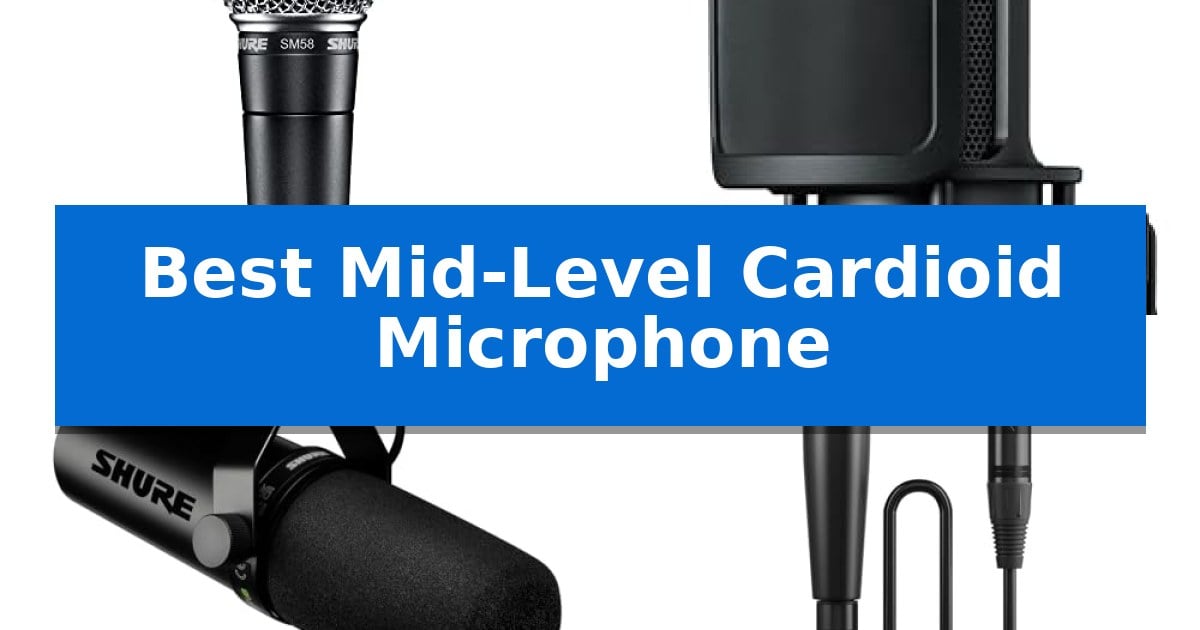
Selecting the right gear for your vocal or instrument recording often comes down to finding a balance between professional clarity and practical usability. Whether you are setting up a home studio or upgrading your live performance kit, the Best Mid-Level Cardioid Microphone serves as the foundation for capturing clean, focused audio while minimizing unwanted room reflections.
Navigating the market requires understanding how different capsule types and polar patterns impact your final sound. We have analyzed five distinct microphones to help you identify which model best aligns with your specific recording environment, gain requirements, and tonal preferences.
You may also want to compare Best Mid-Level Camera Drone, Best Mid-Level Business Laptops, and Best Mid-Level Bookshelf Speakers.
Best Mid-Level Cardioid Microphone
Quick Comparison
| Product | Best For | Key Strength | Score |
|---|---|---|---|
| Shure SM58 Dynamic Vocal Microphone | Best Overall | Legendary vocal clarity with a tuned midrange boost. | 4.9 |
| Shure SM4 Studio Condenser Microphone | Detailed Capture for Home Studios | Patent-pending interference shielding blocks RF noise from electronics. | 4.4 |
| Shure SM7dB Dynamic Vocal Microphone | Built-in Preamp for Clean Gain | Built-in preamp provides up to +28 dB of clean gain. | 4.7 |
| Phenyx Pro PM-25 Dynamic Microphone | Balanced Tone for Versatile Use | Cardioid polar pattern effectively isolates the voice from ambient noise. | 4.6 |
| Audio-Technica PRO 45 Condenser Microphone | Ideal for Overhead Sound Capture | High-SPL handling for loud environments | 4.8 |
How We Chose
- Polar pattern consistency and off-axis noise rejection.
- Frequency response characteristics and tonal balance.
- Build quality and physical durability for long-term use.
- Compatibility with standard audio interfaces and mixers.
- Integrated features like pop protection or built-in gain control.
1 Shure SM58 Dynamic Vocal Microphone — Industry Standard for Live Vocals
Achieving professional vocal clarity in both studio and live environments often comes down to the reliability of your hardware. The Shure SM58 Pro XLR Dynamic Vocal Microphone is engineered with a finely tuned frequency response and a subtle midrange lift, a design choice that ensures vocals remain warm and articulate while effectively cutting through a dense mix.
This microphone utilizes a precision cardioid pickup pattern to focus tightly on the sound source. By isolating the voice, it minimizes unwanted background noise and potential feedback, which is essential for maintaining clean audio reproduction in varied settings. The inclusion of an integrated spherical grille and built-in filter serves as a practical solution for reducing plosives and wind noise, eliminating the immediate need for external pop filters.
Built to endure the rigors of frequent use, the Shure SM58 Pro XLR Dynamic Vocal Microphone features a rugged metal construction and a reinforced stand adapter. This focus on durability makes it a consistent choice for touring professionals and podcasters alike. With its XLR connectivity, it integrates seamlessly into standard professional audio chains, providing a stable, interference-resistant signal path.
While it excels in versatility, the Shure SM58 Pro XLR Dynamic Vocal Microphone is a dynamic microphone, meaning it requires an external audio interface or mixer with a preamp to function. Users should ensure they have the necessary XLR cables and amplification equipment to support this professional-grade setup.
Best for: Performers, podcasters, and broadcasters who require a durable, industry-standard microphone for consistent vocal isolation in live or studio settings.
Skip if: Users who require a plug-and-play USB microphone or those who need a high-sensitivity condenser mic for capturing delicate, quiet acoustic instruments.
PROS
- Legendary vocal clarity with a tuned midrange boost.
- Precision cardioid pattern for superior feedback rejection.
- Integrated pop protection reduces the need for extra accessories.
- Rugged metal construction ensures long-term durability.
CONS
- Requires external audio interface or mixer for operation.
2 Shure SM4 Studio Condenser Microphone — Detailed Capture for Home Studios
Achieving professional-grade audio in a home studio environment requires a microphone that balances sensitivity with noise management. The Shure SM4 Studio Condenser Microphone distinguishes itself with a brass 1-inch dual-diaphragm capsule, which is engineered to deliver clean, controlled low-end frequencies alongside smooth, detailed highs for natural audio reproduction.
Designed for versatility, this microphone features a uniform cardioid polar pattern that provides superior off-axis rejection of unwanted background noise. Its high-SPL handling allows it to capture sound sources up to 140dB without distortion, making it a robust choice for recording both delicate vocals and loud instruments. The inclusion of patent-pending interference shielding effectively blocks RF noise from common home-studio sources like laptops and Wi-Fi routers.
Usability is enhanced by the integrated pop filter and a woven mesh Faraday cage, which work together to minimize plosive sounds and rumble. This design ensures that recordings are mix-ready from the start, reducing the need for extensive post-production editing. The large sweet spot also helps mitigate the proximity effect, providing more consistent audio quality even when the performer is close to the mic.
Built for longevity, the Shure SM4 Studio Condenser Microphone features a rugged, all-metal construction suitable for both studio and stage environments. Its low-profile, camera-ready design ensures it remains unobtrusive during live-streaming or video recording sessions. The kit comes complete with a detachable magnetic pop filter, a shock mount, a brass mic stand adapter, and a zippered carrying case.
Best for: Home-studio creators and streamers who need a durable, mix-ready condenser microphone with built-in RF interference shielding.
Skip if: Users who require a multi-pattern microphone for omnidirectional or figure-eight recording tasks will need a more specialized device.
PROS
- Patent-pending interference shielding blocks RF noise from electronics.
- High-SPL handling up to 140dB prevents distortion during loud recordings.
- Integrated pop filter and Faraday cage minimize plosives and rumble.
- Rugged all-metal construction offers long-term durability.
CONS
- Fixed cardioid polar pattern limits flexibility for non-directional recording needs.
3 Shure SM7dB Dynamic Vocal Microphone — Built-in Preamp for Clean Gain
The Shure SM7dB Dynamic Vocal Microphone simplifies professional audio setups by integrating a built-in preamp directly into the microphone body. This design choice eliminates the need for external gain boosters, allowing users to achieve clean, studio-quality levels by connecting directly to an XLR interface.
Engineered with a precision cardioid pickup pattern, this microphone excels at isolating the speaker's voice while rejecting background noise and room reflections. The inclusion of air suspension shock isolation further protects recordings from handling vibrations, ensuring a clean signal for podcasting, streaming, and vocal tracking.
Users can customize their sound profile using rear-panel EQ switches, which provide options for bass roll-off and mid-range presence boost. These controls allow for immediate tone shaping without the need for additional software plugins or outboard processing gear, making it a versatile tool for various voice types.
The Shure SM7dB Dynamic Vocal Microphone is built for longevity with a rugged all-metal construction that features advanced electromagnetic shielding to block hum and interference. The package includes a detachable windscreen and a switch cover plate, providing a complete, road-ready solution for consistent performance in diverse recording environments.
Best for: Podcasters and streamers who want a high-quality dynamic microphone that integrates directly with standard XLR interfaces without requiring external gain boosters.
Skip if: Users who require a lightweight or portable microphone for travel, as the all-metal construction and integrated preamp design result in a substantial 2.7-pound weight.
PROS
- Built-in preamp provides up to +28 dB of clean gain.
- Precision cardioid pattern effectively rejects unwanted background noise.
- Integrated EQ switches allow for direct tone shaping.
- Rugged all-metal construction offers high durability and electromagnetic shielding.
CONS
- Significant weight of 2.7 pounds may require a sturdy microphone arm.
- Non-portable design is optimized for stationary studio or desk setups.
4 Phenyx Pro PM-25 Dynamic Microphone — Balanced Tone for Versatile Use
Achieving professional-grade vocal clarity requires equipment that balances sensitivity with noise rejection. The Phenyx Pro PM-25 Dynamic Microphone addresses this by utilizing a cardioid polar pattern to isolate the speaker's voice while effectively minimizing ambient background noise.
Designed for versatility, this microphone features a specially tuned EQ curve that emphasizes warm, full-bodied lows and naturally bright highs. This tonal balance ensures that vocal reproduction remains authentic and expressive across various applications, from studio recording to live stage performances.
The Phenyx Pro PM-25 Dynamic Microphone is engineered for efficiency, boasting a sensitivity of -50±2dB and a low impedance of 260Ω. These specifications allow the microphone to deliver a high-output signal even when paired with lower-gain mixers or audio interfaces, preventing the need for aggressive gain boosting that can introduce unwanted noise.
Durability and convenience are central to its design. The unit features full-metal construction for both the handle and the capsule, providing robust protection. It arrives as a complete solution, including a 16.4 ft XLR cable, a mic clip, and a protective storage pouch, making it ready for immediate use in professional or casual setups.
Best for: Users seeking a versatile, durable, and high-output dynamic microphone for vocals, public speaking, or stage performance.
Skip if: Users requiring a condenser microphone for high-frequency detail or those who prefer a USB-native connection without an external audio interface.
PROS
- Cardioid polar pattern effectively isolates the voice from ambient noise.
- Full-metal construction ensures long-term durability and protection.
- High-output design works well with lower-gain audio interfaces.
- Comprehensive accessory kit includes a 16.4 ft XLR cable and storage pouch.
CONS
- Wired XLR-only connectivity requires an external interface or mixer.
5 Audio-Technica PRO 45 Condenser Microphone — Ideal for Overhead Sound Capture
The Audio-Technica PRO 45 ProPoint Cardioid Condenser Hanging Microphone is engineered for overhead sound capture, featuring a specialized design that excels when suspended above choirs and orchestras. Its ability to handle high sound pressure levels ensures clear audio reproduction in demanding acoustic environments without compromising signal integrity.
Equipped with a wide-range condenser element and a low-mass diaphragm, this microphone provides a flat, smooth frequency response that captures natural sound across the spectrum. The integration of self-contained electronics removes the need for external power modules, simplifying the setup process for permanent installations or temporary stage rigging.
The microphone includes a 25-foot (7.6 m) permanently attached cable terminated with an XLRM-type connector, offering significant reach for high-ceiling applications. Its compact form factor, measuring approximately 2.25 inches in height, allows for discreet placement, ensuring the hardware remains unobtrusive while maintaining optimal positioning for sound pickup.
This model is backed by a 2-year warranty on parts and labor, providing long-term support for professional and institutional use cases. By focusing on high-SPL handling and a streamlined, self-powered design, it serves as a reliable solution for capturing balanced, wide-area audio in large performance spaces.
Best for: Best for overhead sound capture in choirs, orchestras, and large performance venues.
Skip if: Skip if you require a handheld or desk-mounted microphone, as this unit is specifically designed for hanging suspension.
PROS
- High-SPL handling for loud environments
- Self-contained electronics for simplified setup
- Flat, smooth frequency response for natural audio
- 25-foot cable included for flexible positioning
CONS
- Permanently attached cable limits replacement options
- Hanging-only design restricts mounting versatility
Best Mid-Level Cardioid Microphone Buying Guide
Understanding Polar Patterns
A cardioid polar pattern is essential for most home and studio setups because it prioritizes sound directly in front of the microphone while rejecting noise from the sides and rear. This design is particularly effective at isolating your voice from ambient room noise or computer fan hum.
Choosing a microphone with a tight, uniform pickup pattern ensures that your recordings remain focused. If you are recording in an untreated space, the ability of the microphone to reject off-axis sound becomes even more critical for maintaining professional-sounding tracks.
Dynamic vs. Condenser Capsules
Dynamic microphones are generally known for their ruggedness and ability to handle high sound pressure levels, making them a reliable choice for live stages and loud vocalists. They typically require more gain from your interface but are excellent at ignoring background noise.
Condenser microphones offer higher sensitivity and a more detailed high-frequency response, which is often preferred for studio vocals and acoustic instruments. While they are more sensitive to room acoustics, they capture subtle nuances that dynamic mics might miss.
Frequency Response and Tone Shaping
The frequency response of a microphone dictates how it colors your sound. Many microphones feature a midrange presence boost to help vocals cut through a mix, while others offer a flatter, more neutral response for accurate reproduction.
Look for microphones that include built-in EQ switches or filters if you want to adjust your tone at the source. These features allow you to roll off low-end rumble or boost presence without relying heavily on post-production software.
Connectivity and Gain Requirements
Most mid-level microphones utilize an XLR connection, which requires a dedicated audio interface or mixer to provide phantom power or clean gain. Ensure your current interface can provide enough gain for your chosen microphone, especially if you are using a dynamic model.
Some modern microphones now include built-in preamps or high-sensitivity designs that reduce the need for external signal boosters. This simplifies your signal chain and ensures you can achieve a strong, clean recording level with standard equipment.
Durability and Mounting
A microphone is an investment, so construction quality matters. Models featuring all-metal construction and reinforced grilles are better suited for frequent handling or touring environments compared to plastic-heavy alternatives.
Consider how the microphone mounts to your stand. Reliable shock mounts or integrated stand adapters are necessary to prevent handling noise and vibrations from being picked up during your recording sessions.
Frequently Asked Questions
What is the main benefit of a cardioid polar pattern?
A cardioid pattern focuses on the sound source directly in front of the mic while rejecting noise from the sides and rear, which helps isolate your voice in noisy environments.
Do I need an audio interface for these microphones?
Yes, these models use XLR connections, which require an audio interface or mixer to convert the signal for your computer or recording device.
Are dynamic microphones better than condenser microphones?
Neither is strictly better; dynamic mics are more durable and handle loud sources well, while condenser mics capture more detail and are ideal for controlled studio environments.
What is the proximity effect?
The proximity effect is an increase in bass response that occurs when a sound source is very close to a directional microphone. Some mics are designed to minimize this for more consistent sound.
Can I use these microphones for podcasting?
Absolutely. Many of these models are industry standards for podcasting because they provide clear, focused vocal capture and effectively reject background noise.
Conclusion: Our Top Pick
When evaluating the options for a reliable vocal and studio microphone, the Shure SM58 Dynamic Vocal Microphone stands out as the most versatile and durable choice. Its legendary reputation is built on a consistent frequency response and a rugged design that performs reliably in both live and studio settings.
For those seeking a dependable, industry-standard solution that minimizes background noise and handles high-pressure vocal delivery with ease, this microphone remains a top recommendation. Its ability to deliver warm, articulate sound without complex setup makes it an essential tool for any creator.