
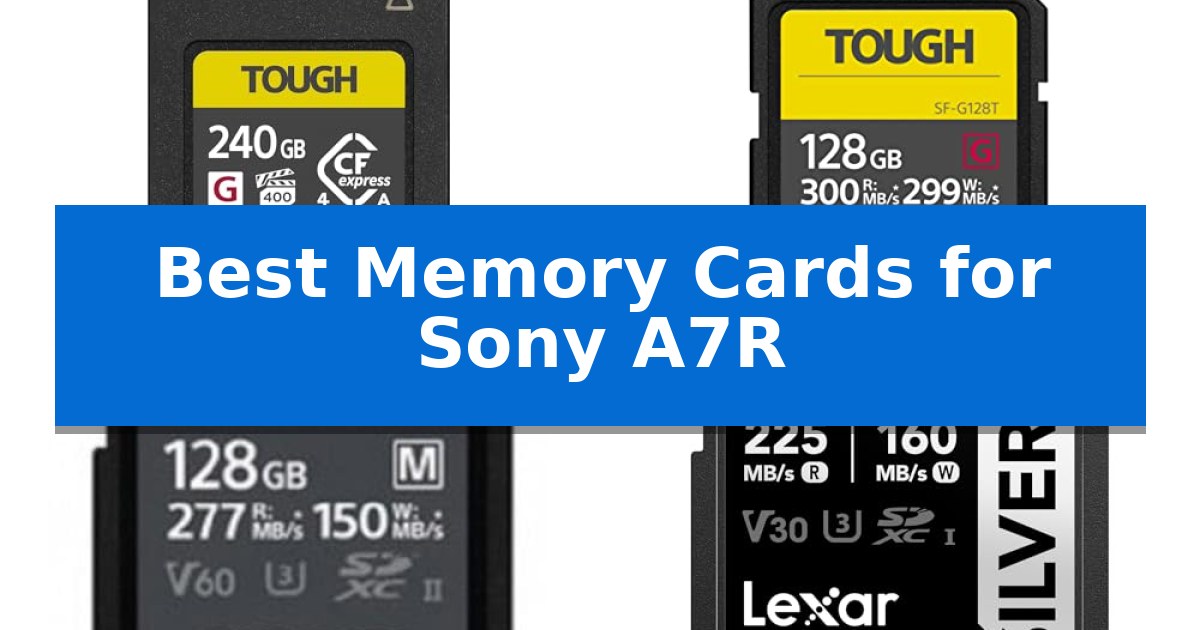
Capturing high-resolution images with a Sony A7R requires a storage solution that can keep pace with the camera's demanding data output. Whether you are shooting rapid-fire burst sequences or high-bitrate video, the right card ensures your buffer clears quickly and your files remain secure.
We have analyzed the Best Memory Cards for Sony A7R to help you distinguish between high-speed CFexpress options and reliable UHS-II SD cards. By understanding your specific shooting requirements, you can select the media that balances transfer speed, capacity, and long-term durability for your professional workflow.
You may also want to compare Best Memory Cards for Sony A7C II, Best Memory Cards for Sony A7C, and Best Memory Cards for Sony A7 V.
Best Memory Cards for Sony A7R
Quick Comparison
| Product | Best For | Key Strength | Score |
|---|---|---|---|
| Sony CEA-G CFexpress Type A Card | Best Overall | VPG400 certification guarantees stable high-bitrate video recording. | 4.9 |
| Sony TOUGH-G SDXC UHS-II Card | Reliable Durability for Burst Shooting | High-durability monolithic construction with 18x greater bend strength than standard SD cards. | 4.9 |
| Sony TOUGH-M SDXC UHS-II Card | Balanced Performance for 4K | 18x stronger than standard UHS-II cards for enhanced physical durability. | 4.9 |
| Lexar Silver SD Memory Card | Versatile Choice for Enthusiasts | V30 speed class supports smooth 4K 60FPS video recording. | 4.4 |
| SanDisk Extreme PRO SD Card | Efficient Offload for Post-Production | Fast read speeds up to 200MB/s with QuickFlow Technology. | 4.7 |
How We Chose
- Interface Compatibility: Verifying support for CFexpress Type A or UHS-II SD slots.
- Sustained Write Speeds: Assessing the ability to handle high-resolution burst modes and video bitrates.
- Transfer Efficiency: Measuring read speeds to reduce downtime during post-production offloading.
- Physical Durability: Evaluating resistance to environmental factors like water, dust, and physical impact.
- Capacity Reliability: Ensuring the card maintains stable performance across its full storage volume.
1 Sony CEA-G CFexpress Type A Card — Maximum Speed for 8K Video
Capturing high-bitrate footage and rapid bursts on a high-resolution sensor requires a storage medium that keeps pace with the camera's internal processing. The Sony CEA-G Series CFexpress Type A Memory Card CEA-G240T utilizes next-generation PCIe Gen 4 technology to support demanding workflows, ensuring that data throughput remains consistent during intensive recording sessions.
Engineered for professional environments, this card features a reinforced Tough construction designed to withstand the rigors of field use. To maintain reliability during extended 4K or 8K video capture, the card incorporates enhanced heat dissipation, which helps prevent thermal throttling and maintains stable performance throughout long takes.
The card carries VPG400 certification, a critical specification for videographers who require a guaranteed minimum write speed for high-bitrate recording. By meeting this standard, the media ensures that the camera's buffer does not become a bottleneck, allowing for seamless data writing even when shooting at maximum resolution and frame rates.
With read speeds reaching up to 1800MB/s and write speeds up to 1700MB/s, the Sony CEA-G Series CFexpress Type A Memory Card CEA-G240T significantly reduces the time required to offload large files to a workstation. This efficiency is essential for creators who need to move quickly from the field to the editing suite without waiting for slow data transfers.
Best for: Professional videographers and photographers using Sony cameras who require VPG400-certified stability for 8K video and high-speed burst shooting.
Skip if: Users who do not own a camera specifically compatible with the CFexpress Type A interface, as this card will not function in standard SD or CFexpress Type B slots.
PROS
- VPG400 certification guarantees stable high-bitrate video recording.
- PCIe Gen 4 technology enables rapid read and write speeds for efficient file transfers.
- Reinforced Tough construction provides enhanced durability for challenging shooting conditions.
- Enhanced heat dissipation supports consistent performance during long-duration recording.
CONS
- Proprietary form factor limits compatibility exclusively to specific CFexpress Type A-enabled devices.
2 Sony TOUGH-G SDXC UHS-II Card — Reliable Durability for Burst Shooting
Reliability during high-speed photography is essential when working with high-resolution sensors. The Sony TOUGH-G SDXC UHS-II Card distinguishes itself through a unique one-piece molded construction, offering a level of bend strength 18 times greater than the standard SD specification. This design choice removes common failure points, such as the write-protection switch and ribs, creating a monolithic structure that is both dustproof and waterproof to the IPX8 standard.
For photographers utilizing the Sony A7R series, this card provides the necessary throughput for demanding workflows. It supports transfer speeds up to 300 MB/s and write speeds up to 299 MB/s, making it suitable for continuous burst mode shooting and 4K video recording. The card is fully UHS-II, Class 10, and U3 compliant, ensuring it meets the data requirements of modern high-resolution cameras.
Compatibility remains a key consideration for existing setups. While the card is optimized for UHS-II hardware, it maintains backward compatibility with UHS-I equipment, albeit at lower performance levels. The unit is built to withstand extreme environments, with an operating temperature range spanning from -13℉ to +185℉, providing consistent performance in varied field conditions.
The Sony TOUGH-G SDXC UHS-II Card balances high-speed performance with physical resilience. By eliminating the fragile write-protection switch and utilizing high-hardness materials, it offers a distinct advantage for users who frequently swap cards in challenging environments. This focus on structural integrity ensures that data remains protected during intensive use.
Best for: Professional photographers and videographers requiring high-speed burst shooting and extreme physical durability for their Sony A7R cameras.
Skip if: Users who require a physical write-protection switch for their specific workflow or those who do not utilize UHS-II compatible hardware may find this card's specialized design unnecessary.
PROS
- High-durability monolithic construction with 18x greater bend strength than standard SD cards.
- Fast write speeds up to 299 MB/s suitable for 4K recording and continuous burst shooting.
- IPX8 waterproof and IP6X dustproof rating for reliable operation in harsh environments.
- Ribless, switchless design eliminates common mechanical failure points.
CONS
- No physical write-protection switch may be a limitation for certain established file-management workflows.
- Premium pricing reflects the specialized construction and high-speed performance specifications.
3 Sony TOUGH-M SDXC UHS-II Card — Balanced Performance for 4K
Reliability in the field starts with the Sony TOUGH-M series SDXC UHS-II Card, which features a specialized Toughness design engineered to be 18x stronger than standard UHS-II cards. This construction provides the physical resilience necessary for demanding photography sessions, ensuring that your data remains protected against accidental drops or bending during rapid card swaps.
Beyond its physical durability, this 128GB card is built to handle the high-resolution data demands of modern cameras. It supports 4K video recording and offers read speeds of up to 277MB/s alongside write speeds of 150MB/s. These specifications facilitate efficient file transfers to your workstation, reducing the time spent waiting for large image batches or high-bitrate video files to offload.
Environmental protection is integrated into the design with IPX8 waterproof and IPX6 dustproof ratings. These features provide peace of mind when shooting in unpredictable weather or challenging outdoor locations where moisture and debris are common concerns. The card is designed to maintain functionality under these conditions, allowing you to focus on the composition rather than the safety of your storage media.
To support long-term usage, the card includes a five-year limited warranty. This coverage reflects the manufacturer's commitment to the longevity of the hardware. By combining high-speed performance with rugged environmental sealing, this card serves as a dependable storage solution for photographers who require consistent results in varied shooting environments.
Best for: Photographers and videographers who require high-speed data transfer and physical durability for outdoor or professional shooting environments.
Skip if: Users who do not require extreme physical durability or high-speed UHS-II performance may find more cost-effective options with standard SD card specifications.
PROS
- 18x stronger than standard UHS-II cards for enhanced physical durability.
- IPX8 waterproof and IPX6 dustproof ratings for environmental protection.
- Capable of 4K video recording with 277MB/s read and 150MB/s write speeds.
- Includes a five-year limited warranty.
CONS
- Premium build and durability features may result in a higher cost compared to standard-grade memory cards.
4 Lexar Silver SD Memory Card — Versatile Choice for Enthusiasts
Reliability in the field often hinges on the storage medium's ability to handle high-resolution data streams without interruption. The Lexar 128GB Silver SD Memory Card is engineered to support demanding workflows, featuring a V30 speed class that ensures stable performance for 4K 60FPS video recording. This makes it a practical choice for photographers and videographers who require consistent write speeds to capture high-quality footage.
Data management is streamlined by the card's 225MB/s maximum read speed, which significantly reduces the time spent transferring large files to a workstation. With a 160MB/s maximum write speed, the card is prepared to handle rapid shutter releases, ensuring that the buffer clears efficiently during sustained shooting sessions.
Beyond raw speed, the Lexar 128GB Silver SD Memory Card is built for challenging environments. It features a robust design that is wearproof, drop-proof, temperature-proof, x-ray-proof, shockproof, magnetic-proof, and vibration-resistant. This level of physical protection provides peace of mind when working in diverse outdoor or studio settings.
Compatibility is a primary strength of this series, as it is designed to integrate seamlessly with a wide range of camera systems, including Sony, Canon, and Nikon. Backed by a Lifetime Limited Warranty, this card offers a durable storage solution for enthusiasts and professionals who need a dependable, versatile memory card for their daily creative tasks.
Best for: Photographers and videographers requiring a reliable, durable, and fast UHS-I storage solution for 4K video and high-resolution photography.
Skip if: Users who require UHS-II or CFexpress speeds for high-burst professional sports photography or 8K raw video recording.
PROS
- V30 speed class supports smooth 4K 60FPS video recording.
- 225MB/s read speed enables fast file transfers to computers.
- Extensive physical durability protects against drops, temperature extremes, and magnetic interference.
- Lifetime Limited Warranty provides long-term support for the hardware.
CONS
- UHS-I interface may limit performance in cameras requiring faster UHS-II or CFexpress cards.
- 128GB capacity may be insufficient for long-duration 4K recording sessions.
5 SanDisk Extreme PRO SD Card — Efficient Offload for Post-Production
High-resolution photography requires reliable storage that keeps pace with rapid data transfer needs, especially when working with demanding camera systems. The SANDISK 128GB Extreme PRO SD Memory Card is engineered to support professional workflows by utilizing SanDisk QuickFlow Technology, which enables read speeds of up to 200MB/s to significantly reduce offload times when paired with compatible hardware.
For photographers capturing high-bitrate content, this card provides UHS Speed Class 3 (U3) and Video Speed Class 30 (V30) ratings. These specifications ensure a sustained video capture rate of 30MB/s, making it a suitable choice for recording 4K UHD video and managing the high-volume data generated during sequential burst mode photography.
Reliability in the field is supported by a lifetime limited manufacturer warranty, providing long-term assurance for your media. While the card is built to handle intensive tasks, achieving its maximum potential requires using the SanDisk Professional PRO-READER SD and microSD, which is sold separately to fully leverage the proprietary high-speed interface.
The SANDISK 128GB Extreme PRO SD Memory Card balances performance and capacity for creators who need to move large files quickly. By prioritizing efficient data transfer, it helps maintain a smooth post-production pipeline, allowing you to spend less time waiting for file transfers and more time editing your work.
Best for: Photographers and videographers who require fast offload speeds for 4K video and high-speed burst photography.
Skip if: Users who do not have a compatible high-speed card reader or host device will not be able to achieve the maximum 200MB/s read speeds.
PROS
- Fast read speeds up to 200MB/s with QuickFlow Technology.
- V30 and U3 ratings for reliable 4K UHD video recording.
- Lifetime limited warranty for long-term peace of mind.
- Optimized for sequential burst mode photography.
CONS
- Maximum speeds require compatible host devices or readers.
- High-speed reader sold separately.
Best Memory Cards for Sony A7R Buying Guide
Understanding Card Interfaces
The Sony A7R series often supports multiple card types depending on the specific model generation. CFexpress Type A cards offer the highest performance, utilizing PCIe Gen 4 technology to handle massive data throughput required for 8K video and ultra-fast burst photography.
Alternatively, UHS-II SD cards remain a standard for many photographers. While they do not reach the extreme speeds of CFexpress, they provide a more versatile and cost-effective solution for standard 4K recording and high-resolution still photography.
The Importance of Write Speeds
A card's write speed is the most critical factor for preventing buffer lockups. If your card's write speed is slower than the camera's data output, you will be forced to wait for the buffer to clear before taking another shot.
Look for cards with VPG400 or V90 ratings if you frequently record high-bitrate video. These certifications guarantee a minimum sustained write speed, ensuring your footage does not drop frames during complex recording tasks.
Durability and Environmental Protection
Professional photography often takes place in unpredictable environments. Cards with reinforced Tough construction or monolithic molding are designed to resist bending, drops, and physical shocks that could otherwise corrupt your data.
Look for IPX8 waterproof and IPX6 dustproof ratings if you shoot outdoors. These features provide a critical layer of protection against the elements, ensuring your images remain safe even in challenging weather conditions.
Offloading and Workflow Efficiency
High read speeds are essential for reducing the time spent transferring files to your computer. Cards that support QuickFlow technology or high-speed PCIe interfaces can significantly decrease the wait time between finishing a shoot and starting your edit.
Pairing your high-speed cards with a compatible professional-grade card reader is just as important as the card itself. Using an outdated reader can create a bottleneck, negating the speed benefits of your high-performance memory card.
Capacity Considerations
Choosing the right capacity depends on your file format and shooting volume. High-resolution RAW files and 8K video consume space rapidly, making 128GB or 240GB capacities a common starting point for professional work.
While larger cards offer more room, some photographers prefer using multiple smaller cards to mitigate the risk of data loss. Always consider your backup strategy alongside your primary storage capacity.
Frequently Asked Questions
Can I use a UHS-I card in my Sony A7R?
Yes, most Sony A7R cameras are backward compatible with UHS-I cards. However, you will experience significantly slower write and read speeds, which may limit burst shooting and video recording capabilities.
What does the V90 rating mean?
The V90 rating indicates a minimum sustained write speed of 90MB/s. This is specifically designed to support high-bitrate 4K video recording without dropping frames.
Do I need a special reader for CFexpress Type A cards?
Yes, CFexpress Type A cards require a compatible reader that supports the CFexpress Type A interface. Standard SD card readers will not work with these cards.
Are 'Tough' cards really more durable?
Yes, cards marketed as 'Tough' typically feature a one-piece molded construction that provides higher bend strength and better resistance to water and dust compared to standard SD cards.
How often should I format my memory card?
It is best practice to format your memory card in-camera after you have successfully backed up your files to a computer or external drive. This helps maintain the file system integrity.
Conclusion: Our Top Pick
For photographers and videographers demanding the absolute best performance from their Sony A7R, the Sony CEA-G CFexpress Type A Card is the clear choice. Its ability to handle high-bitrate 8K video and rapid-fire bursts makes it an essential tool for high-end workflows.
While the CFexpress card offers superior speed, ensure your specific camera model supports the Type A interface before purchasing. For those using standard SD slots, the Sony TOUGH-G series remains a highly reliable alternative for demanding field conditions.