
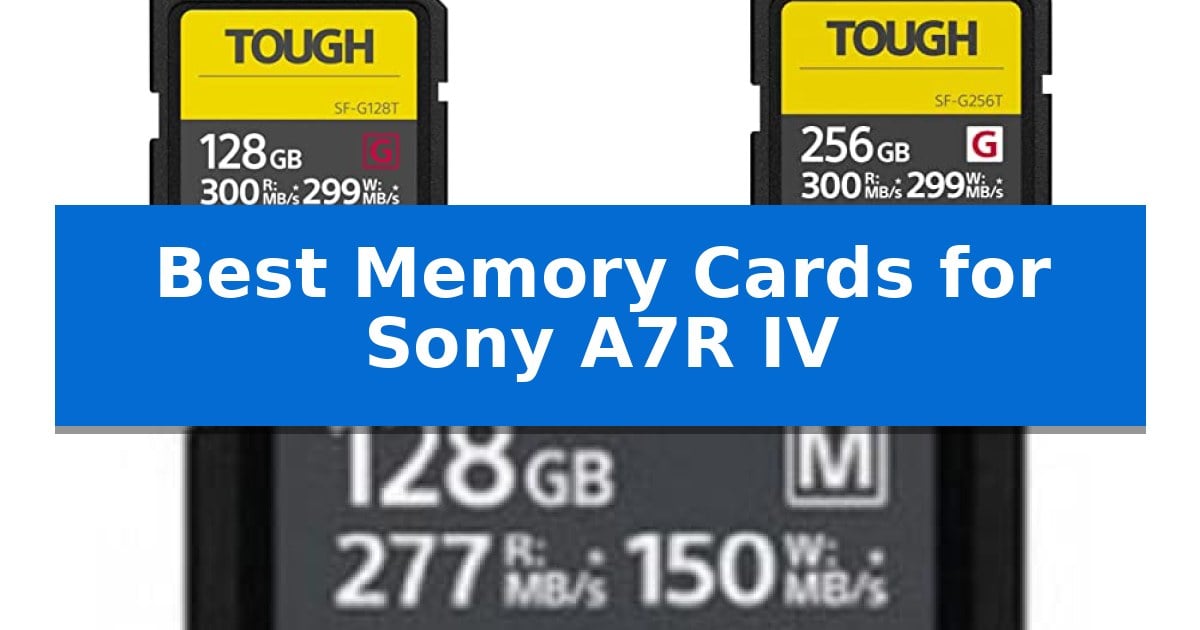
The Sony A7R IV is a high-resolution powerhouse that demands storage media capable of keeping pace with its massive file sizes and demanding data throughput. Choosing the right card is essential to avoid bottlenecks during continuous burst shooting or while capturing high-bitrate video, ensuring your workflow remains uninterrupted.
We have analyzed the Best Memory Cards for Sony A7R IV to help you identify which options provide the necessary speed, durability, and capacity for your specific shooting style. Whether you are a studio photographer or a field videographer, selecting a card that matches your camera's technical requirements is the most important step in protecting your creative output.
You may also want to compare Best Memory Cards for Sony A7R, Best Memory Cards for Sony A7C II, and Best Memory Cards for Sony A7C.
Best Memory Cards for Sony A7R IV
Quick Comparison
| Product | Best For | Key Strength | Score |
|---|---|---|---|
| Sony TOUGH-G Series SDXC UHS-II Card | Best Overall | 18x greater bend strength than standard SD cards due to one-piece molded construction. | 4.9 |
| Sony Tough G Series SDXC UHS-II Memory Card 256GB | Durable High-Capacity Storage | TOUGH specification provides superior crush and shock resistance. | 4.9 |
| Sony TOUGH-M Series SDXC UHS-II Card | Reliable Performance for 4K Video | 18x stronger than standard SD cards for superior physical durability | 4.5 |
How We Chose
- Data Transfer Rates: We prioritized cards with high read and write speeds to ensure efficient file offloading and buffer clearing during burst sequences.
- UHS-II Compliance: We focused on UHS-II interface support, which is critical for maximizing the performance potential of the A7R IV.
- Physical Durability: We assessed the structural integrity of each card, specifically looking for water, dust, and bend-resistance ratings.
- Capacity Options: We evaluated the available storage tiers to ensure they accommodate the large file sizes generated by the camera's sensor.
- Reliability Features: We considered design choices like ribless construction that minimize the risk of physical breakage during frequent card swaps.
1 Sony TOUGH-G Series SDXC UHS-II Card — Maximum Speed for Burst Shooting
The Sony TOUGH-G Series SDXC UHS-II Card is engineered for high-stakes photography, featuring a unique one-piece molded construction that provides 18 times the bend strength of standard SD cards. This robust design removes the traditional rib structure and write-protection switch, creating a seamless, durable exterior that is both IPX8 waterproof and IPX6 dustproof.
Designed to handle the high-resolution demands of modern cameras, this card supports UHS-II, Class 10, and U3 standards. It delivers fast file transfer speeds of up to 300 MB/s and write speeds up to 299 MB/s. These specifications make it a capable choice for 4K video recording and continuous burst mode shooting where data throughput is critical.
Beyond its physical durability, the card maintains broad compatibility. While it achieves its maximum performance in UHS-II compatible slots, it remains backward compatible with UHS-I equipment, offering speeds up to 95 MB/s for transfers and 90 MB/s for writing in older devices. The card is rated to operate in extreme environments, functioning in temperatures ranging from -13°F to +185°F.
The trade-off for this specialized construction is the absence of a physical write-protection switch. Users who rely on this manual toggle to prevent accidental data deletion will need to manage file protection settings directly through their camera's software interface.
Best for: Professional photographers and videographers requiring extreme physical durability and high-speed write performance for 4K recording and continuous burst shooting.
Skip if: Users who rely on a physical write-protection switch to manage data security will find the ribless, switchless design of this card inconvenient.
PROS
- 18x greater bend strength than standard SD cards due to one-piece molded construction.
- IPX8 waterproof and IPX6 dustproof rating for use in harsh environments.
- High-speed performance with up to 300 MB/s read and 299 MB/s write speeds.
- Backward compatibility with UHS-I devices.
CONS
- No physical write-protection switch, requiring software-based file management.
2 Sony Tough G Series SDXC UHS-II Memory Card 256GB — Durable High-Capacity Storage
Reliability in demanding field environments is the primary requirement for high-resolution cameras like the Sony A7R IV, and the Sony Tough G Series SDXC UHS-II Memory Card 256GB addresses this with a specialized TOUGH specification. This design features a crush and shock-proof construction that provides physical resilience against the rigors of professional use, ensuring your data remains protected during travel or intensive shooting sessions.
Beyond its physical durability, this card is engineered for high-performance workflows. It delivers fastest write speeds of up to 299 MB/s, which is essential for clearing the buffer during burst shooting or capturing high-resolution video. The UHS-II interface ensures that the card can keep pace with the data demands of modern mirrorless sensors, minimizing downtime between shots.
Usability is enhanced by a rib-less and switchless design, which removes common points of failure found in traditional SD cards. This structural choice eliminates the risk of breakage at the connector pins or accidental activation of the write-protect switch. Furthermore, the card carries an IP68 rating, providing the highest level of dust and water proofing to safeguard your media in unpredictable weather conditions.
To provide additional peace of mind, the card is supported by Memory Card File Rescue software, which assists in recovering data in the event of accidental deletion or file corruption. With a 5-year manufacturer warranty, this storage solution is built to serve as a long-term, dependable component of your photography kit.
Best for: Professional photographers and videographers who require high-speed performance and maximum physical durability for outdoor or field-based shooting.
Skip if: Users who primarily shoot in controlled studio environments and do not require the specialized crush-proof, IP68-rated construction may find more cost-effective standard UHS-II options.
PROS
- TOUGH specification provides superior crush and shock resistance.
- IP68 dust and water proofing for extreme environmental protection.
- Fast write speeds up to 299 MB/s support high-resolution burst imaging.
- Rib-less and switchless design eliminates common mechanical failure points.
CONS
- Premium pricing compared to standard SDXC cards due to specialized ruggedization.
3 Sony TOUGH-M Series SDXC UHS-II Card — Reliable Performance for 4K Video
Reliability in the field is paramount when shooting high-resolution stills or 4K video, and the Sony TOUGH-M Series SDXC UHS-II Card is engineered to withstand demanding environments. Featuring a specialized toughness design, this card is rated to be 18x stronger than standard UHS-II cards, providing a robust physical buffer against the rigors of professional photography.
Beyond its structural integrity, this card is built for performance, offering read speeds of up to 277MB/s and write speeds of up to 150MB/s. These specifications ensure efficient data transfer and provide the necessary throughput to support 4K video recording, making it a capable companion for the high-data requirements of the Sony A7R IV.
Environmental protection is a core component of its design, with an IPX8 waterproof and IPX6 dustproof rating. These features offer peace of mind when working in unpredictable weather or challenging outdoor locations where exposure to the elements is unavoidable.
The card is backed by a five-year limited warranty, reflecting its focus on long-term utility. With a 128GB capacity, it provides ample space for large RAW files and high-bitrate video, balancing storage needs with the physical durability required for intensive, on-the-go workflows.
Best for: Photographers and videographers who prioritize physical durability and environmental protection for high-resolution 4K capture in challenging outdoor conditions.
Skip if: Users who require the absolute fastest write speeds for continuous high-speed burst shooting may find the 150MB/s limit a bottleneck compared to higher-tier V90 cards.
PROS
- 18x stronger than standard SD cards for superior physical durability
- IPX8 waterproof and IPX6 dustproof ratings for harsh environments
- Supports 4K video recording with consistent write performance
- Includes a five-year limited warranty for long-term support
CONS
- 150MB/s write speed may limit performance for high-speed burst photography
Best Memory Cards for Sony A7R IV Buying Guide
Understanding UHS-II Interface
The UHS-II interface is a critical standard for the Sony A7R IV, as it utilizes a secondary row of pins to achieve significantly higher data transfer speeds compared to standard UHS-I cards. This interface is necessary for photographers who frequently shoot in continuous burst mode, as it allows the camera's buffer to clear much faster.
When selecting a card, ensure it is explicitly labeled as UHS-II. While the camera is backward compatible with UHS-I cards, using them will significantly limit your write speeds and may cause the camera to lag during high-speed shooting or when recording high-quality video.
The Importance of Write Speeds
For the A7R IV, write speed is the most vital metric. Because the camera produces very large image files, a slow write speed will cause the camera to stop recording or stall while it waits for the card to catch up. A card with a high sustained write speed ensures that you can keep shooting without waiting for the buffer to empty.
Look for cards that specify a high V90 or V60 video speed class. These ratings guarantee a minimum sustained write speed, which is particularly important for videographers who need to maintain a consistent data stream for 4K recording without dropped frames.
Durability and Build Quality
Professional photography often takes place in unpredictable environments, making card durability a key factor. Cards with a one-piece molded construction are significantly more resistant to bending and impact than traditional multi-piece SD cards.
Features such as IPX8 waterproof and IP6X dustproof ratings provide peace of mind when shooting outdoors. A robust design ensures that your data remains protected even if the card is accidentally dropped or exposed to moisture.
Capacity Considerations
The A7R IV's high-resolution sensor creates large file sizes, meaning storage space fills up quickly. A 128GB or 256GB card is often the sweet spot for most users, providing enough room for a full day of shooting without requiring constant card changes.
If you primarily shoot video, you may find that higher capacities are necessary to avoid splitting long clips across multiple cards. Always balance your capacity needs against your budget, keeping in mind that larger cards are more efficient for long-form projects.
Reliability and Data Recovery
Reliability is not just about speed; it is about data integrity. Some cards include specialized software like File Rescue, which can help recover accidentally deleted or corrupted files, adding an extra layer of security to your workflow.
Choosing a card from a reputable manufacturer with a limited warranty is a wise investment. A 5-year warranty is standard for high-performance cards and serves as an indicator of the manufacturer's confidence in the card's long-term reliability.
Frequently Asked Questions
Can I use a UHS-I card in my Sony A7R IV?
Yes, the Sony A7R IV is backward compatible with UHS-I cards. However, you will experience slower write speeds, which may limit your ability to shoot in continuous burst mode or record high-bitrate video.
What does the V90 rating mean?
The V90 rating indicates that the card has a minimum sustained write speed of 90MB/s. This is ideal for high-resolution photography and 4K video recording, ensuring the card can handle the data flow without interruption.
Are these cards waterproof?
Many high-performance cards, such as the Sony TOUGH series, feature IPX8 waterproof ratings, meaning they are designed to withstand submersion in water according to specific testing standards.
Why is a ribless design better?
A ribless design removes the fragile plastic ribs found on standard SD cards, which are prone to breaking. This increases the overall structural integrity and reliability of the card during frequent insertion and removal.
How do I know if my card is UHS-II?
UHS-II cards can be identified by the extra row of pins on the back of the card and the 'II' symbol printed on the front label.
Conclusion: Our Top Pick
For photographers and videographers using the Sony A7R IV, the Sony TOUGH-G Series SDXC UHS-II Card stands out as the most reliable choice. Its combination of high-speed performance, reaching up to 299MB/s write speeds, and its exceptionally durable, one-piece molded construction makes it perfectly suited for the demands of a high-resolution camera system.
While other options offer different capacities or slightly lower performance tiers, the TOUGH-G series provides the best balance of speed and physical protection. It effectively minimizes the risk of data loss and mechanical failure, allowing you to focus entirely on your composition and creative process.