
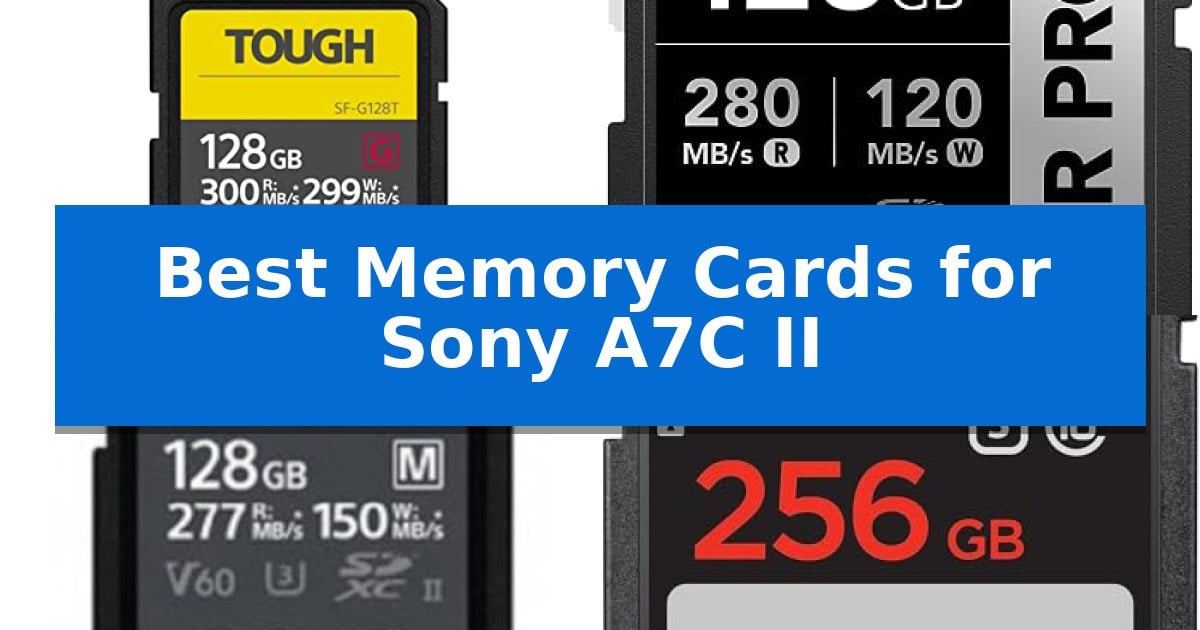
Capturing high-resolution stills and detailed 4K video with the Sony A7C II requires a memory card that can keep pace with the camera's high-speed data output. Choosing the wrong card can lead to dropped frames during video recording or frustrating delays when clearing the buffer during continuous burst shooting.
Finding the Best Memory Cards for Sony A7C II is essential for maintaining a seamless workflow. We have evaluated several top-tier options based on their read/write speeds, durability, and compatibility with the camera's UHS-II and UHS-I interface requirements to help you select the right storage for your specific shooting needs.
You may also want to compare Best Memory Cards for Sony A7C, Best Memory Cards for Sony A7 V, and Best Memory Cards for Sony A7 IV.
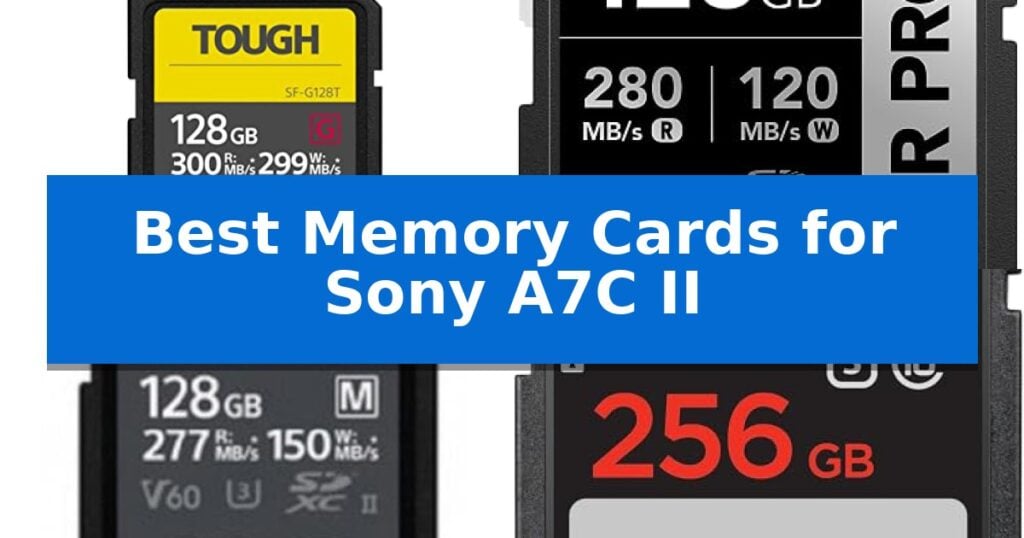
Best Memory Cards for Sony A7C II
Quick Comparison
| Product | Best For | Key Strength | Score |
|---|---|---|---|
| Sony TOUGH-G Series SD Card | Best Overall | One-piece molded construction provides 18x greater bend strength than standard cards. | 4.9 |
| Lexar SILVER PRO SD Card | Fast Workflow for High-Res Video | Blazing-fast transfer speeds up to 280MB/s read. | 4.5 |
| Sony TOUGH-M Series SD Card | Reliable Performance for Daily Use | 18x stronger than standard UHS-II cards for superior physical durability. | 4.6 |
| SanDisk Extreme PRO SD Card | High Capacity for Long Shoots | V30 and U3 ratings ensure stable 4K UHD video recording. | 4.8 |
| Lexar Silver SD Card | Essential Speed for 4K Capture | V30 rating supports stable 4K 60FPS video recording. | 4.6 |
How We Chose
- Bus Interface Compatibility: Ensuring the card supports UHS-II for maximum write speeds required by high-bitrate video modes.
- Sustained Write Performance: Verifying Video Speed Class (V60/V90) ratings to prevent buffer overflow during 4K capture.
- Physical Durability: Assessing build quality, including water, dust, and bend resistance for field reliability.
- Transfer Efficiency: Evaluating maximum read speeds to reduce downtime when offloading large files to a computer.
- Capacity Reliability: Confirming storage tiers that balance long-form recording needs with data safety.
1 Sony TOUGH-G Series SD Card — Maximum Durability for Pro Shooters
Reliability in the field often hinges on the physical integrity of your storage media, and the Sony TOUGH-G Series SD Card addresses this with a unique one-piece molded construction. This design achieves a level of bend strength 18 times greater than the standard SD specification, providing a robust physical foundation for high-stakes photography and videography.
Engineered for demanding workflows, this card features a ribless design that eliminates the write-protection switch, removing common points of failure found in traditional SD cards. It is fully compliant with UHS-II, Class 10, and U3 standards, supporting high-speed data operations. With transfer speeds reaching up to 300 MB/s and write speeds up to 299 MB/s, it is well-suited for intensive tasks such as 4K video recording and continuous burst mode shooting.
Environmental protection is a core component of its architecture, featuring an IPX8 waterproof and IP6X dustproof rating. The monolithic structure is designed to withstand harsh conditions, with an operating temperature range spanning from -13°F to +185°F. This makes it a dependable choice for photographers working in unpredictable outdoor environments.
While optimized for UHS-II compatible cameras, the card maintains backward compatibility with UHS-I equipment, though performance will be limited to the capabilities of the host device. It is backed by a 5-year limited warranty, reflecting the manufacturer's focus on long-term utility for professional users.
Best for: Professional photographers and videographers requiring extreme physical durability and high-speed write performance for 4K recording.
Skip if: Users who prioritize a physical write-protection switch or those who do not require the high-speed benefits of UHS-II for their specific camera setup.
PROS
- One-piece molded construction provides 18x greater bend strength than standard cards.
- IPX8 waterproof and IP6X dustproof ratings ensure reliability in harsh environments.
- High-speed performance with up to 299 MB/s write speeds supports 4K video and burst shooting.
- Ribless design removes fragile components like the write-protection switch.
CONS
- No physical write-protection switch may be a disadvantage for users accustomed to manual locking.
- UHS-II performance is only fully realized in compatible camera bodies.
2 Lexar SILVER PRO SD Card — Fast Workflow for High-Res Video
The Lexar 128GB SILVER PRO SD Memory Card is engineered to support demanding workflows by delivering blazing-fast transfer speeds of up to 280MB/s read and 120MB/s write. This high-capacity SDXC card is designed to handle the data requirements of modern mirrorless cameras, ensuring that high-resolution 4K UHD and 1080p Full-HD video files are captured without dropped frames or buffering.
For photographers and videographers working on tight deadlines, the card's rapid read speeds significantly accelerate the entire workflow, allowing for quick offloading of large media files to editing software. The card is built to perform under pressure and has been rigorously tested for reliability across various camera systems, drones, and camcorders.
Compatibility is a core strength of this storage solution, as it remains backwards-compatible at UHS-I speeds, ensuring it functions seamlessly with existing equipment. Users are further supported by a lifetime limited warranty and access to a free recovery tool, providing additional peace of mind for long-term use.
While this card offers robust performance for high-resolution capture, it is important to note that its peak performance is optimized for devices that support UHS-II standards. Users with older hardware that lacks UHS-II support will still benefit from the card's reliability, though they will be limited to the maximum transfer speeds allowed by their camera's specific interface.
Best for: Professional photographers and videographers who require high-speed, reliable storage for 4K video recording and rapid file transfers.
Skip if: Casual users with older camera equipment that does not support UHS-II speeds, as they may not fully utilize the card's high-performance capabilities.
PROS
- Blazing-fast transfer speeds up to 280MB/s read.
- Supports 4K UHD and 1080p Full-HD video capture without buffering.
- Includes a lifetime limited warranty for long-term reliability.
- Backwards-compatible with UHS-I devices.
CONS
- Peak performance requires UHS-II compatible hardware.
3 Sony TOUGH-M Series SD Card — Reliable Performance for Daily Use
Capturing high-resolution imagery and 4K video requires a storage medium that can withstand demanding field conditions. The Sony TOUGH-M Series SD Card is engineered with a specialized toughness design that is rated to be 18x stronger than standard UHS-II cards, providing a robust physical foundation for your data.
Beyond its structural integrity, this card is built for reliability in unpredictable environments. It features IPX8 waterproof and IPX6 dustproof ratings, ensuring that your captured media remains protected from the elements. This level of durability is essential for photographers who frequently operate in outdoor or challenging settings.
Performance-wise, the card supports 4K video recording and offers read speeds up to 277MB/s alongside write speeds of 150MB/s. These specifications facilitate efficient data transfer and consistent write performance during intensive shooting sessions. The card is backed by a five-year limited warranty, reflecting its intended use as a dependable tool for daily professional or enthusiast workflows.
When integrating this card into your setup, consider the balance between its high-strength construction and the specific speed requirements of your projects. While it provides significant physical protection, ensure your workflow aligns with the V60 and U3 class performance ratings to maximize its utility during high-bitrate recording.
Best for: Photographers and videographers who prioritize physical durability and environmental protection for their media storage.
Skip if: Users who require the absolute highest write speeds for sustained high-frame-rate 8K or RAW video recording may find the V60 rating limiting compared to V90 alternatives.
PROS
- 18x stronger than standard UHS-II cards for superior physical durability.
- IPX8 waterproof and IPX6 dustproof ratings for reliable field use.
- Supports 4K video recording with consistent write speeds.
- Includes a five-year limited warranty for added peace of mind.
CONS
- V60 speed class may not meet the requirements for the most demanding high-bitrate recording modes.
4 SanDisk Extreme PRO SD Card — High Capacity for Long Shoots
Capturing high-resolution 4K video and rapid sequential bursts requires a storage medium that can keep pace with the Sony A7C II. The SanDisk 256GB Extreme PRO SD Memory Card is engineered to support these demanding workflows, providing the necessary overhead for professional-grade media capture.
This card utilizes UHS Speed Class 3 (U3) and Video Speed Class 30 (V30) ratings, ensuring a sustained video capture rate of at least 30MB/s. This classification is essential for maintaining consistent performance during 4K UHD recording, preventing dropped frames or interruptions during critical shoots.
Beyond recording, the card excels in data management through SanDisk QuickFlow Technology. When paired with a compatible reader like the SanDisk Professional PRO-READER, it achieves read speeds of up to 200MB/s. This significantly reduces the time required to offload large files to a workstation, allowing photographers to return to the field faster.
For photographers who rely on burst mode, the card supports shot speeds up to 140MB/s. This write performance helps clear the camera buffer efficiently, ensuring the Sony A7C II remains responsive during fast-paced action sequences. With a lifetime limited manufacturer warranty, it provides a reliable foundation for long-term storage needs.
Best for: Photographers and videographers requiring reliable 4K UHD recording and fast file offload speeds for their Sony A7C II.
Skip if: Users who require extreme high-bitrate recording formats that exceed V30 sustained write speed requirements may need a V60 or V90 rated card.
PROS
- V30 and U3 ratings ensure stable 4K UHD video recording.
- QuickFlow Technology enables rapid read speeds up to 200MB/s.
- 140MB/s write speeds support efficient sequential burst photography.
- Lifetime limited warranty offers long-term peace of mind.
CONS
- Maximum read speeds require a compatible SanDisk reader to achieve full potential.
- V30 classification may be a bottleneck for the highest bitrate video settings on some professional cameras.
5 Lexar Silver SD Card — Essential Speed for 4K Capture
Reliability during high-resolution video capture is essential for the Sony A7C II, and the Lexar 128GB Silver SD Memory Card provides a specialized solution for this workflow. With a V30 speed class rating, this card is engineered to support 4K 60FPS video recording, ensuring smooth data throughput for demanding visual projects.
Beyond its video capabilities, the card features a 225MB/s maximum read speed, which significantly reduces wait times when offloading large files to a computer or workstation. The 160MB/s maximum write speed ensures that the buffer clears efficiently, allowing photographers to maintain their shooting rhythm without interruption.
Designed for versatility and resilience, the Lexar 128GB Silver SD Memory Card is built to withstand challenging environments. Its construction is wearproof, drop-proof, temperature-proof, x-ray-proof, shockproof, magnetic-proof, and vibration-resistant, providing a layer of physical security for stored media.
This card offers broad compatibility across various camera systems, including Sony, Canon, and Nikon, making it a flexible choice for creators who utilize multiple setups. It is backed by a Lifetime Limited Warranty, reflecting a commitment to long-term utility for enthusiasts and professionals alike.
Best for: Photographers and videographers requiring reliable 4K video recording and efficient file transfer speeds for their Sony A7C II.
Skip if: Users who require V60 or V90 speed classes for high-bitrate video formats or burst-heavy professional sports photography may find the V30 rating insufficient.
PROS
- V30 rating supports stable 4K 60FPS video recording.
- 225MB/s read speed accelerates file transfer workflows.
- Comprehensive durability features protect against drops, shocks, and extreme temperatures.
- Lifetime Limited Warranty provides long-term peace of mind.
CONS
- V30 speed class is limited compared to higher-tier V60 or V90 cards for intensive professional workflows.
Best Memory Cards for Sony A7C II Buying Guide
Understanding Speed Classes
The Sony A7C II utilizes specific data rates for its various recording formats. Speed classes like V60 and V90 indicate the minimum sustained write speed of the card, which is critical for video. A V60 card is generally sufficient for most 4K recording, while V90 cards provide additional headroom for high-bitrate settings.
It is important to distinguish between maximum burst speeds and sustained write speeds. While marketing often highlights the highest possible read speed, the sustained write speed is what prevents your camera from stopping mid-recording.
UHS-II vs. UHS-I Compatibility
The Sony A7C II is compatible with both UHS-II and UHS-I cards. UHS-II cards feature an extra row of pins that enable significantly faster data transfer rates. If you frequently shoot long bursts or high-bitrate video, investing in a UHS-II card will noticeably improve your camera's buffer clearing time.
If you primarily shoot casual photos or lower-bitrate video, a UHS-I card may be more cost-effective. However, note that you will be limited by the slower interface speeds when transferring files to your computer.
Durability and Environmental Protection
Memory cards are often exposed to harsh conditions, from extreme temperatures to moisture. Cards with IPX8 waterproof ratings and high-hardness construction are designed to protect your data against accidental drops or exposure to the elements.
Features like a ribless design or the removal of a write-protection switch can also enhance physical longevity by eliminating fragile components that are prone to breaking over time.
Capacity Considerations
Choosing the right capacity depends on your file format and shooting volume. For 4K video, a 128GB card is often considered the sweet spot, offering a balance between recording time and the risk of losing data if a single card fails.
If you shoot primarily in RAW format, you may find that you fill cards faster than expected. In these cases, opting for a 256GB card can provide peace of mind during long shoots where changing cards is inconvenient.
Workflow Efficiency
The time spent offloading footage is a significant part of the creative process. Cards with higher read speeds (up to 300MB/s) can drastically reduce the time you spend waiting for files to transfer to your editing workstation.
Pairing a high-speed card with a compatible UHS-II card reader is necessary to actually achieve these advertised transfer speeds. Without the proper reader, you will be bottlenecked by the speed of your computer's port.
Frequently Asked Questions
Can I use a UHS-I card in my Sony A7C II?
Yes, the Sony A7C II is backward compatible with UHS-I cards. However, you will not be able to utilize the higher write speeds required for certain high-bitrate video modes.
What does the V90 rating mean?
A V90 rating means the card has a minimum sustained write speed of 90MB/s, which is ideal for demanding 4K video recording and high-speed continuous burst photography.
Do I need a special reader for UHS-II cards?
To take full advantage of the faster read speeds offered by UHS-II cards, you should use a dedicated UHS-II compatible card reader.
Are these cards waterproof?
Many professional-grade cards, such as the Sony TOUGH series, are rated IPX8 waterproof, providing protection against accidental submersion.
How do I know if my card is fast enough for 4K video?
Look for a V30, V60, or V90 label on the card. For the Sony A7C II, a V60 or V90 card is recommended to ensure reliable 4K video capture without dropped frames.
Conclusion: Our Top Pick
Selecting the right memory card is a vital step in ensuring your Sony A7C II performs reliably under pressure. For photographers and videographers who require the highest level of physical durability and sustained write speeds, the Sony TOUGH-G Series SD Card stands out as the most robust choice.
Its one-piece molded construction and high-speed performance make it an excellent partner for the A7C II, especially when shooting in challenging environments or capturing high-bitrate 4K footage. While other options offer great value for daily use, this card provides the peace of mind that your data is protected by industry-leading build standards.