
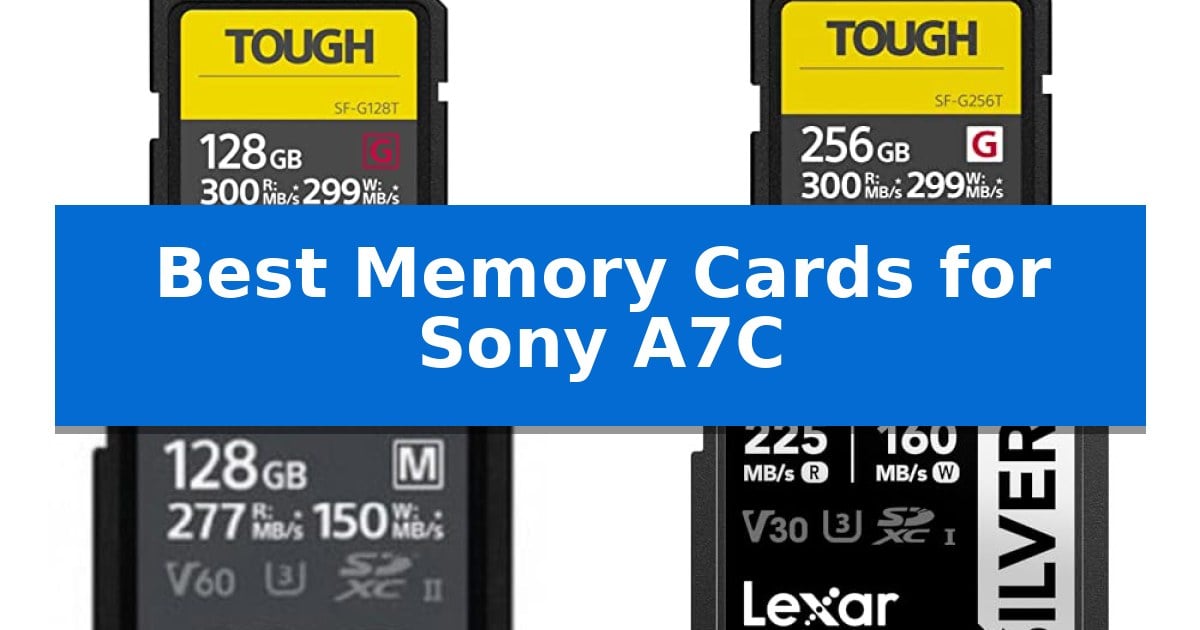
Choosing the right storage media for your camera is essential for maintaining consistent performance during critical shoots. Whether you are capturing high-resolution still images or recording 4K video, the Best Memory Cards for Sony A7C must provide the necessary write speeds and structural integrity to handle your workflow without data loss.
Our guide evaluates several SDXC options based on their interface standards, durability ratings, and transfer capabilities. By understanding how these specifications align with your specific shooting style, you can select a card that ensures your camera operates at its full potential without unnecessary bottlenecks.
You may also want to compare Best Memory Cards for Sony A7 V, Best Memory Cards for Sony A7 IV, and Best Memory Cards for Sony A7.
Best Memory Cards for Sony A7C
Quick Comparison
| Product | Best For | Key Strength | Score |
|---|---|---|---|
| Sony TOUGH-G Series SDXC UHS-II Card | Best Overall | One-piece molded construction provides superior bend strength. | 4.9 |
| Sony Tough G Series SDXC UHS-II Memory Card 256GB | High Capacity for Long Shoots | TOUGH specification provides superior crush and shock resistance. | 4.6 |
| Sony TOUGH-M Series SDXC UHS-II Card | Reliable Performance for 4K Video | 18x stronger than standard UHS-II cards for enhanced physical durability. | 4.7 |
| Lexar Silver SDXC UHS-I Card | Budget Friendly for Daily Use | V30 speed class supports 4K 60FPS video recording. | 4.6 |
| Gigastone SDXC UHS-I Card | Value Option for Casual Shooters | Durable construction including waterproof and shock-proof ratings. | 4.6 |
How We Chose
- Bus Interface: Prioritizing UHS-II compatibility for high-bandwidth tasks like 4K video recording.
- Write Speed: Evaluating sustained write performance to ensure buffer clearing during continuous burst shooting.
- Durability: Assessing physical construction standards such as waterproof, dustproof, and bend-strength ratings.
- Capacity: Considering storage volume requirements for long-duration recording sessions.
- Compatibility: Verifying support for both UHS-II and UHS-I camera interfaces.
1 Sony TOUGH-G Series SDXC UHS-II Card — Maximum Durability for Field Work
Reliability in the field often hinges on the physical integrity of your storage media. The Sony TOUGH-G Series SDXC UHS-II Card addresses this with a unique, one-piece molded construction that achieves a level of bend strength 18 times greater than the standard SD specification. By removing the ribbing and the write-protection switch, this design eliminates common failure points, ensuring the card remains robust during intensive outdoor shoots.
Performance capabilities are tailored for demanding workflows, featuring transfer speeds up to 300 MB/s and write speeds up to 299 MB/s. These specifications make it well-suited for high-bitrate 4K video recording and continuous burst mode photography on the Sony A7C. The card is UHS-II, Class 10, and U3 compliant, ensuring it keeps pace with the camera's high-speed data requirements.
Environmental protection is a core feature, as the monolithic structure provides an IPX8 waterproof rating and an IP6X dustproof rating. It is designed to operate in a wide temperature range from -13°F to +185°F, allowing for consistent use in diverse climates. While it delivers maximum performance in UHS-II compatible slots, it remains backward compatible with UHS-I equipment, albeit at lower speeds.
The Best Memory Cards for Sony A7C selection process prioritizes structural durability and high-speed throughput to prevent data loss and bottlenecks. This card serves as a specialized tool for photographers and videographers who prioritize hardware resilience in unpredictable shooting environments.
Best for: Professional photographers and videographers who require extreme physical durability and high-speed performance for 4K recording in challenging field conditions.
Skip if: Casual users or studio photographers who do not require ruggedized, waterproof construction and can utilize more cost-effective standard SD cards.
PROS
- One-piece molded construction provides superior bend strength.
- Ribless, switchless design removes common physical failure points.
- IPX8 waterproof and IP6X dustproof ratings for extreme environments.
- High-speed performance with 300MB/s read and 299MB/s write speeds.
CONS
- Lack of a physical write-protection switch may be inconvenient for users accustomed to manual locking.
2 Sony Tough G Series SDXC UHS-II Memory Card 256GB — High Capacity for Long Shoots
Reliability during high-stakes shoots is essential, and the Sony Tough G Series SDXC UHS-II Memory Card 256GB addresses this with a specialized TOUGH specification that provides a crush and shock-proof design. This card is engineered to withstand demanding environments, featuring IP68-rated dust and water proofing to protect your data in unpredictable conditions. Its physical construction is notably distinct, utilizing a rib-less and switchless design that eliminates common points of failure found in standard SD cards, such as broken ribs or a snapped write-protect switch.
Beyond its physical durability, this card is built for performance-heavy tasks. It supports fast write speeds of up to 299 MB/s, which is critical for maintaining consistent performance during burst and high-resolution imaging. For photographers and videographers using the Sony A7C, this card offers a seamless workflow by ensuring the buffer clears quickly during rapid-fire sequences. The 256GB capacity provides ample space for long-duration shoots, reducing the frequency of media swaps.
Compatibility extends to the Memory Card File Rescue software, which provides a safety net for data recovery if needed. This software is a practical inclusion for professionals who need to ensure their captured content remains accessible even in the event of accidental deletion or file corruption. While the card commands a higher cost than standard UHS-II alternatives, the investment is centered on its ruggedized architecture, which is specifically designed to mitigate the risks of physical damage in the field.
Best for: Professional photographers and videographers who require extreme physical durability and high-speed write performance for burst shooting.
Skip if: Casual users who do not require high-speed write performance or the extra protection of a ruggedized, shock-proof design.
PROS
- TOUGH specification provides superior crush and shock resistance.
- IP68-rated dust and water proofing for harsh environments.
- Fast write speeds up to 299 MB/s support high-resolution burst shooting.
- Rib-less and switchless design eliminates common physical breakage points.
CONS
- Higher cost compared to standard UHS-II SD cards due to specialized rugged construction.
3 Sony TOUGH-M Series SDXC UHS-II Card — Reliable Performance for 4K Video
Reliability in the field starts with physical resilience, and the Sony TOUGH-M Series SDXC UHS-II Card is engineered to withstand demanding environments. Featuring a specialized toughness design, this card is rated as 18x stronger than standard UHS-II cards, providing a robust storage solution for photographers who frequently swap media in challenging conditions.
Beyond its physical build, the card is built for high-performance workflows. It supports 4K video recording and delivers read speeds up to 277MB/s alongside write speeds up to 150MB/s. These specifications ensure that data transfer from the card to a workstation is efficient, minimizing downtime during post-production.
The card is also designed to handle exposure to the elements, boasting IPX8 waterproof and IP6X dustproof ratings. This protection is essential for maintaining data integrity when shooting outdoors or in unpredictable weather. With a five-year limited warranty, it offers a long-term commitment to reliability for professional and enthusiast gear setups.
While the card excels in durability, users should ensure their hardware supports the UHS-II interface to fully utilize the rated speed capabilities. It remains a practical choice for those prioritizing a balance between high-speed data handling and structural integrity for their camera equipment.
Best for: Photographers and videographers who require a durable, weather-resistant storage solution for high-resolution 4K video recording.
Skip if: Users who do not require extreme physical durability or those using older camera systems that do not support the UHS-II interface.
PROS
- 18x stronger than standard UHS-II cards for enhanced physical durability.
- IPX8 waterproof and IP6X dustproof ratings for outdoor reliability.
- Supports 4K video recording with efficient 277MB/s read speeds.
- Backed by a five-year limited warranty.
CONS
- Premium build may exceed the needs of casual shooters who do not face harsh environments.
4 Lexar Silver SDXC UHS-I Card — Budget Friendly for Daily Use
Capturing high-resolution imagery and 4K video requires a reliable storage medium that can keep pace with the Sony A7C's data demands. The Lexar 128GB Silver SD Memory Card provides a balanced solution for photographers and videographers who need consistent performance without over-investing in specialized professional-grade media.
Engineered with a V30 speed class rating, this card is capable of supporting 4K 60FPS video recording, ensuring smooth footage capture for your creative projects. It features a 160MB/s maximum write speed, which helps maintain stability during continuous shooting, while the 225MB/s maximum read speed significantly reduces the time required to transfer large files to your computer.
Beyond its speed, the card is built to withstand challenging environments. Its durable construction is rated to be wearproof, drop-proof, temperature-proof, x-ray-proof, shockproof, magnetic-proof, and vibration-resistant, offering peace of mind when shooting on location. It also includes a Lifetime Limited Warranty, reflecting confidence in its long-term reliability.
Designed for broad compatibility, the Lexar 128GB Silver SD Memory Card integrates seamlessly with the Sony A7C and other standard camera systems. It serves as a practical, high-capacity storage option for enthusiasts who prioritize a mix of speed, ruggedness, and value for their daily photography and videography needs.
Best for: Enthusiast photographers and videographers needing reliable, high-capacity storage for 4K video and daily shooting.
Skip if: Professional users requiring ultra-high-speed V60 or V90 cards for high-bitrate RAW video or extremely fast burst-mode photography.
PROS
- V30 speed class supports 4K 60FPS video recording.
- 225MB/s read speed enables efficient file transfers.
- Comprehensive durability including shock, temperature, and x-ray resistance.
- Lifetime Limited Warranty for long-term peace of mind.
CONS
- UHS-I interface limits maximum theoretical speeds compared to UHS-II alternatives.
5 Gigastone SDXC UHS-I Card — Value Option for Casual Shooters
Capturing high-resolution media requires a storage medium that balances speed with physical resilience. The Gigastone 128GB SD Card 4K Camera Pro is built to withstand demanding field conditions, featuring a design that is waterproof, temperature-proof, x-ray-proof, shock-proof, and magnetic-proof. These protections provide a necessary buffer against environmental hazards, ensuring that your data remains secure during outdoor shoots or travel.
For users of the Sony A7C, this full-sized SD card offers the technical specifications required for consistent performance. It carries a UHS-I A1 V30 U3 Class 10 rating, which is the industry standard for maintaining the sustained write speeds necessary for 4K Ultra HD video recording. This ensures that the card can handle the data throughput demands of high-bitrate video without dropping frames.
Efficiency in post-production workflows is supported by a 150MB/s read speed and up to 100MB/s data transfer speed. These rates allow for faster offloading of large video files and high-resolution image batches to your workstation. The card adheres to standard dimensions of 32mm by 24mm, guaranteeing a precise fit within the camera's SD slot, and includes a mini case to keep the card protected when it is not inside the camera.
Reliability is further reinforced by a 5-year limited warranty, offering long-term support for your storage investment. While this card is optimized for 4K video and standard photography, it utilizes a UHS-I interface. This is a key trade-off to consider, as it does not reach the higher transfer ceilings found in UHS-II cards, which may be preferred by professionals who frequently shoot high-speed bursts or massive cinema-grade files.
Best for: Casual photographers and videographers seeking a reliable, durable storage solution for 4K video and high-resolution stills.
Skip if: Professional users requiring ultra-high-speed UHS-II transfer rates for rapid burst shooting or high-bitrate professional cinema formats.
PROS
- Durable construction including waterproof and shock-proof ratings.
- 5-year limited warranty for long-term peace of mind.
- V30 speed class support for reliable 4K video recording.
- Includes a mini case for convenient protection.
CONS
- UHS-I interface limits maximum transfer speeds compared to UHS-II alternatives.
Best Memory Cards for Sony A7C Buying Guide
Understanding UHS-II vs. UHS-I
The UHS-II interface is designed for high-performance cameras, offering significantly faster data transfer rates compared to the older UHS-I standard. If you frequently shoot 4K video or high-speed bursts, a UHS-II card is necessary to prevent the camera buffer from filling up prematurely.
While UHS-I cards are generally more affordable, they are better suited for casual photography or lower-bitrate video recording. Always check your camera's manual to ensure it supports the faster bus interface to justify the investment in higher-tier cards.
The Importance of Write Speeds
Write speed determines how quickly data is moved from your camera's buffer to the memory card. For photographers, a fast write speed is critical for clearing the buffer during rapid-fire sequences, allowing you to keep shooting without waiting for the camera to catch up.
For videographers, a consistent minimum write speed is required to maintain the data stream for high-bitrate 4K footage. Look for cards with V30, V60, or V90 ratings, which guarantee the minimum sustained write speed required for reliable video capture.
Physical Durability and Build Quality
Memory cards used in field environments are subject to extreme conditions. Cards with TOUGH specifications often feature one-piece molded construction, which provides superior bend strength and resistance to impact compared to standard plastic designs.
Features like IPX8 waterproof and IP6X dustproof ratings provide peace of mind when shooting in inclement weather. A ribless, switchless design can also eliminate common failure points, such as broken write-protection switches.
Data Recovery and Reliability
Even the most reliable cards can occasionally suffer from file corruption. Some manufacturers include data recovery software that can help retrieve lost or accidentally deleted files, providing an extra layer of security for your work.
Always consider the warranty period offered by the manufacturer. A longer warranty, such as a lifetime limited warranty, often reflects the manufacturer's confidence in the card's long-term endurance and reliability.
Choosing the Right Capacity
Your storage needs depend on your file format and shooting volume. High-resolution RAW files and 4K video consume space rapidly, making 128GB or 256GB cards more practical for professional or extended use.
If you are a casual shooter, a 128GB card typically offers a balance between cost and capacity. Always balance your budget with the reality of how much footage you capture in a single session to avoid running out of space mid-shoot.
Frequently Asked Questions
Can I use a UHS-II card in a UHS-I camera?
Yes, UHS-II cards are backward compatible with UHS-I equipment. However, the card will operate at UHS-I speeds, so you will not gain the performance benefits of the UHS-II interface.
What does the V90 rating mean?
The V90 rating indicates a minimum sustained write speed of 90MB/s, which is sufficient for high-bitrate 4K and even 8K video recording.
Are all SD cards waterproof?
No, only cards specifically rated with IPX standards are tested for water resistance. Always check the product specifications for durability ratings.
Does a faster card make my camera take better photos?
No, a faster card does not affect image quality. It only improves the speed at which images are saved to the card and transferred to your computer.
Why is a ribless design considered better?
A ribless design removes fragile plastic parts that can break off inside the camera, potentially causing damage or making the card difficult to insert and remove.
Conclusion: Our Top Pick
For photographers and videographers requiring the highest level of reliability and speed, the Sony TOUGH-G Series SDXC UHS-II Card is our top recommendation. Its one-piece molded construction provides exceptional bend strength and durability, while the high-speed UHS-II interface ensures seamless performance for demanding 4K recording and burst-mode photography.
While this card is a premium investment, its robust design and fast transfer speeds make it an ideal choice for field work where data integrity is paramount. If your shooting requirements are less intensive, other options in this list may provide sufficient performance at a lower price point, but for maximum peace of mind, the TOUGH-G series remains the standard.