
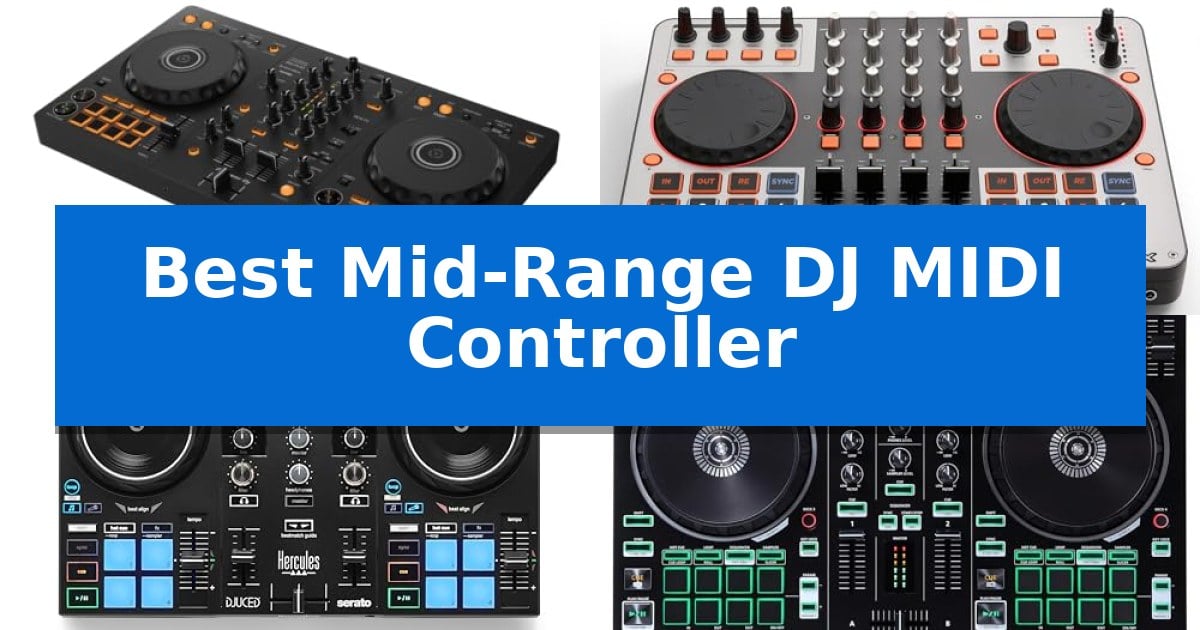
Stepping up to a Best Mid-Range DJ MIDI Controller involves finding a balance between professional-grade features and intuitive design. Whether you are moving from a basic starter unit or looking for a reliable piece of gear for live sets, the right controller should offer enough depth to grow your skills without overwhelming your workflow.
Selecting the right hardware depends on your specific needs, such as deck requirements, software integration, and portability. We have analyzed the current market to help you identify which controller aligns with your mixing style and performance goals.
You may also want to compare Best Mid-Range DJ Controller, Best Mid-Range Digital Voice Recorders, and Best Mid-Range Digital SLR Camera.
Best Mid-Range DJ MIDI Controller
Quick Comparison
| Product | Best For | Key Strength | Score |
|---|---|---|---|
| Pioneer DJ DDJ-FLX4 DJ Controller | Best Overall | Smart Fader technology simplifies volume and BPM management for smooth transitions. | 4.9 |
| DJ Tech 4MIX DJ Controller | Four-Deck Control for Complex Sets | 4-deck hands-on control for complex mixing. | 4.4 |
| Hercules DJControl Inpulse 200 MK3 | Visual Guides for Precise Mixing | Beatmatch Guide LEDs provide essential visual feedback for manual tempo alignment. | 4.3 |
| Roland DJ-202 DJ Controller | Legendary Drum Sounds Integrated | Integrated ACB technology for authentic TR-808, TR-909, and TR-606 drum sounds. | 4.3 |
| Numark Party Mix III DJ Controller | Portable Mixing with Light Show | Integrated LED light show that syncs to the beat | 4.4 |
How We Chose
- Software Integration: Compatibility with industry-standard platforms like Serato, VirtualDJ, and Algoriddim.
- Deck Control: The ability to manage two or four decks effectively for complex mixing.
- Connectivity and Audio: The quality of the built-in sound card and the variety of input/output options for live performance.
- Portability and Design: The physical footprint, weight, and layout ergonomics for travel and setup.
- Performance Features: The inclusion of specialized tools like performance pads, stem separation, and dedicated FX controls.
1 Pioneer DJ DDJ-FLX4 DJ Controller — Industry Standard for Beginners
Transitioning from bedroom practice to live streaming requires hardware that simplifies the technical overhead of managing multiple audio sources and software integration. The Pioneer DJ DDJ-FLX4 DJ Controller addresses this by offering a streamlined, professional-grade layout that functions as an all-in-one hub for both mixing and broadcasting.
Designed to accommodate growth, this 2-channel, 2-deck controller provides the essential tactile controls needed to learn fundamental techniques. It features 16 Performance Pads that grant direct access to Hot Cues, Pad FX, Beat Jump, and Sampler functions, allowing users to build complex sets without needing to navigate deep software menus.
For those newer to the craft, the Smart Fader feature acts as a significant bridge, automatically adjusting volume, bass, and BPM to ensure smooth transitions between tracks. This allows for genre blending with a single fader movement, reducing the immediate pressure of manual beatmatching while learning the underlying mechanics of track structure.
Connectivity is a primary strength, as the device integrates with PC, Mac, iPhone, iPad, and Android platforms via USB or Bluetooth. The inclusion of a built-in sound card allows for direct speaker connection, while the dedicated mic input enables seamless livestreaming or MCing from a single device, making it a versatile choice for creators working within limited desk space.
Best for: Beginner DJs and content creators who need a compact, multi-platform controller that simplifies the transition into livestreaming.
Skip if: Professional DJs requiring a 4-channel setup or those who prefer standalone hardware that does not rely on a connected computer or mobile device.
PROS
- Smart Fader technology simplifies volume and BPM management for smooth transitions.
- Multi-platform compatibility supports PC, Mac, and mobile devices via USB or Bluetooth.
- Integrated mic input allows for easy livestreaming from a single hardware unit.
- 16 Performance Pads provide versatile control over effects and samples.
CONS
- 2-channel limitation may restrict advanced mixing techniques compared to 4-channel controllers.
2 DJ Tech 4MIX DJ Controller — Four-Deck Control for Complex Sets
Managing complex sets requires a reliable interface that balances portability with deep control, and the DJ Tech 4MIX DJ Controller provides this through its dedicated 4-deck operation. This unit allows DJs to transition between four distinct channels, utilizing an integrated soundcard that handles master and cue outputs directly via USB, eliminating the need for external audio interfaces.
The controller features an ergonomic mixer layout equipped with smooth EQ and filter knobs, enabling precise frequency manipulation during live sets. Its fast deck switching capability is powered by illuminated deck select buttons, which provide immediate visual feedback when jumping between decks A, B, C, and D. This design choice ensures that users can maintain a professional workflow without losing track of their active channels.
Performance-focused features include large illuminated pads designed for triggering cues and loops, alongside dedicated FX buttons and large knobs for parameter control. These physical controls are intended to assist in building drops and enhancing creative transitions. The unit is bundled with VirtualDJ LE software and is fully mappable, offering flexibility for those who prefer specific software environments.
Weighing in at 6 pounds, the device maintains a balance between a sturdy build and portable utility. While it offers comprehensive hands-on control, users should note that it relies on a USB connection for its integrated audio processing, making it a dedicated solution for digital-first setups.
Best for: DJs requiring a compact, 4-deck hardware interface for digital mixing and live performance.
Skip if: Users who require standalone functionality without a computer or those who prefer a 2-deck layout for simpler mixing workflows.
PROS
- 4-deck hands-on control for complex mixing.
- Integrated soundcard with master and cue outputs.
- Illuminated performance pads for intuitive cue and loop triggering.
- Fully mappable for compatibility with major DJ programs.
CONS
- Requires computer connection for audio processing and software operation.
- 6-pound weight may be less portable than smaller 2-channel controllers.
3 Hercules DJControl Inpulse 200 MK3 — Visual Guides for Precise Mixing
The Hercules DJControl Inpulse 200 MK3 simplifies the learning curve for new DJs by integrating Beatmatch Guide LEDs directly into the hardware. These visual cues illuminate near the jog wheels and tempo faders, providing real-time feedback to ensure tracks remain perfectly aligned without relying solely on auditory guesswork.
Designed for mobility, this ultra-portable 2-channel controller weighs just over two pounds and fits easily into a standard backpack. Its compact footprint does not sacrifice functionality, as it includes 8 performance pads and dedicated Stems controls, allowing users to isolate vocals and instrumentals from tracks during live sets to create unique mashups.
The unit features a built-in virtual sound card, which facilitates direct streaming to various platforms without the need for additional audio interfaces. Users can access millions of tracks through integrated support for services like Spotify, Apple Music, and TIDAL, while the Intelligent Music Assistant provides track suggestions based on BPM and energy levels to maintain set flow.
Compatibility is a core strength, as the device offers flexible software options including DJUCED and Serato DJ Lite. The included DJ Academy tutorials provide step-by-step guidance, making it a practical choice for those transitioning from unboxing to their first mix quickly.
Best for: Beginner DJs who want a portable, all-in-one controller with visual learning aids to master beatmatching and stem-based remixing.
Skip if: Professional DJs requiring advanced multi-channel mixing, XLR balanced outputs, or full-sized jog wheels for complex scratching techniques.
PROS
- Beatmatch Guide LEDs provide essential visual feedback for manual tempo alignment.
- Integrated Stems controls allow for real-time vocal and instrumental isolation.
- Ultra-portable design makes it ideal for travel and mobile setups.
- Built-in virtual sound card simplifies the connection for live streaming.
CONS
- Compact size may feel cramped for users accustomed to full-sized professional decks.
- Limited to 2 channels, which may restrict complex multi-deck mixing setups.
4 Roland DJ-202 DJ Controller — Legendary Drum Sounds Integrated
Integrating classic percussion into a modern digital workflow, the Roland DJ-202 Compact DJ Controller bridges the gap between traditional beat-making and contemporary performance. This two-channel, four-deck controller is designed for portability without sacrificing the tactile control required for professional-grade mixing.
At the heart of the unit is Roland's proprietary ACB (Analog Circuit Behavior) technology, which recreates the iconic sounds of the TR-808, TR-909, and TR-606 drum machines. These sounds are fully integrated into an onboard 16-step sequencer, allowing users to trigger samples and build beats in real-time directly through the included Serato DJ Lite software.
The hardware features large, low-latency platters optimized for scratching, alongside eight dedicated performance pads that manage Hot Cues, loops, and sampler modes. For vocalists or hosts, the integrated mic input includes professional-grade processing options such as gate, hi-pass, reverb, and echo effects, ensuring high-quality audio output via the 24-bit/48 kHz interface.
Designed for mobile setups, the controller is USB-powered and features a rugged, lightweight chassis with easy-grab handles. It offers flexible connectivity, including RCA stereo outputs for direct speaker or amplifier integration and a MIDI output for syncing external instruments, making it a versatile Best Mid-Range DJ MIDI Controller for those who prioritize sound design and portability.
Best for: Producers and DJs who want to integrate legendary drum machine sounds and real-time sequencing into a portable, USB-powered performance setup.
Skip if: Users who require a standalone controller without a computer or those needing more than two physical mixer channels for complex multi-source setups.
PROS
- Integrated ACB technology for authentic TR-808, TR-909, and TR-606 drum sounds.
- Onboard 16-step sequencer for real-time beat creation and sampler control.
- USB-powered portability with a rugged, lightweight design.
- Professional-grade mic input with built-in effects like reverb and echo.
CONS
- Limited to two channels for physical mixing, despite four-deck software capability.
- Relies on computer connection via Serato DJ Lite for primary operation.
5 Numark Party Mix III DJ Controller — Portable Mixing with Light Show
Transforming any space into an energized dance floor, the Numark Party Mix III DJ Controller features an integrated LED light show that automatically projects and synchronizes to the beat of your music. This compact, USB-powered unit is designed for portability, allowing you to pack it in a backpack and perform anywhere using a laptop, smartphone, or tablet.
The controller offers a professional workflow through its integrated pro audio interface, which includes a main RCA output for PA or home speakers and a dedicated 1/8-inch headphone jack for cueing tracks. Beginners can utilize the Visual Beat Align and Smart Faders to facilitate smooth transitions, while the 16 performance pads and 3-band EQ provide the necessary tools for live mashups and real-time Stems control.
Connectivity is streamlined with both Bluetooth and USB-C options, enabling wireless performance or reliable wired connections to modern devices. The package includes Serato DJ Lite and Algoriddim djay integration, along with exclusive access to step-by-step video training to help new users get started immediately.
Measuring 13.3 inches in width and weighing 2.42 pounds, the Numark Party Mix III DJ Controller balances a lightweight chassis with essential mixing features. It includes a smartphone/tablet stand and a 1/8-inch to stereo RCA adapter, ensuring you have the core components needed to connect to external sound systems right out of the box.
Best for: Beginner DJs who need a highly portable, all-in-one controller with built-in lighting for mobile setups.
Skip if: Professional DJs requiring advanced multi-channel mixing, full-sized jog wheels, or XLR balanced audio outputs.
PROS
- Integrated LED light show that syncs to the beat
- Bluetooth and USB-C connectivity for versatile device pairing
- Real-time Stems control and 16 performance pads
- Ultra-portable and lightweight design
CONS
- Limited to RCA outputs, lacking professional balanced XLR connections
Best Mid-Range DJ MIDI Controller Buying Guide
Understanding Deck Control
The number of decks a controller can manage is a fundamental decision. A 2-channel controller is often sufficient for standard mixing, providing a straightforward path for beginners to learn the basics of beatmatching and transitions.
Conversely, a 4-deck controller offers significantly more creative freedom. It allows you to layer tracks, samples, and loops simultaneously, which is essential for more complex, professional-style performances.
Software Ecosystems
Most controllers are designed to work seamlessly with specific software, such as Serato DJ Lite, VirtualDJ, or djay. Choosing a controller that supports your preferred software is critical for a smooth setup.
Check if the controller is mappable or offers plug-and-play functionality. Some units include software licenses, which can provide significant value and immediate access to advanced features.
Audio Interface and Connectivity
A built-in sound card is a standard requirement for modern DJ controllers. It allows you to connect your speakers and headphones directly to the controller, ensuring high-quality audio output without needing external hardware.
Consider the available outputs, such as RCA connections, and inputs like microphone jacks. These are vital if you plan to MC or stream your sets live from a single device.
Portability and Build
If you frequently travel to gigs or house parties, the physical dimensions and weight of your controller are paramount. A compact, lightweight unit that fits easily into a backpack is often preferred for mobile DJs.
Look for durable construction that can withstand the rigors of transport. While plastic builds are common to save weight, ensure the knobs, faders, and pads feel responsive and sturdy enough for regular use.
Performance Pads and FX
Performance pads are essential for triggering hot cues, loops, and samples on the fly. The responsiveness and size of these pads can greatly impact your ability to perform complex routines.
Dedicated FX controls and filter knobs allow you to manipulate your sound in real-time. These features are what differentiate a basic controller from a more advanced, creative-focused instrument.
Frequently Asked Questions
Do I need a 4-deck controller to be a professional DJ?
Not necessarily. Many professional DJs perform exclusively on 2-deck setups. A 4-deck controller is only necessary if your specific mixing style requires layering more than two tracks at once.
Can I use these controllers with any DJ software?
Most controllers are optimized for specific software like Serato or VirtualDJ. While some are MIDI-mappable to other programs, it is best to choose a controller that natively supports the software you intend to use.
What is the benefit of a built-in sound card?
A built-in sound card allows you to output audio directly from the controller to your speakers and headphones. This eliminates the need for an external audio interface, simplifying your setup.
Are these controllers compatible with smartphones and tablets?
Some modern controllers feature Bluetooth or USB-C connectivity specifically designed for mobile devices. Always check the product specifications to ensure compatibility with your specific tablet or phone.
How do I know if a controller is portable enough for me?
Check the weight and dimensions provided in the product details. If you plan to carry your gear in a backpack, look for units under 5 pounds with a slim profile.
Conclusion: Our Top Pick
For those seeking the most versatile and reliable option, the Pioneer DJ DDJ-FLX4 DJ Controller stands out as the premier choice. Its intuitive layout, inherited from professional-grade gear, makes it an excellent tool for both beginners and those looking to refine their skills.
With its smart fader technology and broad compatibility, this controller provides a solid foundation for growth. While other models offer specific advantages like 4-deck control or integrated light shows, the overall build quality and software integration of the Pioneer unit make it the most balanced investment for a mid-range setup.