
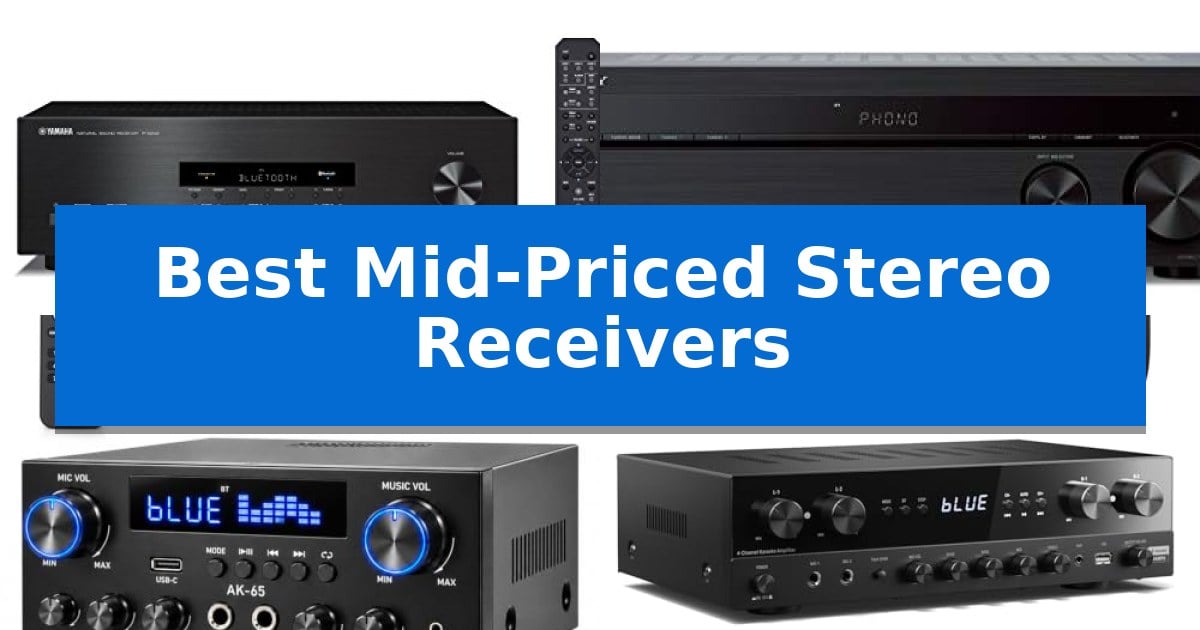
Selecting the right audio hub for your home system requires balancing power, connectivity, and long-term reliability. Whether you are building a dedicated vinyl listening station or looking to centralize your digital streaming, the Best Mid-Priced Stereo Receivers offer the essential circuitry to drive your speakers without the unnecessary complexity of high-end home theater units.
Our selection focuses on units that provide clean amplification and versatile input options for modern and classic sources. By prioritizing core audio performance and build quality, these receivers serve as the foundation for a balanced sound system that fits comfortably into your existing living space.
You may also want to compare Best Mid-Priced Speakers with Subwoofer, Best Mid-Priced Speaker System, and Best Mid-Priced Soundbars for TV.
Best Mid-Priced Stereo Receivers
Quick Comparison
| Product | Best For | Key Strength | Score |
|---|---|---|---|
| Yamaha R-S202BL Stereo Receiver | Best Overall | Bluetooth connectivity for wireless music streaming | 4.9 |
| Sony STRDH190 Stereo Receiver | Classic Phono Integration | Dedicated phono input for direct turntable integration | 4.4 |
| Joengoep AK65 Stereo Receiver | Versatile Digital Connectivity | Versatile connectivity including Optical, Coaxial, USB, and Bluetooth 5.0. | 4.5 |
| Donner MAMP5 Stereo Receiver | High-Power Karaoke Flexibility | 1000W peak power capacity for driving multiple speaker groups. | 4.6 |
| Pyle PDA29BU.5 Stereo Receiver | Compact Desktop Audio Solution | Compact dimensions suitable for small desks and tight spaces. | 4.6 |
How We Chose
- Input Versatility: Assessing the availability of dedicated phono stages, digital optical/coaxial inputs, and auxiliary connections.
- Amplification Stability: Evaluating the rated power output and the ability to drive standard 4-ohm to 16-ohm speaker loads.
- Wireless Integration: Checking for stable Bluetooth connectivity to support modern mobile streaming.
- Form Factor and Build: Considering the physical dimensions and chassis design for integration into standard AV furniture.
- Control Customization: Reviewing the presence of manual tone controls and remote functionality for daily usability.
1 Yamaha R-S202BL Stereo Receiver — Reliable Hi-Fi Audio Foundation
Achieving a balanced audio setup often begins with a reliable foundation, and the Yamaha R-S202BL Stereo Receiver provides a straightforward solution for those prioritizing core functionality. With its brushed aluminum finish and simplistic design, this unit integrates easily into existing home audio environments while offering the essential connectivity required for a modern stereo system.
The receiver features Bluetooth integration, allowing for wireless streaming from mobile devices to your preferred music services. For traditional sources, it includes 40 station FM/AM preset tuning, ensuring quick access to local broadcasts. The advanced circuitry design supports a wide frequency response of 10Hz – 100kHz, catering to a broad range of audio signals.
Versatility is a key aspect of this model, highlighted by a speaker selector for two systems, which allows users to switch between different sets of speakers or power two zones independently. The inclusion of a headphone terminal and a dedicated subwoofer output provides additional flexibility for those looking to expand their soundstage or enjoy private listening sessions.
Designed for efficiency, the Yamaha R-S202BL Stereo Receiver includes an auto power standby function to manage energy usage when the device is not in active use. Its compact dimensions of 17.125 inches in width and 5.5 inches in height make it suitable for standard shelving units, offering a functional, no-nonsense approach to stereo amplification.
Best for: Users seeking a reliable, entry-level stereo receiver with Bluetooth streaming and multi-speaker support for a home audio setup.
Skip if: Users who require advanced digital inputs like HDMI, optical, or coaxial connections for modern home theater integration.
PROS
- Bluetooth connectivity for wireless music streaming
- Speaker selector for managing two independent speaker systems
- Dedicated subwoofer output for enhanced low-frequency performance
- 40 station FM/AM preset tuning for radio access
CONS
- Lacks digital audio inputs such as optical or coaxial
- No HDMI connectivity for modern television integration
2 Sony STRDH190 Stereo Receiver — Classic Phono Integration
Achieving a balanced audio setup often begins with a reliable foundation, and the Sony STRDH190 Stereo Receiver provides a straightforward solution for those looking to integrate both modern digital streaming and classic analog sources. Designed with a low-profile chassis measuring just 5.25 inches in height, this unit fits comfortably into most standard AV cabinets while maintaining a clean, minimalist aesthetic.
At its core, the receiver delivers 100 watts per channel at 8 ohms, providing sufficient power for a variety of home speaker setups. A key feature for vinyl enthusiasts is the dedicated phono input, which allows for direct turntable connection without the need for an external preamp. For digital convenience, the built-in Bluetooth functionality enables wireless streaming from smartphones, tablets, or computers, making it easy to access modern music services.
Versatility is further enhanced by the ability to connect up to four speakers. The integrated A/B switching allows users to toggle between two sets of speakers or play them simultaneously in different zones. With four additional stereo RCA inputs and a 3.5mm front-panel jack, the receiver accommodates a wide range of legacy and modern audio equipment.
The internal architecture prioritizes signal clarity, utilizing a large-capacity power transformer designed to minimize interference. The inclusion of an FM tuner with 30 station presets and a full-size 1/4-inch headphone jack rounds out the feature set, ensuring that both speaker-based listening and private headphone sessions are well-supported.
Best for: This receiver is best for listeners who need a versatile, compact hub to bridge the gap between vinyl turntables, legacy analog components, and modern Bluetooth streaming.
Skip if: Skip this model if you require advanced features like HDMI switching, multi-channel surround sound processing, or network-based streaming apps.
PROS
- Dedicated phono input for direct turntable integration
- Bluetooth connectivity for wireless audio streaming
- A/B speaker switching for multi-zone or multi-speaker configurations
- Low-profile design fits easily into standard AV furniture
CONS
- Lacks HDMI inputs or outputs for video integration
- Limited to two-channel stereo output
3 Joengoep AK65 Stereo Receiver — Versatile Digital Connectivity
The Joengoep AK65 Stereo Receiver provides a versatile foundation for home audio setups by combining a 500W peak output with the efficient TPA3116D2 amplifier chip. This unit is engineered to drive a variety of passive speakers, ranging from 4Ω to 16Ω, making it suitable for bookshelf speakers or floor-standing towers.
Connectivity is a primary focus of this receiver, featuring Optical and Coaxial digital inputs for direct, lossless integration with TVs, gaming consoles, and Blu-ray players. For wireless convenience, it utilizes Bluetooth 5.0 technology with a transmission range of up to 64 feet, allowing for seamless streaming from mobile devices and laptops.
Beyond standard audio playback, the device includes dual microphone inputs with independent volume and echo controls, positioning it as a functional choice for karaoke or public announcements. A dedicated RCA subwoofer output allows users to expand their 2.0 system into a 2.1 configuration for enhanced low-frequency performance.
The design incorporates a dynamic LED spectrum display that provides real-time visual feedback, alongside physical knobs for bass, treble, and master volume adjustments. It includes a remote control for couch-side operation and supports a wide voltage range of 90–240V, ensuring compatibility across diverse power environments.
Best for: Users seeking a multi-functional, compact amplifier that bridges digital TV/gaming audio with traditional passive speaker setups and karaoke capabilities.
Skip if: Audiophiles requiring high-end discrete components or those needing multi-channel surround sound processing for complex home theater configurations.
PROS
- Versatile connectivity including Optical, Coaxial, USB, and Bluetooth 5.0.
- Dedicated subwoofer output for 2.1 channel audio expansion.
- Integrated karaoke features with dual mic inputs and echo control.
- Customizable sound via physical bass and treble adjustment knobs.
CONS
- Limited to 2.0/2.1 channel output, lacking support for surround sound formats.
- Physical footprint may be small, but requires external passive speakers to function.
4 Donner MAMP5 Stereo Receiver — High-Power Karaoke Flexibility
The Donner MAMP5 Stereo Receiver provides a robust 1000W peak power output, designed to drive up to four groups of eight speakers simultaneously. This unit serves as a versatile central hub for home audio setups, offering independent control over four channels to accommodate diverse speaker configurations ranging from 4 to 16 ohms.
Connectivity is a primary focus, featuring Bluetooth 5.3 for wireless streaming alongside Optical and Coaxial digital inputs for integration with modern smart TVs. While it lacks HDMI, the inclusion of dual 1/4'' microphone jacks with an integrated Talk Over function positions this receiver as a functional choice for karaoke or public speaking events where background music needs to be ducked for clarity.
Usability is managed through a multifunction remote that allows for granular adjustments to treble, midrange, and bass settings across all input modes. Users can also utilize the USB port to play media files, supporting up to 64G capacity, which adds a layer of flexibility for those who prefer local digital storage over streaming.
The physical design maintains a compact footprint at approximately 13.7 inches in length and 3.9 inches in height, making it suitable for standard media shelves. It is important to note that the system requires manual power management via the front-panel button to prevent potential humming noise, as the remote control does not fully cut the power supply.
Best for: Home users seeking a high-power, multi-channel amplifier with integrated karaoke features and diverse input options for legacy and digital audio sources.
Skip if: Users who require HDMI ARC/eARC connectivity for seamless TV audio integration or those who prefer a fully automated power-down sequence via remote control.
PROS
- 1000W peak power capacity for driving multiple speaker groups.
- Versatile input selection including Bluetooth 5.3, Optical, and Coaxial.
- Independent channel control and customizable EQ settings.
- Dual microphone inputs with Talk Over functionality for events.
CONS
- No HDMI input for modern television audio standards.
- Manual power management required at the unit to avoid humming.
- Remote control batteries are not included.
5 Pyle PDA29BU.5 Stereo Receiver — Compact Desktop Audio Solution
Managing audio inputs across multiple devices requires a versatile interface that balances power with a compact footprint. The Pyle PDA29BU.5 Stereo Receiver addresses this by integrating a 200-watt peak power amplifier into a chassis measuring just 7 by 6.2 inches, making it a practical choice for desktop or home audio setups where space is constrained.
This receiver provides extensive connectivity, featuring 5 distinct inputs including RCA, USB, SD card, and Bluetooth wireless streaming. The inclusion of dual 1/4-inch microphone inputs allows for vocal integration, while the built-in digital LED display provides clear feedback on input modes and track information. Users can adjust audio output via dedicated rotary knobs for bass, treble, and master volume, ensuring precise control over the sound profile.
Designed for flexibility, the system includes an FM radio antenna to improve signal sensitivity and a remote control for adjustments from a distance. With its 100-watt RMS continuous power rating, it is capable of driving two stereo speakers, providing a straightforward amplification solution for computer audio or small-scale home theater configurations.
The Pyle PDA29BU.5 Stereo Receiver offers a balance of modern wireless convenience and traditional wired inputs. Its small form factor and integrated controls simplify the management of various audio sources, from legacy CD players to modern smartphones, within a single, unified system.
Best for: This receiver is best for users needing a compact, multi-input amplifier for desktop audio, small home theater setups, or karaoke applications.
Skip if: Skip this model if you require high-fidelity audiophile-grade amplification, support for surround sound formats, or a high-wattage output for large-room speaker systems.
PROS
- Compact dimensions suitable for small desks and tight spaces.
- Versatile input options including Bluetooth, USB, SD, and RCA.
- Dedicated EQ controls for bass, treble, and microphone volume.
- Integrated LED display for easy input and track monitoring.
CONS
- Limited power output compared to full-sized home theater receivers.
- Basic feature set focused on stereo amplification rather than advanced surround sound processing.
Best Mid-Priced Stereo Receivers Buying Guide
Understanding Power Ratings
When evaluating receivers, pay close attention to the RMS power rather than just the peak power. RMS represents the continuous power the amplifier can deliver, which is a more accurate indicator of how the unit will perform during extended listening sessions.
Ensure the receiver's impedance rating matches your speakers. Most mid-priced models support a range of 4 to 16 ohms, but verifying this compatibility prevents overheating and ensures the amplifier can drive your specific speakers effectively.
Connectivity and Inputs
If you plan to use a turntable, a dedicated phono input is essential. This input includes the necessary pre-amplification to bring low-level signals from a record player up to line level, eliminating the need for an external preamp.
For digital sources like smart TVs or gaming consoles, look for optical or coaxial digital inputs. These connections provide a clean, noise-free signal path that preserves the audio quality of your digital media.
Speaker Switching and Zones
Many stereo receivers feature A/B speaker switching, which allows you to connect two pairs of speakers. This is useful if you want to route audio to different rooms or compare two sets of speakers without disconnecting wires.
Some models allow you to play both sets simultaneously, though you should verify that your receiver can handle the combined impedance load of two pairs of speakers running at the same time.
Tone Control and Customization
Physical knobs for bass and treble adjustment allow you to tailor the sound profile to your room's acoustics and your personal preferences. This manual control is often more intuitive than navigating through digital menus.
Additional features like loudness compensation or echo control can be beneficial for specific use cases, such as karaoke or low-volume listening, where you might want to boost specific frequencies to maintain clarity.
Physical Dimensions
Before purchasing, measure your intended shelf or cabinet space. While many modern receivers are designed with a low-profile chassis, others may be taller or deeper, requiring adequate clearance for ventilation.
Proper airflow is critical for the longevity of your receiver. Ensure there is at least a few inches of space around the top and sides of the unit to prevent heat buildup during operation.
Frequently Asked Questions
Do I need an external preamp if my receiver has a phono input?
No, a receiver with a dedicated phono input already includes the necessary circuitry to amplify the signal from a turntable.
Can I connect a subwoofer to a stereo receiver?
Many stereo receivers include a dedicated subwoofer output or a line-level output that can be used to connect an active powered subwoofer.
What is the benefit of Bluetooth 5.0 or 5.3 in a receiver?
These newer Bluetooth versions offer improved stability, faster pairing, and a longer transmission range compared to older versions.
Can I use 4-ohm speakers with these receivers?
Most of the receivers listed support a range of 4 to 16 ohms, but always check the specific manual to ensure your speaker impedance is within the supported range.
Is it better to use optical or RCA cables for a TV connection?
Optical cables provide a digital connection that is generally less susceptible to interference than analog RCA cables, making them ideal for connecting TVs.
Conclusion: Our Top Pick
For those seeking a balanced and reliable audio foundation, the Yamaha R-S202BL Stereo Receiver stands out for its straightforward design and focus on core hi-fi performance. Its advanced circuitry and support for two speaker systems make it a versatile choice for most home setups.
While it lacks some of the specialized digital inputs found on newer, multi-purpose amplifiers, its reliability and clean audio output provide a stable base for any stereo system. It is an excellent choice for listeners who prioritize sound quality and build integrity over complex digital features.