
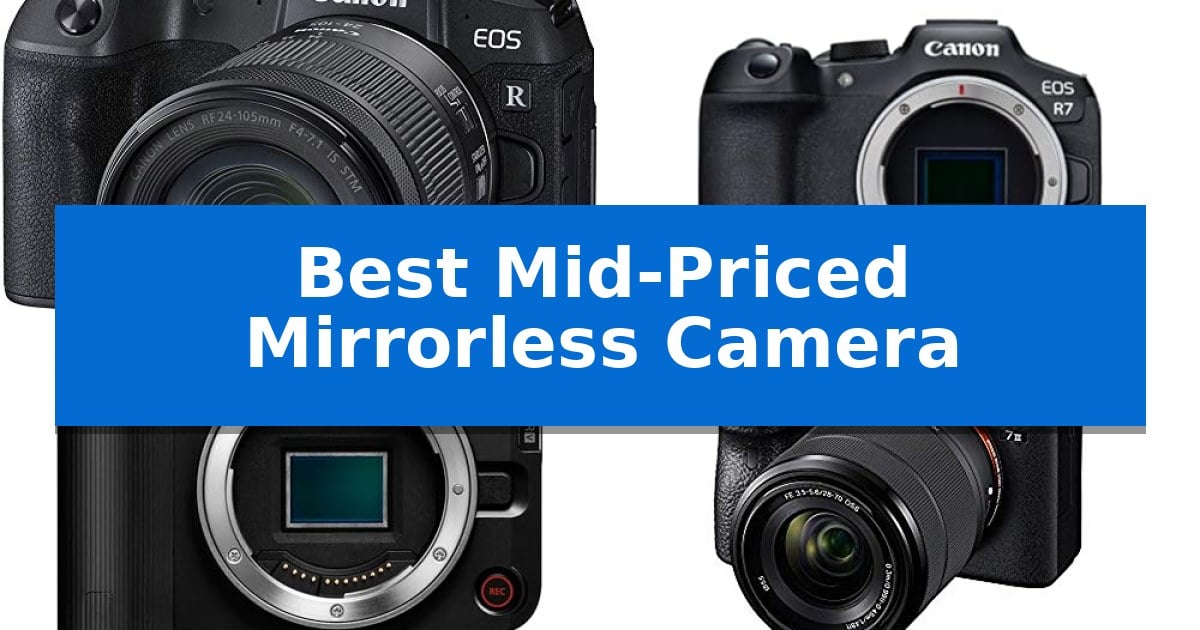
Choosing a new camera often feels like a compromise between professional-grade features and budget constraints. Whether you are upgrading from a smartphone or moving from an older DSLR, finding the Best Mid-Priced Mirrorless Camera requires balancing sensor performance, autofocus reliability, and lens ecosystem compatibility to ensure your investment serves your creative goals for years to come.
We have analyzed five distinct mirrorless options to help you navigate the current market. By focusing on sensor types, stabilization capabilities, and specific use cases like vlogging or action photography, this guide highlights the trade-offs inherent in each model. Read on to see which camera aligns best with your specific shooting style and technical requirements.
You may also want to compare Best Mid-Priced Microphone, Best Mid-Priced Lenovo Laptop, and Best Mid-Priced Laser Printers.
Best Mid-Priced Mirrorless Camera
Quick Comparison
| Product | Best For | Key Strength | Score |
|---|---|---|---|
| Canon EOS RP Mirrorless Camera | Best Overall | Compact and lightweight form factor ideal for travel. | 4.9 |
| Canon EOS R7 Mirrorless Camera | High-Speed APS-C Performance | High-speed performance with up to 30 fps electronic shutter. | 4.3 |
| Canon EOS R50 Mirrorless Camera | Streamlined Content Creation | Dedicated vertical video tripod mount for streamlined social media content creation. | 4.6 |
| Sony Alpha a7 III Mirrorless Camera | Versatile Full-Frame Standard | Advanced 24.2MP BSI full-frame sensor for high-resolution output. | 4.6 |
| Fujifilm X-E5 Mirrorless Camera | High-Resolution Compact Power | 40.2MP high-resolution sensor for detailed imaging. | 4.9 |
How We Chose
- Sensor Format and Resolution: Comparing full-frame versus APS-C sensors to balance image quality and telephoto reach.
- Autofocus Performance: Assessing the sophistication of tracking systems for subjects like people, animals, and vehicles.
- Stabilization Capabilities: Evaluating in-body image stabilization (IBIS) for handheld shooting and video stability.
- Video Features: Identifying cameras with high-resolution recording, frame rate flexibility, and vlogging-specific interfaces.
- Portability and Ergonomics: Considering the physical footprint, weight, and button layout for travel and extended use.
1 Canon EOS RP Mirrorless Camera — Accessible Full-Frame Entry
Stepping into the world of full-frame photography often involves balancing high-end image quality with portability, a challenge the Canon EOS RP Mirrorless Camera addresses through its compact, lightweight design. This camera serves as an accessible entry point for those looking to transition from smaller sensors without the bulk typically associated with professional-grade bodies.
The included RF24-105mm lens provides a versatile zoom range, making it a practical choice for travel and general photography. To assist with handheld stability, the system features Optical Image Stabilization capable of up to 5 stops of shake correction, which helps maintain clarity in varying conditions.
Beyond traditional photography, the device adapts to modern workflows by offering 4K UHD 2160p video capture. Users can also leverage the EOS Utility Webcam Beta Software or a clean HDMI output to transform the camera into a high-quality webcam, adding utility for content creators and remote professionals.
For those interested in close-up work, the lens offers a maximum magnification of 0.4x with a minimum focusing distance of 0.66 feet in auto focus. When utilizing the Center Focus Macro mode, magnification increases to 0.5x with a minimum focusing distance of 0.43 feet, providing flexibility for detailed subjects.
Best for: Travelers and vloggers seeking a lightweight, full-frame camera that doubles as a high-quality webcam.
Skip if: Users who require professional-grade, high-speed burst performance or specialized cinema-focused video features.
PROS
- Compact and lightweight form factor ideal for travel.
- Versatile RF24-105mm lens included for varied shooting scenarios.
- Optical Image Stabilization provides up to 5 stops of shake correction.
- Integrated webcam functionality via EOS Utility software.
CONS
- Limited macro capabilities compared to dedicated macro lenses.
- 4K video capture may have specific limitations compared to higher-tier cinema cameras.
2 Canon EOS R7 Mirrorless Camera — High-Speed APS-C Performance
The Canon EOS R7 Mirrorless Camera provides a high-speed shooting experience for photographers who need to capture fast-moving subjects with precision. Featuring a 32.5-megapixel APS-C CMOS sensor, this camera is engineered for significant telephoto reach, making it a capable tool for sports, wildlife, and action photography.
Performance is driven by the Dual Pixel CMOS AF system, which utilizes approximately 100% of the sensor area with up to 651 autofocus zones. This technology ensures consistent subject detection and tracking, whether you are shooting stills or recording video. For action, the camera supports a 15 fps mechanical shutter and a 30 fps electronic shutter, alongside a RAW Burst Mode that includes a 1/2-second pre-shooting buffer to help secure the perfect frame.
Stability is managed through a 5-Axis In-body Image Stabilization (IBIS) system, which integrates with lens-based stabilization to reduce shake during handheld use. This is particularly useful for low-light conditions or when using long telephoto lenses. For content creators, the 4K video capabilities are bolstered by Movie Servo AF, allowing for professional-grade subject tracking during recording sessions that exceed 30 minutes.
Designed for portability, the camera maintains a compact and lightweight form factor while incorporating a firm, ergonomic grip. The inclusion of an extra LP-E6NH battery pack supports extended field use, ensuring the device remains ready for long vlogging or shooting sessions without frequent power interruptions.
Best for: Photographers and content creators who require high-speed continuous shooting and advanced autofocus for sports, wildlife, or action-oriented video production.
Skip if: Users who prefer a full-frame sensor for specific wide-angle depth-of-field requirements or those who do not require high-speed burst capabilities.
PROS
- High-speed performance with up to 30 fps electronic shutter.
- Advanced Dual Pixel CMOS AF covering 100% of the sensor area.
- 5-Axis In-body Image Stabilization for steady handheld capture.
- Extended recording time exceeding 30 minutes for video projects.
CONS
- APS-C sensor format may not meet the needs of users specifically seeking full-frame aesthetic characteristics.
3 Canon EOS R50 Mirrorless Camera — Streamlined Content Creation
The Canon EOS R50 Mirrorless Camera introduces a specialized workflow for creators as the first model in the EOS V series to feature a dedicated Vertical Video tripod mount and a front-facing record button. This design choice prioritizes rapid content production, allowing users to transition seamlessly between horizontal and vertical shooting orientations without complex rigging.
Equipped with a 24.2 MP APS-C CMOS Image Sensor and the DIGIC X Image Processor, this camera supports versatile recording formats including 4K 59.94p crop and 4K 29.97p full-width video. The inclusion of a Slow and Fast mode provides direct control over frame rates, enabling creative playback speed adjustments directly within the camera interface.
Autofocus performance is driven by Dual Pixel CMOS AF II technology, which utilizes advanced subject detection. This system is capable of tracking people, animals, and vehicles, with a specific Register People Priority feature to maintain focus on primary subjects during dynamic recording sessions.
Designed for portability and ease of use, the unit weighs 2.12 pounds and maintains a compact form factor suitable for handheld vlogging or live streaming setups. The interface has been specifically redesigned to cater to content creators, streamlining access to essential video settings and recording controls.
Best for: Content creators and vloggers who require a dedicated, compact camera for high-quality vertical and horizontal video production.
Skip if: Photographers seeking a full-frame sensor or those who require advanced professional-grade ports and weather-sealed construction will find this entry-level APS-C model limiting.
PROS
- Dedicated vertical video tripod mount for streamlined social media content creation.
- Dual Pixel CMOS AF II with intelligent subject detection for reliable focus tracking.
- Front Record button and redesigned interface tailored for solo creators.
- Slow and Fast mode for creative in-camera frame rate control.
CONS
- 4K 59.94p recording is limited to a cropped sensor area, reducing the field of view.
- Body-only configuration requires separate investment in compatible RF-S or RF lenses.
4 Sony Alpha a7 III Mirrorless Camera — Versatile Full-Frame Standard
The Sony Alpha a7 III Mirrorless Camera provides a versatile foundation for photographers through its 24.2MP Back-Illuminated 35mm Full-frame Image Sensor, which utilizes a 1.8X readout speed to capture detailed imagery. This sensor architecture, paired with the Exmor R CMOS design, supports a broad ISO range of 50 to 204,800 and a 15-stop dynamic range, offering significant flexibility when shooting in varying lighting conditions.
Precision in focus is managed by a sophisticated system featuring 693 phase-detection and 425 contrast AF points, covering 93% of the image area. This density of focus points allows for reliable subject tracking, complemented by the ability to shoot at up to 10fps using either the silent or mechanical shutter. These capabilities ensure that the camera remains responsive during fast-paced shooting scenarios.
Designed for practical use, the system includes the SEL2870 lens in the box, providing a standard zoom range for immediate utility. The body features a 3-inch LCD for composition and review, while the included NP-FZ100 rechargeable battery supports extended sessions. The camera also offers 14-bit uncompressed RAW output, preserving maximum data for post-processing workflows.
While this model is a robust tool for full-frame imaging, its physical footprint—weighing 1.75 pounds—reflects its substantial sensor and internal hardware. Users should consider that the Sony Alpha a7 III Mirrorless Camera is built for those prioritizing sensor performance and autofocus precision, which necessitates a larger body than compact or APS-C alternatives.
Best for: Photographers who require a high-performance, full-frame sensor and advanced autofocus tracking for versatile shooting environments.
Skip if: Users seeking an ultra-compact or lightweight camera body for casual travel will find the full-frame dimensions and weight of this system less portable.
PROS
- Advanced 24.2MP BSI full-frame sensor for high-resolution output.
- Extensive 693-point phase-detection autofocus system for precise tracking.
- 15-stop dynamic range provides excellent flexibility in high-contrast scenes.
- 10fps continuous shooting capability with AE/AF tracking.
CONS
- Larger physical footprint compared to smaller sensor formats.
- Weight of 1.75 pounds may be noticeable during long handheld sessions.
5 Fujifilm X-E5 Mirrorless Camera — High-Resolution Compact Power
The Fujifilm X-E5 Mirrorless Camera distinguishes itself with a high-resolution 40.2MP APS-C X-Trans CMOS 5 HR sensor, providing significant detail for photographers who require sharp, professional-grade imagery in a compact form factor. This device is engineered for versatility, pairing its advanced sensor with the X-Processor 5 to ensure responsive operation and high-quality output across a wide range of lighting conditions.
Designed for both still photography and videography, the camera supports 6.2K video capture at 29.97 fps and 4K at 59.94 fps, reaching bitrates of up to 200 Mb/s. The inclusion of a 7-stop in-body image stabilization system is a critical feature, as it compensates for camera shake to maintain clarity during handheld shooting or when working in challenging light.
Focus accuracy is managed by a 425-point hybrid AF system that utilizes AI-powered subject detection to track subjects with precision. This makes the camera well-suited for dynamic environments where maintaining focus on moving targets is essential. The system is designed to provide reliable performance, allowing users to concentrate on composition rather than manual adjustments.
This curated bundle includes the XF 23mm f/2.8 lens, a 64GB SD card, a cleaning kit, and a blower, offering a foundational set of tools for immediate use. Users should note that while this package covers essential accessories, it is not an all-inclusive solution, and additional specialized equipment may be required depending on the specific shooting requirements.
Best for: Photographers and videographers seeking a high-resolution, stabilized system in a compact, portable body.
Skip if: Users who require a complete, all-in-one professional production kit, as this bundle is a curated selection that may necessitate further accessory purchases.
PROS
- 40.2MP high-resolution sensor for detailed imaging.
- 7-stop in-body image stabilization for handheld clarity.
- AI-powered subject detection for precise autofocus.
- 6.2K professional video recording capabilities.
CONS
- Not a complete, all-in-one solution for every professional requirement.
- Additional accessories may be needed based on specific workflows.
Best Mid-Priced Mirrorless Camera Buying Guide
Understanding Sensor Formats
The choice between full-frame and APS-C sensors is the most significant decision when selecting a camera. Full-frame sensors generally offer superior low-light performance and shallower depth of field, which is ideal for portraiture and artistic photography.
Conversely, APS-C sensors provide a 'crop factor' that effectively increases the reach of your lenses. This makes them a popular choice for wildlife and sports photographers who need extra magnification without the bulk of massive telephoto glass.
The Importance of Autofocus Systems
Modern mirrorless cameras rely heavily on Dual Pixel CMOS AF or similar hybrid systems. These technologies use pixels on the imaging sensor itself to detect focus, providing near-instant subject tracking across almost the entire frame.
Look for systems that include AI-powered subject detection. This feature automatically identifies eyes, faces, animals, or vehicles, allowing you to focus on composition rather than manually adjusting your focus point during fast-paced action.
Stabilization and Handheld Shooting
In-body image stabilization (IBIS) is a critical feature for those who shoot without a tripod. By compensating for camera shake, IBIS allows for slower shutter speeds and smoother video footage, even when using lenses that lack their own optical stabilization.
When evaluating stabilization, check the 'stops' of correction provided. A higher number of stops indicates better performance in dim lighting, where you might otherwise need to increase your ISO and introduce digital noise.
Video and Vlogging Considerations
If your primary goal is content creation, prioritize cameras with 4K video recording and dedicated vlogging features. Look for models that include a vertical video tripod mount or a front-facing record button, as these simplify the workflow for social media platforms.
Additionally, verify the camera's ability to act as a high-quality webcam via clean HDMI output or dedicated software. This versatility ensures your camera remains useful even when you are not actively out in the field.
Lens Ecosystem and Compatibility
A camera body is only as good as the glass attached to it. Before purchasing, research the available RF or X-mount lenses for your chosen system. A robust selection of native lenses ensures you can expand your kit as your skills grow.
Consider the versatile zoom range of kit lenses, which often provide the best starting point for beginners. If you have existing lenses from a previous system, check if an adapter is available to maintain compatibility with your new mirrorless body.
Frequently Asked Questions
What is the main advantage of a mirrorless camera over a DSLR?
Mirrorless cameras are generally more compact and lightweight because they lack the complex mirror mechanism of a DSLR. They also offer advanced electronic viewfinders that show you exactly how your exposure will look before you take the shot.
Do I need a full-frame camera for professional results?
Not necessarily. While full-frame sensors excel in low light, modern APS-C sensors are highly capable and offer significant advantages in size, weight, and telephoto reach for sports or wildlife photography.
Can I use my old lenses on a new mirrorless camera?
Often, yes. Many manufacturers offer mount adapters that allow you to use older DSLR lenses on their new mirrorless bodies, though you should check specific compatibility for autofocus and stabilization features.
What does 'IBIS' mean in camera specifications?
IBIS stands for In-Body Image Stabilization. It is a system inside the camera body that physically moves the sensor to counteract camera shake, resulting in sharper handheld photos and smoother video.
Are these cameras suitable for beginners?
Yes, many of these models feature intuitive user interfaces and automated modes that make them accessible to beginners, while still offering the manual controls that advanced photographers require.
Conclusion: Our Top Pick
For those seeking the best balance of performance and accessibility, the Canon EOS RP Mirrorless Camera stands out as a premier choice. Its full-frame sensor delivers high-quality imagery in a remarkably compact and lightweight body, making it an excellent companion for both travel and daily content creation.
While other models in this list offer specialized features like higher frame rates or APS-C specific benefits, the overall versatility and ease of use provided by the Canon system make it our top recommendation. It provides a solid foundation for photographers looking to step into the world of full-frame mirrorless technology without the complexity or weight of larger professional systems.