
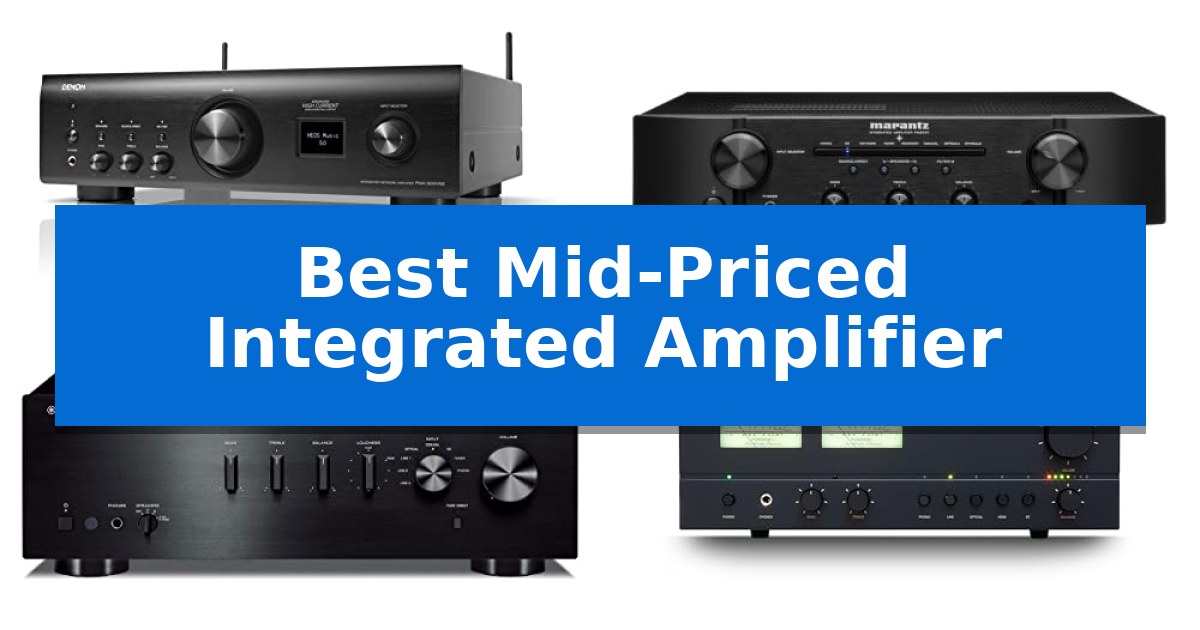
Finding the right balance between power, clarity, and connectivity is essential when building a high-fidelity sound system. A Best Mid-Priced Integrated Amplifier serves as the heart of your audio chain, bridging the gap between your analog sources and modern digital streaming needs without requiring a massive investment.
Whether you are looking to drive demanding floor-standing speakers or seeking a refined, musical experience for your vinyl collection, the current market offers versatile solutions. We have analyzed the latest models to help you navigate the trade-offs between classic analog warmth and modern digital convenience, ensuring you find an amplifier that fits your specific listening habits.
You may also want to compare Best Mid-Priced In-Ear Headphones, Best Mid-Priced HP Laptop, and Best Mid-Priced Home Theater Systems.
Best Mid-Priced Integrated Amplifier
Quick Comparison
| Product | Best For | Key Strength | Score |
|---|---|---|---|
| Denon PMA-900HNE Integrated Amplifier | Best Overall | Advanced High-Current circuit provides 85W per channel for powerful speaker driving. | 4.9 |
| Marantz PM6007 Integrated Amplifier | Refined Sound for Analog Enthusiasts | Advanced HDAM-SA3 circuitry for improved dynamic range. | 4.3 |
| Yamaha A-S301 Integrated Amplifier | Reliable Entry into Hi-Fi | Integrated digital inputs (coax and optical) for modern source compatibility. | 4.8 |
| NAD C3030 Integrated Amplifier | Classic Design with Modern Digital | HybridDigital amplification provides high-current power with low distortion. | 4.8 |
| Juson Audio PA2 Tube Amplifier | Warmth of Vacuum Tube Sound | Switchable triode and ultralinear modes for customizable sound profiles. | 4.7 |
How We Chose
- Power output and speaker compatibility for various impedance ratings.
- Connectivity options including phono stages, digital inputs, and wireless streaming protocols.
- Build quality and internal circuitry design for signal purity.
- Ease of use, including remote control functionality and voice assistant integration.
- Versatility for multi-room audio or home theater system expansion.
1 Denon PMA-900HNE Integrated Amplifier — Best for Multi-Room Streaming
Integrating high-fidelity audio with modern streaming convenience, the Denon PMA-900HNE Integrated Stereo Amplifier features an Advanced High-Current (AHC) single push-pull circuit that delivers 85W per channel. This design choice enables the unit to drive demanding speakers while maintaining detailed imaging and impactful bass response, making it a versatile hub for both analog and digital music collections.
Beyond its amplification capabilities, the unit serves as a comprehensive streaming solution through built-in HEOS technology. This allows for seamless multi-room audio distribution and direct access to popular streaming services via Wi-Fi, Bluetooth, or AirPlay 2. Users can manage playback and volume hands-free using voice commands through Alexa, Siri, or Google Assistant, simplifying control in a modern home theater setup.
The amplifier is equipped with a dedicated MM/MC phono equalizer, catering to vinyl enthusiasts who require precise cartridge support. Its connectivity suite includes three optical inputs and one coaxial input, ensuring compatibility with CD players, Blu-Ray decks, and television audio. For those with extensive digital libraries, the device supports high-resolution formats including ALAC, FLAC HD, and DSD via USB or network connections.
Measuring 17.1 inches in length and 5.1 inches in height, the Denon PMA-900HNE Integrated Stereo Amplifier balances a compact footprint with robust build quality. While it offers extensive digital flexibility, it remains a traditional two-channel integrated amplifier at its core, prioritizing audio purity and versatile input options for diverse home audio environments.
Best for: Audiophiles who need a single device that bridges the gap between high-resolution digital streaming and traditional analog vinyl playback.
Skip if: Users who require a multi-channel surround sound processor for a complex home theater setup will find this two-channel amplifier insufficient for their needs.
PROS
- Advanced High-Current circuit provides 85W per channel for powerful speaker driving.
- Built-in HEOS and AirPlay 2 enable seamless multi-room wireless streaming.
- Dedicated MM/MC phono input allows for direct turntable connection without an external preamp.
- High-resolution audio support for formats like DSD and FLAC HD.
CONS
- Two-channel limitation prevents use in multi-speaker surround sound home theater configurations.
2 Marantz PM6007 Integrated Amplifier — Refined Sound for Analog Enthusiasts
Achieving a balanced hi-fi foundation requires an amplifier that prioritizes signal purity and versatile connectivity without occupying excessive shelf space. The Marantz PM6007 Integrated Amplifier addresses this with a slim, 4.13-inch high profile that houses a high-current power supply capable of driving demanding speakers with precision and energy.
At the core of its performance is the proprietary HDAM-SA3 circuitry, which replaces standard op-amps to provide a wider dynamic range and reduced distortion. This is complemented by a reference-class AK4490 DAC, supporting high-resolution audio up to 192-kHz/24-bit. These components ensure that digital sources, connected via the two optical or single coaxial inputs, are rendered with clarity and detail.
Vinyl enthusiasts are well-catered to by the integrated MM phono stage, which utilizes FET circuitry to minimize noise and simplify the signal path. For broader system integration, the unit offers five analog inputs, a subwoofer output, and speaker A/B switching, allowing for flexible configuration in various listening environments.
Tuned by the Marantz Sound Master, the Marantz PM6007 Integrated Amplifier is engineered to deliver a consistent, musical output. With its gold-plated terminals and robust thermal compensation, it serves as a reliable, refined hub for those looking to elevate their 2-channel audio experience.
Best for: Audiophiles and vinyl enthusiasts seeking a compact, high-fidelity hub for both digital and analog sources.
Skip if: Users requiring multi-channel surround sound processing or integrated wireless streaming capabilities will need a different type of receiver.
PROS
- Advanced HDAM-SA3 circuitry for improved dynamic range.
- Integrated MM phono stage with low-noise FET input.
- High-resolution AK4490 DAC for digital source fidelity.
- Slimline design fits easily into compact audio racks.
CONS
- No built-in wireless streaming or network connectivity.
- Limited to 2-channel stereo output configurations.
3 Yamaha A-S301 Integrated Amplifier — Reliable Entry into Hi-Fi
The Yamaha Audio A-S301BL Natural Sound Integrated Stereo Amplifier serves as a foundational component for home audio setups by offering versatile connectivity options, including both digital coax and Toslink optical inputs. This design choice allows users to integrate modern digital sources, such as televisions or streaming devices, directly into a traditional stereo system without requiring external digital-to-analog converters.
Beyond its digital capabilities, the unit maintains a classic approach to audio routing with multiple analog inputs including a dedicated phono stage. This inclusion provides a straightforward path for connecting turntables alongside other line-level audio equipment. The amplifier is built with a substantial package weight of 21.0 lbs, reflecting its robust construction and internal power management components.
Usability is enhanced through flexible output configurations, featuring support for Speakers A, B, or A plus B setups. This functionality enables users to drive two sets of speakers simultaneously or switch between them depending on the listening environment. Additionally, the inclusion of a subwoofer output allows for easier integration of low-frequency reinforcement, providing a path for users to expand their soundstage.
Measuring 17.125 inches in length and 15.25 inches in width, the Yamaha A-S301 Integrated Amplifier occupies a standard footprint suitable for most equipment racks. While it provides a comprehensive set of inputs and outputs for a mid-priced integrated amplifier, users should ensure their specific speaker impedance and power requirements align with the unit's specifications to maintain optimal performance.
Best for: Audiophiles seeking a reliable, versatile integrated amplifier that bridges the gap between legacy analog equipment and modern digital audio sources.
Skip if: Users requiring high-power output for extremely demanding speaker loads or those who need integrated wireless streaming capabilities will need to look elsewhere.
PROS
- Integrated digital inputs (coax and optical) for modern source compatibility.
- Dedicated phono input for direct turntable connection.
- Speaker A/B switching and dedicated subwoofer output for flexible system configuration.
CONS
- No built-in wireless streaming or Bluetooth connectivity.
- Substantial physical footprint and weight may limit placement options in smaller spaces.
4 NAD C3030 Integrated Amplifier — Classic Design with Modern Digital
The NAD C3030 Integrated Amplifier bridges the gap between traditional high-fidelity audio and modern digital convenience through its HybridDigital amplification design. By delivering 50W per channel into 8Ω with significant dynamic headroom, this unit provides the necessary power to drive a wide range of speakers with consistent accuracy and low distortion.
Designed for versatility, the amplifier incorporates a Texas Instruments PCM5242 DAC to handle digital sources, while analog enthusiasts are supported by a dedicated MM phono stage featuring precise RIAA equalization. The inclusion of HDMI eARC and Bluetooth aptX HD ensures that both television audio and wireless streaming are integrated seamlessly into the high-fidelity signal path.
The physical construction emphasizes both utility and aesthetic appeal. The dual illuminated VU meters provide real-time visual feedback of music dynamics, housed in a compact chassis that fits easily into standard media units. Practical additions like a bass-managed subwoofer output and a dedicated front-panel headphone output offer flexible configuration options for various listening environments.
This amplifier serves as a comprehensive hub for a modern stereo system, balancing the requirements of legacy vinyl playback with current digital connectivity standards. Its custom-designed power supply ensures a noise-free foundation, making it a reliable choice for those seeking a clean, detailed sound profile in a mid-priced package.
Best for: Audiophiles who need a versatile hub that balances high-quality analog phono playback with modern digital inputs like HDMI eARC and Bluetooth.
Skip if: Users who require multi-channel surround sound processing or significantly higher wattage for driving large, power-hungry floor-standing speakers.
PROS
- HybridDigital amplification provides high-current power with low distortion.
- Comprehensive connectivity including HDMI eARC, Bluetooth aptX HD, and MM phono stage.
- Dual VU meters offer authentic retro aesthetic and visual dynamics feedback.
- Compact chassis design allows for easy integration into existing media furniture.
CONS
- Fixed 50W per channel output may limit performance with very demanding speaker loads.
- Stereo-only configuration lacks support for multi-channel home theater setups.
5 Juson Audio PA2 Tube Amplifier — Warmth of Vacuum Tube Sound
Achieving a rich, authentic sound profile in a home audio system often requires the specific harmonic characteristics provided by vacuum tubes. The Juson Audio PA2 Tube Amplifier distinguishes itself by offering a versatile push-pull Class AB design, which balances high-efficiency power delivery with the warm, detailed sonic signature sought after by audiophiles.
This integrated amplifier is built around a premium vacuum tube configuration, utilizing 4pcs EL34, 2pcs 4JD6, and 2pcs 4BE7 tubes. Users can tailor their listening experience by switching between triode mode, which emphasizes a smooth, vintage tonality, and ultralinear mode, which provides tighter bass response and increased power for more demanding audio passages.
Beyond its primary speaker amplification capabilities, the unit features a dedicated vacuum tube headphone output. This allows for a high-fidelity personal listening experience, specifically optimized to drive high-impedance headphones with the same lush, tube-amplified quality found in its main stage performance.
Integration into a modern hi-fi setup is straightforward thanks to the 3-way line level input system. This allows for the simultaneous connection of multiple sources, such as turntables—when paired with an external phono stage—streamers, or CD players, making it a central hub for diverse analog and digital audio collections.
Best for: Audiophiles seeking a versatile, tube-based amplification solution that supports both high-impedance headphones and traditional speaker setups.
Skip if: Users who require built-in phono preamplification or digital-to-analog conversion (DAC) capabilities will need to add external components to complete their signal chain.
PROS
- Switchable triode and ultralinear modes for customizable sound profiles.
- Dedicated vacuum tube headphone output for high-fidelity personal listening.
- Push-pull Class AB design providing a balance of power and clarity.
- 3-way line level inputs for flexible source connectivity.
CONS
- No integrated phono stage for direct turntable connection.
- Vacuum tube maintenance required over time compared to solid-state alternatives.
Best Mid-Priced Integrated Amplifier Buying Guide
Understanding Power and Speaker Matching
The power rating, measured in watts per channel, determines how well an amplifier can drive your speakers. It is important to match the amplifier's output with your speakers' sensitivity and impedance to ensure clean sound without distortion.
Look for high-current designs if you have speakers that dip to low impedance levels. A robust power supply is often more indicative of true performance than raw wattage numbers alone.
Analog vs. Digital Connectivity
Modern integrated amplifiers often bridge the gap between legacy analog gear and digital sources. If you use a turntable, ensure the unit has a dedicated, high-quality phono stage for moving magnet or moving coil cartridges.
For digital users, built-in DACs and wireless options like Bluetooth, AirPlay, or network streaming services provide significant convenience. Check for optical or coaxial inputs if you plan to connect a CD player or TV audio directly.
The Role of Circuitry and Build
Internal components, such as discrete amplifier modules or specialized DAC chips, directly impact the sound signature. Some manufacturers prioritize a 'musical' or warm sound, while others focus on clinical accuracy and detail.
Consider the chassis design and build quality as well. A well-shielded, rigid enclosure helps minimize interference and vibration, which can improve the overall signal-to-noise ratio.
Multi-Room and Smart Features
If you want a cohesive home audio experience, look for platforms like HEOS or similar multi-room streaming capabilities. These systems allow you to synchronize music across different rooms or control your entire setup via a smartphone app.
Voice control integration via Alexa or Google Assistant adds another layer of convenience, allowing you to change tracks or adjust volume hands-free.
Space and Ergonomics
Integrated amplifiers come in various sizes, from slimline models that fit on crowded shelves to larger, full-sized units. Measure your available space and ensure there is enough clearance for ventilation to prevent overheating.
Consider the layout of the front panel and the quality of the remote control. A logical interface and responsive controls make daily operation much more enjoyable.
Frequently Asked Questions
What is the main advantage of an integrated amplifier?
An integrated amplifier combines a pre-amplifier and a power amplifier into a single chassis, saving space and reducing the need for multiple interconnect cables.
Do I need a separate phono preamp?
Many modern integrated amplifiers include a built-in phono stage, so you can connect your turntable directly. If your amplifier lacks one, you would need an external phono preamp.
Can I use an integrated amplifier with my TV?
Yes, if the amplifier has optical, coaxial, or HDMI inputs, you can connect your TV to enjoy better sound quality through your stereo speakers.
What does 'high-current' mean in an amplifier?
High-current design allows the amplifier to provide the necessary power to drive speakers that have difficult or fluctuating impedance loads, ensuring consistent performance.
Is wireless streaming quality as good as wired?
While wired connections are generally considered the gold standard for fidelity, modern wireless protocols like AirPlay 2 and high-bitrate Bluetooth offer excellent quality that is sufficient for most listeners.
Conclusion: Our Top Pick
Selecting the right amplifier depends on your specific source material and speaker requirements. For those seeking a versatile, modern solution that handles both streaming and traditional analog sources with ease, the Denon PMA-900HNE Integrated Amplifier stands out as a highly capable choice.
Its combination of robust power, built-in HEOS streaming, and dedicated phono inputs makes it a flexible foundation for a wide variety of home audio systems. While other models may offer more specialized analog-only performance or different aesthetic designs, the Denon provides a comprehensive feature set that addresses the needs of most contemporary listeners.