
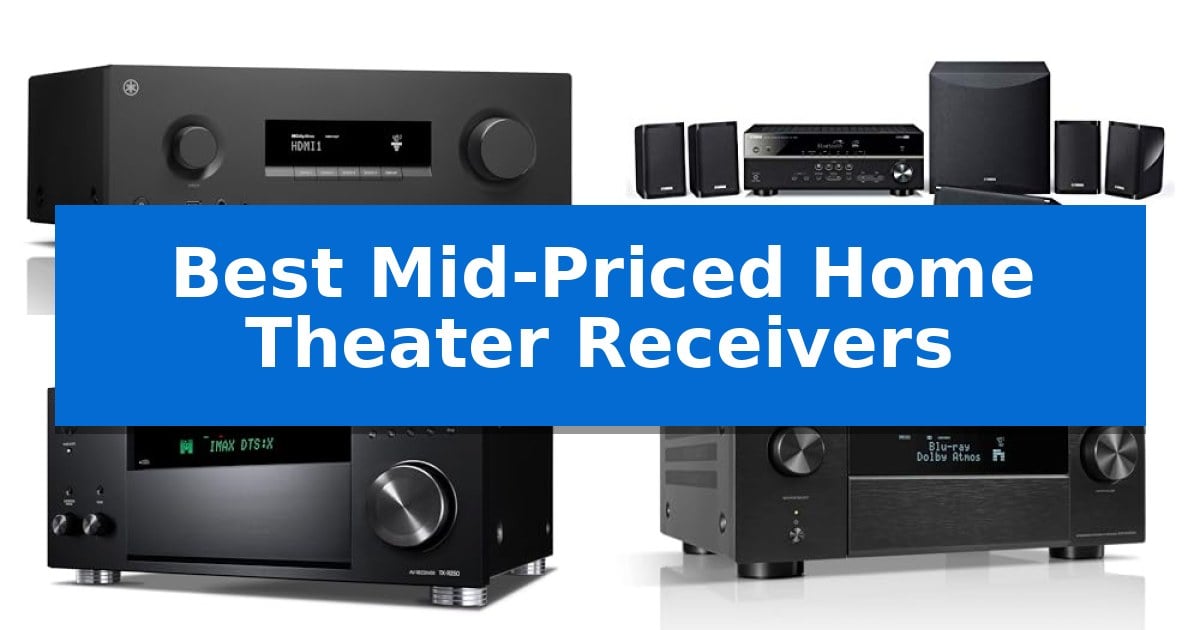
Finding the right balance between advanced features and cost is essential when building a modern entertainment space. The Best Mid-Priced Home Theater Receivers offer the core functionality needed for high-definition video and immersive audio without the premium price tag of flagship models.
Whether you are upgrading your gaming setup with 8K support or looking to expand your surround sound capabilities, selecting the right unit depends on your specific speaker layout and source device compatibility. We have analyzed the latest options to help you identify which receiver aligns with your home theater goals.
You may also want to compare Best Mid-Priced Home Theater Projector, Best Mid-Priced Home Speakers, and Best Mid-Priced HD TV.
Best Mid-Priced Home Theater Receivers
Quick Comparison
| Product | Best For | Key Strength | Score |
|---|---|---|---|
| Yamaha RX300A AV Receiver | Best Overall | Advanced video support including 4K120 and 8K60 for high-performance gaming. | 4.9 |
| Yamaha YHT-4950U Home Theater System | Complete All-in-One Surround Solution | Complete all-in-one package including receiver, five speakers, and subwoofer. | 4.3 |
| Onkyo TX-RZ50 AV Receiver | Advanced Dirac Live Room Correction | Dirac Live Room Correction for advanced acoustic optimization. | 4.4 |
| Denon AVR-X4800H AV Receiver | High-End Multi-Room Audio Support | 9.4-channel amplification with 125W per channel for large-scale audio. | 4.8 |
| SOBATTY 7.1-Channel AV Receiver | Budget-Friendly 7.1 Surround Sound | High-end audio decoding for uncompressed 7.1-channel surround sound. | 4.5 |
How We Chose
- Video connectivity standards including 8K and 4K/120Hz support for gaming consoles.
- Audio processing formats such as Dolby Atmos and DTS:X for immersive soundscapes.
- Room correction technology to optimize audio output based on specific room acoustics.
- Input and output flexibility for connecting multiple media players, turntables, and displays.
- Ease of setup and user interface accessibility for daily operation.
1 Yamaha RX300A AV Receiver — Modern 8K Gaming Features
The Yamaha RX300A AV Receiver provides a modern foundation for home entertainment by integrating 4K120 and 8K60 video support alongside advanced gaming features like ALLM and VRR. This 5.2-channel unit is designed to handle high-bandwidth signals, making it a suitable choice for users looking to connect next-generation gaming consoles and high-definition displays through a single, streamlined hub.
Beyond its visual capabilities, the receiver delivers 70W of authoritative power and supports immersive audio formats including Dolby Atmos and DTS Virtual:X. The inclusion of an included setup microphone allows the system to perform automatic room correction, adjusting output based on your specific acoustic environment and speaker characteristics to maintain sound clarity.
Usability is a core focus, evidenced by the Bluetooth Multipoint functionality, which enables pairing with two source devices for quick switching between audio streams. The interface is managed through an intuitive Quick Guide and an on-screen settings menu, while the Scene buttons provide a shortcut for users to save and recall up to four custom audio presets for different types of content.
Connectivity remains a priority with HDMI eARC/ARC support, simplifying the connection between the receiver and your television. The Yamaha RX300A AV Receiver balances these technical specifications with a compact footprint, measuring approximately 17.125 inches in width, ensuring it fits into most standard media cabinets while maintaining the necessary airflow for operation.
Best for: Users seeking a mid-priced receiver that supports modern 8K/120Hz gaming standards and immersive Dolby Atmos audio in a 5.2-channel configuration.
Skip if: Users requiring more than five channels of amplification or those with complex multi-room audio needs beyond a standard home theater setup.
PROS
- Advanced video support including 4K120 and 8K60 for high-performance gaming.
- Automatic room correction via the included setup microphone.
- Bluetooth Multipoint for seamless switching between two audio source devices.
- Customizable Scene buttons for quick access to preferred audio settings.
CONS
- 5.2-channel limitation restricts expansion to more complex surround sound configurations.
- 70W power output may be insufficient for driving very large or low-sensitivity speakers in expansive rooms.
2 Yamaha YHT-4950U Home Theater System — Complete All-in-One Surround Solution
The Yamaha Audio YHT-4950U 4K Ultra HD 5.1-Channel Home Theater System provides a comprehensive audio solution by bundling an AV receiver with five speakers and a dedicated subwoofer in one package. This system is designed for users seeking a straightforward setup that includes essential components for surround sound without requiring separate component matching.
Equipped with four HDMI inputs, the receiver supports 4K Ultra HD content, making it compatible with modern high-definition displays and media sources. The inclusion of Bluetooth connectivity allows for direct streaming of music and podcasts from mobile devices, offering a convenient alternative to wired connections.
For installation, the system utilizes Yamaha YPAO room optimization, which assists in calibrating the audio output to the specific acoustics of your environment. It also features flexible speaker placement options, such as virtual cinema front, which helps achieve a surround sound effect even when space constraints limit the ideal positioning of rear speakers.
The system is built for efficiency, maintaining a standby power consumption of ≤ 0.2 W. With a frequency response range of 28Hz to 25kHz, it covers a broad spectrum of audio frequencies suitable for home entertainment. The package includes all necessary speaker wire, ensuring that the hardware is ready for integration immediately upon arrival.
Best for: Homeowners seeking an all-in-one, pre-matched 5.1 surround sound system that includes the receiver, speakers, and subwoofer in a single purchase.
Skip if: Users who require advanced wireless multi-room audio capabilities or those who prefer to build a custom system with specific high-end speakers and a separate, more powerful receiver.
PROS
- Complete all-in-one package including receiver, five speakers, and subwoofer.
- YPAO room optimization for simplified audio calibration.
- Bluetooth streaming functionality for mobile devices.
- 4K Ultra HD support via four HDMI inputs.
CONS
- No wireless functionality for speaker connectivity.
- Fixed component set limits future individual hardware upgrades.
3 Onkyo TX-RZ50 AV Receiver — Advanced Dirac Live Room Correction
Achieving a balanced home theater setup often hinges on the precision of your acoustic environment, which is where the Onkyo TX-RZ50 9.2-Channel THX Certified AV Receiver distinguishes itself. This unit integrates Dirac Live Room Correction, a sophisticated calibration technology that analyzes your room's specific acoustics to optimize output for your connected speakers. By addressing the unique challenges of your listening space, it ensures that audio performance remains consistent across various media formats.
Designed for modern entertainment demands, this 9.2-channel receiver supports 8K HDMI connectivity, providing the bandwidth necessary for high-resolution video pass-through. This makes it a capable hub for users integrating next-generation gaming consoles and high-fidelity streaming devices into their home theater systems. The inclusion of THX Certification indicates that the hardware meets specific performance standards for volume and sound quality, intended to replicate a cinema-like experience in a residential setting.
The Onkyo TX-RZ50 AV Receiver features a robust build, measuring approximately 17.13 inches in width and 7.94 inches in height, with a substantial weight of 36.05 pounds. This physical footprint reflects the internal amplification components required to drive a multi-speaker configuration. Users should ensure their media console or rack can accommodate these dimensions and provide adequate ventilation for the unit during operation.
For those managing complex setups, the receiver offers the flexibility to handle multiple inputs, streamlining the connection of various audio and video sources. Its focus on calibration and high-bandwidth video support positions it as a central component for enthusiasts looking to refine their home audio experience without moving into ultra-high-end professional equipment.
Best for: Home theater enthusiasts who prioritize precise room acoustic calibration and support for high-resolution 8K video sources.
Skip if: Users with limited shelf space or those who do not require a 9.2-channel configuration may find this unit's size and complexity unnecessary for their needs.
PROS
- Dirac Live Room Correction for advanced acoustic optimization.
- 8K HDMI support for high-resolution video pass-through.
- THX Certified performance standards.
- 9.2-channel output capacity for expansive surround sound setups.
CONS
- Substantial physical footprint requires significant rack or shelf space.
- Heavy construction at over 36 pounds may limit placement options.
4 Denon AVR-X4800H AV Receiver — High-End Multi-Room Audio Support
Achieving a high-fidelity home theater experience requires a receiver capable of managing complex 3D audio formats and high-bandwidth video signals. The Denon AVR-X4800H AV Receiver serves as a central command hub, offering 9.4 channels of amplification with 125W per channel to drive sophisticated surround sound configurations in larger spaces.
This receiver is engineered to handle modern visual standards, featuring 8K/60Hz pass-through and support for HDR10+, Dolby Vision, and Dynamic HDR. With 10 HDMI ports—including 7 inputs and 3 outputs—it provides extensive connectivity for gaming consoles, Blu-ray players, and UHD displays, supporting 4K/120Hz gaming via VRR and ALLM technologies.
Beyond its video capabilities, the unit excels in audio versatility. It supports Dolby Atmos, DTS:X Pro, IMAX Enhanced, and Auro-3D for immersive soundscapes. For those without dedicated height speakers, Dolby Height Virtualization and DTS Virtual:X simulate overhead audio, while the integrated HEOS platform enables wireless multi-room streaming from services like Spotify and TIDAL.
The Denon AVR-X4800H AV Receiver is designed for flexible system integration, featuring (4) RCA/XLR subwoofer outputs to ensure balanced low-frequency performance. Its robust build and comprehensive input array, including a dedicated phono input for turntables, make it a versatile choice for users looking to consolidate their media components into a single, high-performance system.
Best for: Home theater enthusiasts requiring a 9.4-channel setup with extensive 8K video support and multi-room wireless audio capabilities.
Skip if: Users with smaller rooms or limited speaker configurations who do not require the advanced 9-channel amplification or the specific multi-subwoofer output options.
PROS
- 9.4-channel amplification with 125W per channel for large-scale audio.
- Comprehensive 8K and 4K/120Hz video support for modern gaming and displays.
- Advanced 3D audio format compatibility including Auro-3D and DTS:X Pro.
- Integrated HEOS wireless multi-room streaming functionality.
CONS
- Large physical footprint may require significant cabinet space.
- Complex feature set may be excessive for basic stereo or 5.1 setups.
5 SOBATTY 7.1-Channel AV Receiver — Budget-Friendly 7.1 Surround Sound
Achieving a cinematic audio experience at home often requires balancing power with connectivity. The SOBATTY 7.1-Channel AV Receiver addresses this by integrating a high-end audio decoding chip capable of processing full-range, uncompressed 7.1-channel surround signals, ensuring that multi-directional sound is delivered accurately across your speaker array.
For modern media setups, the receiver features an upgraded HDMI 2.0 connection system that supports 4K-60Hz and HDR video transmission. With three HDMI inputs and one output, it maintains stable audio-video synchronization for gaming consoles and streaming devices. The inclusion of dedicated optical and coaxial digital audio ports provides versatile options for connecting legacy hardware like CD players or set-top boxes.
The unit is built around a professional-grade amplifier circuit designed to stabilize output power across all channels. This architecture is intended to minimize signal distortion during high-volume playback, maintaining clarity for movies and lossless music alike. Its design prioritizes straightforward integration, utilizing a plug-and-play wiring layout that accommodates standard passive home theater speaker sets.
Measuring 17.1 inches in width and weighing 19 pounds, this receiver is sized for typical home entertainment consoles. While it provides a robust foundation for a 7.1 surround system, users should ensure their existing passive speakers are compatible with the amplifier's output requirements to achieve the intended audio fidelity.
Best for: Home theater enthusiasts looking for a dedicated 7.1-channel amplifier with essential HDMI 2.0 and digital audio connectivity.
Skip if: Users requiring advanced features like HDMI 2.1, wireless streaming, or multi-room audio support will find this unit too limited for their needs.
PROS
- High-end audio decoding for uncompressed 7.1-channel surround sound.
- HDMI 2.0 support for 4K-60Hz and HDR video pass-through.
- Versatile digital audio inputs including optical and coaxial ports.
- Professional-grade amplifier circuit to reduce signal distortion.
CONS
- Limited connectivity options compared to modern network-enabled receivers.
- Lacks advanced wireless features such as Bluetooth or Wi-Fi integration.
Best Mid-Priced Home Theater Receivers Buying Guide
Understanding Channel Configurations
The number of channels, such as 5.2 or 9.4, dictates the complexity of your surround sound system. A 5.2-channel receiver is typically sufficient for standard living rooms, providing front, center, and surround speakers along with two subwoofer outputs for balanced bass.
For larger spaces or more immersive setups, 9.4-channel receivers allow for additional height speakers and multiple subwoofers. Always ensure your chosen receiver matches the number of speakers you plan to install to avoid underutilizing your hardware.
Video Pass-Through and Gaming Features
Modern receivers must support current video standards like 4K/120Hz and 8K/60Hz to ensure compatibility with the latest gaming consoles and high-end displays. Features like ALLM (Auto Low Latency Mode) and VRR (Variable Refresh Rate) are critical for gamers who want to minimize input lag and screen tearing.
Check that your receiver supports HDMI eARC, which allows for high-quality audio transmission from your TV back to the receiver using a single cable. This simplifies your cable management and ensures your audio system can handle high-bitrate formats.
Room Correction Technology
Every room has unique acoustic properties that can negatively impact sound quality. Room correction software, such as Dirac Live or proprietary systems like Yamaha's YPAO, uses a microphone to measure these characteristics and automatically adjust the receiver's output.
This process helps flatten frequency responses and correct timing issues, leading to clearer dialogue and more precise sound effects. Investing in a receiver with robust room correction is one of the most effective ways to improve your home theater experience.
Connectivity and Multi-Room Audio
Consider how many devices you need to connect, including streaming boxes, Blu-ray players, and turntables. A receiver with sufficient HDMI inputs and dedicated phono inputs ensures you won't need to constantly swap cables.
If you plan to listen to music throughout your home, look for multi-room audio support such as HEOS or Bluetooth Multipoint. These features allow you to stream audio to different zones or switch between paired devices seamlessly.
Power Output and Speaker Compatibility
The power rating, measured in watts per channel, determines how well the receiver can drive your speakers. While higher wattage is generally better for large rooms, ensure the receiver's impedance rating is compatible with your specific speakers.
Most mid-priced receivers are designed to handle standard 6-ohm or 8-ohm speakers effectively. Always verify the specifications to prevent distortion at high volumes and ensure your amplifier core can handle the demands of your chosen speaker set.
Frequently Asked Questions
What is the difference between 5.1 and 7.1 channel systems?
A 5.1 system includes five main speakers and one subwoofer, while a 7.1 system adds two additional rear surround speakers for a more enveloping sound field in larger rooms.
Do I need an 8K receiver if I only have a 4K TV?
While not strictly necessary, an 8K-capable receiver provides future-proofing and often includes better support for high-refresh-rate gaming, which can benefit 4K displays.
Can I use wireless speakers with these receivers?
Most of these receivers are designed for wired passive speakers. Some models support wireless multi-room streaming via apps like HEOS, but the primary surround channels typically require physical speaker wire connections.
How often should I run the room correction setup?
You should run the room correction setup whenever you move your speakers, change your furniture layout, or add new acoustic treatments to your room.
What is HDMI eARC?
HDMI eARC (Enhanced Audio Return Channel) allows your TV to send high-quality, uncompressed audio signals back to your receiver through a single HDMI cable, simplifying your setup.
Conclusion: Our Top Pick
Selecting the right receiver requires balancing your current speaker setup with the video standards of your source devices. The Yamaha RX300A AV Receiver stands out as the top choice for most users due to its comprehensive support for 8K video, Dolby Atmos, and user-friendly setup features that simplify the integration process.
While models like the Denon AVR-X4800H offer more channels for larger installations, the Yamaha RX300A provides the best combination of modern gaming features and audio performance for standard home theater environments. Ensure your speaker layout is compatible with the 5.2-channel configuration before finalizing your purchase.