
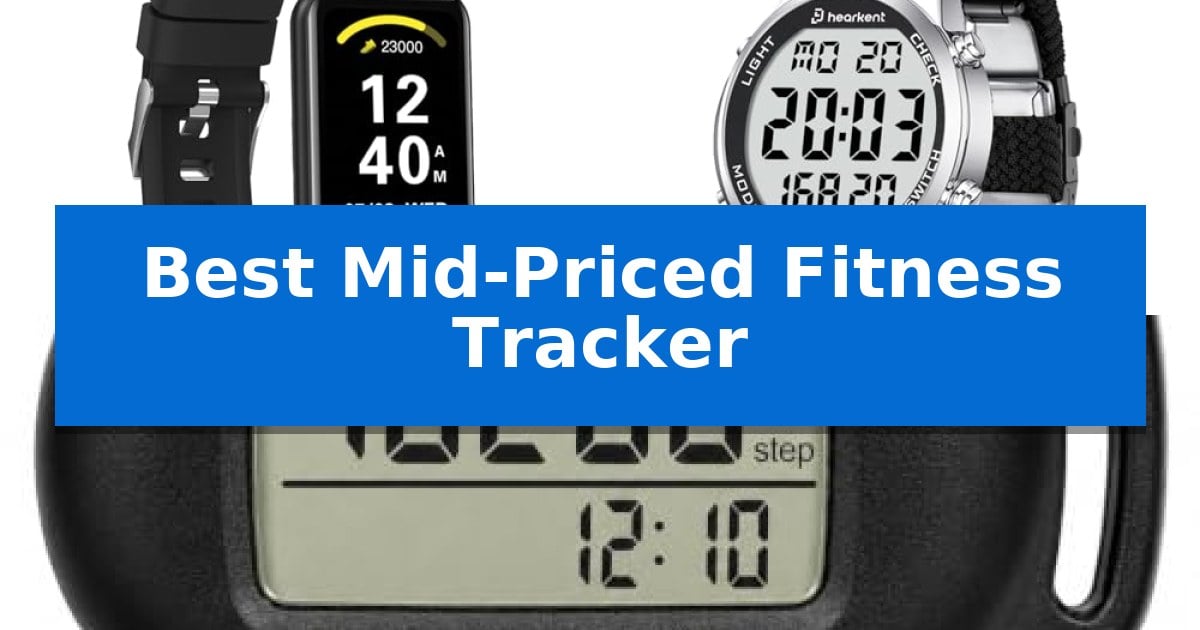
Finding the right balance between advanced health monitoring and affordability can be a challenge. Whether you are looking to track your daily steps, monitor sleep patterns, or keep an eye on calories burned, the Best Mid-Priced Fitness Tracker options offer a practical solution without the premium price tag of high-end smartwatches.
Our guide focuses on devices that provide reliable data and user-friendly interfaces. We examine how different designs—from sleek wristbands to versatile clip-on pedometers—cater to various lifestyles, ensuring you find a tool that fits your personal fitness goals and daily routine.
You may also want to compare Best Mid-Priced DSLR Cameras, Best Mid-Priced Drone with Camera, and Best Mid-Priced Drone.
Best Mid-Priced Fitness Tracker
Quick Comparison
| Product | Best For | Key Strength | Score |
|---|---|---|---|
| Zewa Bluetooth Fitness Activity Tracker | Best Overall | Slim and lightweight silicone design with a secure metal clasp. | 4.9 |
| Hearkent Pedometer Watch | Simple Non-Digital Tracking | No Bluetooth or app required for operation. | 4.5 |
| Biaccrss 3D Pedometer | Multi-Position Step Accuracy | 3D tri-axis sensor allows for accurate tracking in various positions. | 4.6 |
How We Chose
- Accuracy of step and activity monitoring sensors
- Ease of data synchronization and app integration
- Battery life and charging convenience
- Comfort and durability of the physical design
- Clarity of the display and interface usability
1 Zewa Bluetooth Fitness Activity Tracker — App-Synced Health Stats
Tracking daily activity and sleep patterns requires a device that balances functionality with a comfortable, unobtrusive form factor. The Zewa Bluetooth Fitness Activity Tracker addresses this with a slim, lightweight silicone band that remains secure during movement thanks to its integrated metal clasp.
This tracker offers a comprehensive suite of health monitoring tools, including real-time heartrate monitoring, step counting, and calorie tracking. By syncing with the Zewa Fit Pro app, users can view detailed statistics and manage sedentary reminders. The device also supports native integration with Apple and Google Health Apps, allowing for seamless data consolidation across existing ecosystems.
Designed for versatility, the tracker features a universal fit and a display that provides local weather updates and supports both metric and imperial units. The interface is highly customizable, offering three distinct home screens and the ability to view information in either English or Spanish. The raise-to-wake functionality ensures quick access to data without needing to press buttons during a workout.
Maintenance is straightforward, as the unit utilizes fast charging via a standard USB connection. With a focus on both daytime activity and nighttime rest, the tracker is built to be worn continuously, providing a consistent stream of health metrics throughout the day and night.
Best for: Users seeking a lightweight, slim-profile tracker that integrates directly with Apple and Google Health ecosystems.
Skip if: Users who require advanced GPS tracking or a high-resolution color touchscreen interface for detailed mapping.
PROS
- Slim and lightweight silicone design with a secure metal clasp.
- Seamless synchronization with Apple and Google Health Apps.
- Includes real-time heartrate monitoring and sedentary reminders.
- Fast charging via standard USB interface.
CONS
- No built-in GPS for standalone outdoor activity tracking.
2 Hearkent Pedometer Watch — Simple Non-Digital Tracking
Tracking daily activity does not always require complex software or constant device charging. The Hearkent Pedometer Watch offers a straightforward, hardware-focused approach to monitoring steps, mileage, and calories without the need for Bluetooth connectivity or smartphone applications. Designed for those who prefer a traditional watch interface, it provides an immediate view of fitness data directly on the wrist.
The device features a premium alloy case and a soft nylon strap, balancing durability with a weight of 69 grams. It is built to accommodate wrist circumferences between 5.51 and 8.27 inches, utilizing a folding stainless steel clasp for secure wear. For visibility in low-light environments, the watch includes an EL backlight that remains active for 5 seconds upon activation.
Functionality is centered on simplicity and utility. Beyond step and calorie tracking, the watch includes a stopwatch, countdown timer, alarm, and hourly chime. It operates on a standard CR 2032 battery, eliminating the need for frequent charging. To ensure accuracy, the watch incorporates a 10-second anti-miscount function, which prevents the device from recording movement until 10 seconds of continuous activity are detected.
Practicality extends to its daily maintenance and environmental resilience. The watch is 30-meter water resistant, making it suitable for everyday wear, including splash-prone activities like hand washing. Data management is automated, with the device resetting the step count at midnight while allowing users to view the previous day's totals, providing a consistent record of daily movement.
Best for: Individuals seeking a simple, non-digital fitness tracking solution that functions as a traditional watch without requiring apps, Bluetooth, or frequent battery charging.
Skip if: Users who require advanced health metrics like heart rate monitoring, sleep tracking, or data synchronization with mobile fitness platforms.
PROS
- No Bluetooth or app required for operation.
- 10-second anti-miscount function to improve step accuracy.
- EL backlight for clear data visibility in low light.
- 30-meter water resistance for everyday durability.
CONS
- Manual battery replacement required as it uses a CR 2032 cell.
- Limited tracking scope compared to modern smartwatches.
3 Biaccrss 3D Pedometer — Multi-Position Step Accuracy
Tracking daily movement requires a device that adapts to your routine rather than forcing you to adjust your gear. The Biaccrss 3D Pedometer utilizes a 3D tri-axis sensor to record steps accurately regardless of whether it is clipped to your waist, tucked into a pocket, or stored inside a backpack. This versatility makes it a practical choice for those who prefer a dedicated, screen-based tracker over smartphone-integrated solutions.
To ensure data integrity, the device features smart 10-step counting, which ignores accidental movements or brief shifts to prevent false positives. Once you reach the 10-step threshold, the unit automatically includes those initial steps in your total. Beyond basic step counting, it functions as a comprehensive activity monitor, calculating walking distance, calories burned, and estimated fat burned based on your personal weight and stride length settings.
Managing your fitness history is straightforward with the 30-day activity memory. This allows you to review your progress directly on the backlit LCD screen without the need for Bluetooth, mobile apps, or a smartphone connection. The unit also includes a 24-hour clock for added utility during your daily routine.
Designed for portability, the Biaccrss 3D Pedometer weighs approximately 29.5 g and comes with a hook-and-loop carrying strap. It is powered by a single replaceable CR2032 battery, removing the need for frequent charging cables. This simple, no-nonsense design focuses on core tracking metrics for users who prioritize offline data access and multi-position placement flexibility.
Best for: Users who prefer a dedicated, screen-based activity tracker that functions entirely offline without the need for smartphones or Bluetooth connectivity.
Skip if: Individuals who require advanced features like heart rate monitoring, sleep tracking, or seamless synchronization with mobile fitness applications.
PROS
- 3D tri-axis sensor allows for accurate tracking in various positions.
- 30-day onboard memory enables progress review without a smartphone.
- Smart 10-step filtering reduces false counts from accidental movement.
- Backlit display ensures visibility in different lighting conditions.
CONS
- Lacks wireless connectivity for automatic data syncing or app integration.
- Requires manual entry of personal data like stride length for accurate estimates.
Best Mid-Priced Fitness Tracker Buying Guide
Understanding Tracking Technology
Most trackers utilize tri-axis sensors to detect movement from multiple directions. This technology is essential for accurate step counting, whether the device is worn on the wrist, clipped to a waistband, or carried in a pocket.
Some models include anti-miscount features that require a minimum number of consecutive steps before recording. This helps filter out non-walking movements, such as arm gestures or accidental shaking, ensuring your data remains reliable.
Connectivity and Data Management
Modern fitness trackers often offer Bluetooth app synchronization, allowing you to view detailed statistics on your smartphone. This integration is ideal for those who want to track long-term trends, such as sleep patterns or calorie burn over weeks and months.
Alternatively, some users prefer non-digital or standalone tracking. These devices store data directly on the unit, providing a simpler experience that does not require a smartphone or constant app updates.
Design and Wearability
The physical form factor of your tracker significantly impacts how often you will use it. Slim wristbands are generally designed for 24/7 wear, including sleep tracking, while compact pedometers offer versatility for those who prefer not to wear a watch-style device.
Consider the clasp and strap material when choosing your device. A sturdy silicone band with a metal clasp provides security during rigorous activity, whereas a lightweight clip-on design may be more suitable for casual walking or office environments.
Display and Visibility
A clear display is crucial for checking your progress on the go. Look for features like EL backlighting, which ensures that your step count, distance, and time are readable in low-light conditions or during evening walks.
Some devices allow for customizable home screens, letting you prioritize the metrics that matter most to you. This level of personalization can make your daily fitness routine more efficient and motivating.
Battery and Maintenance
Power management varies between models. Rechargeable trackers typically use standard USB connections for fast charging, while others rely on replaceable coin-cell batteries that can last for months without needing a power outlet.
Always check the water resistance rating of your chosen device. While many trackers are splash-proof for hand washing or light rain, they are rarely designed for swimming or submersion in hot water.
Frequently Asked Questions
Do I need a smartphone to use a fitness tracker?
Not necessarily. While many trackers sync with apps for detailed analysis, several models function as standalone devices that display your steps and calories directly on the screen.
How do I ensure my step count is accurate?
Ensure the device is worn securely according to the manufacturer's instructions. Many trackers use sensors that require a few seconds of continuous movement to start counting, which helps reduce false data.
Can I wear my tracker while sleeping?
Yes, if the device is designed for comfort and includes sleep tracking features. Slim, lightweight wristbands are generally the most comfortable option for overnight use.
What is the difference between a wristband and a clip-on tracker?
A wristband is worn like a watch and is convenient for constant monitoring. A clip-on tracker is more discreet and can be attached to clothing or a bag, which is ideal if you prefer not to wear anything on your wrist.
How often do I need to charge my fitness tracker?
This depends on the model. Rechargeable devices may need charging every few days, while those using replaceable batteries can often go months without maintenance.
Conclusion: Our Top Pick
Choosing the right device depends on whether you prioritize app-based insights or simple, distraction-free tracking. For those who want a comprehensive health overview, the Zewa Bluetooth Fitness Activity Tracker stands out for its ability to sync seamlessly with health apps and provide real-time heart rate monitoring.
If you prefer a device that is ready to use out of the box without the need for digital connectivity, the Zewa model remains a strong contender due to its slim design and versatile features. Always consider your preferred wearing style and data management needs before making your final selection.