
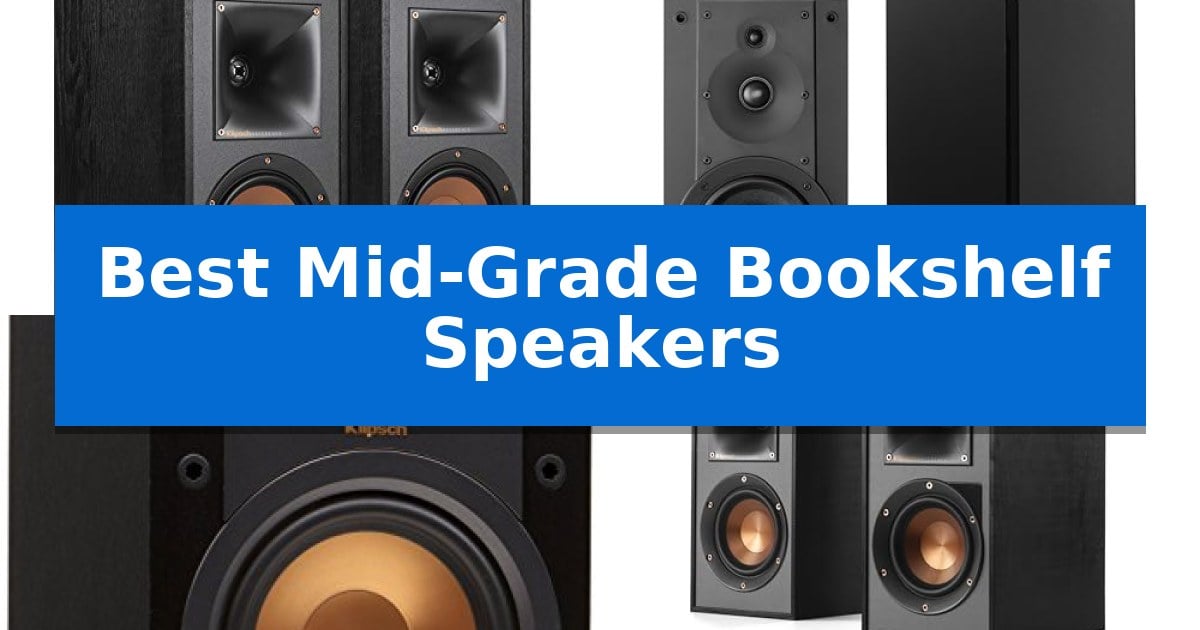
Finding the right audio setup often comes down to balancing acoustic performance with the physical constraints of your living space. The Best Mid-Grade Bookshelf Speakers serve as a versatile middle ground, offering more depth and detail than compact desktop units without requiring the floor space of large tower systems.
Whether you are building a dedicated home theater or looking to enhance your primary listening area, choosing the right pair requires careful attention to driver configuration and enclosure design. This guide examines several prominent models to help you identify which speaker characteristics align with your specific audio goals and room environment.
You may also want to compare Best Mid-Grade 3D Printers, Best Mid-Fi Closed-Back Headphones, and Best Mid-Budget Surround Sound Speakers.
Best Mid-Grade Bookshelf Speakers
Quick Comparison
| Product | Best For | Key Strength | Score |
|---|---|---|---|
| Klipsch R-51M Bookshelf Speakers | Best Overall | 90×90 Square Tractrix Horns for improved high-frequency clarity and directionality. | 4.9 |
| Sony SS-CS5M2 Bookshelf Speakers | Expansive Hi-Res Soundstage | 3-way, 3-driver design for improved frequency separation | 4.7 |
| Klipsch R-15M Bookshelf Speakers | Efficient Reference-Grade Audio | 90×90 Tractrix Horn for enhanced high-end imaging | 4.3 |
| Klipsch R-41M Bookshelf Speakers | Compact High-Resolution Detail | LTS tweeter technology minimizes distortion for clearer high-frequency output. | 4.9 |
| Polk Audio T15 Bookshelf Speakers | Versatile Home Theater Entry | Wall-mountable design for flexible room placement | 4.5 |
How We Chose
- Driver Configuration: Assessing the role of tweeters and woofers in delivering balanced frequency response.
- Enclosure Design: Analyzing how port placement and cabinet materials influence sound dispersion and resonance.
- System Compatibility: Evaluating how easily these speakers integrate with standard AV receivers and existing home theater components.
- Physical Dimensions: Considering the impact of speaker size on placement flexibility and room aesthetics.
1 Klipsch R-51M Bookshelf Speakers — Dynamic Horn-Loaded Clarity
The Klipsch R-51M Bookshelf Speakers utilize 90×90 Square Tractrix Horns to direct high-frequency energy precisely toward the listener, reducing artificial reverb caused by indirect sound bouncing off walls. This design choice aims to provide a cleaner, more detailed audio presentation suitable for those seeking a focused soundstage in a mid-sized room.
These speakers feature 1" Aluminum LTS (Linear Travel Suspension) tweeters, which are engineered to minimize distortion for enhanced performance. The low-frequency foundation is handled by dual 5.25" spun-copper IMG (Injection Molded Graphite) woofers. These cones are designed to be exceptionally light while maintaining rigidity, allowing for minimal cone breakup and distortion at higher volumes.
For low-frequency extension, the Klipsch R-51M employs a bass-reflex design via a rear-firing port. This configuration matches the cabinet to the woofers to produce deeper bass output. Because the port is located on the back, placement requires careful consideration; positioning the speakers too close to a wall may alter the bass response, so providing some clearance is recommended for balanced output.
Measuring 13.3" x 7" x 8.5", these speakers offer a compact footprint that fits easily on shelves, stands, or desks. The build quality is supported by a 5-year limited warranty, reflecting the manufacturer's confidence in the durability of the components. They are well-suited for users who prioritize horn-loaded efficiency and a distinct, forward-leaning sound signature in their home audio setup.
Best for: Listeners who prefer a dynamic, horn-loaded sound signature and require a compact footprint for shelf or stand placement.
Skip if: Those who need to place speakers flush against a wall or in a corner, as the rear-firing port requires clearance to prevent boomy or distorted bass.
PROS
- 90×90 Square Tractrix Horns for improved high-frequency clarity and directionality.
- Spun-copper IMG woofers provide a rigid, lightweight cone for reduced distortion.
- Compact dimensions allow for versatile placement in smaller rooms or on desktops.
- 5-year limited warranty indicates long-term support for the hardware.
CONS
- Rear-firing port requires specific placement away from walls to maintain bass accuracy.
2 Sony SS-CS5M2 Bookshelf Speakers — Expansive Hi-Res Soundstage
Achieving a balanced soundstage in a compact footprint requires precise engineering, and the Sony SS-CS5M2 Bookshelf Speakers address this by utilizing a dedicated 3-way, 3-driver system. These speakers are designed to handle a wide frequency response of 53-50,000 Hz, supporting Hi-Res Audio playback to ensure that high-frequency details remain faithful to the source material.
The internal architecture features a 5.12-inch woofer paired with a bass reflex enclosure, which works to minimize distortion while boosting low-end frequencies. To maintain clarity, the system incorporates a high-precision tweeter alongside a wide-dispersion super tweeter, creating an expansive sound stage that fills the listening area effectively.
Constructed with premium componentry and a reinforced cellular cone, these speakers are built to deliver undistorted audio output. Their compact dimensions—measuring 13.2 inches in height—make them well-suited for smaller spaces, while their design serves as a direct aesthetic and functional match for Sony AV receivers.
These speakers provide a versatile solution for home theater setups where space is at a premium but audio fidelity remains a priority. By integrating specialized drivers for different frequency ranges, the system ensures that both vocal clarity and bass response are addressed within a single, manageable unit.
Best for: Small to medium-sized rooms where a compact, Hi-Res capable 3-way speaker system is needed to complement a home theater setup.
Skip if: Users requiring extreme low-frequency output for large spaces or those who prefer floor-standing speakers with larger woofer diameters.
PROS
- 3-way, 3-driver design for improved frequency separation
- Hi-Res Audio support with a wide 53-50,000 Hz range
- Compact footprint ideal for small-space installations
- Bass reflex enclosure for reduced distortion
CONS
- Limited low-end extension compared to larger floor-standing speakers
3 Klipsch R-15M Bookshelf Speakers — Efficient Reference-Grade Audio
The Klipsch R-15M Bookshelf Speakers utilize an exclusive 90×90 Tractrix Horn design paired with aluminum tweeters to deliver high-end response and enhanced imaging. This engineering choice aims to provide a clean, natural sound profile, making these speakers a notable option for those seeking precise audio reproduction in a mid-grade setup.
At the heart of their performance is the Linear Travel Suspension (LTS) tweeter, a technology derived from the brand's flagship series to minimize distortion during detailed playback. Complementing this is the spun copper Injection Molded Graphite (IMG) woofer, which is designed to be both lightweight and rigid. This combination allows for efficient low-frequency response and helps maintain clarity even when the volume is pushed.
The physical construction features a durable MDF cabinet with a brushed polymer veneer finish, allowing the units to integrate into various home environments. For connectivity, the speakers include 5-way binding posts, which offer the flexibility required for different receiver or amplifier setups. A rear-firing port is also precisely flared to reduce turbulence, ensuring that low-frequency output remains stable.
Usability is further supported by a strong, flexible, and removable grille that is acoustically transparent, protecting the drivers while maintaining a refined aesthetic. Measuring 12.5 inches in height, these speakers are sized to fit comfortably on most shelves or dedicated stands, providing a balance between physical presence and acoustic capability.
Best for: Listeners seeking efficient, reference-grade audio performance in a compact bookshelf form factor.
Skip if: Users requiring integrated amplification or wireless connectivity, as these are passive speakers that necessitate an external receiver.
PROS
- 90×90 Tractrix Horn for enhanced high-end imaging
- Linear Travel Suspension (LTS) tweeter to minimize distortion
- Spun copper IMG woofer for rigid, efficient low-frequency response
- 5-way binding posts for versatile connection options
CONS
- Passive design requires a separate amplifier or receiver
- Rear-firing port requires careful placement to avoid wall-proximity interference
4 Klipsch R-41M Bookshelf Speakers — Compact High-Resolution Detail
The Klipsch R-41M Reference Bookshelf Speakers utilize a 1-inch aluminum Linear Travel Suspension (LTS) tweeter mated to a 90×90 square Tractrix Horn, a design choice engineered to minimize distortion and enhance high-frequency detail. This specialized horn-loaded geometry aims to improve resolution and efficiency, making these speakers a distinct option for listeners seeking clarity in a compact footprint.
Measuring 11.3 inches in height and 5.75 inches in width, these speakers feature a 4-inch spun-copper Injection Molded Graphite (IMG) woofer. The cabinet is constructed from reinforced MDF with a black textured wood grain vinyl finish, which serves to reduce cabinet vibration and minimize audible coloration during playback.
With a frequency response of 68 hertz to 21 kilohertz and a nominal impedance of 8 ohms, the Klipsch R-41M Reference Bookshelf Speakers are designed to handle 50 watts of continuous power, with peak handling up to 200 watts. The 90dB sensitivity rating indicates they can achieve significant output levels with standard amplification.
The inclusion of Kapton material in the tweeter suspension provides a rigid yet lightweight component that supports the speaker's ability to maintain high efficiency. These speakers are suited for setups where space is limited but high-resolution audio performance is required, though their physical dimensions and frequency range necessitate careful placement for optimal sound reproduction.
Best for: Listeners seeking high-frequency detail and efficient performance in a compact, space-saving bookshelf speaker design.
Skip if: Users requiring deep, sub-bass frequency extension or those with very large listening environments that demand higher power handling.
PROS
- LTS tweeter technology minimizes distortion for clearer high-frequency output.
- Reinforced MDF cabinet construction reduces unwanted vibration and coloration.
- High sensitivity rating of 90dB allows for efficient operation with various amplifiers.
- Compact dimensions make them suitable for smaller shelves or desktop setups.
CONS
- Limited low-frequency response starting at 68 hertz may require a subwoofer for full-range audio.
- Fixed physical size may not suit users looking for larger, floor-standing speaker presence.
5 Polk Audio T15 Bookshelf Speakers — Versatile Home Theater Entry
Building a home theater setup often starts with finding speakers that balance size and performance. The Polk Audio T15 Bookshelf Speakers utilize a 0.75-inch tweeter and a 5.25-inch Dynamic Balance driver to provide clear, balanced audio output even when operating at lower volume levels.
These passive bookshelf speakers are designed for versatility within a surround sound configuration. Whether utilized as front, left-right, or rear channels, they integrate into existing home theater systems with a straightforward connection to an AV receiver. Their wall-mountable design offers flexible placement options for rooms where floor space is limited.
The Polk Audio T15 units serve as a foundational component for those beginning their audio journey. They are engineered to be compatible with a broader 5.1 setup, allowing users to expand their system later by incorporating T50 towers, a T30 center channel, and a dedicated subwoofer. This modular approach supports scaling the audio experience as needs evolve.
Measuring 10.7 inches in height and 6.5 inches in width, these speakers maintain a compact footprint. With a 5-year warranty on parts and labor, they provide a reliable entry point for home audio enthusiasts seeking a consistent sound profile for movies and music.
Best for: Home theater beginners looking for a compact, wall-mountable speaker pair that can integrate into a larger 5.1 surround sound system.
Skip if: Users who require active, self-powered speakers or those seeking high-output floor-standing speakers for large, dedicated listening rooms.
PROS
- Wall-mountable design for flexible room placement
- Dynamic Balance driver technology for clear audio
- Modular compatibility with other T-series components
- 5-year warranty on parts and labor
CONS
- Passive design requires an external AV receiver
- Limited bass depth compared to larger floor-standing speakers
Best Mid-Grade Bookshelf Speakers Buying Guide
Understanding Driver Technology
The drivers—specifically the tweeter and the woofer—are the heart of any speaker system. In the mid-grade category, you will often find specialized materials like aluminum tweeters or spun-copper IMG woofers designed to minimize distortion while maintaining high output efficiency.
A 3-way driver system can offer a more nuanced soundstage by dedicating specific drivers to high, mid, and low frequencies. Conversely, a 2-way design remains a standard for many bookshelf models, providing a reliable and often more compact solution for smaller listening areas.
The Role of Enclosure and Porting
The cabinet construction, typically made of MDF (Medium Density Fiberboard), is essential for reducing unwanted vibrations that can color the sound. A well-built cabinet ensures that the audio you hear is as close to the source as possible, without interference from the enclosure itself.
Rear-firing ports are a common feature in bookshelf speakers, designed to enhance low-frequency response. However, these require careful placement; if the speaker is pushed too close to a wall, the bass can become muddy or distorted due to turbulence.
Integration and Connectivity
Most mid-grade bookshelf speakers are passive, meaning they require an external amplifier or AV receiver to function. When selecting your speakers, ensure your receiver has the appropriate power handling capabilities to match the speaker's impedance, usually rated at 8 ohms.
Look for 5-way binding posts on the rear of the unit. These provide the most flexibility, allowing you to use various connection types such as bare wire, spade lugs, or banana plugs, ensuring a secure and reliable signal path.
Placement and Soundstage
To get the most out of your speakers, proper positioning is vital. Ideally, they should be placed at ear level, with the tweeters angled slightly toward the listener to create an accurate stereo image.
If you are using these for a home theater setup, consider whether the speakers are wall-mountable. This feature is particularly useful for rear or surround channels, allowing you to save floor space while maintaining an immersive audio experience.
Hi-Res Audio Compatibility
For listeners who prioritize high-fidelity playback, look for speakers labeled as Hi-Res Audio compatible. These models are engineered to handle a wider frequency response, capturing subtle details in recordings that standard speakers might miss.
While Hi-Res capability is a benefit, it is most effective when paired with high-quality source material and a capable amplifier. Ensure your entire signal chain supports the resolution you intend to play to see a genuine improvement in sound quality.
Frequently Asked Questions
Do I need a separate subwoofer with these bookshelf speakers?
While many mid-grade bookshelf speakers provide decent low-end response, a dedicated subwoofer is often recommended for a full-range home theater experience, especially for deep bass in movies.
Can I use these speakers with any amplifier?
You should check the power handling specifications of your amplifier against the recommended wattage of the speakers. Most standard AV receivers are compatible, but always verify the impedance requirements.
What is the difference between a 2-way and 3-way speaker?
A 2-way speaker uses two drivers (a tweeter and a woofer), while a 3-way speaker adds a dedicated midrange driver. 3-way systems can often provide better separation of frequencies, though 2-way systems are often more compact.
Are these speakers suitable for wall mounting?
Some models are designed with wall-mounting capabilities, while others are intended for stands or shelves. Always check the product specifications to see if mounting hardware or brackets are supported.
What does 'bass-reflex' mean?
A bass-reflex enclosure uses a port or vent to allow the air inside the cabinet to interact with the woofer, which helps extend the speaker's low-frequency output compared to a sealed design.
Conclusion: Our Top Pick
Selecting the right speakers involves balancing your room size, your existing receiver's power, and your listening preferences. For those seeking a blend of high-end clarity and robust construction, the Klipsch R-51M Bookshelf Speakers stand out as a versatile choice for both music and home theater applications.
Their use of Tractrix Horn technology and aluminum LTS tweeters provides a dynamic sound profile that performs well in a variety of settings. While other options like the Sony SS-CS5M2 offer unique 3-way configurations, the Klipsch model remains a reliable, high-performing solution for most mid-grade audio setups.