
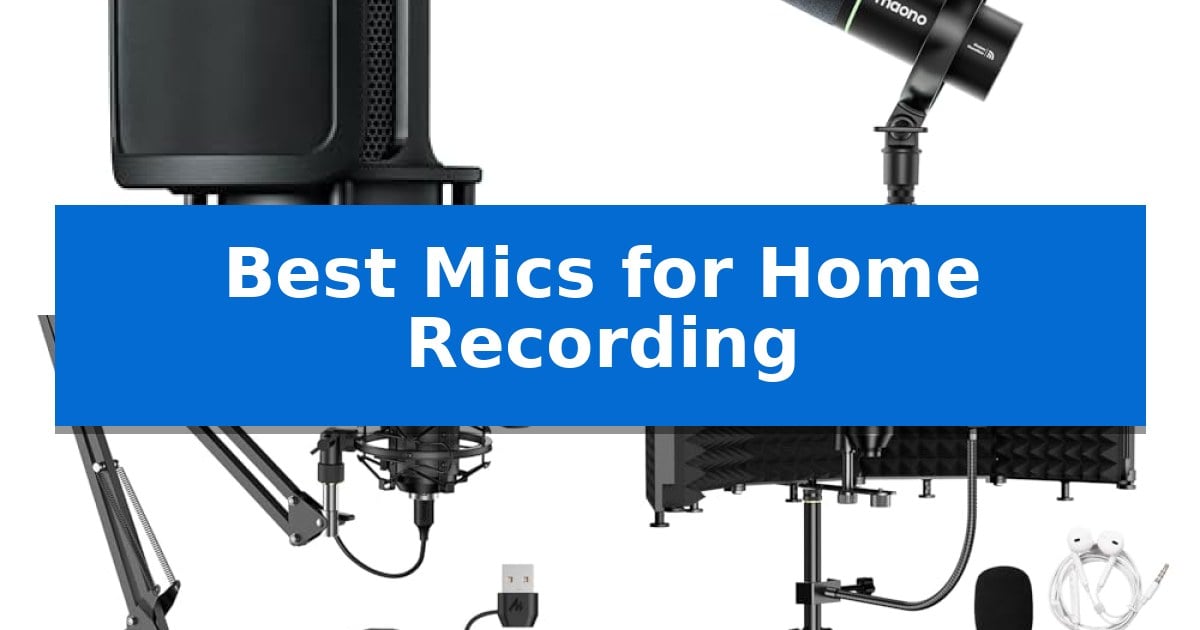
Setting up a personal studio often begins with the search for the Best Mics for Home Recording. Whether you are capturing vocals for a podcast, streaming, or tracking instruments, the right microphone can significantly improve your audio clarity while minimizing the need for extensive post-production editing.
Selecting the right tool depends on your specific environment and recording goals. From versatile hybrid options to specialized condenser kits, we have analyzed the latest hardware to help you navigate the features that matter most for your home setup.
You may also want to compare Best Mics for Discord Calls, Best Mics for Audiobook Recording, and Best Mics for Audio Clarity.
Best Mics for Home Recording
Quick Comparison
| Product | Best For | Key Strength | Score |
|---|---|---|---|
| Shure SM4 Condenser Microphone | Best Overall | Patent-pending interference shielding effectively blocks RF noise from common household electronics. | 4.9 |
| Maono PD200W Hybrid Microphone | Flexible Wireless and Wired Recording | Tri-mode connectivity including wireless, USB, and XLR. | 4.7 |
| Maono A04 USB Microphone | Easiest Plug-and-Play Setup | Plug and play USB connectivity requires no extra drivers. | 4.6 |
| Dejasound Studio Recording Microphone | All-in-One Vocal Starter Kit | Plug-and-play USB connectivity for direct use with computers and smartphones. | 4.7 |
| Tonor TC777 Pro-IS Microphone | Complete Acoustic Isolation Bundle | Complete all-in-one bundle including isolation shield, pop filter, and tripod. | 4.3 |
How We Chose
- Capsule type and polar pattern accuracy for noise rejection.
- Connectivity options including XLR, USB, and wireless capabilities.
- Included accessories such as shock mounts, pop filters, and isolation shields.
- Build quality and physical footprint for desktop or boom arm mounting.
- Compatibility with common operating systems and recording software.
1 Shure SM4 Condenser Microphone — Professional Studio-Grade Clarity
Achieving professional audio quality in a home environment requires equipment that manages both acoustic nuances and environmental interference. The Shure SM4 Condenser Microphone addresses these challenges with a brass 1-inch dual-diaphragm capsule, engineered to deliver smooth, detailed highs and controlled low-end frequencies for natural sound reproduction.
Designed for versatility, this microphone features a uniform cardioid polar pattern that excels at off-axis noise rejection, ensuring the focus remains on the primary sound source. To combat common home-recording issues, it incorporates patent-pending interference shielding technology to block RF noise from nearby electronics like laptops and Wi-Fi routers, alongside an integrated pop filter and Faraday cage to minimize plosive sounds.
The Shure SM4 Condenser Microphone is built for high-pressure scenarios, capable of handling sound sources up to 140dB without distortion. Its all-metal construction provides the durability required for consistent studio use, while the sleek, low-profile design ensures it remains unobtrusive during video recordings or live-streaming sessions.
This kit includes essential accessories such as a detachable magnetic pop filter, a shock mount, and a brass mic stand adapter, providing a comprehensive setup for immediate use. By reducing the proximity effect through its large "sweet spot" design, it offers consistent audio quality, making it a practical choice for those seeking mix-ready audio directly from the source.
Best for: Home-studio creators and streamers who need a durable, interference-shielded microphone that delivers mix-ready audio with minimal post-processing.
Skip if: Users who require a USB-native microphone will need an external audio interface to connect this XLR-based condenser.
PROS
- Patent-pending interference shielding effectively blocks RF noise from common household electronics.
- High-SPL handling up to 140dB allows for distortion-free recording of loud instruments.
- Integrated pop filter and shock mount provide a clean, plosive-free signal out of the box.
- Rugged all-metal construction ensures long-term durability for studio or stage environments.
CONS
- XLR-only connectivity requires a separate audio interface or mixer for operation.
2 Maono PD200W Hybrid Microphone — Flexible Wireless and Wired Recording
The Maono PD200W Hybrid Microphone offers a versatile recording solution by providing three distinct connectivity modes: wireless, USB, and XLR. This flexibility allows creators to transition from a mobile wireless setup to a stable, pro-level interface connection without needing multiple microphones for different production environments.
Equipped with a 30mm dynamic capsule and a cardioid pickup pattern, the microphone is engineered to deliver clear vocal reproduction while minimizing unwanted background noise. The inclusion of three-stage noise cancellation helps maintain audio focus, which is particularly useful for recording in spaces that lack professional soundproofing.
The MaonoLink app provides granular control over the audio profile, offering four master-tuned presets and adjustable parameters like EQ and reverb. For multi-person recordings, the system supports connecting two wireless microphones to a single receiver, allowing for independent track recording to simplify post-production editing.
Designed for long-form content, the unit features a 60-hour battery life when RGB lighting is disabled and maintains a stable 60m wireless range. The package includes a desktop stand and various cables, providing a comprehensive kit for immediate setup across PCs, tablets, and professional audio interfaces.
Best for: Creators who need a versatile microphone that can switch between wireless, USB, and XLR connectivity for varied recording environments.
Skip if: Users who require a dedicated, high-end studio XLR microphone and do not need wireless or USB functionality may find the hybrid features unnecessary.
PROS
- Tri-mode connectivity including wireless, USB, and XLR.
- Independent track recording when using two wireless mics with one receiver.
- MaonoLink app for precise EQ and reverb adjustments.
- Long-lasting battery providing up to 60 hours of use.
CONS
- Camera/Lightning accessories for direct-to-camera sync are sold separately.
3 Maono A04 USB Microphone — Easiest Plug-and-Play Setup
Achieving clear audio for podcasts or streaming often starts with a reliable hardware foundation. The Maono A04 USB Microphone simplifies this process by integrating a professional sound chipset capable of 192kHz/24Bit resolution, ensuring high-fidelity audio reproduction directly through a USB connection.
Designed for immediate use, this plug and play condenser microphone eliminates the need for external sound cards or complex driver installations. It features a 16mm electret condenser transducer that provides a strong bass response, while the included magnet ring on the cable works to minimize interference during recording sessions.
The Maono A04 USB Microphone comes as an all-in-one set, including an adjustable scissor arm stand, a metal shock mount, a pop filter, and a foam windscreen. These accessories help maintain audio clarity by reducing plosives and vibrations, provided the desk surface is less than 2.1 inches thick.
Compatibility is broad, supporting most PCs, laptops, and gaming consoles like the PS4 and PS5. While it integrates seamlessly with software such as Discord, Twitch, and Zoom, users should note that this specific model is not compatible with Maono Link software, which is reserved for the upgraded Gen2 version.
Best for: Content creators and podcasters seeking a comprehensive, easy-to-install entry-level recording kit.
Skip if: Users who require advanced software integration like Maono Link or those who need a microphone compatible with Xbox consoles.
PROS
- Plug and play USB connectivity requires no extra drivers.
- Includes a complete accessory kit with a shock mount and pop filter.
- High-resolution 192kHz/24Bit sampling rate for clear audio.
- Broad compatibility with Windows, macOS, and gaming consoles.
CONS
- Not compatible with Maono Link software.
- Incompatible with Xbox gaming systems.
4 Dejasound Studio Recording Microphone — All-in-One Vocal Starter Kit
Achieving professional-grade audio at home often requires balancing multiple components, but the Dejasound Studio Recording Microphone simplifies this by bundling a condenser mic with a dedicated isolation shield. This all-in-one kit is designed for immediate use, featuring a plug-and-play USB output that connects directly to PCs, laptops, or smartphones without requiring external audio interfaces.
The core of the system is a 16mm diaphragm condenser microphone utilizing a cardioid polar pattern, which focuses on sound sources directly in front of the capsule. It supports high-fidelity recording with a 192kHz/24Bit sampling rate and a frequency response of 30Hz-16kHz. For real-time control, the unit includes an integrated 3.5mm headphone jack for monitoring, along with onboard volume adjustment and a dedicated mute button.
To address environmental noise, the kit includes a foldable isolation shield constructed from five high-density, sound-absorbing panels. This triple acoustic design helps minimize unwanted reflections during vocal or podcast recording. The entire setup is built for portability, with the complete kit weighing 4.1lbs, making it suitable for users who need to move their recording station between different rooms or locations.
The package is comprehensive, providing essential accessories such as a tripod stand, a pop filter, and necessary adapters for Lightning and Type-C connectivity. This integration of hardware and acoustic treatment offers a streamlined path for creators looking to establish a home studio setup without sourcing individual components separately.
Best for: Creators and podcasters seeking a complete, portable, and easy-to-install USB recording solution for vocal and music production.
Skip if: Users who require professional XLR connectivity or specific studio-grade phantom power interfaces for high-end audio hardware.
PROS
- Plug-and-play USB connectivity for direct use with computers and smartphones.
- Integrated 5-panel isolation shield for improved acoustic control in untreated rooms.
- All-in-one kit includes tripod, pop filter, and monitoring headphones.
- Onboard controls for volume, echo, and muting.
CONS
- Fixed USB interface limits compatibility with professional XLR-based audio equipment.
- Integrated design may be less modular than separate professional microphone and stand setups.
5 Tonor TC777 Pro-IS Microphone — Complete Acoustic Isolation Bundle
Achieving professional-grade audio for podcasts or home streaming requires more than just a microphone; it demands a controlled acoustic environment. The Tonor TC777 Pro-IS Microphone addresses this by providing a comprehensive, all-in-one solution that includes a 3-panel foldable isolation shield designed to minimize ambient noise and echo through its high-density acoustic foam layers.
Beyond its physical shielding, the Tonor TC777 Pro-IS Microphone offers granular control over the recording process. Users can adjust sensitivity via the bottom gain dial and utilize the one-touch mute button with a built-in LED indicator to manage audio status instantly. The bundle also includes a height-adjustable metal tripod and a dual-layer pop filter, ensuring the hardware can be positioned for optimal vocal pickup while reducing plosive sounds.
Compatibility is a core strength of this system, as it is designed for plug-and-play operation across Windows, macOS, iOS, and Android platforms, as well as gaming consoles like the PS4 and PS5. It integrates seamlessly with common communication software such as Zoom, Skype, and Discord, making it a versatile choice for both creative projects and remote meetings.
The unit is built for flexibility, allowing users to either utilize the included desktop tripod or mount the microphone to a standard boom arm. With a two-year warranty provided by the manufacturer, this kit serves as a practical, ready-to-use foundation for those establishing a home recording space.
Best for: Beginners and podcasters who need an all-in-one acoustic isolation and recording setup for their desk.
Skip if: Users who require compatibility with Xbox consoles or those who already own professional-grade acoustic treatment and prefer a standalone microphone.
PROS
- Complete all-in-one bundle including isolation shield, pop filter, and tripod.
- High-density acoustic foam effectively reduces ambient noise and echo.
- Integrated gain and mute controls for real-time audio management.
- Broad compatibility with major operating systems and gaming consoles.
CONS
- Not compatible with Xbox consoles or iPhone 14 and earlier models.
- Fixed footprint of the isolation shield may be too large for extremely compact desk spaces.
Best Mics for Home Recording Buying Guide
Understanding Polar Patterns
The cardioid polar pattern is the standard for most home recording applications. It is designed to prioritize sound directly in front of the microphone while rejecting noise from the sides and rear, which is essential for minimizing room echo.
If you are recording in an untreated space, a tight cardioid pattern helps isolate your voice from ambient sounds like computer fans or air conditioning. Always check the off-axis rejection specs to ensure the mic will perform well in your specific room.
Connectivity: XLR vs. USB
USB microphones offer the most straightforward setup, allowing you to plug directly into a computer or mobile device without an external interface. This is ideal for beginners or those who need a portable, all-in-one solution.
XLR microphones provide a more professional, stable signal path but require an external audio interface. This setup is preferred for long-term studio growth, as it allows you to upgrade your preamp and interface independently of the microphone.
The Importance of Acoustic Isolation
Even a high-quality microphone can struggle in a room with hard, reflective surfaces. Isolation shields and pop filters are critical accessories that physically block plosives and reduce the amount of room reverb captured by the capsule.
Bundles that include these components often provide better value and immediate results for home users. If your space is not soundproofed, prioritize kits that include a woven mesh Faraday cage or high-density foam shielding.
Handling SPL and Distortion
Sound Pressure Level (SPL) handling determines how loud a source the microphone can capture before the signal begins to distort. If you plan to record loud instruments or aggressive vocals, look for a high SPL rating.
A microphone with a high SPL threshold ensures your recordings remain clean and undistorted, even when the source volume is pushed to the limit. This is a key differentiator for versatile studio mics.
Build Quality and Mounting
The physical construction of your microphone affects its longevity and ease of use. All-metal builds are generally more durable and provide better shielding against RF noise from cell phones and Wi-Fi routers.
Consider the mounting options included in your kit. A shock mount is essential for preventing vibrations from your desk or floor from traveling into the recording, while a sturdy stand ensures consistent positioning during long sessions.
Frequently Asked Questions
Do I need an audio interface for a USB microphone?
No, USB microphones have built-in analog-to-digital converters, allowing them to connect directly to your computer's USB port.
What is the benefit of a condenser microphone?
Condenser microphones are highly sensitive and excellent at capturing detailed, natural highs, making them ideal for studio vocals and acoustic instruments.
Can I use an XLR microphone with my phone?
You generally need an audio interface or a compatible mobile adapter to connect an XLR microphone to a smartphone or tablet.
What is a pop filter used for?
A pop filter is placed between the speaker and the microphone to minimize plosive sounds, such as 'p' and 'b' consonants, which can cause harsh spikes in audio.
How do I reduce background noise in my recordings?
Using a microphone with a cardioid polar pattern, utilizing an isolation shield, and keeping your gain settings at an appropriate level are the most effective ways to reduce unwanted background noise.
Conclusion: Our Top Pick
For those seeking the most reliable and high-fidelity option, the Shure SM4 Condenser Microphone stands out as the best choice. Its combination of a brass dual-diaphragm capsule and interference shielding technology provides a mix-ready sound that is difficult to match in a home studio environment.
While other options offer more connectivity variety or bundled extras, the build quality and audio precision of the Shure SM4 make it a long-term investment for any creator. It effectively balances professional-grade performance with the durability needed for consistent, high-quality home recording.