
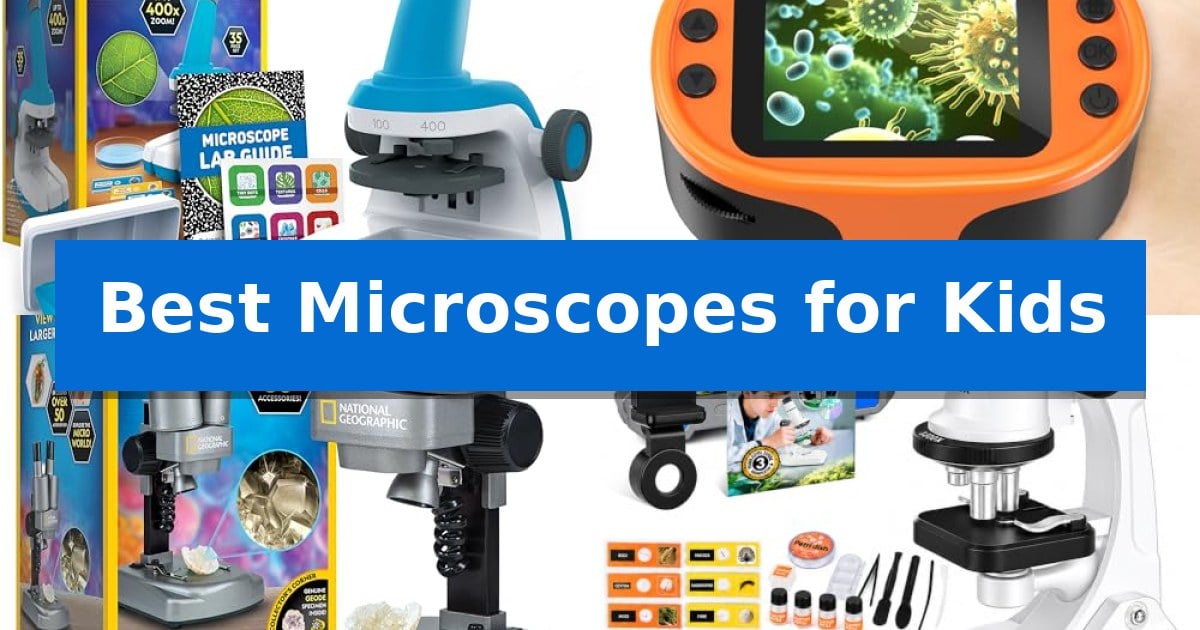
Finding the right tools to nurture a child's interest in biology can transform a simple backyard walk into a profound scientific discovery. The Best Microscopes for Kids are designed to bridge the gap between abstract textbook concepts and the tangible, fascinating reality of cells, insects, and mineral structures.
Selecting the right model depends on whether your young scientist prefers structured laboratory work or spontaneous outdoor exploration. We have analyzed current options to help you identify which features—from digital screens to traditional glass slides—best support your child's specific learning style and age group.
You may also want to compare Best Microscopes for Horticulture, Best Microscopes for Homeschooling, and Best Microscopes for Homeschool Biology.
Best Microscopes for Kids
Quick Comparison
| Product | Best For | Key Strength | Score |
|---|---|---|---|
| National Geographic Microscope for Kids | Best Overall | Dual lighting system for viewing both opaque and translucent specimens. | 4.9 |
| BEBANG Kids Digital Microscope | Easiest for Documenting Discoveries | 32GB memory card included for extensive photo and video documentation. | 4.4 |
| National Geographic Dual LED Microscope | Versatile Viewing for 3D Objects | Dual LED illumination enables viewing of both slides and 3D objects. | 4.3 |
| Mileonaim Kids Microscope Kit | Complete Lab Setup for Beginners | Comprehensive 61-piece set including tools and slides | 4.4 |
| BMDSAE Handheld Digital Microscope | Portable Pick for Outdoor Exploration | 1000X magnification with manual focus control for detailed specimen viewing. | 4.5 |
How We Chose
- Optical Clarity and Magnification Range
- Ease of Focus and Adjustment Controls
- Inclusion of Educational Materials and Specimens
- Portability and Build Quality for Younger Users
- Digital Integration and Documentation Capabilities
1 National Geographic Microscope for Kids — Best for Structured STEM Learning
Introducing the National Geographic Microscope for Kids, a specialized tool designed to bridge the gap between casual curiosity and structured scientific exploration. Featuring large focus knobs, a soft-touch eyepiece, and an adjustable platform, this unit simplifies the mechanics of microscopy for younger users, ensuring specimens remain positioned for clear observation.
The device offers three levels of magnification supported by dual lighting systems—positioned both above and below the stage—to provide consistent illumination for various specimen types. This dual-light configuration allows children to view both opaque objects, such as the included 6 rocks and minerals, and translucent samples like the 6 prepared plant slides provided in the kit.
Beyond the hardware, the kit functions as a comprehensive STEM lab, including essential accessories like a pipette, specimen dish, and tweezers. To facilitate guided learning, it comes with an entertaining lab guide that features specific viewing activities, a science-themed game, and merit badge stickers to track progress through various experiments.
With a compact footprint measuring approximately 11 by 6.7 inches and a weight of 1.82 pounds, the microscope is scaled for younger hands while maintaining a functional design. The inclusion of 6 blank slides encourages independent preparation, allowing children to transition from observing provided samples to investigating their own discoveries.
Best for: Young children ages 6 and up who require a guided, all-in-one STEM learning experience with pre-prepared specimens.
Skip if: Users seeking professional-grade optical clarity, high-resolution digital imaging, or advanced magnification levels beyond 400x.
PROS
- Dual lighting system for viewing both opaque and translucent specimens.
- Complete STEM kit including prepared slides, blank slides, and essential lab tools.
- Ergonomic design featuring large focus knobs and a soft-touch eyepiece for ease of use.
- Guided learning materials including a lab guide and activity stickers.
CONS
- Fixed magnification range limited to 400x, which may not satisfy older students or advanced hobbyists.
2 BEBANG Kids Digital Microscope — Easiest for Documenting Discoveries
The BEBANG Kids Digital Microscope simplifies the process of scientific discovery by including a 32GB memory card, allowing young explorers to capture photos and videos of their findings without the constraints of limited internal storage. This handheld device transforms everyday objects like insects, coins, and plant life into high-resolution learning opportunities.
Designed for versatility, the microscope features five adjustable magnification levels ranging from 200X to 1000X. The upgraded 3mm slide viewing slot ensures that the included 5 real glass prepared slides move smoothly, making it easier for children to position samples accurately for clear observation.
Portability is a core strength of this STEM toy, weighing only 0.34 lb and featuring a compact, pocket-sized body. It is powered by a rechargeable battery that supports approximately 2.5 hours of continuous use, making it suitable for both classroom projects and outdoor nature excursions.
To ensure a complete educational experience, the kit arrives with a custom EVA hard-shell carrying case that organizes the microscope, charging cable, and accessories. The simple focus wheel and intuitive controls are specifically calibrated to reduce frustration for beginners, supporting independent exploration for children aged 4 to 12.
Best for: Young students and nature enthusiasts aged 4-12 who need a portable, all-in-one tool for documenting biological specimens and everyday objects.
Skip if: Users requiring professional-grade lab optics or high-power compound microscopy for advanced academic research will find the handheld design and magnification range insufficient.
PROS
- 32GB memory card included for extensive photo and video documentation.
- Portable, lightweight design with a protective custom EVA case for field use.
- Real glass prepared slides provide an authentic biological learning experience.
- Rechargeable battery offers 2.5 hours of continuous exploration time.
CONS
- Handheld form factor may be less stable than a traditional desktop microscope stand for long-duration viewing.
- Magnification range is optimized for casual discovery rather than professional laboratory analysis.
3 National Geographic Dual LED Microscope — Versatile Viewing for 3D Objects
The National Geographic Dual LED Microscope offers a versatile approach to discovery by providing both upper and lower illumination, allowing young scientists to examine everything from prepared biological slides to opaque 3D objects. This dual-functionality makes it a practical tool for diverse STEM activities, moving beyond the limitations of traditional slide-only microscopes.
Equipped with two sets of optical glass lenses, the device provides 20x and 50x magnification levels. The inclusion of 50+ accessories—such as 10 prepared slides, 10 blank slides, tweezers, and an eye-dropper—ensures that users have the necessary equipment to begin experiments immediately upon unboxing. A mini geode is also included to demonstrate the utility of the upper LED light source for 3D specimen viewing.
Designed with a focus on accessibility, the unit measures approximately 12.5 inches in height and weighs 2 pounds, making it a manageable size for younger users. The 1-year warranty against manufacturer defects provides a baseline of support for the hardware, which is constructed to facilitate an introduction to biological and physical science concepts.
While the kit provides a comprehensive starting point for exploration, it is specifically tailored for the 8-12 age range. The reliance on fixed magnification levels and the included accessory set prioritizes ease of use over the advanced, high-power capabilities found in professional laboratory equipment.
Best for: Children aged 8-12 interested in exploring both biological slides and 3D objects through a versatile, all-in-one STEM kit.
Skip if: Users seeking high-power magnification or professional-grade laboratory features will find the fixed 20x and 50x settings insufficient for advanced study.
PROS
- Dual LED illumination enables viewing of both slides and 3D objects.
- Includes a comprehensive 50+ piece accessory set for immediate experimentation.
- Features optical glass lenses for clear magnification at 20x and 50x.
- Backed by a 1-year warranty against manufacturer defects.
CONS
- Fixed magnification levels limit the device to entry-level observation.
- The compact design is specifically optimized for younger users, which may feel restrictive for older students.
4 Mileonaim Kids Microscope Kit — Complete Lab Setup for Beginners
Introducing the Mileonaim Kids Microscope Kit, a comprehensive 61-piece science set designed to turn home learning into a hands-on laboratory experience. This kit provides magnification powers of 100X, 400X, and 1200X, allowing young biologists to examine everything from tiny organisms to everyday household objects in clear detail.
The kit is built for versatility, including 12 pre-prepared specimen slides and 32 blank plastic slides that encourage children to move beyond passive observation to active experimentation. It comes equipped with essential laboratory tools such as tweezers, a dropper, a scalpel, and a mixing plate, providing a complete setup for budding scientists to create their own samples.
Designed with portability in mind, the Mileonaim Kids Microscope Kit features a sturdy construction and includes a compact ABS carrying case. This ensures that all components store neatly, making it easy for children to transport their equipment for school projects or family trips.
This microscope serves as an ideal STEM educational tool, fostering a love for biology and botany through screen-free, interactive play. The inclusion of a phone holder allows for capturing images of discoveries, while the integrated LED light ensures specimens are properly illuminated for study, making it a functional and engaging gift for students aged 6-12.
Best for: Students aged 6-12 looking for a complete, portable STEM starter kit for home or classroom biology exploration.
Skip if: Users requiring professional-grade optical clarity or advanced laboratory-standard magnification for high-level scientific research.
PROS
- Comprehensive 61-piece set including tools and slides
- Portable design with a dedicated ABS carrying case
- Versatile magnification options from 100X to 1200X
- Includes phone holder for capturing and sharing discoveries
CONS
- Plastic slide construction may be less durable than glass alternatives
- Manual focus and setup requires adult supervision for younger children
5 BMDSAE Handheld Digital Microscope — Portable Pick for Outdoor Exploration
Turning a backyard walk into a scientific expedition requires more than just a magnifying glass; it requires a tool that bridges the gap between curiosity and discovery. The BMDSAE Handheld Digital Microscope stands out by offering 1000X optical and digital magnification paired with a 2MP camera, allowing children to view plant cells and insect anatomy with clarity directly on its integrated 2.0-inch IPS screen.
Designed specifically for younger explorers, this device features an oversized focus dial that accommodates uncoordinated fingers and a shock-absorbent rubber casing built to withstand accidental drops. With a featherlight 200g body and an included lanyard, it is engineered for portability, whether the child is investigating specimens in the garden or documenting findings at a science museum.
The microscope simplifies the learning process with an 8-LED lighting system featuring three brightness modes and a diffuser to prevent glare, ensuring clear visibility in various environments. Its 600mAh battery provides up to 2 hours of continuous use, and the unit can be kept powered via USB, making it a reliable companion for extended discovery sessions.
Beyond real-time viewing, the device supports digital documentation by storing photos and AVI videos on its 32MB internal storage. Files can be easily exported to Windows or Mac systems via USB, enabling kids to build digital portfolios, share their findings with teachers, or create science fair presentations that track their research over time.
Safety remains a priority, as the unit is constructed from eco-friendly ABS plastic and meets CE, FCC, and CPC safety standards. The product arrives in gift-ready packaging and includes a 12-month warranty, providing a durable and educational tool that encourages long-term scientific engagement.
Best for: Young children aged 3-12 who need a durable, portable, and easy-to-use digital tool for outdoor and indoor scientific exploration.
Skip if: Users requiring professional-grade lab optics or high-resolution microscopic photography for advanced research applications.
PROS
- 1000X magnification with manual focus control for detailed specimen viewing.
- Kid-friendly design featuring shock-absorbent casing and oversized controls.
- Integrated 2.0-inch IPS screen for immediate viewing without needing a separate computer.
- Digital storage capability allows for saving and exporting photos and videos of discoveries.
CONS
- Limited internal storage capacity may require frequent file transfers for heavy users.
Best Microscopes for Kids Buying Guide
Understanding Magnification Needs
Most entry-level microscopes offer a range of magnification levels, typically starting at 20x or 100x and going up to 1000x or 1200x. For younger children, lower magnification is often more practical because it provides a wider field of view, making it easier to locate and keep specimens in focus.
Higher magnification levels are impressive on paper but often require precise lighting and steady hands to yield a clear image. When choosing, prioritize the quality of the lenses and the stability of the platform over the maximum magnification number.
Digital vs. Traditional Optical Viewing
Traditional optical microscopes use eyepieces and require children to look through a lens, which helps develop patience and fine motor skills. These are excellent for learning the fundamentals of biology and slide preparation.
Digital microscopes, by contrast, project the image onto a screen. This is often more engaging for younger children or those who struggle with traditional eyepieces, as it allows multiple people to view the discovery simultaneously and document findings through photos or videos.
The Importance of Prepared Specimens
A microscope is only as interesting as the objects placed under it. Kits that include a variety of prepared slides allow children to start exploring immediately without the frustration of learning how to mount their own specimens right away.
Look for kits that also provide blank slides and basic tools like tweezers and pipettes. This encourages the transition from passive observation to active experimentation, allowing children to collect their own samples from the garden or kitchen.
Durability and Portability
Children are naturally curious and often want to take their tools outside. A portable design with a protective carrying case is essential for protecting the delicate optics from bumps and drops during field trips to the park or backyard.
Consider the materials used in the construction. Models featuring shock-absorbent casing or sturdy ABS plastic are better suited for younger users who may not yet have the fine motor control required for professional-grade metal equipment.
Lighting and Power Sources
Proper illumination is critical for seeing fine details. Dual-light systems, which provide both top and bottom lighting, are highly versatile because they allow for the viewing of both transparent slides and opaque 3D objects like rocks or coins.
Check the power requirements for your chosen model. Rechargeable batteries are convenient for frequent use, while battery-operated units offer the ultimate freedom for outdoor exploration where power outlets are unavailable.
Frequently Asked Questions
What is the best age to start using a microscope?
Many models are suitable for children as young as 4 to 6 years old, provided they have adult supervision. Digital handheld models are often the most accessible for younger children, while traditional optical models are better suited for ages 8 and up.
Do I need to buy extra slides?
Most kits come with a starter set of prepared and blank slides. While these are sufficient for initial learning, purchasing a separate set of prepared biological slides can keep the experience fresh as your child's interests grow.
Are digital microscopes better than traditional ones?
Neither is strictly 'better'; they serve different purposes. Digital microscopes are excellent for documentation and group viewing, while traditional microscopes are superior for teaching the classic scientific method and developing manual focus skills.
How do I clean the lenses?
Always use a soft, lint-free microfiber cloth to clean the lenses. Avoid using harsh chemicals or paper towels, which can scratch the delicate glass or plastic surfaces.
Can these microscopes be used for school projects?
Yes, many of these kits are designed with STEM learning in mind and include guides or activities that align well with elementary and middle school science curricula.
Conclusion: Our Top Pick
When selecting the right tool for your young scientist, the National Geographic Microscope for Kids stands out as the most balanced choice for structured learning. Its combination of adjustable magnification, dual lighting for both slides and 3D objects, and a comprehensive set of prepared specimens provides an immediate, high-quality introduction to the microscopic world.
While other models offer digital screens or higher magnification, this kit excels by focusing on the fundamentals of scientific observation. It is a durable, well-supported option that encourages children to engage with the world around them through hands-on experimentation, making it our top recommendation for fostering a lifelong love of science.