
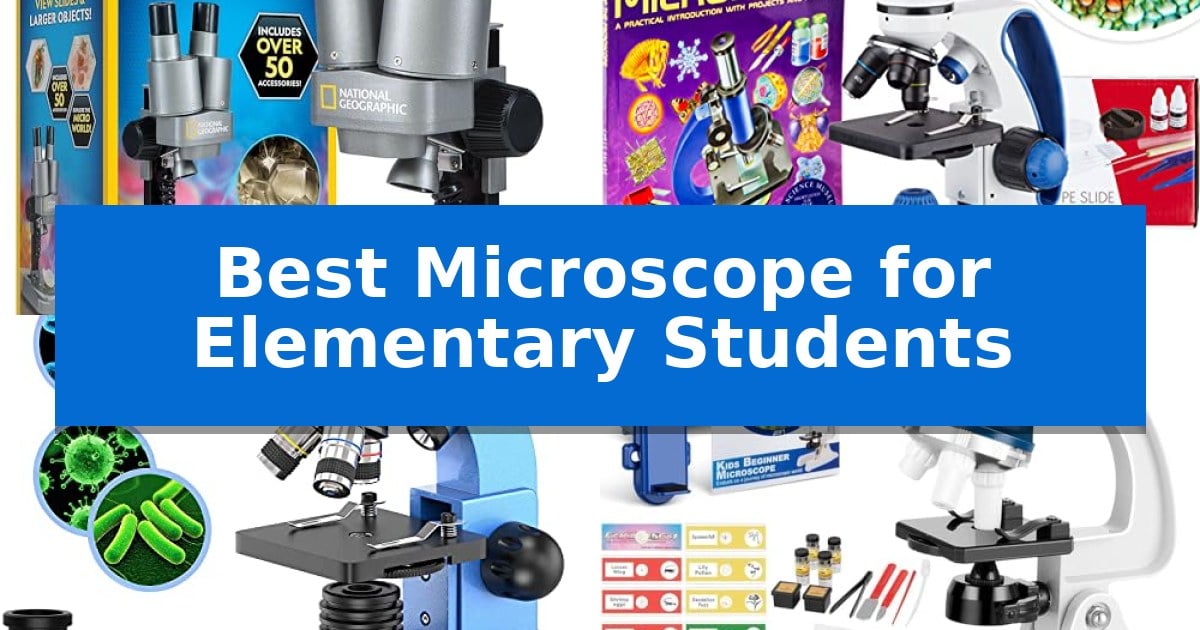
Introducing young learners to the wonders of biology requires tools that are both accessible and engaging. The Best Microscope for Elementary Students should bridge the gap between simple toy-like devices and complex laboratory equipment, providing clear magnification without overwhelming the user with complicated controls.
Selecting the right instrument involves balancing ease of use with the durability needed for classroom or home exploration. Whether your child is interested in examining prepared slides or collecting their own samples from the backyard, finding a model that supports their growing curiosity is essential for a successful STEM learning experience.
You may also want to compare Best Microscope for Electronics Work, Best Microscope for Electronic Repair, and Best Microscope for DSLR Photography.
Best Microscope for Elementary Students
Quick Comparison
| Product | Best For | Key Strength | Score |
|---|---|---|---|
| National Geographic Dual LED Microscope | Best Overall | Dual LED illumination for both slides and 3D objects | 4.9 |
| AmScope M162C-2L Metal Frame Microscope | Durable Metal Construction | Sturdy metal frame for long-term stability and durability. | 4.9 |
| Emarth 40X-1000X Compound Microscope | Includes Comprehensive Educational Kit | Dual light illumination for viewing both opaque and translucent specimens. | 4.6 |
| Uarzt 58-Piece Kids Microscope Kit | Easiest All-in-One Setup | Comprehensive 58-piece set includes both prepared and blank slides for immediate and long-term use. | 4.6 |
| TOMLOV DM301 Pro Digital Microscope | Best for Digital Sharing | 7-inch IPS screen provides a clear, shared viewing experience. | 4.3 |
How We Chose
- Optical clarity and magnification range suitable for biological specimens.
- Ease of operation, including focus mechanisms and lighting controls.
- Durability of the frame and overall construction quality.
- Inclusion of essential accessories like slides, tools, and storage solutions.
- Versatility in viewing both prepared slides and 3D objects.
1 National Geographic Dual LED Microscope — Best for Younger Beginners
Introducing young learners to the scientific method requires equipment that is both approachable and functional. The National Geographic Dual LED Microscope provides a versatile entry point for students aged 8-12, featuring dual LED illumination that allows for the observation of both traditional biological slides and opaque 3D objects.
This kit functions as a two-in-one system, utilizing lower lights for transparent specimens and upper lights for solid items. With 20x and 50x magnification provided by optical glass lenses, the device is engineered for clarity while remaining simple enough for independent use during home experiments. The dual-light design is particularly beneficial for students who want to transition from viewing prepared slides to examining physical items like the included mini geode, providing a tactile connection to scientific study.
The package includes a comprehensive set of 50+ accessories, such as 10 prepared slides, 10 blank slides, tweezers, and an eye-dropper, enabling students to transition from observing existing samples to creating their own. This extensive accessory set ensures that young scientists have the necessary tools to begin their own investigations immediately, fostering an environment of active discovery rather than passive observation.
Designed with a compact footprint of 7.25 by 5.7 inches and weighing only two pounds, this microscope fits easily on a standard desk or study table. It is backed by a 1-year warranty against manufacturer defects, providing a reliable foundation for early STEM education. Its small size makes it an ideal choice for home study areas where space is at a premium, without sacrificing the essential functionality needed for elementary-level science projects.
Best for: Younger students aged 8-12 who need a simple, dual-purpose microscope for exploring both slides and 3D objects.
Skip if: Users requiring high-power magnification beyond 50x or professional-grade laboratory features will find this entry-level model too limited.
PROS
- Dual LED illumination for both slides and 3D objects
- Comprehensive 50+ piece kit including prepared and blank slides
- Optical glass lenses providing 20x and 50x magnification
- Compact and lightweight design suitable for young users
CONS
- Limited magnification range compared to advanced laboratory microscopes
2 AmScope M162C-2L Metal Frame Microscope — Durable Metal Construction
Introducing the AmScope M162C-2L-WM-SP14-50P100S 1000X Dual Light Glass Lens Metal Frame, a tool engineered to provide a stable foundation for young scientists. Its sturdy metal frame ensures the instrument remains steady during delicate adjustments, while the coaxial coarse and fine focusing knobs offer precise control over image clarity, allowing students to learn the fundamentals of microscopy with ease.
This model features an optical glass monocular design that supports a wide range of discovery through its 40X-1000X magnification range. With five distinct widefield magnification levels, users can transition from observing larger specimens to examining finer details. The inclusion of top and bottom LED lights provides versatile illumination, enabling the study of both translucent slides and opaque objects.
Usability is enhanced by a single lens condenser with a 6-hole disc diaphragm, which allows students to adjust the light intensity and contrast for better viewing. The microscope is designed for longevity and practical learning, arriving as part of a comprehensive bundle that includes introductory materials and essential slide-preparation tools, making it a ready-to-use solution for educational environments.
While the metal construction provides necessary durability, the unit remains compact with dimensions of 12 inches in height and 8 inches in width. This balance of build quality and manageable size makes it a suitable choice for students who need a reliable, stationary device for their home or classroom laboratory.
Best for: Elementary students who need a durable, multi-functional microscope with both top and bottom lighting for diverse specimen study.
Skip if: Users requiring a portable, battery-operated microscope for field work, as this unit is designed for stationary desk use.
PROS
- Sturdy metal frame for long-term stability and durability.
- Dual LED lighting system allows for viewing both slides and solid objects.
- Coaxial coarse and fine focusing provides precise image control.
- Comprehensive bundle includes necessary tools for immediate slide preparation.
CONS
- Stationary design may be less convenient for those needing a portable or lightweight device.
3 Emarth 40X-1000X Compound Microscope — Includes Comprehensive Educational Kit
Introducing the Emarth 40X-1000X Compound Microscope, a tool engineered to bridge the gap between a toy and a professional lab instrument. Its dual light system featuring both top and bottom illumination allows young scientists to examine a wide variety of specimens, from opaque objects to translucent biological slides, providing versatility for diverse experiments.
Designed with a durable metal frame, this microscope offers the stability required for precise observation. The rotatable head and smooth focusing mechanism ensure that students can comfortably adjust their view, while the 6 color filters built into the system help enhance contrast, making it easier to identify details in various samples.
The package includes a comprehensive 52-piece educational kit, which provides immediate hands-on experience. By including both prepared and blank slides along with essential tools, the set serves as a complete entry point for STEM learning, suitable for school labs, homeschool environments, or curious adult beginners.
This compound microscope supports a magnification range of 40X to 1000X, offering the power necessary for real biology exploration. It is a practical choice for those seeking a reliable, high-powered device that prioritizes educational value and ease of use over complex, professional-grade laboratory features.
Best for: Elementary and middle school students seeking a durable, high-powered compound microscope for STEM learning and biology experiments.
Skip if: Users requiring professional-grade optics, digital imaging capabilities, or advanced laboratory-standard precision will find this beginner-focused model limiting.
PROS
- Dual light illumination for viewing both opaque and translucent specimens.
- Durable metal frame construction for long-term stability.
- 52-piece kit includes everything needed for immediate experimentation.
- 6 built-in color filters to improve image contrast.
CONS
- Batteries not included for the illumination system.
- Beginner-focused design lacks advanced professional features.
4 Uarzt 58-Piece Kids Microscope Kit — Easiest All-in-One Setup
The Uarzt 58-Piece Kids Microscope Kit provides an accessible entry point for young learners to explore biological specimens through an optical microscope experience. By including a colorful, detailed guide, this set helps children identify basic microscope components and develop foundational observation skills for examining plants and insects.
This 58-piece complete science kit is designed for immediate use, featuring 13 prepared slides and 31 blank slides for DIY projects. The package includes essential lab tools such as tweezers, a dropper, and a scalpel, allowing students to conduct hands-on experiments right out of the box. Measuring 4.6"L x 2.75"W x 8.15"H, the unit requires 2 AA batteries to operate.
Portability and organization are central to the design, as the kit comes with a carrying case to keep all components secured between sessions. Whether utilized in a homeschooling environment or an elementary classroom, the kit is built to encourage interactive learning between students and instructors.
While this set serves as an effective introductory science tool, it is important to note that it is not intended to function as professional laboratory equipment. It is best suited for children ages 5-12 who are beginning their journey into STEM through guided, screen-free discovery.
Best for: Elementary students ages 5-12 seeking an all-in-one, portable introductory science kit for home or classroom STEM exploration.
Skip if: Users requiring professional-grade laboratory optics or high-magnification research capabilities will find this introductory toy-grade microscope insufficient for their needs.
PROS
- Comprehensive 58-piece set includes both prepared and blank slides for immediate and long-term use.
- Included carrying case ensures organized storage and easy transport between learning spaces.
- Educational guide helps beginners learn microscope parts and basic observation techniques.
- Versatile lab tools like tweezers and a scalpel support hands-on STEM experimentation.
CONS
- Introductory design is not intended for professional laboratory or advanced research applications.
- Batteries required (2 AA) are not included with the kit.
5 TOMLOV DM301 Pro Digital Microscope — Best for Digital Sharing
Visualizing the microscopic world becomes an immersive experience with the TOMLOV DM301 Pro Digital Microscope, which features a large 7-inch IPS display that allows multiple students to view specimens simultaneously without the strain of traditional eyepieces. Designed for accessibility, this unit simplifies the transition from slide preparation to digital observation for learners as young as six.
The device offers 1200X magnification powered by three achromatic lenses, providing the clarity necessary to examine microorganisms and cellular structures. Beyond static viewing, the built-in 8MP camera enables the capture of high-resolution photos and 1080P videos, which can be shared instantly via a companion app using Wi-Fi connectivity. This digital-first approach allows students to document their findings and collaborate on STEM projects with ease.
Versatility is a core component of the design, as the microscope connects directly to TVs, laptops, or projectors via USB or HD output without requiring additional drivers. The dual LED lighting system provides balanced illumination from both top and bottom, ensuring that opaque objects and transparent slides are lit effectively for consistent results.
Practicality for classroom or home use is enhanced by an integrated measurement scale that helps young scientists develop precision in their observations. With an internal battery supporting up to 3 hours of operation, the unit is portable enough for outdoor discovery or flexible placement in a learning environment, and it arrives as a complete kit including slides and accessories to begin experiments immediately.
Best for: Students and families seeking a digital-first, shareable microscopy experience with easy connectivity to larger screens.
Skip if: Users who require traditional optical eyepieces or those who prefer a purely analog, non-digital scientific instrument.
PROS
- 7-inch IPS screen provides a clear, shared viewing experience.
- Wireless app support enables real-time mobile viewing and media capture.
- Direct USB/HD output allows for easy connection to projectors and TVs.
- Integrated measurement scale aids in precise scientific observation.
CONS
- Digital-only interface lacks traditional optical eyepieces for those preferring a classic microscope feel.
Best Microscope for Elementary Students Buying Guide
Magnification Needs
Elementary students typically benefit from a magnification range between 40x and 1000x. While higher numbers often headline marketing materials, the most useful range for beginners is usually at the lower end, which allows for a wider field of view when observing insects, leaves, or fabric fibers.
It is important to understand that higher magnification often results in a darker image and a shallower depth of field. For younger children, a microscope that provides crisp images at 40x or 100x is often more rewarding than one that struggles to focus at higher, more advanced settings.
Lighting Systems
A dual-light system is a critical feature for a versatile student microscope. Bottom illumination is necessary for viewing translucent specimens on slides, while top illumination allows for the observation of opaque, 3D objects like rocks, coins, or insects.
Look for LED lighting, as it stays cool to the touch and provides consistent, bright illumination. Adjustable brightness settings can further enhance the viewing experience by allowing the user to control contrast based on the specific specimen being examined.
Construction and Durability
Since these microscopes are designed for younger users, a sturdy frame is vital. Metal construction is generally preferred over plastic, as it provides the necessary weight to keep the device stable during use and withstands the rigors of frequent handling.
Consider the weight and portability of the unit. A microscope that is too heavy may be difficult for a child to move, while one that is too light might tip over easily. A balance of solid construction and manageable size is the ideal target.
Ease of Use
The focus mechanism should be smooth and responsive. Coaxial coarse and fine focusing knobs allow for more precise adjustments, which is a great skill for students to learn as they advance in their scientific journey.
A rotatable head can also make sharing observations easier in a classroom or family setting. Simple, intuitive controls ensure that the student spends more time observing and less time troubleshooting the equipment.
Included Accessories
A comprehensive kit often includes prepared slides, which provide an instant way to start exploring. Blank slides and coverslips are equally important, as they encourage children to collect their own samples and learn the process of slide preparation.
Additional tools like tweezers, droppers, and storage cases help keep the workspace organized and protect the equipment. These accessories transform a standalone microscope into a complete, ready-to-use science laboratory.
Frequently Asked Questions
What is the difference between a compound and a stereo microscope?
A compound microscope is designed for viewing thin, translucent specimens on slides at higher magnifications. A stereo microscope is typically used for viewing larger, opaque 3D objects at lower magnifications.
Do these microscopes require batteries?
Many portable student microscopes use batteries to power their LED illumination systems, allowing for use in locations without easy access to wall outlets.
Are these microscopes suitable for older students?
Yes, many of these models feature enough optical quality and magnification range to be useful for middle school students and adult beginners interested in basic biology.
How do I clean the lenses?
Always use specialized lens paper and cleaning solutions designed for optical glass. Avoid using tissues or cloth, which can scratch the delicate lens surfaces.
Can I connect these to a computer?
Some digital models, such as the TOMLOV DM301 Pro, offer USB or wireless connectivity to view images on a computer or screen, while traditional optical microscopes do not.
Conclusion: Our Top Pick
Choosing the right equipment is the first step in fostering a lifelong interest in science. For most elementary students, the National Geographic Dual LED Microscope stands out as the most balanced option, offering a high-quality optical experience with the versatility of dual lighting and a robust accessory kit.
While digital models offer exciting sharing capabilities, the tactile experience of using an optical glass lens system remains the gold standard for foundational learning. This kit provides the necessary tools to turn curiosity into discovery, making it an excellent investment for any young budding scientist.