
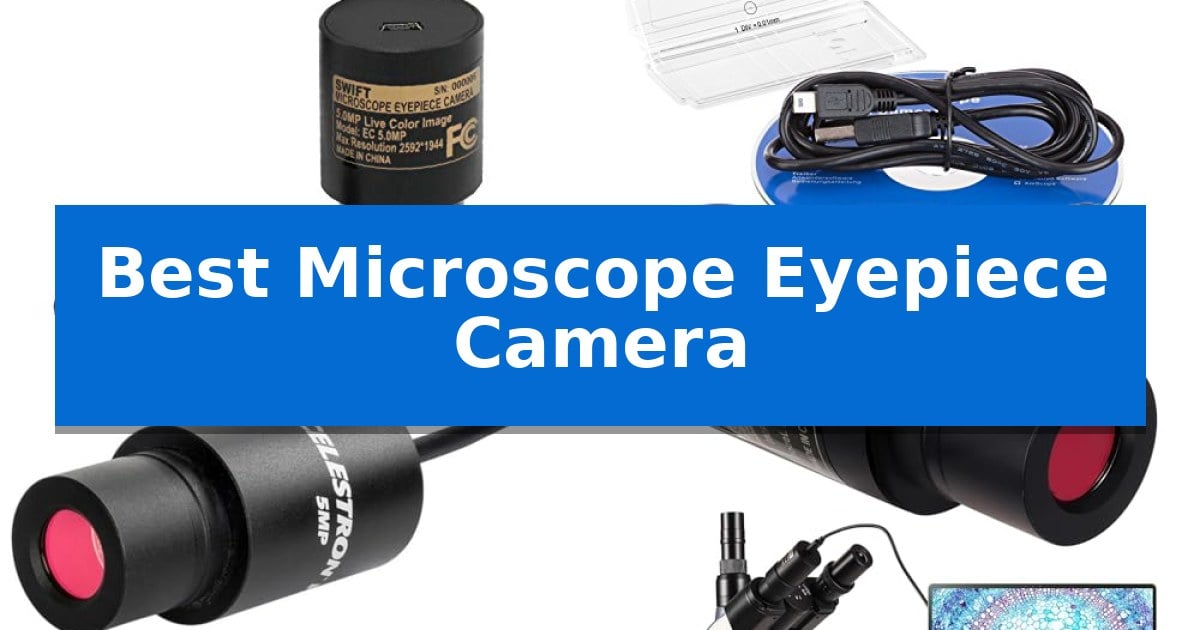
Transforming a traditional optical microscope into a digital imaging system requires a reliable interface that maintains clarity and color accuracy. Finding the Best Microscope Eyepiece Camera involves balancing your specific sensor resolution needs with the physical constraints of your existing eyepiece tubes.
Whether you are documenting slides for educational purposes or capturing live video for clinical review, the right camera simplifies the transition from manual observation to digital storage. We have analyzed current models to help you identify which device offers the necessary compatibility and software features for your specific microscopy setup.
You may also want to compare Best Microscope Eyepiece, Best Microscope Condensers, and Best Microscope Cameras.
Best Microscope Eyepiece Camera
Quick Comparison
| Product | Best For | Key Strength | Score |
|---|---|---|---|
| Swift 5.0 Megapixel Digital Microscope Camera | Best Overall | High-sensitivity Sony Back-illuminated sensor for improved image quality. | 4.9 |
| AmScope 5.0 MP Digital Microscope Camera | Includes Precision Calibration Kit | Broad compatibility with 23mm, 30mm, and 30.5mm microscope tubes. | 4.5 |
| Celestron 5MP Digital Microscope Imager | Versatile Multi-Diameter Fit | Broad compatibility with 23 mm and 30 mm eyepiece diameters. | 4.5 |
| Swift 2-MP Digital Microscope Camera | Reliable Entry-Level Imaging | High-definition 1080p live view at 30 fps for smooth, real-time observation. | 4.3 |
| Muloo 2.0 Megapixel Microscope Camera | Simple Plug-and-Play Setup | Plug-and-play drive-free installation | 4.5 |
How We Chose
- Sensor resolution and image quality for clear, detailed documentation.
- Physical compatibility with standard 23.2mm, 30mm, and 30.5mm eyepiece tubes.
- Software functionality, including measurement, annotation, and calibration tools.
- Frame rate stability during live video streaming and real-time observation.
- Cross-platform OS support for seamless integration with existing lab computers.
1 Swift 5.0 Megapixel Digital Microscope Camera — High-Resolution Sony Sensor
Capturing high-resolution microscopic imagery for educational or clinical presentations requires a reliable interface between your optics and digital display. The Swift 5.0 Megapixel Digital Microscope Camera addresses this by utilizing a high-sensitivity Sony Back-illuminated sensor, which improves the signal-to-noise ratio to ensure clear, high-speed live streams and detailed still photography.
Designed for versatility, this camera features a USB 2.0 connection that enables a straightforward plug-and-play setup. Users simply slide the mount into the eyepiece tube and connect the cable to a computer to begin capturing images. The device supports a live image speed of up to 30 frames per second at its maximum resolution of 2592×1944, maintaining smooth motion during observation.
Compatibility is a core strength of this model, as it includes adapters to fit 23.2mm, 30mm, and 30.5mm eyepiece tubes, making it suitable for a wide range of compound and stereo microscopes. The included software is provided on a USB flash disk for convenient installation and is compatible with both Mac OS X and Windows 7–11 in 32 and 64-bit versions.
Whether you are a clinician sharing findings or an instructor demonstrating specimens to a large audience, the Swift 5.0 Megapixel Digital Microscope Camera offers a practical solution for digital documentation. While the USB 2.0 interface is efficient for most standard applications, users requiring ultra-high-speed data transfer for specialized research might consider the limitations of this connection standard.
Best for: Clinicians, educators, and students who need a versatile, high-resolution camera to share and document microscope imagery across various operating systems.
Skip if: Users who require advanced, high-speed data transfer interfaces beyond USB 2.0 or those using specialized non-standard eyepiece diameters not covered by the included adapters.
PROS
- High-sensitivity Sony Back-illuminated sensor for improved image quality.
- Broad compatibility with 23.2mm, 30mm, and 30.5mm eyepiece tubes.
- Smooth live video output at up to 30 frames per second.
- Cross-platform support for Windows and Mac OS.
CONS
- USB 2.0 interface may limit transfer speeds compared to newer standards.
- Requires computer connection for operation and software installation.
2 AmScope 5.0 MP Digital Microscope Camera — Includes Precision Calibration Kit
Capturing high-resolution microscopic imagery requires a reliable interface, and the AmScope 5.0 MP Digital Microscope Camera serves as a versatile bridge between optical observation and digital documentation. This device is engineered to transform standard microscopes into digital imaging stations, allowing users to capture still images and stream live video directly to a computer.
The camera features a 5MP sensor that provides the resolution necessary for detailed documentation. Compatibility is a core strength of this model, as it supports Windows XP, Vista, 7, 8, and 10, ensuring it integrates with a wide range of existing computer setups. To accommodate different optical systems, the package includes two mounting adapters, allowing the camera to fit standard 23mm, 30mm, and 30.5mm eyepiece tubes.
Beyond simple image capture, the included user-friendly software expands the utility of the camera by offering advanced processing tools. Users can perform Stitching, EDF (Extended Depth of Focus), and precise measurement functions, which are essential for scientific or educational analysis. The inclusion of a calibration kit ensures that these measurements remain accurate across different magnifications.
The system is designed for broad technical integration, supporting Native C/C++, Directshow, and Twain standards. This flexibility makes the AmScope 5.0 MP Digital Microscope Camera a practical choice for those who need to move beyond visual inspection and into digital record-keeping or collaborative viewing without requiring complex hardware modifications.
Best for: Users needing to document microscopic observations with accurate measurements and live video streaming on a Windows-based PC.
Skip if: Users requiring high-frame-rate video for fast-moving subjects or those operating on non-Windows operating systems.
PROS
- Broad compatibility with 23mm, 30mm, and 30.5mm microscope tubes.
- Includes a calibration kit for precise measurement accuracy.
- Software supports advanced features like Stitching and EDF.
- Supports Directshow and Twain standards for flexible integration.
CONS
- Windows-only software compatibility limits use on macOS or Linux systems.
- Requires a wired USB connection to a computer for operation.
3 Celestron 5MP Digital Microscope Imager — Versatile Multi-Diameter Fit
Transforming a traditional optical microscope into a digital imaging workstation is streamlined with the Celestron 5MP Digital Microscope Imager. This device replaces a standard eyepiece, allowing users to capture high-resolution still images and 30 fps video directly to a computer, effectively digitizing specimens for documentation and analysis.
The unit features a 5MP CMOS sensor housed in a durable aluminum body, making it suitable for consistent use in educational or laboratory settings. It is designed for broad compatibility, fitting microscopes that accept standard 23 mm or 30 mm eyepiece diameters. This flexibility allows the imager to integrate into various existing optical setups without requiring specialized adapters.
Connectivity is managed via a simple USB-powered interface, which handles both data transfer and power requirements. The imager is compatible with both Mac and Windows PCs, and it includes proprietary software that provides tools for measurement, calibration, note-taking, and live stream comparison. These features enable users to perform side-by-side analysis of two live streams, which is particularly useful for comparative biology or quality control tasks.
While this imager offers a versatile solution for digitizing microscopy, users should ensure their existing microscope is compatible with the specified eyepiece dimensions before purchase. The two-year limited warranty provides additional support for this hardware, ensuring long-term utility in a professional or academic environment.
Best for: Students and laboratory professionals looking to digitize traditional microscopy for documentation and analysis.
Skip if: Users requiring ultra-high-speed frame rates or those with specialized microscope eyepieces outside the 23mm or 30mm standard sizes.
PROS
- Broad compatibility with 23 mm and 30 mm eyepiece diameters.
- High-resolution 5MP CMOS sensor for clear imaging.
- Comprehensive software suite included for measurement and calibration.
- Durable aluminum housing designed for lab environments.
CONS
- USB-tethered operation requires a constant connection to a computer.
- Limited to standard eyepiece sizes, excluding non-standard optical systems.
4 Swift 2-MP Digital Microscope Camera — Reliable Entry-Level Imaging
Capturing clear, high-resolution imagery from a microscope requires a reliable interface between your optics and digital display. The SWIFT EP2M 2-MP 1920 * 1080 Digital Eyepiece Microscope Camera provides a stable, hands-free solution for teaching, lab reviews, and quality control inspection by replacing a standard eyepiece with a digital sensor.
Designed for versatility, this camera features a GC2053 sensor with 2.7 μm pixels, delivering a 1920*1080 resolution at 30 fps. It operates within a 390–650 nm visible light range, ensuring consistent results for various microscopic applications. The unit is compact, measuring 35×35×62.5 mm and weighing approximately 70 g, making it an unobtrusive addition to most optical setups.
The included S-Viewer software facilitates essential digital tasks, such as calibrating scales, measuring specimens, and annotating images. Users can capture photos and videos directly to a PC, with the software offering both auto white balance and manual exposure controls (0.1–30 ms) to refine image quality based on specific lighting conditions.
Compatibility is a primary focus, as the device is designed to fit 23.2 mm eyepieces and most trinocular phototubes. It connects via USB and is compatible with Windows 7–11 and macOS, providing a broad range of integration options for modern laboratory or classroom environments. Please note that some specific microscope models may require an additional adapter, sold separately.
Best for: Educational and laboratory environments requiring a straightforward, digital interface for live viewing and basic image analysis.
Skip if: Users requiring medical-grade diagnostic imaging or those using specialized microscope mounts that do not support 23.2 mm or standard trinocular phototube connections.
PROS
- High-definition 1080p live view at 30 fps for smooth, real-time observation.
- S-Viewer software included for integrated measurement and annotation capabilities.
- Broad compatibility with standard 23.2 mm eyepiece tubes and major operating systems.
- Compact and lightweight design that minimizes strain on the microscope head.
CONS
- Not intended for medical use, limiting its application in clinical diagnostics.
- Potential adapter requirement for non-standard microscope configurations.
5 Muloo 2.0 Megapixel Microscope Camera — Simple Plug-and-Play Setup
Transitioning from traditional optical observation to digital documentation is a seamless process with the Muloo 2.0 Megapixel Microscope Camera. This electronic eyepiece is engineered to replace standard microscope oculars, allowing users to capture and store high-resolution images directly to a PC or mobile device without requiring complex hardware modifications.
The device features a standard 23.2mm optical interface, ensuring broad compatibility with a wide range of traditional optical microscopes. By utilizing a USB 2.0 connection, the camera facilitates the efficient transfer of visual data, making it a practical tool for educational environments or specimen documentation where digital records are required.
Usability is prioritized through a drive-free, plug-and-play design that functions across Windows and other operating systems. This architecture eliminates the need for specialized driver installations, enabling immediate operation once the unit is connected to a host device. The camera is further optimized for realistic color restoration and provides a high frame rate output, which helps maintain visual clarity when observing moving specimens or recording video sequences.
While the unit simplifies the digitization of microscopic imagery, users should note that the USB 2.0 interface may impose limitations on data transfer speeds when compared to more modern connectivity standards. Nevertheless, for those seeking a straightforward, reliable method to bridge the gap between manual microscopy and digital storage, this camera offers a functional and accessible solution.
Best for: Users seeking a simple, plug-and-play digital upgrade for standard 23.2mm optical microscopes.
Skip if: Users requiring specialized high-resolution scientific imaging or those whose microscopes utilize non-standard eyepiece diameters.
PROS
- Plug-and-play drive-free installation
- Universal compatibility with 23.2mm eyepiece mounts
- High frame rate for smooth video capture
- Realistic color reproduction
CONS
- USB 2.0 interface may limit transfer speeds compared to modern standards
Best Microscope Eyepiece Camera Buying Guide
Understanding Sensor Resolution
The resolution of your camera, measured in megapixels, directly impacts the level of detail captured in your images. A higher megapixel count is generally beneficial for large-format printing or detailed analysis, though it requires a high-quality optical path to be fully utilized.
For most routine lab work or educational demonstrations, a 2MP to 5MP sensor provides a balance between file size and image clarity. Ensure your computer hardware can handle the data throughput of your chosen resolution to avoid lag during live viewing.
Ensuring Physical Compatibility
Before purchasing, verify the diameter of your microscope's eyepiece tube. Most digital cameras come with adapters to fit standard 23.2mm, 30mm, or 30.5mm tubes, but it is essential to confirm that your specific model is supported.
Some specialized or older microscopes may require additional third-party adapters. Always check the manufacturer's specifications regarding the mounting interface to ensure a secure, vibration-free fit that keeps your image centered.
Software and Measurement Tools
The software accompanying your camera is often as important as the hardware itself. Look for features like real-time measurement, calibration, and annotation, which are critical for scientific documentation and reporting.
Verify that the software is compatible with your current operating system, whether you are using Windows or macOS. Some manufacturers provide downloadable software, while others include it on a USB drive for immediate installation.
Frame Rate and Live Streaming
If your primary use case involves live demonstrations or teaching, the frame rate is a vital specification. A camera capable of 30 frames per second (fps) ensures that motion remains smooth and responsive during live viewing.
Lower frame rates may result in choppy video, which can be distracting during presentations. Always prioritize models that maintain a stable frame rate at your desired resolution to ensure a professional viewing experience for your audience.
Sensor Sensitivity and Lighting
Back-illuminated sensors often provide better sensitivity and a higher signal-to-noise ratio, which is particularly useful in low-light conditions or when working with specific types of microscopy like darkfield or fluorescence.
Improved sensitivity allows for clearer images with less digital noise, resulting in more accurate color reproduction. This is essential for clinical or research environments where precise visual data is required for accurate interpretation.
Frequently Asked Questions
Will these cameras fit my existing microscope?
Most models include adapters for standard 23.2mm, 30mm, and 30.5mm eyepiece tubes, making them compatible with a wide range of compound and stereo microscopes.
Can I use these cameras on a Mac?
Many modern digital microscope cameras are cross-platform compatible, supporting both Windows and macOS, but you should always check the specific product specifications for your OS version.
What is the difference between 2MP and 5MP cameras?
A 5MP camera captures more pixels, providing higher detail for large prints or deep zooming, while a 2MP camera is often sufficient for standard lab documentation and live viewing.
Do I need special software to use the camera?
Yes, most cameras come with proprietary software that allows you to capture, measure, and annotate images, which is often included on a USB drive or available for online download.
Are these cameras suitable for medical diagnostics?
Most consumer and professional-grade digital eyepiece cameras are designed for education, research, and quality control, and are generally not intended for primary medical diagnostic use.
Conclusion: Our Top Pick
Selecting the right imaging tool depends on your specific resolution requirements and the compatibility of your current optical equipment. For those seeking a versatile and high-performance option, the Swift 5.0 Megapixel Digital Microscope Camera stands out due to its high-sensitivity Sony sensor and broad compatibility with multiple eyepiece diameters.
This model offers a reliable 30 fps live view and includes necessary adapters to fit most standard microscopes, making it an effective choice for instructors and clinicians who need to share high-quality images with an audience. Ensure your computer meets the USB 2.0 requirements to fully utilize the camera's capabilities.