
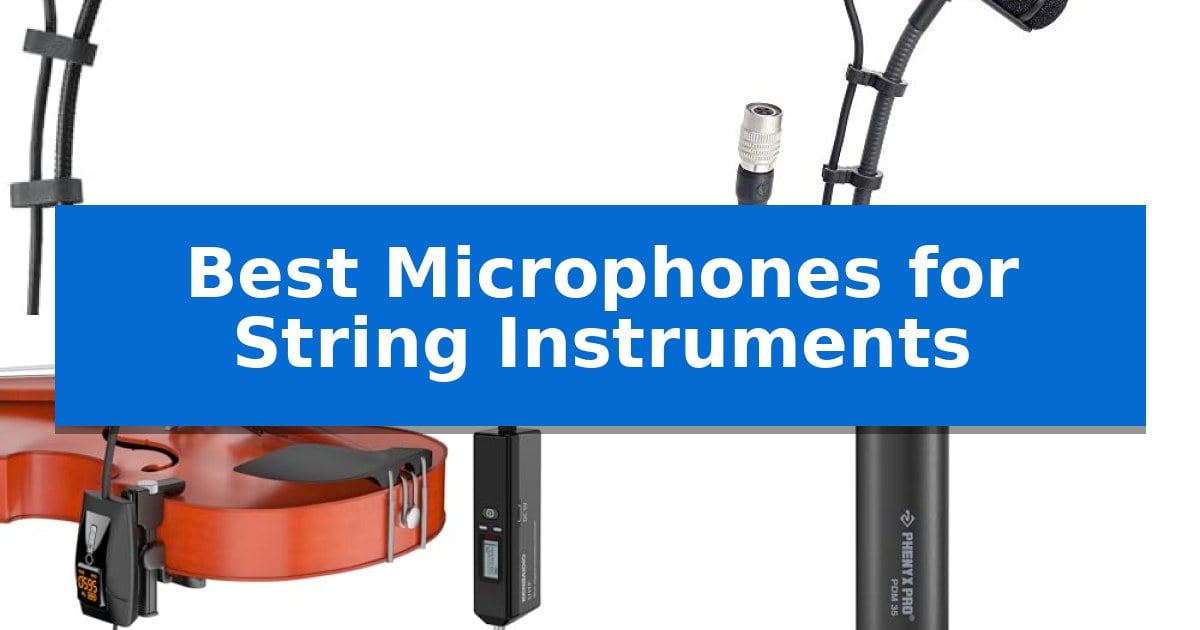
Capturing the delicate resonance of a violin, cello, or acoustic guitar requires a microphone that can handle high-frequency detail without sacrificing warmth. Finding the Best Microphones for String Instruments involves balancing sensitivity, mounting stability, and the specific requirements of your performance environment.
Whether you are playing in a quiet studio or a high-energy stage, the right microphone ensures your instrument's unique character is preserved. This guide examines five distinct models to help you select a solution that provides the isolation and clarity your performance demands.
You may also want to compare Best Microphones for Streaming Under $150, Best Microphones for Streaming Under $100, and Best Microphones for Streaming Under $50.
Best Microphones for String Instruments
Quick Comparison
| Product | Best For | Key Strength | Score |
|---|---|---|---|
| Audio-Technica PRO 35 Instrument Microphone | Best Overall | UniMount clip provides stable, shock-resistant positioning. | 4.9 |
| Audio-Technica ATM350UcW Instrument Microphone | Wireless Ready for Violin Performance | Dedicated violin mount for secure, consistent placement. | 4.5 |
| KENBAIDIO U-730 Wireless Instrument Microphone | Stable UHF Signal for Stage | 200 adjustable UHF channels for interference-free operation. | 4.5 |
| Phenyx Pro PDM35 Condenser Microphone | Balanced Response for String Detail | Cardioid polar pattern provides excellent off-axis noise rejection. | 4.6 |
| EBJ KX-801-1 Instrument Microphone | Suction Mount for Easy Attachment | Detachable suction cup mounting prevents damage to instrument paint. | 4.3 |
How We Chose
- Mounting stability and instrument safety
- Polar pattern effectiveness for noise rejection
- Frequency response accuracy for acoustic detail
- Connectivity options for stage versus studio use
- Signal stability and transmission range
1 Audio-Technica PRO 35 Instrument Microphone — Secure Clip for Precise Positioning
Capturing the nuanced resonance of acoustic instruments requires a microphone that balances sensitivity with isolation. The Audio-Technica PRO 35 Cardioid Condenser Clip-on Instrument Microphone addresses this by utilizing a specialized UniMount clip, which allows for precise positioning directly on the instrument while providing essential shock resistance to protect the internal element from handling noise.
Designed for high-performance capture, this microphone features an extended frequency response that ensures subtle tonal details are preserved during a performance. Its cardioid polar pattern is engineered to minimize off-axis sound, effectively reducing pickup from the sides and rear to maintain clear isolation of the string instrument even in busy stage environments.
The physical design emphasizes reliability and ease of use for performers. It includes a 6' (1.8 m) permanently attached cable, ensuring a secure connection during active playing. With a lightweight build of just 0.2 pounds, the microphone remains unobtrusive, allowing musicians to focus on their technique without the distraction of bulky equipment.
For those integrating this into a professional setup, the Audio-Technica PRO 35 offers a balance of durability and technical precision. It is backed by a 2-year warranty on parts and labor, providing long-term support for the condenser element. This model serves as a practical solution for musicians who require consistent, focused audio capture without the complexity of larger, stand-mounted alternatives.
Best for: Musicians needing a secure, low-profile microphone that isolates string instrument audio from ambient stage noise.
Skip if: Users who require a wireless setup or those who prefer a large-diaphragm studio microphone for non-live recording environments.
PROS
- UniMount clip provides stable, shock-resistant positioning.
- Cardioid polar pattern improves sound isolation.
- Extended frequency response captures detailed instrument nuances.
- Lightweight design ensures the microphone does not interfere with playing.
CONS
- Permanently attached cable limits replacement options if damaged.
- Wired connection requires cable management during performance.
2 Audio-Technica ATM350UcW Instrument Microphone — Wireless Ready for Violin Performance
Capturing the nuance of a string instrument requires a specialized approach that balances tonal accuracy with the physical constraints of the performance space. The Audio-Technica ATM350UcW Clip-On Instrument Microphone is engineered for this exact purpose, featuring a dedicated violin mount that secures the mic directly to the instrument, ensuring consistent placement during dynamic movements.
This wireless cardioid condenser microphone utilizes a 5-inch gooseneck that allows for precise positioning of the capsule relative to the bridge or f-holes. By keeping the microphone off the floor and attached to the instrument, it minimizes the risk of picking up unwanted stage noise while maintaining a clear, focused signal path.
Designed for integration into existing wireless setups, the unit includes a 55-inch 4-pin cable specifically configured for use with UniPak wireless transmitters. This design choice prioritizes mobility, allowing performers to move freely across a stage without the limitations of a hardwired connection.
The clip mount provides a stable base for the gooseneck, ensuring the microphone remains secure even during vigorous bowing techniques. With its compact footprint and specialized mounting hardware, this system is a practical solution for musicians who require reliable, high-fidelity sound reinforcement in a live environment.
Best for: Violinists and string players who require a secure, wireless-ready microphone system for live stage performances.
Skip if: Users who prefer a stationary microphone setup or those who do not have a compatible UniPak wireless transmitter system.
PROS
- Dedicated violin mount for secure, consistent placement.
- Flexible 5-inch gooseneck for precise capsule positioning.
- Wireless-ready design with 4-pin cable for UniPak transmitters.
- Cardioid polar pattern helps isolate the instrument sound.
CONS
- Requires a compatible wireless transmitter to function as intended.
- Limited to specific instrument mounting provided by the included hardware.
3 KENBAIDIO U-730 Wireless Instrument Microphone — Stable UHF Signal for Stage
Capturing the nuanced resonance of a violin or cello requires precise placement, which is why the KENBAIDIO U-730 Wireless Instrument Microphone utilizes an innovative gooseneck design. This flexible positioning allows performers to isolate the instrument's natural soundtrack while effectively reducing unwanted resonance and environmental noise.
The system is built for professional utility, featuring a highly sensitive cardioid condenser capsule that delivers a 24-bit/48 kHz sample rate and a frequency response of 30 Hz to 20 kHz. To maintain signal integrity in crowded performance spaces, the unit provides 200 adjustable UHF channels within the 510-590MHz range, ensuring stable transmission up to 196 feet in open areas.
Usability is prioritized through a plug-and-play interface and a clear LED digital screen that displays frequency, battery status, and volume levels. The package includes specialized clamps for both violins (1.18-2.28in) and cellos (1.18-5.71in), utilizing retractable silicone padding to ensure a secure, mark-free grip on the instrument body during active performances.
For extended sessions, the transmitter and receiver house rechargeable lithium-ion batteries that provide up to 6 hours of operation on a single charge. The entire kit is designed for portability, arriving with a dedicated storage case and a 2-in-1 USB cable that allows for simultaneous charging of both components.
Best for: Performers requiring a stable, wireless, and adjustable mounting solution for violins or cellos in live stage environments.
Skip if: Users who require a wired connection for studio-grade critical recording or those who prefer a non-clip-on microphone solution.
PROS
- 200 adjustable UHF channels for interference-free operation.
- Retractable silicone clamps that protect instrument finishes.
- High-fidelity cardioid condenser for clear sound reproduction.
- 6-hour battery life with simultaneous charging capability.
CONS
- Limited to clip-on mounting, which may not suit all instrument playing styles.
4 Phenyx Pro PDM35 Condenser Microphone — Balanced Response for String Detail
Capturing the nuanced resonance of acoustic instruments requires a microphone that balances sensitivity with precise off-axis rejection. The Phenyx Pro PDM35 Condenser Microphone utilizes a specialized cardioid polar pattern to isolate specific sound sources, such as individual strings or percussion elements, while minimizing unwanted background interference in a live or studio environment.
Engineered for versatility, this pencil stick condenser mic features a wide frequency response range designed to highlight crisp high-frequency details. This ensures that the intricate harmonics of string instruments are preserved, providing a smooth and balanced audio output that remains clear throughout the performance.
The Phenyx Pro PDM35 Condenser Microphone is built for practical integration into existing audio setups. Its low impedance and high sensitivity make it easy to drive with standard mixers and audio interfaces, ensuring a stable, balanced signal transmission via the integrated XLR connector. The housing is constructed from sturdy metal for durability, and the included mic clip features a standard thread for broad compatibility with most microphone stands.
This microphone comes as a complete kit, including a foam cover to reduce wind noise, a protective bag for storage, and a user manual. Whether miking a hi-hat or a delicate string instrument, the combination of its focused pickup pattern and robust build quality makes it a reliable tool for consistent sound capture.
Best for: Musicians and sound engineers seeking a focused, high-sensitivity condenser microphone for isolating string instruments or percussion in a live or recording setup.
Skip if: Users requiring a multi-pattern microphone or an integrated USB interface for direct computer recording without an external mixer or audio interface.
PROS
- Cardioid polar pattern provides excellent off-axis noise rejection.
- Wide frequency response captures detailed high-frequency harmonics.
- Sturdy metal housing ensures long-term durability.
- Low impedance design allows for easy integration with standard audio interfaces.
CONS
- XLR-only connectivity requires an external interface or mixer with phantom power.
5 EBJ KX-801-1 Instrument Microphone — Suction Mount for Easy Attachment
Achieving consistent audio capture for acoustic instruments often requires a balance between mobility and signal stability. The EBJ KX-801-1 Instrument Microphone addresses this by utilizing a detachable suction cup design, allowing musicians to mount the transmitter directly onto smooth surfaces of instruments like guitars, violins, cellos, or accordions without risking damage to the finish.
This system operates on a 2.4G wireless transmission protocol, engineered to maintain a stable connection within a range of up to 30 meters (approximately 100 feet). Designed for professional use in recording studios or live stage environments, the microphone provides 6-8 hours of battery life on a single charge, supporting extended performance sessions without the need for frequent power management.
Usability is a primary focus of the EBJ KX-801-1 Instrument Microphone, which includes two suction cups of varying sizes to accommodate different instrument geometries. The setup process is straightforward: attach the transmitter to the instrument, connect the receiver to a speaker or mixer's MIC interface, and power on the units. The package also includes a 3.5mm to 6.35mm adapter, ensuring compatibility with a wide range of portable PA systems, voice amplifiers, and karaoke setups.
By prioritizing high-fidelity audio reproduction, the system aims to deliver clear sound without noticeable delays or interference. The integration of noise reduction technology further assists in maintaining signal integrity during live performances, making it a practical tool for performers who require a reliable, wireless solution for their acoustic setups.
Best for: Musicians seeking a wireless, non-invasive microphone mounting solution for acoustic instruments during live performances or studio recording.
Skip if: Users who require a wired connection for absolute signal reliability or those playing instruments with textured surfaces where suction cups cannot maintain a secure hold.
PROS
- Detachable suction cup mounting prevents damage to instrument paint.
- 2.4G wireless transmission provides a stable 30-meter range.
- Versatile compatibility with various PA systems and mixers via included adapters.
- 6-8 hour battery life supports long performance sessions.
CONS
- Surface dependency requires smooth instrument areas for effective suction.
- Wireless-only operation may not be suitable for environments with high 2.4G frequency congestion.
Best Microphones for String Instruments Buying Guide
Understanding Polar Patterns
Most microphones for string instruments utilize a cardioid polar pattern. This design is essential because it focuses on the sound directly in front of the capsule while rejecting noise from the sides and rear.
By isolating the sound source, a cardioid mic helps prevent feedback during live performances. This is particularly important when playing alongside other musicians or using floor monitors.
Mounting and Instrument Safety
The way a microphone attaches to your instrument can significantly impact both your comfort and the safety of your instrument's finish. UniMount clips or retractable silicone clamps are designed to provide a secure grip without causing damage.
When choosing a mount, consider the size of your instrument. Some clips are specifically optimized for the narrow body of a violin, while others offer the wider reach necessary for a cello.
Wireless vs. Wired Connectivity
Your choice between a wired or wireless system depends on your mobility needs. Wired microphones offer a consistent, interference-free signal and are ideal for stationary recording or seated performances.
Wireless systems provide freedom of movement on stage. When selecting a wireless model, look for UHF transmission technology, which typically offers more stable signal paths in crowded environments compared to basic 2.4G systems.
Frequency Response and Detail
String instruments produce a wide spectrum of harmonics. A microphone with an extended frequency response is better equipped to capture the subtle nuances of your playing, from the initial bow stroke to the decay of the note.
Look for condenser microphones, as they are generally more sensitive to high-frequency transients than dynamic microphones, making them the standard choice for acoustic string reproduction.
Signal Integrity and Impedance
The output of your microphone must match your mixer or audio interface. Low impedance microphones are generally easier to drive and provide a cleaner signal over longer cable runs.
If you are using a wireless setup, ensure the transmitter and receiver are compatible with your existing PA system or mixer inputs, often requiring a standard 1/4-inch or 1/8-inch adapter.
Frequently Asked Questions
Can I use a clip-on microphone on any string instrument?
While many clip-on microphones are versatile, you must ensure the clamp size is compatible with your instrument. Some models are specifically designed for violins, while others include larger clamps for cellos or double basses.
What is the benefit of a condenser microphone for strings?
Condenser microphones are highly sensitive and capable of capturing the fast transients and delicate high-frequency details of string instruments, resulting in a more natural and transparent sound.
Will a clip-on microphone damage my instrument's varnish?
High-quality instrument microphones are designed with protective, non-marring materials like silicone or rubberized padding to ensure they can be attached securely without scratching or damaging the instrument's finish.
Do I need a phantom power supply?
Most condenser microphones require phantom power (typically 48V) provided by your mixer or audio interface to operate. Always check your microphone's technical specifications to confirm power requirements.
How do I reduce feedback during a live performance?
Using a microphone with a tight cardioid polar pattern and keeping your microphone as close to the sound source as possible will help minimize feedback. Additionally, proper placement of your stage monitors can significantly reduce unwanted noise pickup.
Conclusion: Our Top Pick
Selecting the right microphone depends heavily on your specific performance environment and instrument type. For those seeking a reliable, high-fidelity solution that excels in both studio and stage settings, the Audio-Technica PRO 35 Instrument Microphone is our top recommendation. Its combination of a secure UniMount clip, effective cardioid isolation, and extended frequency response makes it a versatile tool for any string player.
While wireless options offer greater mobility, the wired simplicity of the PRO 35 ensures a consistent, high-quality signal without the need for battery management or frequency coordination. It remains a dependable choice for musicians who prioritize sound accuracy and long-term durability.