
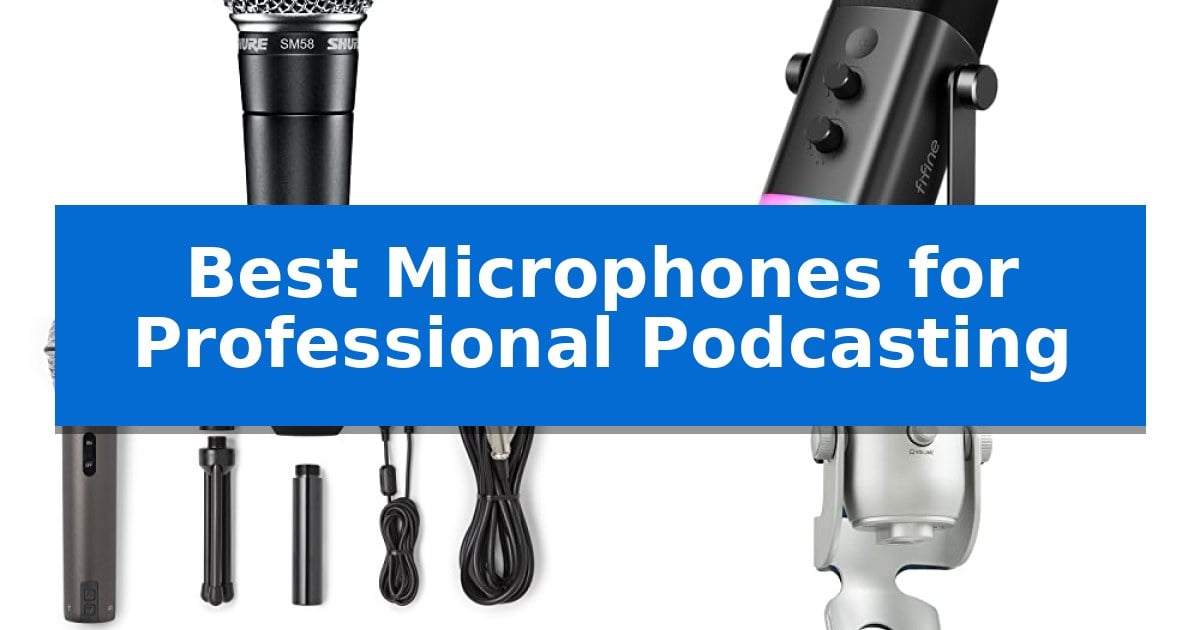
Achieving a broadcast-ready sound is the primary goal for any content creator, yet the sheer variety of hardware can make selecting the right gear feel overwhelming. Whether you are recording in a dedicated studio or a home office, the right equipment ensures your message is heard with clarity and professional authority.
Our guide explores the Best Microphones for Professional Podcasting to help you navigate the differences between XLR, USB, and wireless connectivity. By focusing on essential audio performance and practical integration, we provide the insights needed to select a microphone that elevates your production value.
You may also want to compare Best Microphones for Presentations, Best Microphones for Portable Podcasting, and Best Microphones for Pop Vocals.
Best Microphones for Professional Podcasting
Quick Comparison
| Product | Best For | Key Strength | Score |
|---|---|---|---|
| Shure SM58 Dynamic Vocal Microphone | Best Overall | Finely tuned frequency response for articulate vocal reproduction. | 4.9 |
| FIFINE AmpliGame AM8 Dynamic Microphone | Versatile Dual-Output Connectivity | Dual-output connectivity supporting both USB and XLR interfaces. | 4.7 |
| Samson Q2U Dynamic Microphone | Reliable Entry-Level Broadcast Audio | Dual-output design supporting both USB-C and XLR connections. | 4.6 |
| Logitech Blue Yeti USB Microphone | Flexible Multi-Pattern Recording | Four selectable pickup patterns for diverse recording environments | 4.5 |
| MAONO PD200W Hybrid Wireless Microphone | Freedom of Wireless Podcasting | Hybrid connectivity supports wireless, USB, and XLR interfaces. | 4.6 |
How We Chose
- Capsule type and polar pattern performance for focused vocal capture.
- Connectivity options including XLR, USB, and wireless capabilities.
- Build quality and durability for long-term studio or mobile use.
- Integrated features such as mute buttons, gain control, and noise reduction.
- Compatibility with existing audio interfaces and recording software.
1 Shure SM58 Dynamic Vocal Microphone — Industry Standard for Vocal Clarity
Achieving professional-grade audio in a home studio requires hardware that prioritizes reliability and sonic accuracy. The Shure SM58 Pro XLR Dynamic Vocal Microphone is engineered for these exact demands, featuring a finely tuned frequency response with a subtle midrange lift that produces warm, articulate vocals designed to cut through a mix without additional processing.
Built for versatility, this microphone utilizes a precision cardioid pickup pattern. This design focuses tightly on the speaker's voice while effectively minimizing background noise and feedback, making it an ideal choice for recording in environments that are not acoustically treated. Its integrated pop protection—consisting of a refined spherical grille and a built-in filter—works to reduce plosives and breath noise, maintaining clarity during long recording sessions.
The construction of the Shure SM58 Pro XLR Dynamic Vocal Microphone reflects its history in professional broadcast and live performance. It features a rugged metal construction and a reinforced stand adapter, ensuring it can withstand the physical rigors of frequent use. This durability makes it a long-term investment for podcasters who require consistent performance from their equipment.
As an XLR-based device, this microphone requires an external audio interface or mixer to connect to a computer. This setup provides the benefit of professional-grade signal paths but necessitates additional hardware compared to USB-based microphones. The inclusion of a two-year warranty underscores the manufacturer's commitment to the build quality of this industry-standard tool.
Best for: Podcasters and creators who prioritize vocal clarity and long-term hardware durability in an XLR-based professional audio setup.
Skip if: Users who require a simple plug-and-play USB connection or those who do not already own an external audio interface or mixer.
PROS
- Finely tuned frequency response for articulate vocal reproduction.
- Precision cardioid pickup pattern to isolate voice and reduce background noise.
- Integrated pop protection reduces the need for external accessories.
- Rugged metal construction ensures high durability for frequent use.
CONS
- Requires an external XLR audio interface or mixer for operation.
- Lacks direct USB connectivity for simple computer integration.
2 FIFINE AmpliGame AM8 Dynamic Microphone — Versatile Dual-Output Connectivity
Achieving professional audio quality for your recordings often hinges on the flexibility of your hardware. The FIFINE AmpliGame AM8 Dynamic Microphone offers a distinct advantage by providing both USB and XLR connectivity, allowing creators to transition from simple plug-and-play setups to more complex, professional-grade audio interfaces without needing to replace their primary microphone.
Designed with a cardioid dynamic capsule, this microphone focuses on capturing sound directly in front of the element while rejecting off-axis ambient noise. This design choice helps maintain vocal clarity and intelligibility, even in environments that are not acoustically treated. The included noise-canceling windscreen further assists in reducing unwanted hums from nearby electronics, ensuring a cleaner signal for your listeners.
For those utilizing the USB connection, the microphone provides several integrated controls that simplify the recording workflow. A tap-to-mute button with an LED indicator offers immediate privacy, while a dedicated headphone jack allows for real-time monitoring of your audio levels. Users can also adjust the mic gain knob directly on the chassis to optimize input levels, reducing the need for extensive post-production adjustments.
The physical design incorporates 3/8'' and 5/8'' metal threads, making it compatible with most standard microphone stands and boom arms without requiring additional adapters. When connected via USB, the unit features controllable RGB lighting with multiple modes and a memory function, allowing it to integrate visually with existing gaming or streaming setups. This combination of robust connectivity and practical onboard controls makes it a versatile tool for various recording environments.
Best for: Creators who want a single microphone that can start as a simple USB device and later integrate into a professional XLR audio interface setup.
Skip if: Users who require a dedicated XLR-only microphone or those who prefer a specific studio-grade aesthetic without RGB lighting features.
PROS
- Dual-output connectivity supporting both USB and XLR interfaces.
- Integrated tap-to-mute and headphone monitoring for USB operation.
- Built-in metal threads for broad compatibility with standard mic stands.
- Cardioid dynamic capsule designed to reject off-axis background noise.
CONS
- RGB and function keys are inactive when using the XLR connection.
- XLR cable not included in the package.
3 Samson Q2U Dynamic Microphone — Reliable Entry-Level Broadcast Audio
The Samson Q2U USB/XLR Dynamic Microphone offers a versatile dual-output design that allows creators to connect directly to a computer via a USB-C interface or to professional audio gear through an XLR connection. This flexibility makes it a practical choice for those who need to transition between simple desktop setups and more complex studio environments without replacing their primary hardware.
As a dynamic handheld microphone, this unit is designed to capture sound while minimizing background noise, which is essential for recording in non-treated environments. The inclusion of a tripod desktop stand, tripod extension, mic clip, and windscreen provides the necessary components to begin recording immediately. These accessories help stabilize the microphone and manage plosives during vocal tracking.
The integration of both digital and analog connectivity ensures that the microphone remains functional as a user's recording setup evolves. By providing both a USB-C cable and an XLR cable in the box, the package eliminates the need for immediate additional purchases, simplifying the initial setup process for new podcasters.
While the microphone is well-equipped for vocal clarity, its handheld form factor requires consistent mic technique to maintain optimal levels. Users should note that the included tripod stand is best suited for desk-level placement, and those requiring specific boom arm positioning may need to source compatible mounting hardware separately.
Best for: Podcasters and creators who need a versatile microphone that works with both USB-C computers and professional XLR audio interfaces.
Skip if: Users who require a dedicated studio condenser microphone with high-sensitivity patterns or those who already possess a high-end XLR-only interface and prefer a larger diaphragm microphone.
PROS
- Dual-output design supporting both USB-C and XLR connections.
- Comprehensive accessory bundle including cables, stand, and windscreen.
- Dynamic capsule helps reduce unwanted background noise pickup.
- Plug-and-play compatibility with modern computer interfaces.
CONS
- Handheld form factor may require specific technique for consistent audio levels.
- Included tripod stand has limited height and positioning adjustments.
4 Logitech Blue Yeti USB Microphone — Flexible Multi-Pattern Recording
Achieving broadcast-quality audio requires a versatile tool that adapts to various recording environments, from solo commentary to multi-guest interviews. The Logitech Creators Blue Yeti USB Microphone distinguishes itself with a custom three-capsule array that provides the flexibility needed for professional-grade podcasting without requiring complex external interfaces.
This microphone simplifies the recording process through its four pickup patterns, which include cardioid, omni, bidirectional, and stereo modes. By selecting the appropriate pattern, creators can optimize their audio capture for specific scenarios, such as isolating a single voice or recording multiple participants around a table. The inclusion of Blue VO!CE software further enhances production value by offering advanced modulation, HD audio samples, and clear broadcast vocal effects.
Usability is a core focus of the design, featuring onboard audio controls that allow for real-time adjustments. Users can manage headphone volume, pattern selection, instant mute, and mic gain directly from the device. The positionable design includes an adjustable desktop stand, enabling users to pivot the microphone toward the sound source for improved clarity, while no-latency monitoring ensures precise tracking during live sessions.
While this microphone offers extensive functionality, its size and weight should be considered for those with limited desk space. The unit measures 11.6 inches in height and weighs 3.2 pounds, making it a substantial addition to a workstation. It is a plug-and-play solution, meaning it integrates easily with PC and Mac systems, fitting well into setups that prioritize streamlined, all-in-one hardware over modular professional audio chains.
Best for: Podcasters and streamers who require a versatile, all-in-one USB microphone with multiple pickup patterns and onboard controls.
Skip if: Users who require a compact, lightweight microphone for travel or those who prefer a dedicated XLR-based audio interface setup.
PROS
- Four selectable pickup patterns for diverse recording environments
- Onboard controls for gain, mute, and headphone volume
- Plug and play compatibility with PC and Mac
- Integrated Blue VO!CE software for enhanced vocal effects
CONS
- Substantial footprint and weight may occupy significant desk space
5 MAONO PD200W Hybrid Wireless Microphone — Freedom of Wireless Podcasting
Achieving broadcast-ready audio without a dedicated soundproof booth is a common challenge for creators, but the MAONO PD200W Hybrid Wireless Microphone addresses this with an integrated three-stage noise cancellation system. This dynamic microphone is built to prioritize vocal clarity, utilizing a cardioid pickup pattern to isolate the speaker's voice while minimizing room echo and ambient background noise.
The versatility of the MAONO PD200W Hybrid Wireless Microphone is defined by its hybrid connectivity, offering wireless freedom, USB plug-and-play for digital devices, and XLR output for professional audio interfaces. This flexibility allows users to transition between a mobile setup and a stationary studio environment without changing hardware.
For duo podcasts or interviews, the system supports a single receiver that connects two wireless microphones simultaneously. Each mic is recorded to its own track, which simplifies post-production editing. Furthermore, the device can capture audio and video in sync directly to a camera, reducing the need for manual alignment during the editing process.
Users can further refine their sound through the MaonoLink app, which provides access to four master-tuned preset modes and granular adjustments for EQ and reverb. The hardware is designed for long-form recording sessions, offering up to 60 hours of battery life when the RGB lighting is disabled, and it maintains a stable wireless range of up to 60 meters.
The package includes a comprehensive creator kit, featuring the microphone, a desktop stand, and necessary cables for immediate setup. With its combination of dynamic capsule technology, hybrid connectivity, and app-based sound customization, this microphone provides a robust solution for diverse recording requirements.
Best for: Creators who need a versatile microphone that transitions between wireless, USB, and XLR setups for solo or duo podcasting.
Skip if: Users who require a strictly wired-only professional XLR microphone and do not need wireless functionality or software-based sound processing.
PROS
- Hybrid connectivity supports wireless, USB, and XLR interfaces.
- Three-stage noise cancellation reduces background noise and echo.
- Dual-mic support with individual track recording for interviews.
- MaonoLink app allows for EQ and reverb customization.
CONS
- Camera/Lightning accessories for direct camera sync are sold separately.
- Battery life is limited to 60 hours and is affected by RGB lighting usage.
Best Microphones for Professional Podcasting Buying Guide
Understanding Microphone Connectivity
The choice between XLR and USB connectivity is the most significant decision for a podcaster. XLR microphones require an external audio interface or mixer, which provides more control over gain and signal quality, making them the standard for professional studio setups.
Conversely, USB microphones offer a plug-and-play experience that is ideal for beginners or those who need a portable, streamlined setup. Some modern microphones provide dual-output connectivity, allowing you to start with USB and upgrade to an XLR interface later without replacing your hardware.
Polar Patterns and Background Noise
Most podcasting microphones utilize a cardioid pickup pattern, which is designed to focus on the sound source directly in front of the capsule while rejecting noise from the sides and rear. This is crucial for home studios that may not be perfectly soundproofed.
Some advanced models offer multi-pattern recording, allowing you to switch between cardioid, omnidirectional, or bidirectional modes. This flexibility is beneficial if you plan to record interviews with multiple people around a single microphone or capture ambient sound.
Dynamic vs. Condenser Capsules
Dynamic microphones are generally preferred for podcasting because they are less sensitive to background noise and room reflections. Their robust construction makes them excellent for voiceover work where you want a warm, focused sound that minimizes the need for extensive post-production.
While condenser microphones are known for capturing high-frequency detail, they are often too sensitive for untreated rooms. For most professional podcasting applications, a dynamic capsule provides the best balance of clarity and noise rejection.
Essential Integrated Features
Modern podcast microphones often include built-in features that simplify the recording process. Onboard gain control allows you to adjust your input levels directly on the device, while headphone jacks provide zero-latency monitoring so you can hear exactly what you are recording in real time.
Features like tap-to-mute buttons and integrated pop protection can significantly reduce the time spent on editing. These tools help maintain a clean audio signal, ensuring that plosives and accidental background noise do not compromise your final output.
Durability and Mounting Options
A professional microphone should be built to withstand daily use. Look for rugged metal construction and reinforced stand adapters that ensure the unit remains stable during long recording sessions.
Consider the mounting options available for your desk space. Many microphones come with desktop stands, but for the best results, you may eventually want to mount your microphone on a boom arm to save space and improve positioning relative to your mouth.
Frequently Asked Questions
Do I need an audio interface for a dynamic microphone?
If your microphone is strictly XLR, you will need an audio interface or mixer to convert the analog signal into digital data for your computer. If the microphone has a USB output, you can connect it directly to your computer.
What is the benefit of a cardioid pickup pattern?
A cardioid pattern focuses on sound coming from the front of the microphone while rejecting sound from the back and sides, which helps minimize background noise and room echo.
Can I use a wireless microphone for professional podcasting?
Yes, hybrid wireless microphones offer significant freedom of movement. Ensure the system provides a stable connection and allows for individual track recording if you are interviewing multiple guests.
How close should I be to my microphone?
For most dynamic podcasting microphones, a distance of 2 to 6 inches is recommended to achieve a clear, warm vocal sound while minimizing plosives.
Why is a dynamic microphone better than a condenser for home studios?
Dynamic microphones are generally less sensitive to ambient noise and room reflections, making them more forgiving in environments that lack professional acoustic treatment.
Conclusion: Our Top Pick
Selecting the right microphone depends on your specific recording environment and technical requirements. For those prioritizing consistent, professional-grade vocal clarity, the Shure SM58 Dynamic Vocal Microphone remains an industry benchmark. Its rugged design and finely tuned frequency response make it a reliable choice for any serious podcaster.
While other options offer modern conveniences like USB connectivity or RGB lighting, the Shure SM58's reputation for durability and performance in diverse settings ensures it remains a foundational tool for professional audio capture.