
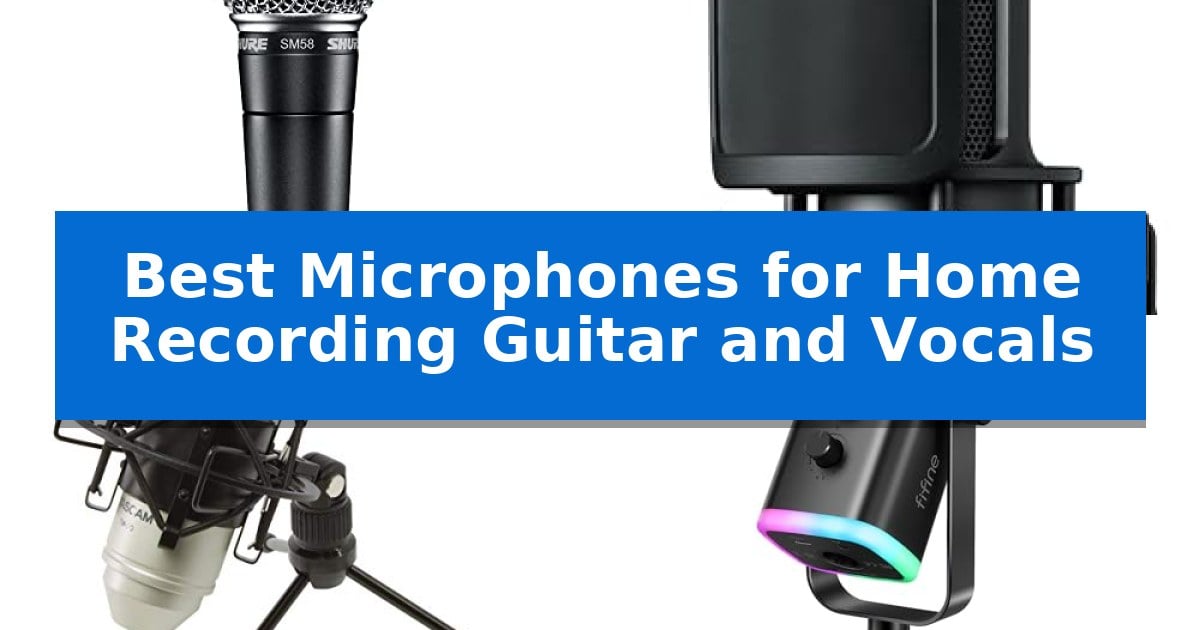
Capturing the nuance of an acoustic guitar or the clarity of a vocal performance requires a microphone that balances sensitivity with accurate frequency response. Whether you are building a professional-grade signal chain or a simple desktop setup, finding the Best Microphones for Home Recording Guitar and Vocals depends on how your chosen hardware interacts with your existing interface and recording environment.
The market offers a wide range of designs, from rugged dynamic models built for high-SPL sources to detailed condenser microphones that excel at picking up subtle acoustic textures. By understanding the differences between connection types and polar patterns, you can select a tool that minimizes unwanted room noise while highlighting the natural character of your instruments and voice.
You may also want to compare Best Microphones for Home Recording, Best Microphones for Home Podcasting, and Best Microphones for Home Music Studios.
Best Microphones for Home Recording Guitar and Vocals
Quick Comparison
| Product | Best For | Key Strength | Score |
|---|---|---|---|
| Shure SM58 Dynamic Vocal Microphone | Best Overall | Finely tuned frequency response for warm vocal reproduction. | 4.9 |
| Shure SM4 Condenser Microphone | Clean Studio-Grade Capture | High-SPL handling up to 140dB for distortion-free recording of loud instruments. | 4.8 |
| Tascam TM-80 Condenser Microphone | Budget-Friendly Starter Kit | High 136dB SPL rating allows for recording loud instruments without distortion. | 4.7 |
| FIFINE AmpliGame AM8 Dynamic Microphone | Versatile Dual-Connection Design | Dual-connection versatility with both USB and XLR outputs. | 4.4 |
| FIFINE K669B USB Condenser Microphone | Easiest Plug-and-Play Setup | Plug-and-play USB connectivity eliminates the need for external power supplies. | 4.3 |
How We Chose
- Signal connectivity, focusing on the versatility of XLR interfaces versus the convenience of USB plug-and-play setups.
- Polar pattern consistency, prioritizing cardioid designs that effectively reject off-axis background noise.
- Maximum sound pressure level (SPL) handling to ensure distortion-free recording of loud guitar amplifiers or percussion.
- Build quality and included accessories, such as shock mounts and integrated pop filters, which reduce the need for additional purchases.
- Frequency response characteristics, looking for balanced profiles that provide clarity for both vocalists and acoustic instruments.
1 Shure SM58 Dynamic Vocal Microphone — Industry Standard for Vocals
Achieving professional-grade audio at home requires equipment that balances sensitivity with durability. The Shure SM58 Dynamic Vocal Microphone is a staple in recording environments, utilizing a finely tuned frequency response with a subtle midrange lift to ensure vocals remain warm and articulate within a dense mix.
Designed for versatility, this microphone excels in both studio recording and live performance settings. Its precision cardioid pickup pattern is engineered to focus tightly on the sound source, effectively minimizing background noise and unwanted feedback, which is essential when tracking vocals or acoustic guitar in an untreated home space.
Usability is enhanced by an integrated pop protection system. The refined spherical grille and built-in filter work together to mitigate plosives and breath noise, maintaining clarity without requiring external accessories. This design choice simplifies the recording chain, allowing for a more streamlined setup.
Built for longevity, the microphone features a rugged metal construction and a reinforced stand adapter. This robust build quality ensures the device can withstand the physical demands of frequent use, backed by a 2-year warranty to provide long-term reliability for home creators.
Best for: Home studio vocalists and instrumentalists seeking a reliable, industry-standard microphone that excels at rejecting background noise.
Skip if: Users requiring a high-sensitivity condenser microphone for capturing ultra-fine acoustic detail or those who prefer a side-address form factor.
PROS
- Finely tuned frequency response for warm vocal reproduction.
- Precision cardioid pickup pattern that minimizes feedback and ambient noise.
- Integrated pop protection reduces the need for external filters.
- Rugged metal construction designed for long-term durability.
CONS
- Dynamic design may require more gain from an interface compared to condenser alternatives.
2 Shure SM4 Condenser Microphone — Clean Studio-Grade Capture
Capturing the nuance of an acoustic guitar or the breathy detail of a vocal performance requires a microphone that balances sensitivity with robust construction. The Shure SM4 Condenser Microphone utilizes a brass 1-inch dual-diaphragm capsule to deliver clean, controlled low-end frequencies alongside smooth, detailed highs, providing a natural sound profile for home studio environments.
Designed for versatility, the Shure SM4 Condenser Microphone features a uniform cardioid polar pattern that excels at off-axis noise rejection, ensuring your primary sound source remains isolated. Its ability to handle high-SPL up to 140dB allows you to record loud instruments without the risk of distortion, making it a reliable choice for both delicate vocals and high-output guitar amplifiers.
Practicality is central to the design, with patent-pending interference shielding technology that blocks RF noise from common home electronics like Wi-Fi routers and laptops. The inclusion of an integrated pop filter and a woven mesh Faraday cage minimizes plosive sounds, resulting in mix-ready audio that requires less post-production correction.
Built for longevity, the microphone features a rugged, all-metal construction suitable for both studio and stage use. Its low-profile, camera-ready design ensures that it does not obscure the performer, which is particularly beneficial for those who record video content or live-stream their music sessions.
Best for: Home studio musicians seeking a versatile, durable condenser microphone that effectively manages high-volume sources and minimizes common electronic interference.
Skip if: Users who require a multi-pattern microphone for specialized stereo or omnidirectional recording techniques will find the fixed cardioid pattern too limiting.
PROS
- High-SPL handling up to 140dB for distortion-free recording of loud instruments.
- Integrated pop filter and Faraday cage for cleaner, mix-ready audio capture.
- Interference shielding specifically designed to block RF noise from home electronics.
- Durable all-metal construction built for long-term studio or stage reliability.
CONS
- Fixed cardioid polar pattern limits flexibility for non-standard recording applications.
3 Tascam TM-80 Condenser Microphone — Budget-Friendly Starter Kit
Capturing the nuance of an acoustic guitar or the clarity of a vocal performance requires a microphone that can handle diverse sound sources without coloring the output. The Tascam TM-80 Large Diaphagm Condenser Microphone is built specifically for this purpose, utilizing an 18mm aluminum diaphragm and a cardioid pickup pattern to isolate the desired sound while minimizing background interference.
Designed for home recording environments, this microphone features internal circuitry optimized to reduce noise and distortion. This focus on signal integrity ensures that your recordings remain clean, preserving the rich, full sound quality necessary for professional-sounding tracks. Whether tracking delicate vocals or rhythmic guitar parts, the hardware is tuned to maintain a balanced frequency response.
Versatility is a core strength of this model, as it boasts a maximum sound pressure rating of 136dB SPL. This high tolerance allows users to record loud instruments, such as guitar amplifiers or percussion, without the risk of clipping or signal degradation. It provides a reliable solution for creators who need one microphone to handle both quiet vocal takes and high-volume instrumental sessions.
The package includes essential accessories to facilitate an immediate start to recording. It comes with a tabletop stand, a six-foot XLR cable, and an elastic shockmount. The shockmount is particularly useful for reducing mechanical rumble and handling noise, ensuring that your recordings remain clear and free of unwanted vibrations during the creative process.
Best for: Home studio musicians and vocalists who need a versatile, all-in-one starter kit capable of handling both quiet vocals and loud instrument amplifiers.
Skip if: Users who require a multi-pattern microphone for specialized recording techniques like stereo miking or omnidirectional room capture.
PROS
- High 136dB SPL rating allows for recording loud instruments without distortion.
- Includes a complete starter accessory kit with a shockmount, stand, and XLR cable.
- Cardioid pickup pattern effectively isolates vocals and instruments from room noise.
- Optimized internal circuitry minimizes self-noise for cleaner signal paths.
CONS
- Fixed cardioid-only pickup pattern limits flexibility for complex recording setups.
4 FIFINE AmpliGame AM8 Dynamic Microphone — Versatile Dual-Connection Design
The FIFINE AmpliGame AM8 Dynamic Microphone offers a versatile dual-connection design, allowing users to switch between USB and XLR outputs to suit different recording environments. This flexibility makes it a practical choice for those transitioning from simple plug-and-play setups to more advanced audio interfaces or mixers.
Equipped with a cardioid dynamic capsule, the microphone is engineered to reject off-axis noise, which helps maintain vocal clarity and focus during home recording sessions. Its frequency response range of 50Hz-16KHz provides a balanced sound profile suitable for capturing both spoken word and acoustic guitar performances without excessive coloration.
For USB users, the device includes integrated RGB lighting with multiple modes and a tap-to-mute button with an LED indicator for quick status checks. The inclusion of a headphone jack with volume monitoring allows for real-time audio feedback, while the gain knob provides tactile control over input levels to help manage signal strength before it reaches your recording software.
The chassis features 3/8'' and 5/8'' metal threads, ensuring compatibility with a wide range of standard microphone stands without requiring additional adapters. The package also includes a windscreen cover designed to reduce unwanted hum and plosives, contributing to a cleaner overall recording experience.
Best for: Beginner creators and home studio users who require a flexible microphone that functions as both a simple USB device and a professional-grade XLR component.
Skip if: Users who exclusively require XLR connectivity will find the integrated RGB and mute features redundant, as these functions are inactive when the microphone is used in XLR mode.
PROS
- Dual-connection versatility with both USB and XLR outputs.
- Integrated tap-to-mute button and LED status light for USB operation.
- Built-in headphone monitoring with independent volume control.
- Universal mounting compatibility via integrated 3/8'' and 5/8'' threads.
CONS
- Limited functionality in XLR mode, as RGB and onboard controls are disabled.
- XLR cable not included in the package.
5 FIFINE K669B USB Condenser Microphone — Easiest Plug-and-Play Setup
The FIFINE K669B USB Condenser Microphone prioritizes a streamlined workflow with its plug-and-play USB-A connectivity, allowing for direct integration with desktop and laptop computers without the need for external phantom power. This design choice simplifies the recording chain for home studios, making it a practical solution for capturing vocals and acoustic guitar directly into recording software like Audacity.
Engineered with a cardioid polar pattern, the microphone is built to focus on the primary sound source while minimizing ambient background noise. The inclusion of an integrated volume knob on the chassis provides immediate physical control over input sensitivity, allowing users to adjust levels or mute the signal entirely to maintain privacy during sessions.
Constructed with a durable metal body, the unit is designed for longevity and includes a stable tripod stand for desk-based placement. The package comes with a 5.9-foot USB cable, providing sufficient reach for various home studio configurations. It is compatible with Windows and Mac OS environments, supporting a wide range of applications from voice-overs to music production.
While the FIFINE K669B USB Condenser Microphone offers a straightforward entry point for home recording, it is important to note that it is not compatible with gaming consoles like Xbox or mobile phones. Users should also ensure that sound-activated recording features in software like Zoom are disabled to prevent automatic volume fluctuations during use.
Best for: Home creators and musicians seeking a simple, budget-conscious USB microphone for vocal and acoustic instrument recording.
Skip if: Users who require compatibility with mobile devices, gaming consoles, or professional XLR-based audio interfaces.
PROS
- Plug-and-play USB connectivity eliminates the need for external power supplies.
- Integrated volume knob allows for quick, tactile gain adjustments.
- Solid metal construction provides enhanced durability for desktop use.
- Cardioid polar pattern effectively isolates the main sound source.
CONS
- Not compatible with Xbox or mobile phone devices.
- Limited to USB connection, preventing use with traditional XLR audio interfaces.
Best Microphones for Home Recording Guitar and Vocals Buying Guide
Dynamic vs. Condenser Microphones
The most fundamental choice in home recording is between dynamic and condenser microphones. Dynamic microphones, like the Shure SM58, are generally more robust and better at handling high-volume sources without distortion, making them ideal for loud guitar cabinets or energetic vocalists.
Condenser microphones, conversely, use a lighter diaphragm that is more sensitive to high-frequency detail and transient response. This makes them the preferred choice for acoustic guitars where capturing the shimmer of strings and the resonance of the wood is essential for a professional-sounding mix.
The Importance of Polar Patterns
Most home recording microphones feature a cardioid polar pattern, which is designed to capture sound primarily from the front while rejecting noise from the sides and rear. This is crucial in home studios that may not have professional acoustic treatment, as it helps isolate your voice or guitar from room reflections.
When recording, ensure the microphone is positioned correctly relative to the source. A cardioid mic placed too far from the sound source will naturally pick up more of the room's ambient noise, which can lead to a 'muddy' or distant-sounding recording that is difficult to fix during post-production.
Connectivity and Interfaces
Choosing between XLR and USB connectivity depends on your current equipment. XLR microphones require an external audio interface to convert the analog signal into digital data, which provides greater control over gain staging and allows for the use of professional-grade preamps.
USB microphones offer a streamlined, all-in-one solution that connects directly to your computer. While these are excellent for beginners or mobile setups, they lack the modularity of an XLR system, meaning you cannot easily upgrade the preamp or converter independently as your studio grows.
Managing Proximity Effect
The proximity effect is a phenomenon where low-frequency response increases as the sound source gets closer to the microphone. While this can add a desirable 'warmth' to a vocal performance, it can also make an acoustic guitar sound boomy or indistinct.
Experimenting with microphone distance is a key skill for any home recordist. If your recording sounds too bass-heavy, simply moving the microphone a few inches further away from the source can often restore a natural, balanced frequency response without requiring complex EQ adjustments later.
Essential Studio Accessories
Beyond the microphone itself, accessories play a vital role in audio quality. A shock mount is essential for condenser microphones to prevent low-frequency vibrations from the floor or desk from traveling through the mic stand and into your recording.
Similarly, a pop filter is non-negotiable for vocal recording. It physically disperses the bursts of air from plosive consonants like 'p' and 'b,' preventing them from overloading the microphone's capsule and creating distracting 'thumping' sounds in your final track.
Frequently Asked Questions
Do I need phantom power for my microphone?
Phantom power (+48V) is typically required for condenser microphones to power their internal electronics. Dynamic microphones, such as the Shure SM58, do not require phantom power and will function perfectly without it.
Can I use a USB microphone for professional recording?
Yes, many modern USB microphones provide high-quality digital conversion. However, XLR microphones are generally preferred for professional studios because they allow you to pair the mic with specific preamps and interfaces to achieve a particular sonic character.
How do I reduce background noise in my recordings?
Using a microphone with a tight cardioid pickup pattern and keeping the mic as close to the sound source as possible are the most effective ways to minimize background noise. Additionally, recording in a room with soft furnishings like curtains or rugs can help reduce unwanted echoes.
What is the best way to record an acoustic guitar?
A common starting point is to place a condenser microphone about 6 to 12 inches away from the guitar, pointed toward the 12th fret. This position captures a balanced mix of the string definition and the body resonance.
Do I need a separate pop filter if my mic has an integrated one?
Integrated pop filters are helpful for casual use, but for serious vocal recording, an external pop filter is often more effective at diffusing air blasts before they hit the microphone capsule, providing a cleaner signal.
Conclusion: Our Top Pick
Selecting the right microphone is the most significant step toward achieving professional-quality results in your home studio. For most users, the Shure SM58 Dynamic Vocal Microphone remains the top recommendation due to its legendary durability, consistent frequency response, and ability to handle both vocal and instrument sources with ease.
While condenser microphones offer more detail for acoustic instruments, the versatility and road-ready construction of the Shure SM58 Dynamic Vocal Microphone make it an indispensable tool for any home recordist. Its ability to reject off-axis noise ensures that your recordings remain clean, even in less-than-perfect acoustic environments.