
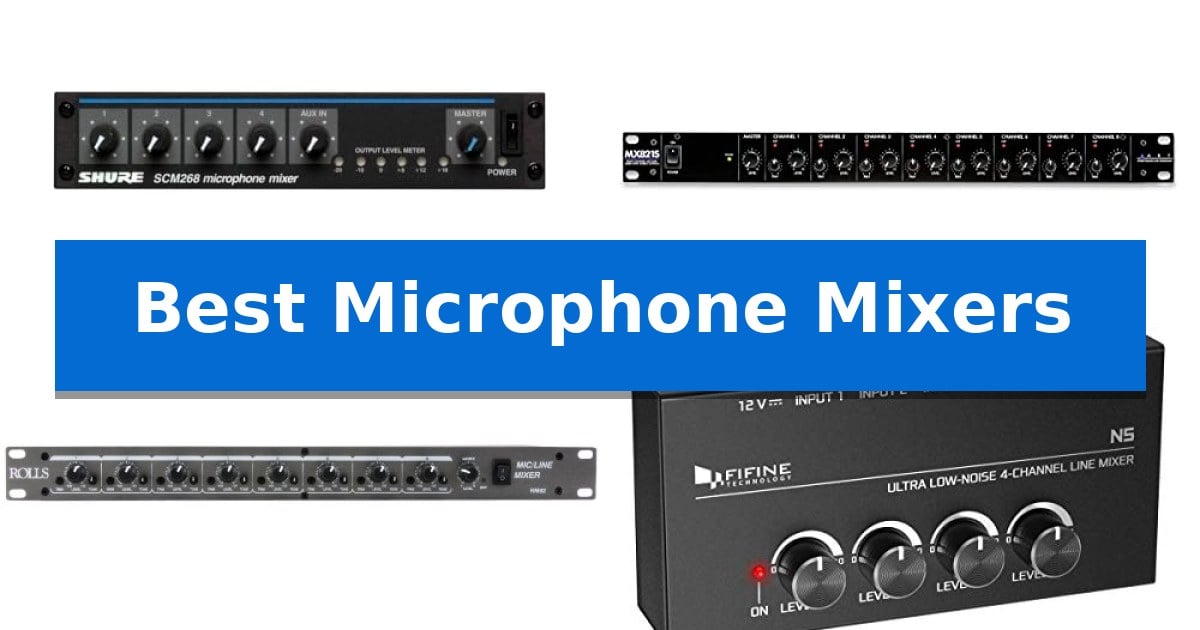
Managing multiple audio sources requires a reliable interface that balances signal integrity with ease of use. Whether you are setting up a small meeting room or a complex studio rig, selecting the right hardware is essential for maintaining clear, professional-grade sound across all your inputs.
Our guide explores the Best Microphone Mixers currently available, focusing on how different routing capabilities and input configurations can streamline your workflow. We examine how these devices handle phantom power, signal processing, and connectivity to ensure your audio chain remains clean and efficient.
You may also want to compare Best Microphone Kits for Voice-Overs Under $50, Best Microphone Kit, and Best Microphone in the $200 Price Range.
Best Microphone Mixers
Quick Comparison
| Product | Best For | Key Strength | Score |
|---|---|---|---|
| Shure SCM268 Microphone Mixer | Best Overall | Six internal transformers for superior signal isolation. | 4.9 |
| ART MX821S Microphone Mixer | High Capacity for Complex Setups | Eight independent channels with individual level and pan control. | 4.4 |
| Rolls RM82 Microphone Mixer | Flexible Routing for Studio Use | Eight XLR inputs with individual +48 VDC phantom power | 4.8 |
| FIFINE N5 Audio Mixer | Compact Pick for Tight Spaces | Ultra low-noise circuitry for high-quality signal integrity. | 4.9 |
| MICNAUX Audio Mixer | All-in-One Wireless Solution | Integrated dual UHF wireless microphones for a clutter-free setup. | 4.6 |
How We Chose
- Input Capacity and Type: Assessing the number of XLR and line-level inputs available for diverse microphone and instrument setups.
- Signal Processing Features: Evaluating the inclusion of phantom power, low-cut filters, and onboard effects for sound shaping.
- Routing Flexibility: Analyzing how each unit manages signal flow, including auxiliary buses, panning, and monitoring capabilities.
- Build and Form Factor: Considering the physical footprint and rack-mount compatibility for permanent or mobile installations.
- Connectivity Standards: Checking for compatibility with standard audio interfaces, wireless integration, and playback options.
1 Shure SCM268 Microphone Mixer — Reliable for Professional Installations
The Shure SCM268 Microphone Mixer provides a specialized solution for professional installations, featuring six internal transformers that ensure high-quality signal isolation. Designed for environments where reliability is paramount, this unit integrates seamlessly into half-rack spaces and includes all necessary mounting hardware for clean, professional integration.
Engineered for versatility in smaller applications such as meeting rooms, houses of worship, and broadcast facilities, the mixer offers four microphone inputs equipped with built-in low-cut filters. These filters help manage unwanted low-frequency rumble, ensuring clearer audio capture for public address or paging requirements.
The device includes advanced operational features like Juke Box Muting and Paging with Ducking. The Juke Box Mute function automatically suppresses background audio when a connected jukebox is active, while the ducking capability allows the mixer to function effectively as a dedicated paging system, prioritizing voice signals over background music.
Connectivity is handled through five unbalanced aux level inputs and one unbalanced aux level output using standard Phono connectors. For users requiring condenser microphones, the unit provides 12V phantom power, ensuring compatibility with a range of professional audio equipment without needing external power supplies.
Measuring 14.1 inches by 10.2 inches by 3.4 inches, the Shure SCM268 Microphone Mixer is built for fixed installations where space efficiency and consistent performance are required. Its robust construction and specialized feature set make it a dependable choice for sound system rentals and educational paging setups.
Best for: Professional installations in meeting rooms, houses of worship, and broadcast environments requiring reliable paging and background audio management.
Skip if: Users who require balanced XLR outputs or high-channel-count mixing for complex live music performances will find the unbalanced Phono connectivity and four-input limit restrictive.
PROS
- Six internal transformers for superior signal isolation.
- Juke Box Muting and Paging with Ducking functions for automated audio control.
- 12V phantom power support for condenser microphones.
- Half-rack space design with included mounting hardware.
CONS
- Unbalanced Phono connectors limit compatibility with professional balanced audio gear.
- Four-input limit may be insufficient for larger scale events.
2 ART MX821S Microphone Mixer — High Capacity for Complex Setups
Managing complex audio environments requires a device capable of handling multiple signals with precision. The ART MX821S Eight Channel Mic/Line Mixer with Stereo Outputs provides a high-capacity solution for users needing to consolidate diverse inputs into a single stereo feed. Its design prioritizes flexibility, offering eight input channels that accommodate both balanced microphone XLR connections and unbalanced 1/4-inch TS line inputs.
Each channel on the ART MX821S Eight Channel Mic/Line Mixer with Stereo Outputs features independent level and pan controls, allowing for exact placement of mono signals within the stereo image. This granular control is essential for stage, studio, or permanent installations where signal routing must be managed carefully. The inclusion of a switchable +48V low noise phantom power supply for each microphone input ensures compatibility with condenser microphones requiring external power.
Built for professional utility, the unit measures 3.5 inches in height and 21 inches in length, fitting standard rack configurations while maintaining a solid 6.06-pound build. The ART MX821S Eight Channel Mic/Line Mixer with Stereo Outputs is backed by a 3-year manufacturer’s defect warranty, reflecting its intended use in long-term, reliable audio setups. By combining high-density channel counts with individual signal management, it serves as a central hub for complex sound reinforcement.
Best for: Professional audio technicians and installers requiring a high-density, rack-mountable mixer for complex, multi-source sound reinforcement.
Skip if: Users who require built-in digital effects, USB audio interfaces, or advanced signal processing features beyond basic mixing and panning.
PROS
- Eight independent channels with individual level and pan control.
- Switchable +48V phantom power on every channel for condenser microphones.
- Flexible input options supporting both XLR and 1/4-inch TS connections.
- Durable construction backed by a 3-year manufacturer warranty.
CONS
- Lacks integrated digital effects or advanced signal processing.
- No USB connectivity for direct computer recording or digital interfacing.
3 Rolls RM82 Microphone Mixer — Flexible Routing for Studio Use
Managing complex audio routing in a studio environment requires a reliable interface that can handle multiple sources simultaneously. The Rolls RM82 8 Channel Mic/Line Mixer provides a high-density solution for this task, featuring eight XLR microphone inputs alongside eight 1/4" unbalanced inputs. This configuration allows for significant signal management within a compact 1U rack-mount form factor.
The unit is designed for versatility, with each 1/4" input capable of being internally jumpered to function as an Insert or a Direct Output. Users can fine-tune their audio signals using dedicated trim controls and treble/bass cut tone controls. For condenser microphones, the mixer offers individually switchable +48 VDC phantom power, ensuring compatibility with a wide range of professional equipment.
Connectivity options extend beyond the primary channels, including an RCA Aux Buss Input suitable for cascading multiple units or serving as a ninth unbalanced input. Monitoring and recording are facilitated by an RCA Prefader output, which remains independent of the Master Volume. The device is built for professional utility, weighing 5.4 pounds and measuring 5 inches in height, width, and length.
While the Rolls RM82 8 Channel Mic/Line Mixer excels in channel density, it is a specialized tool that requires an understanding of internal jumper configurations for advanced routing. It provides a robust foundation for studio setups where multiple microphones or line-level signals must be consolidated into a single output stream.
Best for: Studio environments requiring high-density microphone and line-level signal consolidation in a compact rack-mount space.
Skip if: Users who require built-in digital effects, USB audio interfaces, or motorized faders for live mixing applications.
PROS
- Eight XLR inputs with individual +48 VDC phantom power
- Flexible routing with internally jumperable 1/4" inputs
- Compact 1U rack-mount design
- Dedicated RCA Prefader output for independent monitoring
CONS
- Requires internal jumpering for advanced input configuration
- Lacks integrated digital effects or USB connectivity
4 FIFINE N5 Audio Mixer — Compact Pick for Tight Spaces
Managing multiple audio sources for a clean, professional mix requires reliable hardware that maintains signal integrity without adding unwanted noise. The FIFINE N5 Audio Mixer addresses this by providing a dedicated 4-channel line-level mixing solution in a remarkably compact, heavy-duty metal enclosure.
This mixer is designed for versatility, allowing users to consolidate signals from microphones, guitars, bass, and keyboards into a single output. Each of the four channels features independent volume control, giving you precise command over your levels. The unit is engineered for ultra low-noise operation, ensuring that your audio remains clear and free from distortion even at higher output levels.
Usability is a key focus, with large, low-profile knobs that are easy to adjust while preventing accidental snagging on cables or clothing. The FIFINE N5 Audio Mixer is particularly well-suited for multikeyboard rigs or submixing tasks before routing to a main console. Its small footprint allows it to sit conveniently on top of a keyboard or crowded desktop, making it a practical addition to any small-stage or recording setup.
Flexibility is built into the connectivity options, supporting both stereo and mono configurations. While the unit does not include cables, it is compatible with standard 1/4" TRS or TS connectors depending on your specific signal needs. A simple LED indicator provides immediate visual confirmation when the device is powered on, ensuring you are ready to monitor or record without complications.
Best for: Musicians and creators needing a compact, low-noise solution to mix multiple line-level signals like keyboards and guitars into a single output.
Skip if: Users who require built-in microphone preamps with XLR phantom power or integrated USB audio interfaces will find this line-level mixer insufficient for their needs.
PROS
- Ultra low-noise circuitry for high-quality signal integrity.
- Compact, heavy-duty metal construction that saves desk space.
- Independent volume controls for each of the four channels.
- Low-profile knob design to prevent accidental adjustments.
CONS
- Cables are not included, requiring separate purchase of 1/4" TRS or TS connectors.
- Line-level only design lacks XLR inputs or phantom power for condenser microphones.
5 MICNAUX Audio Mixer — All-in-One Wireless Solution
The MICNAUX Audio Mixer streamlines audio management by integrating dual UHF wireless microphones directly into the console, operating within the 560–575 MHz band for stable, interference-resistant performance up to 260 feet. This all-in-one design eliminates the need for external receiver units, making it a practical choice for those requiring a portable setup for karaoke, live streaming, or small presentations.
Equipped with four XLR/6.35 mm combo inputs, the mixer provides versatility for various audio sources. Channels 1 and 2 feature 48V phantom power, allowing for the use of professional condenser microphones alongside dynamic mics. Users can shape their sound using a 3-band EQ on every channel and enhance audio with 16 built-in DSP effects, which are adjustable for specific performance needs.
Connectivity options are designed for modern workflows, including Bluetooth streaming for wireless music playback and a USB interface for direct audio recording or playback from flash drives. The unit also includes a built-in LED level meter and a dedicated headphone output, enabling real-time monitoring to ensure balanced levels during live sessions.
Measuring 9.8 by 7.4 inches, the mixer maintains a compact footprint suitable for home studios or mobile PA systems. It is backed by a 2-year manufacturer warranty, providing long-term support for its mixing and wireless components.
Best for: Small-scale live events, karaoke, and home studio recording where an integrated wireless microphone system is required.
Skip if: Professional studio environments requiring high-channel counts or advanced multi-track recording capabilities beyond the 4-channel capacity.
PROS
- Integrated dual UHF wireless microphones for a clutter-free setup.
- 48V phantom power on two channels for condenser microphone compatibility.
- 16 built-in DSP effects for real-time vocal and instrument processing.
- Versatile connectivity including Bluetooth and USB audio playback.
CONS
- Limited to 4 channels, which may restrict larger ensemble setups.
- Fixed UHF frequency range may require adjustments in areas with high signal interference.
Best Microphone Mixers Buying Guide
Understanding Input Requirements
The first step in choosing a mixer is determining the number and type of inputs you need. If you are working primarily with condenser microphones, you must ensure the mixer provides 48V phantom power to each channel. For setups involving keyboards or external audio players, look for units that offer dedicated line-level inputs alongside your microphone channels.
Consider whether you need balanced XLR connections to minimize noise over long cable runs. Some mixers provide combo inputs that accept both XLR and 1/4-inch cables, offering maximum flexibility for changing equipment configurations in a studio or stage environment.
Signal Routing and Control
Effective routing allows you to direct audio exactly where it needs to go, whether that is to a main PA system, a recording device, or a monitor mix. Features like pan controls enable you to place signals within a stereo image, while auxiliary buses provide a separate path for monitoring or external processing.
Advanced features like ducking or juke box muting are particularly useful for paging systems or broadcast applications where background music needs to automatically lower in volume when a microphone is active. Always check if the mixer allows for individual level control per channel to maintain a balanced mix.
Physical Design and Mounting
The physical size of your mixer dictates where it can be placed. If you are working in a tight space, a half-rack or compact desktop unit is ideal. For permanent installations, verify if the unit includes rack-mounting hardware or fits into standard 1U or 2U spaces.
Durability is also a factor, especially for mobile setups. A heavy-duty metal enclosure protects internal components from impact and interference, ensuring consistent performance over time. Look for units with clearly labeled, firm-adjustment knobs that prevent accidental changes during a live performance.
Onboard Processing and Effects
While some users prefer a dry signal for post-processing, others require immediate sound shaping. Built-in DSP effects can add depth to vocals or instruments without the need for external gear. Features like low-cut filters are essential for removing unwanted rumble or handling noise from microphones before the signal reaches your main output.
If you are streaming or recording, consider mixers that offer USB interfaces or Bluetooth connectivity. These modern additions simplify the process of integrating digital audio sources or sending your final mix directly to a computer or mobile device.
Compatibility and Power
Always check the power requirements of your mixer. While many units use standard IEC cords, some smaller mixers may rely on external AC adapters. Ensure your power source is stable to avoid introducing hum or noise into your audio signal.
Compatibility extends to your existing cables as well. Ensure your chosen mixer supports the connectors you already use, whether they are RCA phono, 1/4-inch TS, or XLR. Using the correct cable type is vital for maintaining signal integrity and preventing ground loops.
Frequently Asked Questions
What is phantom power and do I need it?
Phantom power (+48V) is an electrical current sent through microphone cables to power condenser microphones. If you use condenser mics, you must have a mixer that provides this power.
Can I use a microphone mixer for live streaming?
Yes, many modern mixers include USB interfaces or auxiliary outputs that allow you to send your mixed audio directly to a streaming computer or interface.
What is the difference between a mic input and a line input?
Mic inputs are designed for low-voltage signals from microphones and include preamplifiers to boost the signal. Line inputs are for higher-voltage signals from devices like keyboards, mixers, or media players.
How do I prevent noise in my audio mix?
Use balanced cables whenever possible, keep cable runs as short as necessary, and ensure all your gear is properly grounded. Using mixers with built-in low-cut filters can also help remove low-frequency noise.
Are rack-mountable mixers better for home use?
Rack-mounting is primarily for organization and permanent installations. For home use, a compact desktop mixer is often more convenient unless you already have a rack system for your other audio equipment.
Conclusion: Our Top Pick
Selecting the right mixer depends on your specific input needs and the environment where you will be working. For professional installations requiring reliability and consistent signal management, the Shure SCM268 Microphone Mixer stands out as a robust solution. Its inclusion of six transformers and built-in low-cut filters ensures a clean, professional sound for meeting rooms, houses of worship, and broadcast applications.
While other models offer more channels or integrated wireless features, the Shure SCM268 excels in providing a dependable, rack-mountable foundation for your audio system. If your setup requires specialized functions like paging with ducking, this unit provides the necessary control to manage your audio environment with precision.