
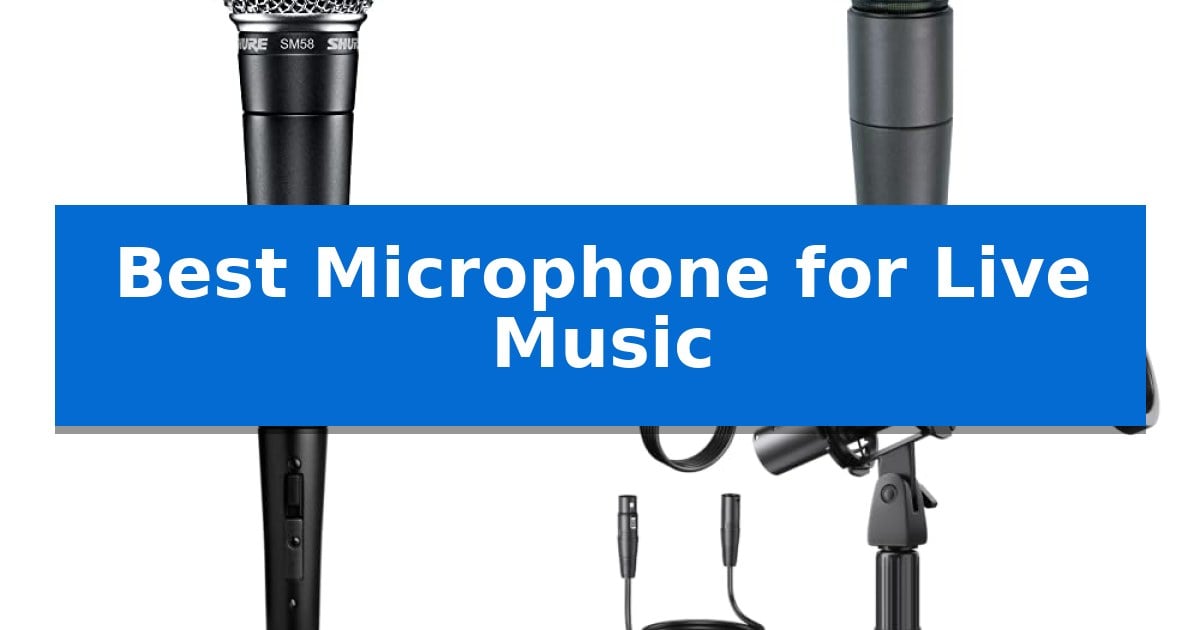
Finding the right gear for a stage environment requires balancing durability with clear sound reproduction. Whether you are performing in small clubs or larger venues, the Best Microphone for Live Music must be capable of handling high sound pressure levels while rejecting unwanted background noise.
Selecting a reliable microphone involves understanding how different polar patterns and frequency responses interact with your specific sound source. We have evaluated several industry-standard options to help you determine which model best suits your vocal or instrumental needs.
You may also want to compare Best Microphone for Live Male Vocals, Best Microphone for Live Jazz Vocals, and Best Microphone for Live Hi-Hat.
Best Microphone for Live Music
Quick Comparison
| Product | Best For | Key Strength | Score |
|---|---|---|---|
| Shure SM58 Dynamic Vocal Microphone | Best Overall | Rugged metal construction designed for touring and professional use. | 4.9 |
| Shure SM57 Dynamic Instrument Microphone | Legendary for Amps and Drums | Rugged construction designed for frequent transport and stage use. | 4.6 |
| Shure SM58S Dynamic Vocal Microphone | Convenient Integrated Mute Switch | Integrated on/off switch for convenient signal control. | 4.3 |
| MAONO HD300T Dynamic Microphone | Versatile Dual USB and XLR | Dual USB/XLR connectivity for maximum equipment compatibility. | 4.5 |
How We Chose
- Polar pattern consistency for feedback rejection
- Frequency response tuning for vocal or instrument clarity
- Physical build quality and road-readiness
- Connectivity options for various sound systems
- Ease of use for live sound adjustments
1 Shure SM58 Dynamic Vocal Microphone — Industry Standard for Live Vocals
Reliability on stage often comes down to a microphone’s ability to isolate a vocal performance while resisting the mechanical stresses of a live environment. The Shure SM58 Pro XLR Dynamic Vocal Microphone utilizes a precision cardioid pickup pattern to focus exclusively on the source, effectively minimizing background noise and feedback in high-volume settings.
Engineered for consistent performance, this microphone features a finely tuned frequency response with a subtle midrange lift. This design choice provides a warm, articulate vocal character that helps voices cut through a dense mix, making it a staple for both professional stages and studio recording sessions.
Durability is central to its design, featuring a rugged metal construction and a reinforced stand adapter that withstands the physical demands of touring. To maintain audio integrity, an integrated pop protection system—comprising a refined spherical grille and a built-in filter—reduces plosives and wind noise without requiring external accessories.
As an industry-standard tool, the Shure SM58 Pro XLR Dynamic Vocal Microphone offers a reliable solution for performers who require consistent, professional sound quality. Its combination of robust build and specialized acoustic filtering makes it a practical choice for live music, podcasting, and broadcast applications where clarity is paramount.
Best for: Live vocal performances and professional stage use where feedback rejection and durability are essential.
Skip if: Users requiring a condenser microphone for high-frequency detail or those needing built-in USB connectivity for direct computer recording.
PROS
- Rugged metal construction designed for touring and professional use.
- Precision cardioid pickup pattern effectively minimizes feedback.
- Integrated pop protection reduces plosives without extra hardware.
- Finely tuned frequency response provides warm, articulate vocal clarity.
CONS
- XLR-only connectivity requires an external audio interface or mixer.
- Dynamic design lacks the sensitivity of condenser microphones for subtle studio nuances.
2 Shure SM57 Dynamic Instrument Microphone — Legendary for Amps and Drums
Reliability on stage often comes down to equipment that can withstand the rigors of constant transport and high sound pressure levels. The Shure SM57 Pro XLR Dynamic Instrument Microphone is engineered for these exact demands, featuring a rugged construction that ensures consistent performance whether you are miking a guitar cabinet or a snare drum.
At the core of its design is a contoured frequency response with a refined presence boost. This specific tuning enhances the attack and clarity of instruments, allowing brass, percussion, and amplified strings to cut through a dense live mix without needing excessive processing. It is a tool built to capture the raw energy of a performance with precision.
The microphone utilizes a cardioid pickup pattern to maintain a focused capture area. By isolating the sound source, it effectively reduces background noise and bleed from other instruments on stage, which is essential for maintaining a clean signal in complex, multi-mic setups. This directional control makes it a staple for close-miking applications.
Designed for versatility, the Shure SM57 Pro XLR Dynamic Instrument Microphone adapts to a wide range of environments. Its ability to handle high sound pressure levels without distortion makes it a dependable choice for loud guitar amps and heavy-hitting drums, providing a consistent, professional-quality sound that engineers rely on for both live gigs and studio sessions.
Best for: Musicians and sound engineers who require a durable, high-SPL capable microphone for close-miking instruments like guitar amps, snare drums, and brass in live or studio settings.
Skip if: Users who need a side-address microphone for vocal broadcasts or those requiring a condenser microphone's higher sensitivity for capturing delicate, low-volume acoustic nuances.
PROS
- Rugged construction designed for frequent transport and stage use.
- Contoured frequency response with a presence boost for instrument clarity.
- Precise cardioid pattern minimizes bleed in high-noise environments.
- High sound pressure level (SPL) handling for loud amplifiers and drums.
CONS
- Dynamic design lacks the high-frequency sensitivity found in condenser microphones.
3 Shure SM58S Dynamic Vocal Microphone — Convenient Integrated Mute Switch
The Shure SM58S Dynamic Vocal Microphone distinguishes itself with an integrated on/off switch, providing performers and presenters with immediate control over their audio signal without needing to adjust settings at the mixer. This feature is particularly useful for managing transitions between songs or speakers in live environments.
Engineered specifically for vocal applications, this microphone utilizes a tuned frequency response to deliver a clear and warm sound profile. Its design helps vocals cut through the mix, making it a reliable tool for stage performances, rehearsals, and studio recording sessions.
The microphone features a focused cardioid polar pattern, which is essential for live music settings. By capturing sound primarily from the front while rejecting off-axis noise, it effectively isolates the performer's voice from instruments, stage monitors, and ambient crowd noise.
Durability is a core aspect of its construction, featuring a hardened grille and internal filtering. These components work together to minimize plosives, breath noise, and handling sounds, ensuring that the audio remains clean even during energetic performances.
With a compact design measuring approximately 6.37 inches in length and weighing less than one pound, the Shure SM58S Dynamic Vocal Microphone is built for the rigors of touring and frequent use in various venues, from clubs to houses of worship.
Best for: Live performers and presenters who require an integrated mute switch for quick, hands-on control of their audio signal during a set.
Skip if: Users who prefer a microphone without a physical switch to avoid the risk of accidental muting during a performance.
PROS
- Integrated on/off switch for convenient signal control.
- Cardioid polar pattern effectively isolates vocals in loud environments.
- Tuned frequency response optimized for vocal clarity.
- Hardened grille construction reduces handling noise and plosives.
CONS
- Physical switch may be prone to accidental activation during intense movement.
4 MAONO HD300T Dynamic Microphone — Versatile Dual USB and XLR
The MAONO HD300T Dynamic Microphone offers a flexible dual-mode architecture, allowing users to switch between USB plug-and-play and professional XLR connectivity. This versatility makes it a practical choice for creators who need to transition between simple computer-based setups and more complex audio interface or mixer configurations.
Equipped with a cardioid dynamic capsule, this microphone is engineered to focus on sound sources directly in front of the diaphragm while minimizing background noise and room reflections. This pickup pattern is particularly useful for maintaining vocal clarity in home studio environments where acoustic treatment may be limited.
For those utilizing the USB connection, the device features zero-latency monitoring via an integrated 3.5mm headphone jack. The onboard volume control provides immediate adjustment of monitoring levels, ensuring that users can manage their audio output without needing to navigate software settings during a session.
The included complete desktop microphone kit provides a streamlined out-of-the-box experience. It comes with a metal desktop stand, a shock mount to mitigate vibration noise, and a pop filter to reduce plosives, creating a stable and ready-to-use setup for podcasting, singing, or streaming.
Best for: Creators who require a versatile microphone that can function as both a simple USB device for streaming and a professional XLR tool for studio recording.
Skip if: Users who require a condenser microphone for capturing high-frequency detail and extreme sensitivity, as this dynamic model is optimized for focused vocal capture.
PROS
- Dual USB/XLR connectivity for maximum equipment compatibility.
- Zero-latency monitoring with dedicated volume control in USB mode.
- Cardioid dynamic capsule effectively reduces unwanted background noise.
- Comprehensive kit includes a shock mount, pop filter, and metal stand.
CONS
- Dynamic capsule design may require closer proximity to the microphone compared to condenser alternatives.
Best Microphone for Live Music Buying Guide
Understanding Polar Patterns
The cardioid polar pattern is the standard for live music because it focuses on sound directly in front of the capsule while rejecting noise from the rear. This design is essential for reducing feedback when using stage monitors.
Choosing a microphone with a tight, uniform pickup pattern ensures that your vocals or instruments remain isolated, even in loud environments where bleed from drums or amplifiers is a constant concern.
Dynamic vs. Condenser Microphones
For most live music applications, dynamic microphones are preferred due to their rugged construction and ability to handle high sound pressure levels without distortion. They do not require external power, making them highly reliable for touring.
While condenser microphones offer higher sensitivity, they are often more fragile and prone to feedback in high-volume settings. Sticking to dynamic capsules is generally the safer choice for unpredictable stage conditions.
Frequency Response and Presence
A microphone with a presence boost in the midrange frequencies helps vocals and instruments cut through a dense live mix. This subtle lift ensures that your performance remains articulate without needing excessive EQ adjustments at the mixing board.
Look for specifications that highlight a tailored frequency response, as these are designed to compensate for the proximity effect and maintain a natural, warm tone during close-miking.
Durability and Build Quality
Live music gear is subjected to constant handling, transport, and accidental drops. A rugged metal construction and a reinforced grille are non-negotiable features for any microphone intended for frequent stage use.
Internal shock mounting is another critical feature that helps minimize handling noise, ensuring that vibrations from the stage or microphone stand do not interfere with your audio signal.
Connectivity and Integration
Most professional live setups rely on XLR connections for balanced, noise-free signal transmission over long cable runs. Ensuring your microphone has a high-quality XLR output is vital for maintaining signal integrity.
Some modern microphones offer dual USB and XLR connectivity, which provides flexibility for those who also record at home. However, for dedicated stage use, the simplicity of a standard XLR connection remains the most reliable path.
Frequently Asked Questions
Why are dynamic microphones better for live music?
Dynamic microphones are built to be durable and can handle high sound pressure levels, making them ideal for the loud, physical environment of a live stage.
What is the benefit of a cardioid pickup pattern?
A cardioid pattern focuses on the sound source in front of the mic while rejecting sound from the back, which significantly helps in preventing feedback from stage monitors.
Do I need an audio interface for these microphones?
If you are using an XLR microphone for live music, you will need a mixer or a PA system. If you choose a dual-mode mic, you can use the USB connection for direct computer recording.
How do I reduce plosives during a performance?
Many live microphones feature built-in pop filters or spherical grilles designed to minimize breath noise and plosives, reducing the need for external accessories.
Is an on/off switch useful for live music?
An integrated switch allows for quick muting between songs or speakers, which can be convenient if you do not have a dedicated sound engineer to manage your channel.
Conclusion: Our Top Pick
When selecting the best microphone for live music, the Shure SM58 Dynamic Vocal Microphone remains the industry benchmark due to its legendary durability and frequency response tuned specifically for vocal clarity. Its ability to reject off-axis noise while maintaining a warm, articulate sound makes it a reliable choice for any performer.
While other options like the SM57 or the versatile MAONO HD300T offer specific advantages for instruments or home recording, the Shure SM58 stands out as the most consistent performer for live stage applications. Its robust metal construction ensures it can withstand the rigors of touring, providing professional results night after night.