
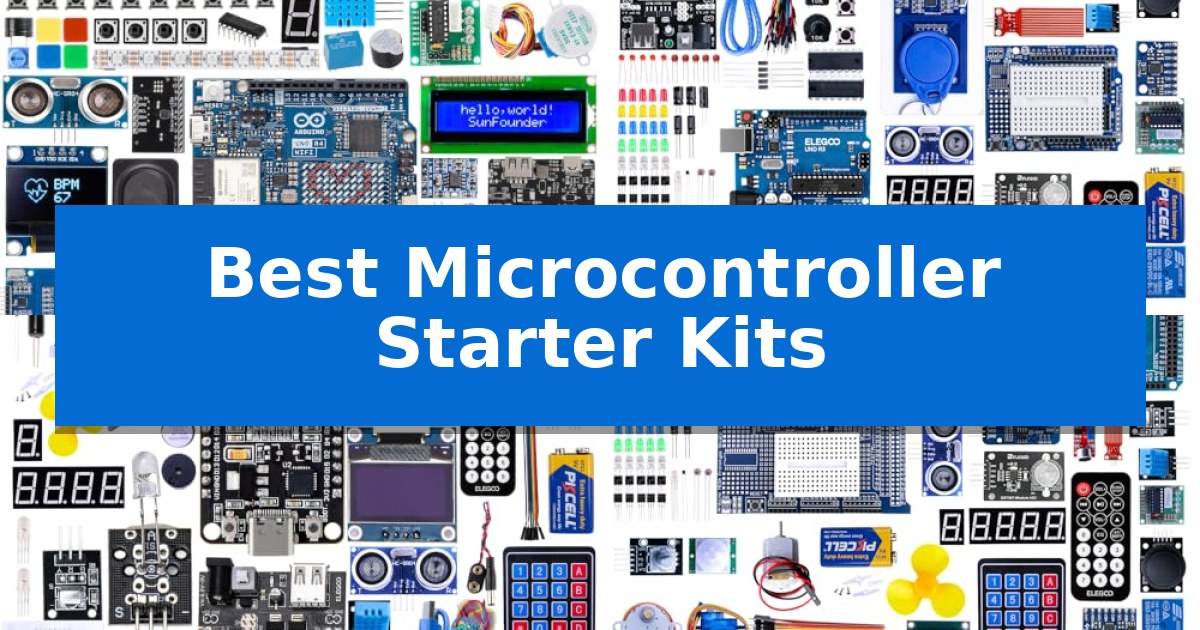
Embarking on a journey into electronics and programming requires the right foundation, and selecting one of the Best Microcontroller Starter Kits is the most effective way to begin. These comprehensive bundles provide the essential hardware, sensors, and instructional materials needed to transform abstract code into tangible, interactive projects.
Whether you are a student exploring STEM concepts or an engineer prototyping new ideas, the right kit bridges the gap between theory and practice. By choosing a set that aligns with your specific learning goals—such as IoT connectivity, robotics, or general circuit building—you can streamline your development process and avoid the frustration of sourcing individual components.
You may also want to compare Best Microcontroller Software Development Tools, Best Microcontroller Software, and Best Microcontroller Learning Kits.
Best Microcontroller Starter Kits
Quick Comparison
| Product | Best For | Key Strength | Score |
|---|---|---|---|
| SunFounder Elite Explorer Kit | Best Overall | Includes the powerful Arduino UNO R4 WiFi board with integrated Bluetooth. | 4.9 |
| ELEGOO UNO R3 Starter Kit | Most complete component variety | Extensive component variety with 200+ parts across 63 types. | 4.8 |
| ELEGOO ESP-32 Starter Kit | Best for connected IoT projects | Integrated Wi-Fi and Bluetooth 4.2 for advanced IoT connectivity. | 4.5 |
| ELEGOO Mega 2560 Starter Kit | High pin count for complex builds | High I/O capacity with 54 digital pins and 16 analog inputs for complex builds. | 4.9 |
| SunFounder 3-in-1 Starter Kit | Versatile robotics and IoT learning | Comprehensive 192-item component set covering sensors, actuators, and power supplies. | 4.7 |
How We Chose
- Microcontroller capability and processing power
- Variety and quality of included electronic components
- Accessibility and depth of guided tutorials
- Compatibility with standard development environments
- Support for advanced applications like IoT or robotics
1 SunFounder Elite Explorer Kit — Advanced IoT with WiFi R4
The SunFounder Elite Explorer Kit centers on the Arduino UNO R4 WiFi, a significant hardware upgrade that integrates a 32-bit processor with built-in WiFi and Bluetooth capabilities. This foundation allows users to move beyond basic circuitry into the realm of connected IoT projects, providing a robust platform for both beginners and experienced engineers.
This comprehensive starter kit includes over 300 high-quality components, such as sensors and displays like the LCD1602 and OLED, enabling a wide variety of hardware configurations. The inclusion of 50+ hands-on projects—divided into basic, fun, and IoT categories—is supported by 100+ free video lessons co-developed with Paul McWhorter, offering a structured learning path for those aged 8 and up.
Designed for versatility, the kit is fully RoHS compliant and maintains compatibility with standard Arduino ecosystems, including the Uno R3 and Nano. The integration with the Arduino IoT Cloud facilitates practical application of coding skills, while the provided technical support and forums assist in navigating programming hurdles during the development process.
While the kit offers extensive resources for learning C++ and electronics, the sheer volume of components may be overwhelming for absolute novices without the guidance of the provided tutorials. It serves as a complete, all-in-one solution for those looking to build interactive, portable projects without needing to source individual parts separately.
Best for: Beginners and students seeking a comprehensive, all-in-one introduction to IoT and electronics using the latest Arduino R4 hardware.
Skip if: Users who already possess a large collection of sensors and microcontrollers and only require specific individual components.
PROS
- Includes the powerful Arduino UNO R4 WiFi board with integrated Bluetooth.
- Comprehensive set of 300+ components for diverse project building.
- Structured learning via 100+ free video lessons and 50+ guided projects.
- Direct IoT app integration support through Arduino IoT Cloud.
CONS
- Large component count may be overwhelming for absolute beginners without tutorial guidance.
2 ELEGOO UNO R3 Starter Kit — Most complete component variety
The ELEGOO UNO R3 Starter Kit simplifies the transition into electronics by providing a comprehensive collection of 200+ components across 63 distinct types, all housed within an organized storage system. This kit is built around the ELEGOO UNO R3 controller, which serves as the central hub for over 30 guided projects ranging from basic LED circuits to complex sensor-based systems like RFID access and motion detection.
Designed for accessibility, the kit allows users to begin prototyping immediately without the need for soldering. By utilizing the included solderless breadboard and pre-soldered modules, beginners can quickly assemble circuits and move between lessons. The package includes essential power accessories such as a 9V, 1A power supply, a breadboard power module, and a 9V battery, ensuring that experiments remain powered without requiring additional hardware purchases.
The educational value of this kit lies in its flexibility for modification. Users are encouraged to program the controller via the Arduino IDE using the provided PDF tutorial and example code. Once the foundational lessons are mastered, the hardware allows for creative adjustments to sensor thresholds, motor behavior, and display text, effectively bridging the gap between guided learning and independent project development.
This kit is a practical choice for those who prefer an all-in-one approach to hardware exploration. While it provides a vast array of sensors and actuators, users should note that it is specifically designed for the Arduino ecosystem. It is an ideal starting point for STEM students, coding clubs, or hobbyists looking to build a versatile foundation in circuit building and embedded programming.
Best for: Students, hobbyists, and educators seeking a comprehensive, solder-free introduction to Arduino-based electronics and programming.
Skip if: Users who require advanced, high-performance microcontrollers beyond the standard UNO R3 or those who already possess a large collection of individual sensors and components.
PROS
- Extensive component variety with 200+ parts across 63 types.
- Solderless design allows for immediate assembly and rapid prototyping.
- Comprehensive power accessories included for flexible project setups.
- Guided PDF tutorials facilitate a structured learning path for beginners.
CONS
- Ecosystem limitation restricts users to the Arduino platform.
- Storage management required to keep 63 types of components organized.
3 ELEGOO ESP-32 Starter Kit — Best for connected IoT projects
The ELEGOO ESP-32 Starter Kit centers on a powerful dual-core processor board, providing an immediate entry point for users looking to explore Internet of Things (IoT) applications. By integrating Wi-Fi and Bluetooth 4.2 directly onto the development board, this kit enables the creation of connected devices that can communicate with cloud services or mobile phones right out of the box.
Beyond the core board, the kit includes over 35 different modules and electronic components, such as sensors, displays, motors, and input devices like keypads. This comprehensive selection allows for a wide range of project types, from simple LED circuits to complex smart home controllers, all supported by the included CP2102 chip for reliable communication.
To facilitate the learning process, the package features a step-by-step online tutorial covering more than 30 projects. Each project is accompanied by complete code, clear circuit diagrams, and instructions, making it accessible for students, makers, and engineers regardless of their prior experience level in electronics or coding.
The ELEGOO ESP-32 Starter Kit is fully compatible with the Arduino IDE, simplifying the programming workflow for those already familiar with that ecosystem. With a focus on quality, the components are carefully selected to ensure reliability, and the kit is backed by dedicated technical support to assist with the learning journey.
Best for: Students, makers, and engineers looking to build connected IoT projects using a versatile, dual-core microcontroller platform.
Skip if: Users who require a simpler, non-connected microcontroller platform or those who do not have an interest in IoT-specific features like Wi-Fi and Bluetooth.
PROS
- Integrated Wi-Fi and Bluetooth 4.2 for advanced IoT connectivity.
- Includes over 35 modules and components for diverse project building.
- Comprehensive online tutorial with 30+ projects and clear code examples.
- Full Arduino IDE compatibility for streamlined programming.
CONS
- Requires familiarity with coding or willingness to follow detailed tutorials to utilize full potential.
4 ELEGOO Mega 2560 Starter Kit — High pin count for complex builds
The ELEGOO Mega 2560 Starter Kit provides a comprehensive foundation for electronics prototyping by centering its design around the high-capacity MEGA 2560 R3 board. This controller offers 54 digital I/O pins, 15 PWM outputs, and 16 analog inputs, making it suitable for complex projects that require managing multiple sensors, motors, and displays simultaneously.
With over 200 components included, this kit is organized to support a wide range of applications, from basic LED circuits to advanced systems involving RFID access, real-time clocks, and environmental monitoring. The inclusion of pre-soldered modules and a solderless breadboard streamlines the assembly process, allowing users to focus on logic and circuit design rather than manual soldering.
The kit is structured around 35+ guided projects that introduce fundamental concepts before encouraging users to modify variables such as sensor thresholds, timing, and motor behavior. This iterative approach helps transition from following structured tutorials to developing custom interactive systems like alarms, monitors, and automated controls.
Designed for repeatable learning, the package includes a dedicated storage case and small-parts box to keep components organized between sessions. By providing a broad array of hardware—including servos, stepper motors, and various sensors—the kit offers the versatility needed to scale project complexity as technical proficiency grows.
Best for: Students, hobbyists, and makers looking for a high-pin-count controller to build complex, multi-sensor electronics projects.
Skip if: Users who require a compact form factor for space-constrained projects or those who prefer a simpler, entry-level board with fewer I/O requirements.
PROS
- High I/O capacity with 54 digital pins and 16 analog inputs for complex builds.
- Extensive component library including over 200 parts like RFID, sensors, and motors.
- Guided learning path with 35+ projects that facilitate skill progression.
- Organized storage solution for efficient component management and repeatability.
CONS
- Larger physical footprint compared to standard-sized microcontroller boards.
- Requires more desk space due to the high volume of included components and the board size.
5 SunFounder 3-in-1 Starter Kit — Versatile robotics and IoT learning
The SunFounder 3-in-1 Starter Kit provides a comprehensive entry point into electronics and programming by combining an Arduino-compatible Uno with a vast collection of 192 components. Designed for learners aged 8 and up, this kit facilitates a progressive learning journey that transitions from basic LED circuits to complex IoT applications and autonomous robot cars.
Central to the experience are the expert-designed courses developed in collaboration with Circuit Basics. These resources include video tutorials and online guides that adapt to the user's current skill level. By integrating high-quality sensors and actuators, the kit allows students to move beyond theoretical concepts and engage in hands-on projects that build practical technical confidence.
The hardware ecosystem is built around versatility, offering three distinct project paths within a single package. Whether focusing on basic electronics, smart home IoT integration, or robotics, the complete component kit ensures that all necessary hardware is included to support 87 distinct projects. This modular approach allows for scalable skill development as users advance through the curriculum.
For those requiring assistance, the manufacturer provides dedicated support through a community forum and technical help channels. This ensures that learners have a reliable path to resolve hardware or coding challenges during their projects, making the kit a well-supported choice for beginners embarking on their first microcontroller experiments.
Best for: Beginners aged 8 and up looking for a comprehensive, project-based introduction to Arduino, IoT, and robotics.
Skip if: Users who already possess a specific microcontroller board or advanced hobbyists seeking specialized industrial-grade sensors not included in this educational bundle.
PROS
- Comprehensive 192-item component set covering sensors, actuators, and power supplies.
- Expert-designed video courses and tutorials tailored for progressive skill building.
- Versatile 3-in-1 functionality supporting basic, IoT, and robotics projects.
- Dedicated technical support and community access for troubleshooting.
CONS
- Requires existing computer access for IDE and programming interface.
- Educational focus may limit utility for advanced professional engineering applications.
Best Microcontroller Starter Kits Buying Guide
Understanding Microcontroller Compatibility
The heart of any kit is the development board, such as the Arduino UNO R4 or ESP-32. Compatibility is crucial; ensure your chosen board supports the Arduino IDE or other common programming environments you intend to use.
Consider whether your projects require specific features like built-in WiFi and Bluetooth. Boards with integrated wireless connectivity are essential for IoT projects, while standard boards remain the gold standard for learning basic circuit logic.
Component Variety and Project Scope
Starter kits vary significantly in the number and type of components included. A robust kit should feature a mix of actuators, sensors, and displays, such as LCD1602 screens, servo motors, and ultrasonic sensors.
Assess the project range offered by the kit. Some sets focus on basic electronics, while others provide the necessary parts for advanced robotics or smart home automation, allowing you to grow your skills over time.
The Importance of Educational Resources
For beginners, the quality of documentation is often more important than the hardware itself. Look for kits that offer step-by-step PDF tutorials, video lessons, and open-source code examples.
Well-structured guides help you move from simple tasks, like blinking an LED, to complex challenges, such as building an RFID access system or an environmental monitor.
Ease of Prototyping and Setup
Efficient prototyping relies on the convenience of the included accessories. Kits that feature pre-soldered modules and solderless breadboards significantly reduce setup time and minimize the need for additional tools.
Organized storage cases are a major benefit, keeping small parts like resistors, LEDs, and jumper wires categorized. This organization prevents loss and makes it easier to transition between different experiments.
Scalability for Future Projects
A great starter kit should not become obsolete as your skills improve. Many kits are compatible with other boards like the Nano or Mega, allowing you to reuse your sensors and modules in future, more complex builds.
Consider the pin count and memory capacity of the microcontroller. If you plan to manage multiple sensors and displays simultaneously, a board with higher I/O capabilities, such as the Mega 2560, offers more flexibility.
Frequently Asked Questions
Are these kits suitable for children?
Many kits are designed for users ages 8 and up, but adult supervision is recommended for younger children, especially when handling small electronic components or power supplies.
Do I need to know how to solder?
Most of these starter kits are designed for solderless prototyping using breadboards and jumper wires, so soldering is generally not required to complete the included projects.
Can I use these kits with a Mac or Linux computer?
Yes, the Arduino IDE and most associated development tools are cross-platform and compatible with Windows, macOS, and Linux operating systems.
What is the difference between an UNO and an ESP-32 board?
An UNO board is typically used for standard circuit learning and basic automation, while an ESP-32 board includes built-in wireless capabilities, making it ideal for IoT and cloud-connected projects.
Are the tutorials included in the box?
Most kits provide tutorials via digital downloads, such as PDFs or online portals, which are frequently updated with new code and project instructions.
Conclusion: Our Top Pick
Selecting the right kit depends on your specific goals, but for those seeking a comprehensive, modern entry point into electronics, the SunFounder Elite Explorer Kit stands out as the most versatile option. Its inclusion of the Arduino UNO R4 WiFi board provides a powerful, future-ready platform that supports both basic learning and advanced IoT applications.
With over 300 components and extensive video support, this kit offers a structured path that is difficult to outgrow. While other kits may offer different pin counts or specific sensor focuses, the balance of hardware quality and educational depth makes this our top recommendation for beginners and engineers alike.