
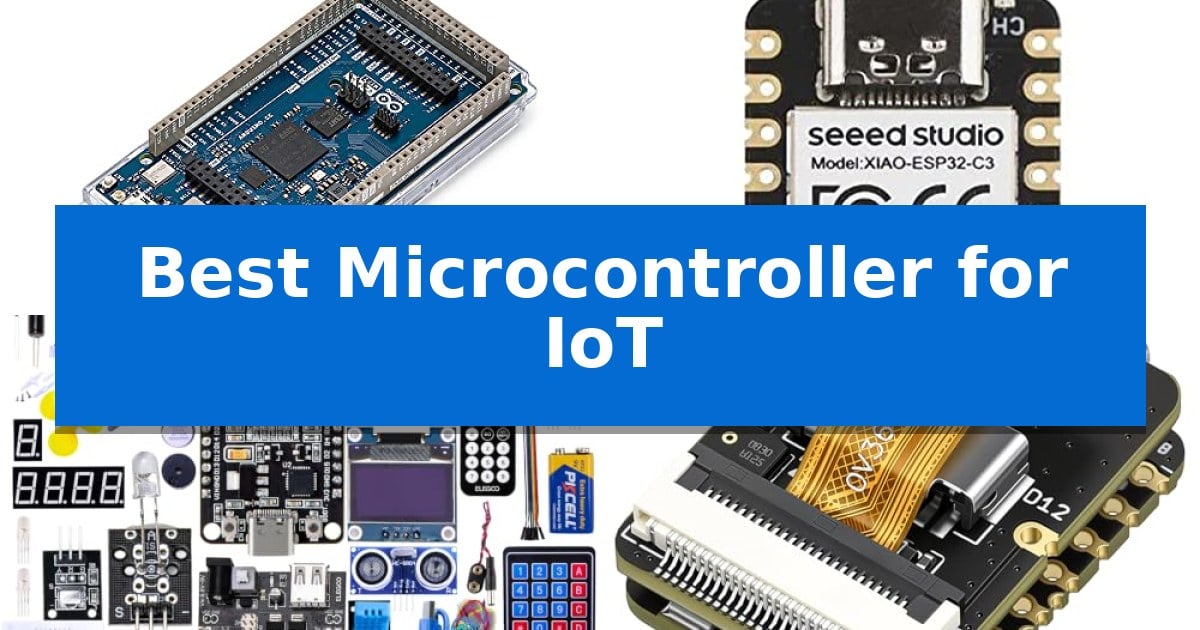
Selecting the Best Microcontroller for IoT requires balancing raw processing power with the specific connectivity needs of your project. Whether you are building a simple home sensor or a complex edge-computing device, the right board serves as the foundation for reliable data transmission and efficient local processing.
Our guide evaluates five distinct development boards to help you identify which hardware aligns with your technical requirements. We focus on essential factors such as wireless protocols, memory capacity, and development environment compatibility to ensure your next connected project functions exactly as intended.
You may also want to compare Best Microcontroller for Humanoid Robots, Best Microcontroller for Data Acquisition, and Best Microcontroller for Capacitance Measurement.
Best Microcontroller for IoT
Quick Comparison
| Product | Best For | Key Strength | Score |
|---|---|---|---|
| Arduino Giga R1 WiFi | Best Overall | Dual-core processing architecture for demanding edge computing tasks. | 4.9 |
| Seeed Studio XIAO ESP32C3 | Tiny Form Factor for Wearables | Ultra-low power consumption with a 44μA deep sleep mode. | 4.9 |
| ELEGOO ESP-32 Starter Kit | Best for Learning IoT Basics | Comprehensive component library with over 35 modules including displays and motors. | 4.5 |
| Meshnology W11 ESP32-S3 Cam | Integrated AI Vision Capabilities | Integrated NPU for efficient local AI inference. | 4.7 |
| DIYables ESP32 Development Board | Reliable USB-C Connectivity | Modern USB Type-C connectivity for reliable power and data transfer. | 4.7 |
How We Chose
- Wireless connectivity standards and range performance.
- Processing architecture and suitability for edge computing.
- Memory and storage capacity for data-intensive applications.
- Interface flexibility and peripheral expansion options.
- Development environment support and ease of integration.
1 Arduino Giga R1 WiFi — High-Performance Edge Computing
Managing complex IoT deployments requires a controller that balances raw processing power with versatile connectivity. The Arduino Giga R1 WiFi addresses this by integrating a dual-core architecture featuring the ARM Cortex-M7 at 480 MHz and the ARM Cortex-M4 at 240 MHz. This specific hardware configuration allows for simultaneous handling of real-time data analysis and high-level edge computing tasks, making it a robust foundation for industrial automation and advanced robotics.
Beyond its processing capabilities, the board simplifies wireless integration through its built-in Wi-Fi and Bluetooth 5.0 modules. These features facilitate reliable communication with cloud services and local sensor networks without requiring additional hardware. For developers working on resource-intensive projects, the inclusion of 16MB of Flash memory and 512KB of SRAM provides the necessary overhead for complex algorithms and large-scale data storage.
The physical design emphasizes flexibility with a wide array of digital and analog I/O, PWM, SPI, I2C, and UART interfaces. The integration of a high-speed USB-C port ensures efficient power delivery and rapid programming cycles. Furthermore, the board maintains compatibility with existing Arduino shields, allowing for seamless expansion of hardware capabilities in both prototyping and production environments.
Choosing the right hardware often involves balancing performance with ecosystem support. By utilizing the Arduino IDE, the Arduino Giga R1 WiFi leverages an extensive library of tools and community-driven resources. This combination of high-performance hardware and accessible software tooling makes it a practical choice for developers focused on professional-grade IoT and edge AI applications.
Best for: Professional developers and engineers building high-performance IoT, edge computing, and robotics projects that require dual-core processing and integrated wireless connectivity.
Skip if: Users working on simple, low-power hobbyist projects may find the advanced dual-core architecture and feature set of this board more complex than necessary for basic sensor monitoring.
PROS
- Dual-core processing architecture for demanding edge computing tasks.
- Integrated Wi-Fi and Bluetooth 5.0 for seamless wireless connectivity.
- Ample 16MB Flash memory and 512KB SRAM for complex applications.
- High-speed USB-C interface for efficient power and programming.
CONS
- Higher complexity compared to entry-level microcontrollers.
- Larger form factor may not suit space-constrained embedded designs.
2 Seeed Studio XIAO ESP32C3 — Tiny Form Factor for Wearables
Integrating advanced connectivity into compact hardware, the Seeed Studio XIAO ESP32C3 leverages a high-performance 32-bit RISC-V processor clocked at 160MHz to serve as a versatile foundation for IoT and edge AI applications. Its diminutive 21×17.5mm footprint and single-sided component layout are specifically engineered for space-constrained environments like wearable technology.
The board distinguishes itself with robust RF performance, utilizing an onboard U.FL antenna to maintain stable Wi-Fi and BLE 5.0 communication over distances exceeding 100 meters. This reliable connectivity, combined with four distinct power modes—including a deep sleep state consuming only 44μA—makes it a practical choice for battery-operated wireless projects.
Engineered for rapid deployment, the Seeed Studio XIAO ESP32C3 features an integrated battery charge IC that supports Li-ion and LiPo power sources. The board provides a comprehensive interface suite, including 11 digital I/O pins with PWM support, 4 analog ADC pins, and standard communication protocols such as UART, IIC, SPI, and IIS, ensuring broad compatibility with various sensors and actuators.
Whether utilized for TinyML tasks or complex IoT control scenarios, this microcontroller balances power efficiency with functional density. Its breadboard-friendly design and support for Arduino and CircuitPython environments simplify the development process, allowing for efficient prototyping and production-ready integration into custom hardware setups.
Best for: Developers building compact, battery-powered IoT wearables or edge AI devices that require reliable long-range wireless connectivity.
Skip if: Projects requiring extensive physical I/O pin counts or high-performance processing capabilities beyond the scope of a single-core RISC-V architecture.
PROS
- Ultra-low power consumption with a 44μA deep sleep mode.
- Compact 21×17.5mm form factor ideal for wearable integration.
- Integrated battery charging support for Li-ion and LiPo cells.
- High-range RF performance via U.FL antenna for stable wireless links.
CONS
- Limited physical space for complex circuitry due to the thumb-sized design.
- Requires external antenna for optimal long-range performance.
3 ELEGOO ESP-32 Starter Kit — Best for Learning IoT Basics
Mastering the fundamentals of connected hardware requires a reliable platform that bridges the gap between simple circuits and complex cloud-based applications. The ELEGOO ESP-32 Super Starter Kit centers on a dual-core microcontroller equipped with integrated Wi-Fi and Bluetooth 4.2, providing the necessary processing power and wireless connectivity to build smart home controllers, weather stations, or remote-controlled gadgets.
This kit is engineered for versatility, bundling over 35 distinct modules and components into a single package. Users receive a comprehensive selection of hardware, including an OLED screen, servo motor, keypad, and various sensors. This variety allows for immediate experimentation with input and output devices without the need to source individual parts separately.
Accessibility remains a core focus, supported by a step-by-step online tutorial that guides beginners through more than 30 projects. Each project includes clear circuit diagrams and refined code, ensuring that those new to electronics can learn to utilize the ESP-32 board's unique capabilities. The platform is fully compatible with the Arduino IDE, simplifying the programming process for students, makers, and engineers alike.
Designed to scale with the user's expertise, the kit facilitates a progression from basic circuit building to advanced IoT applications. The inclusion of the CP2102 chip and USB-C connectivity ensures modern standards for development and power. With a focus on quality and reliable component selection, this kit provides a structured environment for developing the skills required for real-world innovation.
Best for: Students, hobbyists, and engineers seeking a comprehensive, all-in-one hardware platform to learn IoT development and electronics.
Skip if: Users who already possess a large collection of sensors and modules and only require a standalone development board without educational tutorials.
PROS
- Comprehensive component library with over 35 modules including displays and motors.
- Integrated wireless connectivity featuring both Wi-Fi and Bluetooth 4.2.
- Beginner-friendly tutorial with 30+ projects and complete code.
- Arduino IDE compatibility for streamlined programming and development.
CONS
- Fixed component selection may include parts not needed for specific advanced projects.
4 Meshnology W11 ESP32-S3 Cam — Integrated AI Vision Capabilities
The Meshnology W11 ESP32-S3 Cam integrates a powerful ESP32-S3 32-bit dual-core LX7 MCU with a dedicated neural accelerator, enabling local AI vision tasks like pose detection and image classification without requiring external processing chips. This module is designed for developers who need a compact, feature-rich platform for IoT projects requiring both visual intelligence and robust connectivity.
Equipped with 16MB SPI NOR Flash and 8MB PSRAM, the module provides significant memory for high-definition frame buffering and complex multi-tasking. Connectivity is handled via dual-band Wi-Fi and Bluetooth 5.0, supporting Bluetooth Mesh for linking over 200 nodes and long-range transmission up to 1000m. The hardware also includes WPA3 encryption and secure boot to protect firmware integrity.
For physical expansion, the board offers 32 reusable GPIO pins with support for ADC, SPI, I2C, UART, and PWM, alongside an onboard precision temperature sensor and a 6-axis inertial gyro/accelerometer. Power flexibility is a key design choice, featuring an all-in-one Type-C port for data and charging, with support for 5V input or a 3.7V Li-ion battery, complemented by four low-power consumption modes.
The Meshnology W11 ESP32-S3 Cam is compatible with Arduino, ESP-IDF, and MicroPython, supported by extensive documentation and sample code. While highly capable for edge computing, the module is optimized for well-lit environments and is not intended for professional-grade low-light photography.
Best for: Developers building AI-enabled IoT edge devices, smart home gateways, or multi-node sensor networks requiring integrated vision and wireless mesh capabilities.
Skip if: Users requiring professional-grade low-light camera performance or those who do not need onboard AI acceleration and prefer a simpler, lower-cost microcontroller.
PROS
- Integrated NPU for efficient local AI inference.
- Dual-band Wi-Fi and Bluetooth Mesh for versatile connectivity.
- Rich peripheral support including 32 GPIOs and onboard sensors.
- Flexible power options with built-in battery charging circuit.
CONS
- Limited low-light sensitivity for the camera module.
- Not a professional-grade camera for high-end optical requirements.
5 DIYables ESP32 Development Board — Reliable USB-C Connectivity
Modern IoT development requires a balance of processing power and reliable connectivity, and the DIYables ESP32 ESP-WROOM-32 WiFi and Bluetooth Development Board addresses this with its integrated dual-core processor. This board is engineered to handle complex automation tasks while maintaining stable wireless communication, making it a foundational component for smart device projects.
The board features a USB Type-C connector paired with a CP2102 USB-to-Serial converter, which provides a modern interface for both power delivery and data transfer. This setup ensures that developers have a consistent and reliable link between their computer and the microcontroller during the programming and debugging phases.
With a comprehensive 38-pin layout, the device offers extensive GPIO options for interfacing with various sensors, actuators, and expansion modules. This flexibility allows for the creation of sophisticated hardware configurations, while the compact form factor ensures it fits efficiently into space-constrained project enclosures.
Integration is streamlined through full compatibility with the Arduino IDE, allowing both beginners and experienced developers to utilize familiar programming workflows. The combination of WiFi and Bluetooth capability ensures that the board remains versatile for diverse IoT applications, from remote monitoring to local device control.
Best for: Developers seeking a compact, versatile microcontroller with modern USB-C connectivity for diverse IoT and smart home automation projects.
Skip if: Users who require specialized industrial-grade environmental protections or a higher pin count for extremely complex, large-scale hardware arrays.
PROS
- Modern USB Type-C connectivity for reliable power and data transfer.
- Powerful ESP-WROOM-32 dual-core processor for robust performance.
- Extensive 38-pin GPIO layout for versatile hardware interfacing.
- Seamless integration with the Arduino IDE.
CONS
- Compact footprint may limit space for complex breadboard prototyping without additional expansion boards.
Best Microcontroller for IoT Buying Guide
Evaluating Processing Power
The core processor dictates what your device can handle. For simple tasks like reading temperature sensors, a single-core chip is often sufficient. However, for edge AI or real-time data analysis, look for dual-core architectures that can separate communication tasks from heavy computation.
High-performance chips like those found in the Arduino Giga R1 WiFi allow for multitasking, which is vital when your device must maintain a stable network connection while simultaneously processing complex algorithms or managing local sensors.
Connectivity Protocols
IoT devices rely on stable communication. Most modern boards feature integrated Wi-Fi and Bluetooth, but the implementation varies. Check for external antenna support if your device will be placed in an enclosure or a location with poor signal strength.
Consider whether your project requires Bluetooth Mesh for multi-device networks or standard Wi-Fi for cloud connectivity. Reliable RF performance is essential for avoiding data drops in remote monitoring scenarios.
Memory and Storage Requirements
Your code size and data logging needs determine how much Flash memory and PSRAM you require. Complex projects, especially those involving image processing or large firmware updates, require significant onboard storage to avoid frequent crashes or memory bottlenecks.
Always verify if the board supports external storage expansion, such as an SD card slot, which provides a safety net for logging massive amounts of data without overwhelming the internal memory.
I/O and Peripheral Integration
The number of GPIO pins determines how many sensors, actuators, and displays you can connect. Ensure the board provides the specific interfaces your project needs, such as I2C, SPI, or UART, to communicate with external modules.
Look for boards that offer built-in power management, such as Li-ion battery charging circuits, if you plan to deploy your device in a portable or battery-powered configuration.
Development Ecosystem
The ease of programming is often tied to the board's compatibility with established platforms like the Arduino IDE or MicroPython. A well-supported board with extensive documentation and community-provided libraries can save hours of troubleshooting.
Prioritize hardware that simplifies the flashing process, such as boards with USB-C connectivity and integrated USB-to-Serial converters, which streamline the development cycle from prototype to deployment.
Frequently Asked Questions
What is the main advantage of a dual-core microcontroller?
A dual-core processor allows one core to handle intensive tasks like AI inference or data processing while the other manages wireless communication, preventing network lag or system crashes.
Do I need an external antenna for my IoT project?
If your device is inside a metal enclosure or in an area with weak signal, an external antenna is highly recommended to maintain stable Wi-Fi or Bluetooth connectivity.
Can I use these boards for battery-powered projects?
Yes, many modern boards include low-power modes and integrated battery charging circuits, making them suitable for remote, battery-operated sensors.
Are these boards compatible with the Arduino IDE?
Most ESP32-based boards and official Arduino hardware are fully compatible with the Arduino IDE, allowing you to use familiar code libraries and development tools.
How much memory is enough for an IoT project?
Simple sensors require very little memory, but if you are performing image processing, machine learning, or storing large amounts of local data, look for boards with at least 8MB of PSRAM and 16MB of Flash.
Conclusion: Our Top Pick
For users requiring the most robust performance for complex edge computing and industrial-grade IoT applications, the Arduino Giga R1 WiFi stands out as the most capable choice. Its dual-core architecture and extensive I/O options provide the necessary headroom for demanding projects that require both high-speed processing and reliable connectivity.
While other boards in this list offer specific advantages for tiny wearables or AI-vision tasks, the Giga R1 WiFi provides the most comprehensive feature set for developers who do not want to compromise on power or expansion capabilities. It remains the most versatile foundation for scaling from a prototype to a finished, professional-grade connected device.