
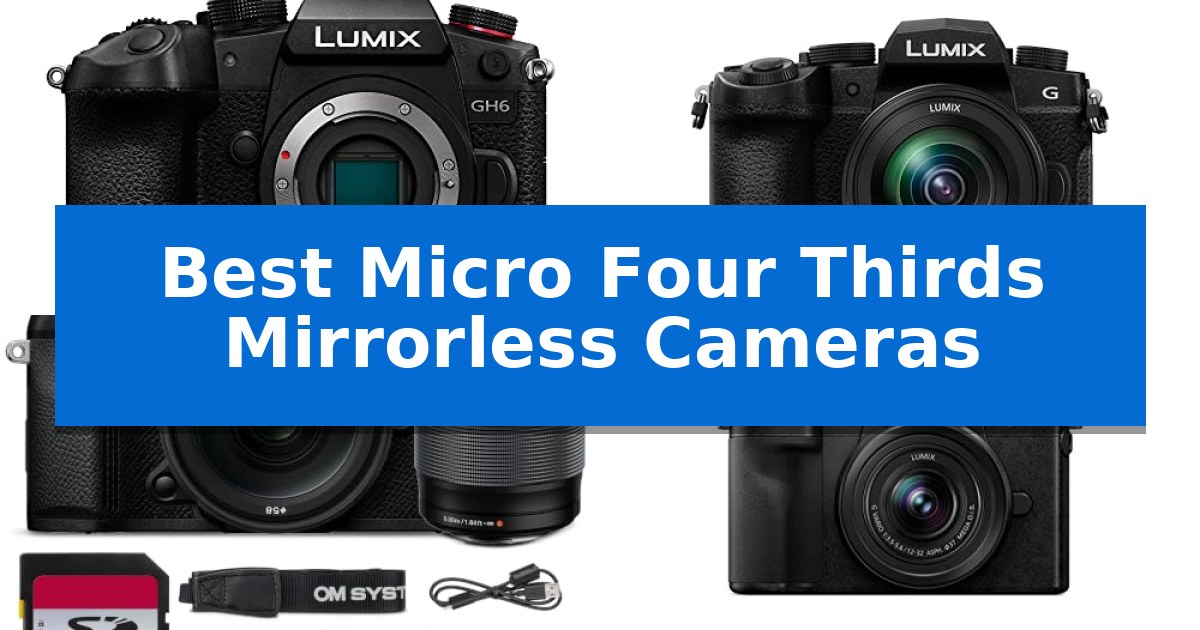
Finding the right camera often comes down to balancing portability with professional feature sets. The Best Micro Four Thirds Mirrorless Cameras offer a unique advantage by pairing compact, lightweight bodies with an extensive ecosystem of interchangeable lenses, making them ideal for both travel and studio work.
Whether you are a content creator needing reliable 4K video or a photographer seeking advanced image stabilization, selecting the right system is essential. We have analyzed the latest models to help you identify which camera best aligns with your specific shooting requirements and creative goals.
You may also want to compare Best Micro Four Thirds Compact Cameras, Best Micro Four Thirds Cameras for Video, and Best Micro Four Thirds Cameras for Beginners.
Best Micro Four Thirds Mirrorless Cameras
Quick Comparison
| Product | Best For | Key Strength | Score |
|---|---|---|---|
| Panasonic LUMIX GH6 Mirrorless Camera | Best Overall | Unlimited recording time for all video modes. | 4.9 |
| Panasonic LUMIX G97 Mirrorless Camera | Hybrid Content Creation | Unlimited 4K 30p video recording prevents overheating during long shoots. | 4.3 |
| OM SYSTEM OM-5 Mark II Mirrorless Camera | Compact Travel Photography | Powerful 5-axis image stabilization for sharp handheld shots. | 4.7 |
| Panasonic LUMIX G100 Mirrorless Camera | Vlogging and Social Media | Advanced 360-degree tracking microphone for clear audio in various environments. | 4.6 |
| Olympus OM-D E-M10 Mark III Mirrorless Camera | Intuitive Handheld Shooting | Integrated five-axis image stabilization for steady handheld shots. | 4.9 |
How We Chose
- Sensor resolution and image processing engine performance.
- In-body image stabilization (IBIS) effectiveness for handheld shooting.
- Video recording specifications including bit rates, frame rates, and thermal management.
- Physical dimensions and weight for portability.
- Lens mount compatibility and ecosystem support.
1 Panasonic LUMIX GH6 Mirrorless Camera — Pro-Level Video Performance
The Panasonic LUMIX GH6 Mirrorless Camera is engineered for demanding video production, featuring a 25.2MP sensor and the Venus Engine to support high-bitrate recording without time limits. This camera is built to handle intensive workflows, offering internal recording in Apple ProRes 422 HQ and 422 for high-quality, low-compression output.
For creators requiring versatility, the system includes pre-installed V-Log/V-Gamut and provides over 13-stops of dynamic range when utilizing the Dynamic Range Boost function. The camera is capable of 5.7K 60p and 4K 120p 10-bit video, ensuring high resolution and frame rates for professional-grade projects.
Stability is a core design focus, with the 5-axis Dual I.S. 2 system providing up to 7.5-stops of correction. This stabilization is complemented by the ability to capture Full-HD high frame rate video at 300fps, allowing for smooth 12.5x slow-motion sequences even in challenging lighting conditions.
The body is designed for reliability in various environments, incorporating a 100MP Hand-Held High Resolution Shot mode for still photography. With a 3-year manufacturer warranty, this camera serves as a robust tool for those who prioritize technical precision and consistent performance in their imaging equipment.
Best for: Professional videographers and creators who require unlimited recording times, high-bitrate internal codecs, and robust image stabilization.
Skip if: Photographers prioritizing a compact, lightweight body for casual travel or street photography may find the GH6's size and video-centric feature set excessive.
PROS
- Unlimited recording time for all video modes.
- Internal Apple ProRes 422 HQ recording.
- 7.5-stop 5-axis Dual I.S. 2 stabilization.
- High-speed 4K 120p 10-bit video capture.
CONS
- Larger physical footprint compared to entry-level mirrorless models.
- Feature set is heavily optimized for video, which may be overkill for pure still photographers.
2 Panasonic LUMIX G97 Mirrorless Camera — Hybrid Content Creation
The Panasonic LUMIX G97 Mirrorless Camera distinguishes itself with a 5-stop 5-axis Dual I.S.2 system, providing stability for both handheld photography and video recording in varied conditions. This camera is built for content creators who require a versatile tool that balances high-resolution imaging with robust video capabilities.
For those focused on video production, the device offers 4K 30p recording with no time limitation, effectively mitigating overheating concerns during extended sessions. It also includes 12-stops of V-Log L for cinematic color grading and supports slow-motion or quick-motion effects in Full HD, providing flexibility for creative storytelling.
The camera features a 1,840k-dot free-angle LCD and a 2,360k-dot OLED Live View Finder, ensuring accurate framing and focus even in bright outdoor environments. The Live View Composite Mode allows users to capture complex scenes like star trails or light painting by combining multiple exposures in real time, simplifying advanced techniques without requiring post-processing software.
Designed for an aggressive shooting style, the Panasonic LUMIX G97 Mirrorless Camera includes the LUMIX G Vario 12-60mm / F3.5-5.6 lens, making it a ready-to-use kit for diverse subjects. The integrated LUMIX Photo Style feature provides quick access to color effects, allowing for immediate creative adjustments directly within the camera interface.
Best for: Content creators seeking a versatile, hybrid camera capable of long-form 4K video and advanced creative photography modes.
Skip if: Photographers who require a larger sensor format for extreme low-light performance or those who do not need integrated video-centric features like V-Log L.
PROS
- Unlimited 4K 30p video recording prevents overheating during long shoots.
- 5-axis Dual I.S.2 provides significant stabilization for handheld work.
- Live View Composite Mode simplifies long-exposure photography.
- Free-angle LCD offers flexible framing for diverse shooting angles.
CONS
- Fixed lens aperture range (F3.5-5.6) may limit low-light performance compared to prime lenses.
3 OM SYSTEM OM-5 Mark II Mirrorless Camera — Compact Travel Photography
The OM SYSTEM OM-5 Mark II Mirrorless Camera centers its design around a 20.4MP Live MOS Micro Four Thirds sensor and the TruePic IX processor, providing a capable foundation for both still photography and 4K video capture. This bundle includes a versatile 14-150mm f/4-5.6 II lens, a 64GB memory card, and a camera bag, making it a comprehensive starting point for travel and daily documentation.
Performance is driven by an advanced 121-point all cross-type phase-detection autofocus system. This setup supports sophisticated tracking modes, including face and eye detection, as well as specialized options like Starry Sky AF, which assists in maintaining focus accuracy during challenging low-light or night photography sessions.
Handheld shooting is supported by a robust 5-axis sensor-shift image stabilization system. This mechanism provides up to 6.5 stops of compensation, which can be extended to 7.5 stops when utilizing compatible Sync IS lenses. This feature is particularly useful for maintaining sharpness in varied lighting conditions without needing a tripod.
For those seeking efficiency in their workflow, a dedicated computational photography button offers immediate access to advanced tools. Users can quickly engage modes such as High-Res Shot, Live ND, focus stacking, and HDR, allowing for creative image manipulation directly within the camera body.
Best for: Travelers and families seeking a compact, all-in-one camera system with advanced stabilization and computational features.
Skip if: Photographers who require a larger sensor format for specific shallow depth-of-field requirements or those who do not need the included versatile zoom lens.
PROS
- Powerful 5-axis image stabilization for sharp handheld shots.
- Advanced 121-point phase-detection autofocus with subject tracking.
- Dedicated computational photography button for quick access to creative modes.
- Comprehensive bundle including lens, memory card, and bag.
CONS
- Fixed lens focal range may not suit specialized telephoto or ultra-wide needs.
4 Panasonic LUMIX G100 Mirrorless Camera — Vlogging and Social Media
Capturing high-quality content requires more than just a smartphone, and the Panasonic LUMIX G100 Mirrorless Camera provides a dedicated solution for creators who need professional-grade results in a portable form factor. This camera is built around the versatile Micro Four Thirds system, allowing users to swap lenses to suit different shooting environments while maintaining a compact, lightweight profile suitable for one-handed recording.
The device is engineered for both photography and videography, offering 4K 24p/30p video capabilities alongside advanced audio features. A standout element is the advanced 360-degree microphone with tracking technology, which automatically adjusts to focus on the subject, whether recording in a crowd or a quiet one-on-one interview. This focus on audio quality ensures that creators can produce clear, professional sound without needing external equipment.
Usability is a core focus, with the camera including an iA (intelligent auto) mode for beginners, while offering full manual controls for those looking to refine their craft. The inclusion of 5-Axis Hybrid I.S. helps maintain steady footage, reducing blur during handheld shots. For those who create content for social media, the camera features a frame marker that displays various aspect ratios, ensuring content is perfectly composed for different platforms.
Beyond field use, the Panasonic LUMIX G100 Mirrorless Camera functions as a high-quality webcam when connected to a computer, providing a crisp, professional look for livestreams and video calls. The system supports seamless transfer to smartphones, simplifying the workflow from shooting to sharing. With its included 12-32mm lens and V-Log L recording support, it provides a comprehensive starting point for those looking to elevate their production value.
Best for: Content creators and vloggers who need a portable, versatile camera with professional audio and video capabilities for social media and streaming.
Skip if: Professional photographers requiring full-frame sensor performance or those who prioritize extreme low-light capabilities over portability.
PROS
- Advanced 360-degree tracking microphone for clear audio in various environments.
- Compact and lightweight design optimized for one-handed vlogging.
- Versatile Micro Four Thirds system compatible with a wide range of lenses.
- Dual-purpose functionality as both a dedicated camera and a high-quality webcam.
CONS
- Smaller sensor size compared to full-frame alternatives, which may limit extreme low-light performance.
- Fixed-screen orientation may not suit all specialized mounting setups.
5 Olympus OM-D E-M10 Mark III Mirrorless Camera — Intuitive Handheld Shooting
Capturing spontaneous moments or professional-grade imagery requires a balance of portability and technical capability, which is where the Olympus OM-D E-M10 Mark III Mirrorless Camera excels. Designed for those who prioritize mobility without sacrificing image quality, this system integrates a sophisticated five-axis image stabilization sensor-shift mechanism that effectively minimizes blur in both handheld photos and video captures.
The camera is built around a compact housing that remains lightweight, making it a practical choice for travel or daily carry. It features an innovative dust removal system utilizing a silent Super Sonic Wave Filter, which helps maintain sensor cleanliness even when changing lenses in varied environments. This focus on durability and ease of use ensures that the internal components remain protected while you focus on framing your shot.
Connectivity is streamlined through built-in WLAN, allowing for immediate sharing of content with mobile devices. The electronic viewfinder provides a clear preview of your composition, while the internal processing engine is optimized to deliver sharp, detailed images that maintain clarity across the entire frame. Whether you are recording in 4K video or shooting stills, the system is engineered to provide consistent results.
While the device offers a wide range of high-quality lens compatibility, its primary trade-off is its specialized Micro Four Thirds sensor size compared to larger full-frame alternatives. However, for users who value a small footprint and reliable stabilization, the Olympus OM-D E-M10 Mark III Mirrorless Camera provides a robust, intuitive platform for diverse photography needs.
Best for: Travelers and enthusiasts who need a lightweight, stabilized camera system for versatile handheld shooting.
Skip if: Users who require the specific depth-of-field characteristics or low-light performance associated with larger full-frame sensor formats.
PROS
- Integrated five-axis image stabilization for steady handheld shots.
- Compact and lightweight design ideal for high mobility.
- Built-in WLAN for quick and easy content sharing.
- Silent Super Sonic Wave Filter for effective dust removal.
CONS
- Micro Four Thirds sensor may not meet the needs of users requiring full-frame performance.
Best Micro Four Thirds Mirrorless Cameras Buying Guide
Sensor and Image Quality
The Micro Four Thirds sensor is the heart of these cameras, providing a balance between high-quality output and a smaller physical footprint. Higher megapixel counts allow for greater detail in stills, while the processing engine determines how well the camera handles noise in low-light conditions.
When choosing a model, consider the dynamic range capabilities. Features like V-Log or Dynamic Range Boost can significantly improve your ability to recover details in high-contrast scenes during post-production.
Image Stabilization Systems
One of the primary benefits of this system is the 5-axis image stabilization. This technology compensates for camera shake, which is critical for handheld photography and smooth video recording without the need for a gimbal.
Look for cameras that offer Dual I.S. 2 support, which coordinates the sensor-shift stabilization with compatible lens-based stabilization to achieve higher stops of correction, ensuring sharp results even at slower shutter speeds.
Video Performance and Thermal Management
For video-focused users, the ability to record without time limits is a major differentiator. Advanced models provide 4K or 5.7K recording with high bit rates and 10-bit color depth, which is essential for professional color grading.
Effective thermal management is necessary to prevent overheating during long recording sessions. Ensure the camera supports internal recording formats like Apple ProRes if your workflow requires high-quality, low-compression files.
Portability and Ergonomics
The compact nature of these cameras makes them excellent for travel. Consider the weight and dimensions of the body, especially if you plan to use it for long periods of handheld shooting or vlogging.
Ergonomic features such as a free-angle LCD screen and a high-resolution OLED Live View Finder are vital for framing shots accurately in various lighting conditions and angles.
Lens Ecosystem and Compatibility
The strength of the Micro Four Thirds system lies in its interchangeable lens mount. Compatibility with a wide range of lenses allows you to adapt your kit for everything from wide-angle landscapes to telephoto wildlife photography.
Verify that the camera supports the specific lenses you intend to use. Many modern cameras include features like dust removal systems to keep your sensor clean when swapping lenses in the field.
Frequently Asked Questions
Are Micro Four Thirds cameras good for professional video?
Yes, many models in this category are designed specifically for professional video, offering features like 10-bit internal recording, V-Log profiles, and high-resolution frame rates.
Can I use my old lenses on new Micro Four Thirds cameras?
The Micro Four Thirds mount is a standardized system, meaning most lenses designed for this mount will be compatible with modern mirrorless bodies.
Is image stabilization necessary if I use a tripod?
While a tripod provides the most stability, in-body image stabilization is still highly beneficial for handheld shots and can help reduce micro-vibrations even when the camera is mounted.
What is the benefit of a 20MP sensor versus a 25MP sensor?
A higher megapixel count generally allows for more detail and larger prints, but it may also require more processing power and storage space.
Are these cameras suitable for vlogging?
Yes, many models feature lightweight designs, built-in microphones, and articulating screens, which are essential tools for vloggers and social media creators.
Conclusion: Our Top Pick
For those seeking the most robust performance, the Panasonic LUMIX GH6 Mirrorless Camera stands out as the premier choice. Its combination of a 25MP sensor, unlimited recording capabilities, and advanced 7.5-stop stabilization makes it a versatile tool for demanding video and photo projects.
While other models offer specific advantages in portability or price, the GH6 provides the most comprehensive feature set for users who require professional-level reliability and image quality in a compact form factor.