
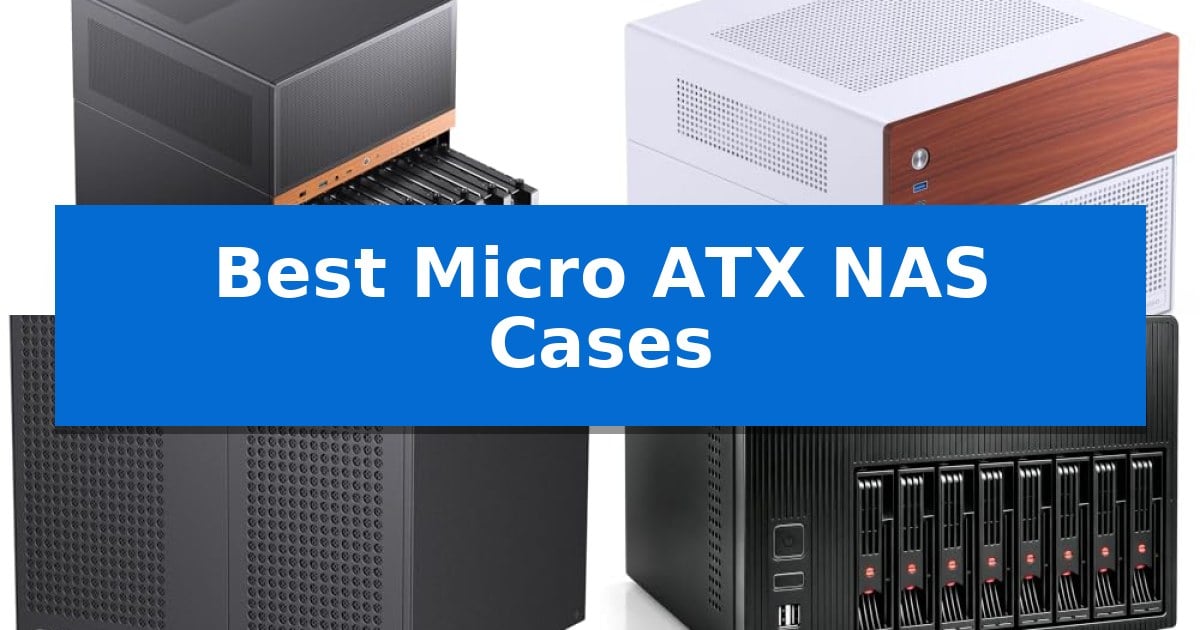
Building a custom network-attached storage system requires a chassis that balances storage density with the physical constraints of your motherboard. Finding the Best Micro ATX NAS Cases involves navigating the trade-offs between compact footprints and the space needed for multiple hard drives, cooling solutions, and power supply units.
Whether you are setting up a high-capacity media server or a reliable backup solution for your home office, the right enclosure dictates your build's longevity and ease of maintenance. This guide examines leading options to help you select a chassis that fits your specific hardware requirements and storage goals.
You may also want to compare Best Micro ATX Motherboards for Ryzen 7 5700G, Best Micro ATX Motherboards for Ryzen 7 3700x, and Best Micro ATX Motherboards for Ryzen 7.
Best Micro ATX NAS Cases
Quick Comparison
| Product | Best For | Key Strength | Score |
|---|---|---|---|
| Jonsbo N6 NAS Case | Best Overall | 9-bay hot-swap storage capacity | 4.9 |
| Jonsbo N4 NAS Case | Compact Walnut Aesthetic | 8-drive bay capacity in a compact form factor. | 4.8 |
| RGEEK 8 Bay NAS Case | Flexible DIY Server Build | Massive 8+2 drive capacity with hot-swappable bays. | 4.5 |
| AUDHEID 8 Bay NAS Case | Dual Airflow Cooling Design | 8 hot-swap drive bays supporting both 3.5-inch and 2.5-inch drives. | 4.8 |
| Rosewill Helium NAS Duo Case | Mid Tower Media Server | Supports up to 8 x 3.5-inch HDDs for extensive storage capacity. | 4.6 |
How We Chose
- Drive Bay Density: Assessing the number of hot-swap and internal bays for 3.5-inch and 2.5-inch drives.
- Form Factor Compatibility: Verifying support for Micro ATX motherboards and specific power supply standards.
- Thermal Management: Analyzing fan mounting options and airflow designs to ensure drive and component longevity.
- Build Flexibility: Evaluating support for expansion cards, CPU coolers, and liquid cooling radiators.
- Physical Footprint: Considering the overall dimensions to ensure the case fits within your intended server space.
1 Jonsbo N6 NAS Case — Best for High-Density Storage
The Jonsbo N6 NAS Case is engineered for high-density storage, featuring a 9-drive bay configuration that supports hot-swap functionality for efficient data management. This Micro ATX chassis balances server-grade capacity with a refined aesthetic, incorporating North American black walnut veneer on the exterior to blend into home or office environments.
Designed for versatility, the case supports both ITX and Micro ATX motherboards and offers flexible power supply options, accommodating ATX units up to 220mm or SFX units up to 100mm. The internal layout is optimized for cooling, with multiple mounting positions for fans, including dedicated spots for the hard drive bay, and support for a 240mm AIO liquid cooler to maintain thermal stability during high-performance tasks.
The chassis provides substantial expansion capabilities, including 4 PCI expansion slots and support for GPUs up to 320mm in length. Connectivity is handled through a front-facing USB 3.2 Gen2 Type-C port and a USB 3.0 port, ensuring modern peripheral compatibility for your home server or workstation setup.
When building, users should note the specific power requirements for the backplane, which utilizes 4 power interfaces (PATA2 + SATA2). To ensure stable operation, it is recommended to connect all four interfaces when using enterprise-level hard drives, while strictly adhering to the guideline of using only one power interface per cable to prevent electrical issues.
Best for: Users requiring a high-density, hot-swappable storage server with a compact footprint and aesthetic wood accents.
Skip if: Users who require a standard tower chassis for extensive liquid cooling loops or those who prefer a tool-less design for non-storage-focused PC builds.
PROS
- 9-bay hot-swap storage capacity
- Flexible power supply support (ATX/SFX)
- Premium aesthetic with black walnut veneer
- Versatile cooling options including 240mm AIO support
CONS
- Specific power cabling requirements for the backplane
- Compact dimensions may limit cable management space
2 Jonsbo N4 NAS Case — Compact Walnut Aesthetic
Integrating a high-capacity storage solution into a compact home setup requires a chassis that balances physical footprint with drive density. The Jonsbo N4 NAS Case addresses this by utilizing a split-compartment design that accommodates up to eight drives while maintaining a footprint of 286mm x 300mm x 228mm. Its distinctive aesthetic features an 8mm thick North American black walnut solid wood panel, blending functional server hardware with home-friendly design elements.
The internal architecture is specifically engineered for Micro-ATX and ITX motherboards, providing four PCI expansion slots for added flexibility. Storage enthusiasts benefit from an 8-drive bay configuration, which includes four hot-swap bays for 3.5-inch HDDs and two additional non-hot-swap 3.5-inch slots, alongside two dedicated 2.5-inch SSD mounts. This layout ensures that users can manage a significant amount of data without requiring a full-tower chassis.
Thermal management and hardware compatibility are prioritized through a built-in 120mm fan and support for downdraft CPU coolers up to 70mm in height. The chassis supports SFX power supplies and GPUs up to 230mm, making it a viable option for versatile server builds. Connectivity is modernized with a front-facing USB 3.2 Gen 2 Type-C port, ensuring fast data access for external peripherals.
Constructed from 0.7mm SGCC steel, the case offers a sturdy frame that supports the weight of multiple drives while maintaining a clean, professional appearance. The combination of the walnut veneer accents and the steel structure provides a durable housing for home office or enterprise storage applications, backed by a 2-year manufacturer warranty.
Best for: Users seeking a compact, aesthetically pleasing NAS chassis that supports high-density storage with Micro-ATX motherboard compatibility.
Skip if: Users who require support for ATX motherboards, full-height expansion cards, or liquid cooling systems, as the compact dimensions and split-compartment design limit these configurations.
PROS
- 8-drive bay capacity in a compact form factor.
- Hot-swap functionality for four 3.5-inch drives.
- North American black walnut front panel for a premium aesthetic.
- USB 3.2 Gen 2 Type-C front I/O connectivity.
CONS
- Limited CPU cooler height (70mm) restricts cooling options.
- SFX power supply requirement limits component choices.
3 RGEEK 8 Bay NAS Case — Flexible DIY Server Build
Building a high-capacity storage server requires a chassis that balances component density with thermal management. The RGEEK 8 Bay NAS Case addresses this by offering a massive 8+2 bay storage capacity, featuring eight hot-swappable 3.5-inch HDD bays alongside two dedicated 2.5-inch SSD slots. This configuration provides the flexibility needed for media servers or extensive data backup arrays within a compact form factor.
Designed for versatility, this case supports Micro-ATX and Mini-ITX motherboards, allowing builders to utilize common hardware standards. It includes four full-height PCIe slots, accommodating network cards or other expansion hardware up to 240mm in length. The internal layout is optimized for cooling, with support for four 12025 fan positions to maintain airflow across the drive bays and motherboard components.
The construction utilizes a 0.8mm galvanized steel inner frame and a cold-rolled steel outer shell, providing a sturdy foundation for heavy drive loads. A magnetic front panel offers quick access to the hot-swap bays, while laser-cut ventilation panels facilitate consistent thermal performance. Measuring 300mm x 270mm x 270mm, the unit is designed to fit on desks or standard server shelves without occupying excessive space.
Compatibility extends to power supply options, as the case supports standard ATX PSUs up to 170mm in length, with adapters available for SFX or FLEX units. The package includes essential accessories like HDD handles and cable management ties, simplifying the assembly process for DIY enthusiasts looking to create a reliable, high-density storage solution.
Best for: Home users and DIY enthusiasts looking to build a high-density, hot-swappable NAS or media server using standard Micro-ATX or Mini-ITX components.
Skip if: Users requiring support for full-sized ATX motherboards or those needing space for liquid cooling radiators, as this case is limited to 55mm tall CPU coolers.
PROS
- Massive 8+2 drive capacity with hot-swappable bays.
- Flexible motherboard support for Micro-ATX and Mini-ITX builds.
- Sturdy steel construction with magnetic front panel access.
- Versatile cooling design with four 120mm fan mounting positions.
CONS
- Limited CPU cooler height (max 55mm) restricts high-performance air cooling options.
- GPU length constraint of 240mm limits the use of larger expansion cards.
4 AUDHEID 8 Bay NAS Case — Dual Airflow Cooling Design
Building a high-capacity storage server requires a chassis that balances drive density with thermal management, and the AUDHEID 8 Bay NAS Case addresses this by incorporating an upper and lower separated independent air duct design. This configuration ensures that heat generated by the hard drives and the motherboard is dissipated through distinct channels, preventing thermal cross-contamination during intensive data operations.
The AUDHEID 8 Bay NAS Case is engineered for versatility, supporting both Mini-ITX and Micro-ATX motherboards. This wide compatibility allows users to select from a variety of low-power NAS mainboards while maintaining a compact footprint. The internal layout accommodates CPU coolers up to 58mm in height and is designed to house 1U or FLEX small power supplies, providing significant flexibility for custom storage builds.
Data integrity and monitoring are central to the design, featuring a full thick steel chassis for structural rigidity and shock protection. Each of the 8 hot-swap drive bays includes dedicated power and read/write indicator lights, allowing for real-time status tracking without needing to access the system software. The hot-swap functionality enables drive replacement or expansion without requiring a system shutdown, which is essential for maintaining uptime in media library or small business backup environments.
The enclosure comes equipped with 3 temperature-controlled silent fans to manage airflow while minimizing noise output. Included with the chassis are essential assembly components such as hard disk stands and SATA data cables, facilitating a straightforward setup process for those constructing private cloud drives or surveillance arrays.
Best for: Users building a compact, high-capacity home media server or small business backup array who require hot-swap drive accessibility and flexible motherboard support.
Skip if: Users who require support for ATX motherboards, standard ATX power supplies, or large tower-style CPU coolers will find this case too restrictive for their components.
PROS
- 8 hot-swap drive bays supporting both 3.5-inch and 2.5-inch drives.
- Dual independent air duct design for optimized thermal management.
- Wide compatibility with Mini-ITX and Micro-ATX motherboards.
- Sturdy steel construction with integrated disk status indicator lights.
CONS
- Strict limitations on power supply form factor (1U/FLEX only).
- CPU cooler height restricted to 58mm.
5 Rosewill Helium NAS Duo Case — Mid Tower Media Server
Building a high-capacity home server requires a chassis that balances internal density with thermal management. The Rosewill Helium NAS Duo Case is specifically engineered for this purpose, offering a robust framework that supports up to 8 x 3.5-inch hard drives in a standard mid-tower footprint.
Designed with a focus on cooling, the case features a mesh panel design that works in tandem with 4 x 140mm PWM fans. This configuration ensures consistent airflow across the drive bays and internal components, which is critical for maintaining stable operating temperatures in a 24/7 server environment.
Versatility is a core component of this chassis, as it provides broad motherboard compatibility, including ATX, Micro ATX, Mini-ITX, and BTF standards. For users looking to incorporate liquid cooling, the case supports a 360mm AIO liquid cooler, allowing for flexible configuration options depending on the heat output of the chosen CPU.
The interior is spacious enough to accommodate a maximum GPU length of 390mm and a CPU cooler height of 180mm, ensuring that the case can house high-performance hardware alongside its storage arrays. For modern peripheral connectivity, the front panel includes a USB 3.2 Type-C port, facilitating fast data transfers for external backup or maintenance tasks.
Best for: Users building a high-capacity home media server or NAS who require support for multiple 3.5-inch hard drives and flexible cooling options.
Skip if: Users looking for a compact small-form-factor (SFF) build will find the mid-tower dimensions and focus on high-capacity storage excessive for their needs.
PROS
- Supports up to 8 x 3.5-inch HDDs for extensive storage capacity.
- Superior airflow provided by the mesh panel and 4 x 140mm PWM fans.
- Broad motherboard compatibility including ATX, Micro ATX, and BTF.
- Modern connectivity with a front-panel USB 3.2 Type-C port.
CONS
- Large mid-tower footprint may not fit in constrained spaces.
Best Micro ATX NAS Cases Buying Guide
Storage Capacity and Hot-Swap Functionality
The primary purpose of a NAS case is to house multiple hard drives securely. When evaluating options, look for the number of hot-swap drive bays, which allow you to replace or upgrade drives without powering down the entire system. This is essential for minimizing downtime in a server environment.
Ensure the case supports the drive sizes you intend to use. Most dedicated NAS enclosures prioritize 3.5-inch HDD support for high-capacity storage, but having dedicated 2.5-inch SSD slots is increasingly important for caching or OS drives to improve system responsiveness.
Motherboard and Power Supply Compatibility
While many NAS builds use Mini-ITX boards, choosing a case that supports Micro ATX motherboards provides more flexibility for adding network interface cards, RAID controllers, or other PCIe expansion cards. Always check the maximum motherboard dimensions the chassis can accommodate.
Power supply support is another critical constraint. Some compact cases require SFX power supplies, while others accommodate standard ATX power supplies. Ensure your chosen PSU provides enough wattage for the total number of drives you plan to install, as mechanical hard drives have significant startup current requirements.
Thermal Management and Airflow
Hard drives generate significant heat, especially when packed closely together in a small enclosure. Look for cases that feature independent air channels or dedicated fan mounts for the drive cage area. Proper airflow prevents thermal throttling and extends the lifespan of your storage media.
If you plan to use a high-performance CPU for transcoding or virtualization, consider the case's support for CPU cooler height and potential AIO liquid cooling mounting points. A case with multiple fan positions allows you to customize the cooling setup to match your specific hardware load.
Build Quality and Accessibility
A sturdy chassis is vital for protecting your data. Cases constructed from thick steel or galvanized steel frames offer better vibration dampening and structural integrity. This reduces noise caused by spinning hard drives and protects the internal components from accidental impact.
Ease of assembly is often overlooked. Features like removable HDD cages, tool-less drive installation, and well-placed cable management cutouts can significantly reduce the time and frustration involved in building or upgrading your server.
Expansion and Future-Proofing
Consider how your storage needs might grow. A case with PCI expansion slots allows you to add more connectivity options later, such as 10GbE network cards or additional SATA controllers. This flexibility ensures the case remains useful even as your data demands increase.
Look for front-panel connectivity, such as USB 3.2 Type-C ports, which provide convenient access for external backups or peripheral devices. While not strictly necessary for a headless server, these ports add significant convenience for initial setup and maintenance tasks.
Frequently Asked Questions
Can I use a standard ATX power supply in all Micro ATX NAS cases?
Not necessarily. Many compact NAS cases are designed specifically for SFX or Flex power supplies to save space. Always verify the power supply compatibility listed in the case specifications before purchasing.
Why is hot-swap functionality important for a home NAS?
Hot-swap bays allow you to replace a failed drive or upgrade capacity without turning off the server. This is highly convenient for maintaining 24/7 uptime for services like media streaming or file backups.
Does the case material affect drive performance?
While material doesn't directly affect data transfer speeds, a high-quality steel chassis provides better vibration dampening. This reduces mechanical stress on hard drives, which can contribute to better long-term reliability.
How much clearance do I need for a CPU cooler in a NAS case?
Clearance varies significantly by model. Compact NAS cases often have strict height limits, sometimes as low as 55mm to 70mm. Always check the maximum CPU cooler height supported by the case to ensure your chosen cooler fits.
Are all these cases compatible with both 3.5-inch and 2.5-inch drives?
Most NAS cases are optimized for 3.5-inch drives, but many include dedicated 2.5-inch mounts or hybrid trays. Check the specific drive bay configuration for each case to ensure it meets your storage mix.
Conclusion: Our Top Pick
Selecting the right chassis is the foundation of a reliable home server. For those prioritizing high-density storage and flexible hardware support, the Jonsbo N6 NAS Case stands out as an excellent choice. Its 9-drive bay configuration and support for multiple power supply positions provide the versatility needed for both home and enterprise-level storage builds.
While the Jonsbo N6 offers impressive capacity, ensure your specific motherboard and PSU dimensions align with its requirements. By focusing on cooling, drive density, and build quality, you can create a robust server that meets your data management needs for years to come.