
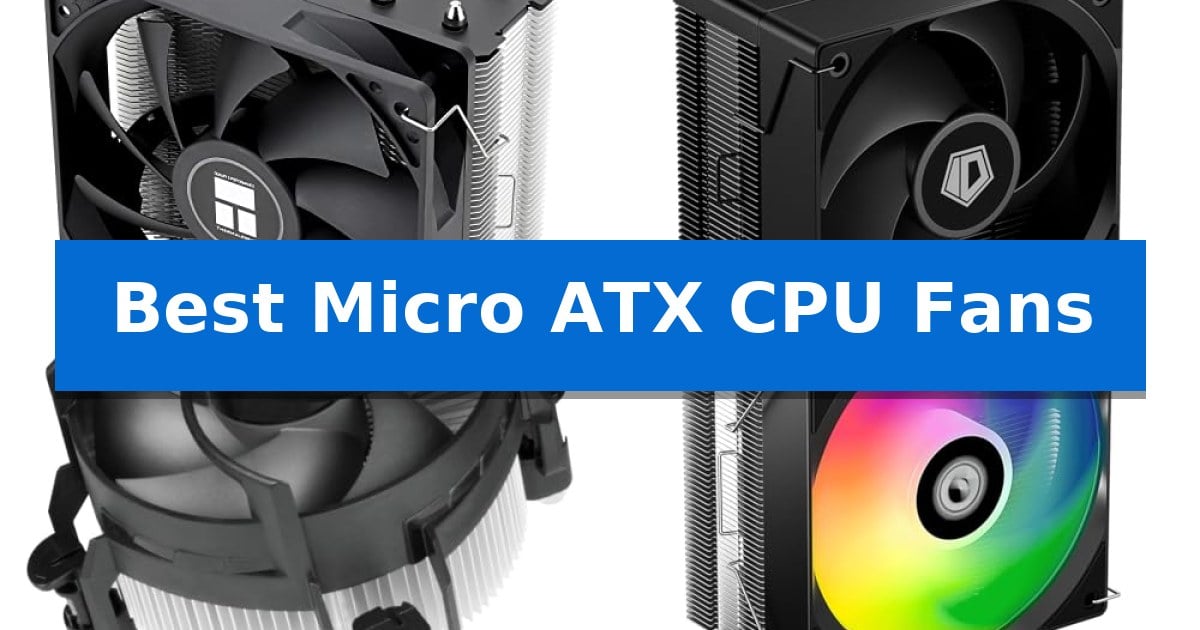
Building a compact PC requires careful planning, especially when managing thermal output within a restricted chassis. Finding the Best Micro ATX CPU Fans is essential for maintaining system stability without sacrificing the space-saving benefits of your smaller motherboard and case configuration.
Our guide examines various cooling solutions designed to fit tight environments while ensuring your processor remains within safe operating temperatures. We focus on physical dimensions, mounting compatibility, and airflow performance to help you identify the right cooler for your specific hardware setup.
You may also want to compare Best Micro ATX Computer Case, Best Micro ATX AM5 Motherboard, and Best Micro ATX AM4 Motherboards.
Best Micro ATX CPU Fans
Quick Comparison
| Product | Best For | Key Strength | Score |
|---|---|---|---|
| Thermalright Assassin X120 Refined SE | Best Overall | Compact 148mm height fits most medium-sized cases. | 4.9 |
| ID-COOLING SE-903-XT V2 | Low-Profile Footprint for Tight Cases | Low-profile footprint prevents interference with RAM and motherboard components. | 4.9 |
| ARCTIC Alpine 17 CO | Space-Saving Radial Heatsink Design | Compact 68.2 mm height ideal for SFF and µATX cases | 4.9 |
| ID-COOLING SE-214-XT V2 | Full Memory Clearance Compatibility | Full memory clearance design prevents RAM interference. | 4.3 |
| HIGH POWER LGA-115x-mITX | Ultra-Low Profile for Small Systems | Ultra-low profile height of 27.3mm fits 1U and compact chassis. | 4.8 |
How We Chose
- Physical dimensions and clearance requirements for mATX and SFF cases.
- Socket compatibility with current Intel and AMD motherboard platforms.
- Airflow efficiency and noise output during standard operation.
- Ease of installation and mounting hardware reliability.
- Integration with RAM slots and surrounding motherboard components.
1 Thermalright Assassin X120 Refined SE — Balanced Cooling for Compact Builds
The Thermalright Assassin X120 Refined SE is engineered with a compact 148mm height, making it a practical choice for users balancing performance with the space constraints of medium-sized computer cases. Its design centers on a 120mm PWM fan and a four-heat-pipe array, providing a focused thermal solution for modern desktop builds.
Equipped with the TL-C12C PWM fan, this cooler achieves a maximum airflow of 66.17CFM while maintaining noise levels at or below 25.6dB(A). The integration of S-FDB bearings and AGHP (Anti-Gravity Heat Pipe) technology helps mitigate the inverse gravity effect, ensuring consistent heat dissipation regardless of whether the cooler is mounted in a vertical or horizontal orientation.
Installation is streamlined through the inclusion of dedicated metal fasteners for both Intel and AMD platforms. It supports a wide range of sockets, including Intel LGA 1150 through 1851 and AMD AM4/AM5, offering broad compatibility for current and recent motherboard layouts.
With its aluminum heatsink and industrial-grade PBT + PC construction, the unit is built for durability, rated for up to 20,000 hours of service life. This cooler presents a straightforward, efficient option for those requiring reliable thermal management within a restricted chassis footprint.
Best for: Users with medium-sized computer cases who need a compact, quiet air cooler with broad socket compatibility.
Skip if: Users requiring extreme-performance liquid cooling for high-TDP overclocked processors or those with ultra-small form factor cases under 148mm in height.
PROS
- Compact 148mm height fits most medium-sized cases.
- AGHP technology ensures consistent performance in any orientation.
- Broad socket support for modern Intel and AMD platforms.
- Quiet operation with a maximum noise level of 25.6dB(A).
CONS
- Not suitable for ultra-compact or low-profile chassis builds.
- Standard 120mm footprint may interfere with tall RAM modules in some tight configurations.
2 ID-COOLING SE-903-XT V2 — Low-Profile Footprint for Tight Cases
Managing thermal output in restricted internal spaces requires a precise balance of cooling capacity and physical clearance. The ID-COOLING SE-903-XT V2 addresses this by utilizing a 100mm PWM fan that increases airflow efficiency compared to its predecessor, ensuring that heat is effectively dissipated from the CPU without demanding excessive motherboard real estate.
Engineered for reliability, this cooler features an enhanced fin-locking structure and reinforced fan clips. These design choices stabilize the aluminum fin stack, which minimizes vibration during operation and provides structural integrity during transport or long-term use. The direct-touch heatpipe design further optimizes thermal transfer by creating a more efficient path between the processor and the heatsink.
Installation is simplified through an upgraded universal mounting bracket that supports both Intel and AMD platforms. This design choice reduces the complexity of the build process, making it a practical choice for users assembling compact systems where workspace is limited. Its low-profile footprint ensures that the cooler does not obstruct RAM slots or other critical motherboard components.
With its refined aesthetic, the ID-COOLING SE-903-XT V2 offers a clean, cohesive look suitable for various build styles, from professional workstations to gaming rigs. By combining a 150W TDP rating with a compact form factor, it provides a balanced solution for users who need dependable cooling within the constraints of ITX or mATX chassis environments.
Best for: Users building in small-form-factor ITX or mATX cases who require a low-profile cooling solution that avoids component interference.
Skip if: Users with high-TDP processors exceeding 150W or those requiring extreme overclocking headroom, as a larger tower cooler or liquid cooling system would be more appropriate.
PROS
- Low-profile footprint prevents interference with RAM and motherboard components.
- Upgraded 100mm PWM fan improves airflow efficiency over previous 92mm models.
- Universal mounting bracket simplifies installation across Intel and AMD platforms.
- Enhanced fin-locking structure improves durability and reduces operational vibration.
CONS
- 150W TDP limit restricts use with high-end, power-hungry processors.
- Compact 100mm fan may be less effective than larger 120mm fans at lower noise levels under heavy loads.
3 ARCTIC Alpine 17 CO — Space-Saving Radial Heatsink Design
Managing thermals in space-constrained builds requires a precise balance of height and airflow, and the ARCTIC Alpine 17 CO addresses this with a compact 92 mm PWM fan and a specialized radial heatsink design. This cooler is engineered specifically for Intel LGA1851 and LGA1700 sockets, making it a focused solution for modern small-form-factor systems.
The unit features a Y-shaped fin design that maximizes the surface area for heat dissipation, allowing the fan to maintain efficient airflow within a total installation height of only 68.2 mm. This low profile ensures compatibility with most Mini-ITX and µATX cases, where clearance for larger tower coolers is often limited.
Installation is streamlined for system builders, as the cooler arrives with pre-applied MX thermal paste and pre-mounted push pins. This design choice simplifies the mounting process, reducing the time required to secure the cooler to the motherboard.
The PWM-controlled fan offers a wide speed range, providing the flexibility to adjust cooling performance based on system load. With a focus on durability and ease of use, this cooler provides a straightforward thermal management option for compatible Intel-based builds.
Best for: Small-form-factor (SFF) PC builders using Intel LGA1851 or LGA1700 sockets who need a low-profile cooling solution.
Skip if: Users with non-Intel motherboards or those requiring high-performance cooling for overclocked, high-TDP processors.
PROS
- Compact 68.2 mm height ideal for SFF and µATX cases
- Pre-applied thermal paste for quick, effortless installation
- PWM-controlled 92 mm fan for flexible cooling performance
- Y-shaped fin design optimizes heat distribution
CONS
- Exclusive compatibility limited to Intel LGA1851 and LGA1700 sockets
- Push-pin mounting may be less secure than screw-based alternatives for heavy transport
4 ID-COOLING SE-214-XT V2 — Full Memory Clearance Compatibility
Managing thermals in a compact system requires a balance of physical clearance and cooling efficiency. The ID-COOLING SE-214-XT V2 ARGB addresses this by utilizing a slim single-tower design that ensures full memory clearance, preventing interference with RAM modules even in crowded micro ATX motherboards.
This cooler features an upgraded tower heatsink equipped with direct touch heatpipes to facilitate efficient heat transfer. To maintain structural integrity and minimize noise, it incorporates an enhanced fin-lock structure and reinforced fan clips, which keep the aluminum fins secure and reduce vibration during operation.
The included fan has been upgraded to provide higher static pressure, which is essential for pushing air through the dense fin array. With a rated noise level of 27.2dB(A), it manages to provide effective cooling without excessive acoustic output, making it a suitable choice for both office and gaming environments.
Installation is streamlined through an upgraded universal mounting bracket that supports a wide range of Intel and AMD sockets, including LGA1851, 1700, and AM5. This design choice simplifies the build process, allowing for a more user-friendly experience when working within the tighter confines of smaller PC cases.
Best for: Users building in compact micro ATX or ATX cases who require guaranteed RAM clearance and efficient thermal management.
Skip if: Users with high-TDP processors exceeding 200W or those requiring liquid cooling solutions for extreme overclocking.
PROS
- Full memory clearance design prevents RAM interference.
- Upgraded universal mounting bracket simplifies installation.
- Direct touch heatpipes improve thermal dissipation efficiency.
- Reinforced fan clips reduce vibration and noise.
CONS
- 200W TDP limit may not be sufficient for high-end enthusiast CPUs.
- Single-tower design lacks the cooling surface area of larger dual-tower alternatives.
5 HIGH POWER LGA-115x-mITX — Ultra-Low Profile for Small Systems
Managing thermals in compact PC builds requires precision, especially when space is at a premium. The HIGH POWER LGA-115x-mITX is engineered specifically for these tight environments, featuring an ultra-low profile height of just 27.3mm from the processor contact point to the top of the fan. This design ensures compatibility with 1U server chassis and small-form-factor cases where standard tower coolers simply cannot fit.
This cooling solution utilizes an 80mm quiet hydraulic bearing fan capable of speeds between 1000 and 3000 RPM. It provides an airflow range of 10.23 to 28.19 CFM, balancing noise levels with the necessary heat dissipation for processors with a TDP of up to 85W. The unit includes a 4-pin PWM power connector, allowing for dynamic speed control based on system temperatures, while maintaining backward compatibility with 3-pin headers.
Installation is streamlined through the inclusion of a dedicated motherboard back plate and a pre-applied layer of thermal paste, reducing the steps required to secure the cooler to the CPU. The assembly combines a durable aluminum heat-sink with the fan, ensuring a lightweight yet effective thermal transfer path. It supports a wide range of Intel sockets, including LGA 1150, 1151, 1155, 1156, and 1200.
Designed for versatility in small-scale computing, the cooler is compliant with FCC, CE, and RoHS standards. Its compact footprint of 3.62 by 3.62 inches makes it a practical choice for users building or maintaining Mini-ITX or Micro-ATX systems where every millimeter of clearance is critical for component layout and airflow management.
Best for: Small-form-factor PC builders needing a low-profile cooling solution for Intel LGA 115x/1200 processors in restricted-height cases.
Skip if: Users with high-TDP processors exceeding 85W or those prioritizing silent operation under heavy, sustained overclocking loads.
PROS
- Ultra-low profile height of 27.3mm fits 1U and compact chassis.
- 4-pin PWM control allows for automated, responsive fan speed adjustments.
- Pre-applied thermal paste and included back plate simplify installation.
- Broad compatibility with Intel LGA 115x and 1200 socket types.
CONS
- 85W TDP limit restricts use with high-performance or high-wattage CPUs.
- Small 80mm fan may produce audible noise at maximum 3000 RPM speeds.
Best Micro ATX CPU Fans Buying Guide
Understanding Form Factor Compatibility
The primary challenge when selecting a cooler for a smaller system is ensuring it fits within the case dimensions. Always verify the maximum CPU cooler height supported by your specific case, as even a few millimeters can prevent the side panel from closing properly.
Additionally, check the proximity of the CPU socket to your RAM slots. Some larger tower coolers may overhang memory modules, requiring you to use low-profile RAM or choose a cooler with a more offset design to maintain full memory clearance.
Airflow and Thermal Management
In a compact build, airflow is often more restricted than in a standard ATX tower. Look for fans that offer a high static pressure rating, as this helps push air effectively through dense heatsink fins even when case airflow is limited.
PWM (Pulse Width Modulation) control is a critical feature to look for. It allows your motherboard to automatically adjust fan speeds based on real-time CPU temperatures, ensuring quiet operation during light tasks and increased cooling power during intensive workloads.
Mounting and Installation
Installation ease varies significantly between models. Some coolers utilize simple push-pin designs that are quick to install but may feel less secure, while others use dedicated backplates and metal fasteners that provide a more robust connection to the motherboard.
Ensure the mounting kit provided is compatible with your specific CPU socket, such as Intel LGA 1700 or AMD AM5. Most modern coolers include universal brackets, but verifying this before purchase prevents unnecessary delays during your build process.
Noise Levels and Bearing Types
Since compact PCs are often placed closer to the user on a desk, noise levels are a significant consideration. Fans equipped with fluid dynamic bearings (FDB) or similar high-quality bearing types generally offer quieter operation and longer service lives compared to standard sleeve bearings.
Pay attention to the decibel (dB) rating provided in the specifications. While lower is generally better, remember that actual noise levels will fluctuate based on the fan speed curve set in your BIOS.
Heatsink Design and Material
The construction of the heatsink, including the number of heat pipes and the material used, directly impacts thermal conductivity. Copper heat pipes with direct-touch technology are common and effective at drawing heat away from the processor quickly.
Aluminum fins are standard for their balance of weight and heat dissipation. Some designs incorporate specialized fin-locking structures, which not only improve structural integrity but can also help reduce vibration-induced noise during operation.
Frequently Asked Questions
Will these coolers fit in a standard ATX case?
Yes, most coolers designed for mATX or SFF systems will easily fit into a standard ATX case, provided your motherboard socket is supported.
Do I need to apply thermal paste separately?
Many modern coolers come with thermal paste pre-applied to the base, though some users prefer to use their own third-party compound for specific thermal requirements.
How do I know if a cooler will block my RAM?
Check the product's dimensions and the manufacturer's compatibility list. Look for coolers labeled as having 'full memory clearance' or 'low-profile' if you have tall RAM heat spreaders.
Can I use a 3-pin fan on a 4-pin header?
Yes, most 4-pin PWM headers are backward compatible with 3-pin fans, though you will lose the ability to control the fan speed via PWM signals.
What is the benefit of a tower cooler over a low-profile cooler?
Tower coolers generally offer better thermal performance due to larger heatsink surface areas, while low-profile coolers are specifically designed for cases with very limited height clearance.
Conclusion: Our Top Pick
Selecting the right cooling solution is a vital step in building a reliable compact system. By prioritizing compatibility with your specific socket and case dimensions, you can ensure your processor remains cool and quiet without compromising your build's footprint.
The Thermalright Assassin X120 Refined SE stands out as our top recommendation due to its balanced performance, effective heat pipe design, and broad compatibility with major CPU platforms. It provides a reliable cooling solution that fits well within the constraints of most medium-sized and compact cases.