
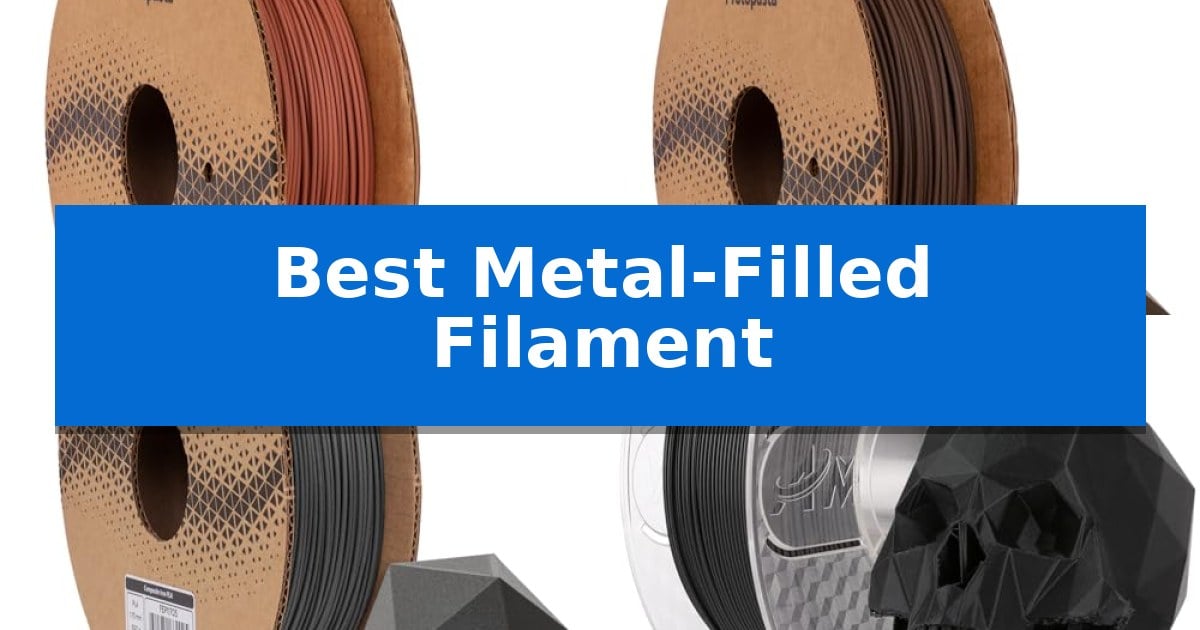
Achieving a professional, high-end look with 3D prints often requires more than just standard plastic. When you need your models to possess the weight, texture, or functional properties of real metal, the Best Metal-Filled Filament provides a unique solution by integrating actual metal powders into a base PLA matrix.
These specialized composites allow makers to go beyond simple aesthetics, offering the ability to polish, patina, or even utilize magnetic properties in functional parts. Whether you are crafting detailed miniatures or durable tools, selecting the right material is essential for achieving the desired finish and performance in your 3D printing projects.
You may also want to compare Best Metal USB Flash Drive, Best Metal TKL Keyboards, and Best Metal Tips for Soldering Irons.
Best Metal-Filled Filament
Quick Comparison
| Product | Best For | Key Strength | Score |
|---|---|---|---|
| Protopasta Copper Filled PLA Filament | Best Overall | High 60% copper powder content for authentic weight and appearance. | 4.9 |
| Protopasta Bronze Filled PLA Filament | Develops realistic patina over time | 60% bronze powder content provides a genuine metallic look and increased density. | 4.6 |
| Protopasta Ferromagnetic Iron PLA Filament | Magnetic properties for functional prints | Ferromagnetic properties allow magnets to stick to finished prints. | 4.3 |
| AMOLEN Iron Powder PLA Filament | Matte finish for magnetic applications | Contains 20% iron powder for magnetic functionality. | 4.8 |
| ELEGOO Metal Bronze PLA Filament | High-gloss sheen for artistic models | Genuine metal filling provides a distinct metallic sheen. | 4.7 |
How We Chose
- Metal content percentage by weight
- Compatibility with standard FDM 3D printers
- Post-processing potential for polishing or patina
- Functional utility such as magnetic attraction
- Consistency in extrusion and diameter accuracy
1 Protopasta Copper Filled PLA Filament — Polishable for authentic metallic finish
Achieving a realistic metallic aesthetic in 3D printed models requires more than just standard plastic. The Protopasta Copper Filled PLA 3D Printer Filament offers a specialized solution by incorporating 60% copper powder by weight into a base PLA material, resulting in a filament with twice the density of standard PLA.
This 1.75mm metallic composite filament is designed for versatility, allowing users to polish or apply a patina to finished prints to enhance the authentic metal look. It is particularly effective for projects like tabletop miniatures, tools, and decorative metallic accessories that benefit from a heavier, more realistic feel.
Compatibility is a primary focus for this material, as it is engineered to work with most consumer 3D printers, including popular models from Prusa, Bambu, Creality, and Ender. The filament is formulated to print smoothly, helping to minimize common extrusion issues like clogs or bubbles during the printing process.
As a product manufactured in the USA, this filament reflects a commitment to quality and material consistency. By utilizing a high-density metal-infused composition, it provides a unique option for creators looking to move beyond the visual limitations of traditional thermoplastic materials.
Best for: Creators and hobbyists who need to produce 3D printed models with an authentic, polishable metallic appearance and weight.
Skip if: Users who require high-strength functional parts, as this composite material is primarily intended for aesthetic and decorative applications rather than structural load-bearing.
PROS
- High 60% copper powder content for authentic weight and appearance.
- Compatible with a wide range of consumer 3D printers.
- Supports polishing and patina finishing techniques.
- Reliable smooth printing performance without clogging.
CONS
- Higher density may require adjustments compared to standard PLA.
- Limited to 500g spool size.
2 Protopasta Bronze Filled PLA Filament — Develops realistic patina over time
Achieving a realistic metallic aesthetic in 3D printing often requires more than just shiny plastic; it demands the weight and texture of actual metal. The Protopasta Bronze Filled PLA Filament addresses this by incorporating 60% bronze powder by weight into its base PLA composition, resulting in a material that is twice as dense as standard PLA.
This 1.75mm metallic composite filament is engineered for versatility, allowing users to polish their finished prints or apply a patina to achieve an authentic aged metal appearance. Because it is designed for consumer printer compatibility, it functions with common platforms like Prusa, Bambu, Creality, and Ender without the typical risks of clogging or bubbling during the extrusion process.
Beyond its visual properties, the filament is manufactured in the USA, reflecting a commitment to quality and material consistency. Whether you are producing tabletop miniatures, functional tools, or automotive models, the material provides a distinct tactile experience that standard polymers cannot replicate.
While this filament offers a unique finish, users should consider that its high metal content makes it significantly denser than traditional plastics. It is a specialized medium best suited for projects where the final aesthetic and physical weight are the primary goals, rather than high-speed functional prototyping.
Best for: Makers and creators who require a realistic, polishable bronze finish and increased physical weight for decorative or display-grade 3D prints.
Skip if: Users primarily focused on high-speed functional prototyping or those who do not intend to perform post-processing like polishing or patination.
PROS
- 60% bronze powder content provides a genuine metallic look and increased density.
- Polish and patina friendly surface allows for advanced post-processing effects.
- Compatible with standard consumer 3D printers including Creality and Bambu.
- Reliable extrusion designed to prevent clogs and bubbles during printing.
CONS
- Higher density compared to standard PLA may require adjustments for specific print settings.
- Specialized material is best utilized with post-processing, which adds time to the workflow.
3 Protopasta Ferromagnetic Iron PLA Filament — Magnetic properties for functional prints
Achieving a realistic metallic aesthetic in 3D printing often requires more than just standard plastic, and the Protopasta Ferromagnetic Iron PLA 3D Printer Filament offers a distinct solution by integrating 45% iron powder by weight into its base PLA composition. This high-density composite material provides a genuine metal-like feel and weight, making it an effective choice for models such as tools, automotive parts, and tabletop miniatures that benefit from a substantial, authentic finish.
Beyond its visual appeal, this 1.75mm metallic composite filament is uniquely ferromagnetic. This functional property allows magnets to adhere directly to finished prints, opening possibilities for interactive displays or functional hardware prototypes. The filament is engineered to maintain compatibility with common consumer printers, including models from Prusa, Bambu, Creality, and Ender, ensuring that users can integrate it into existing workflows without specialized hardware modifications.
The material is designed to support a patina finish, allowing creators to age their prints for a more weathered, realistic appearance. Because it is a composite, the filament is formulated to print smoothly, reducing the likelihood of clogs or bubbles during the extrusion process. As a product manufactured in the USA, it reflects a commitment to quality control and consistent material standards for those seeking reliable results in their composite printing projects.
While this filament excels at providing a metallic look and feel, it is important to note that it is a PLA-based composite. Users should expect the structural characteristics of PLA, enhanced by the density of the iron content. Its primary value lies in its aesthetic versatility and magnetic utility rather than high-temperature or high-stress mechanical applications.
Best for: Creators and hobbyists looking to produce 3D prints with a realistic metallic appearance and magnetic functionality.
Skip if: Users requiring high-strength, heat-resistant, or flexible mechanical parts, as this is a PLA-based composite.
PROS
- Ferromagnetic properties allow magnets to stick to finished prints.
- 45% iron powder content provides a realistic metallic weight and feel.
- Patina-friendly surface allows for weathered, authentic finishes.
- Broad compatibility with standard consumer 3D printers.
CONS
- PLA-based limitations regarding heat resistance and mechanical stress compared to engineering-grade filaments.
4 AMOLEN Iron Powder PLA Filament — Matte finish for magnetic applications
Adding functional magnetic properties to 3D printed objects requires specialized materials, and the AMOLEN Iron Powder PLA Filament provides a unique solution for this requirement. By incorporating 20% iron powder into its composition, this filament allows users to create parts that are attracted to magnets, making it a practical choice for tool holders, fridge magnets, and modular assemblies.
This 1.75mm filament is designed for broad compatibility with most FDM 3D printers, featuring a consistent diameter with a dimensional accuracy of +/-0.02mm to support stable feeding. It operates within an extrusion temperature range of 200–220°C, and the printing bed is optional, with a recommended range of 0–50°C. The material is formulated to provide reliable performance for both functional and decorative prints.
A standout characteristic of this filament is its ability to be post-processed. While it prints with a matte black finish, the surface can be sanded and polished using various grits of sandpaper. This process reveals the iron particles, allowing users to achieve a more realistic metallic appearance on their finished models.
To maintain material integrity, the filament is vacuum-sealed with a desiccant to prevent moisture absorption and dust accumulation. The manufacturer includes a note to pass the filament through the fixed hole after use to prevent tangles, ensuring a smoother experience for subsequent prints.
Best for: Users looking to create functional, magnetic-responsive 3D printed parts like tool holders or custom magnets.
Skip if: Users who require a high-gloss finish directly off the print bed without the need for manual sanding and polishing.
PROS
- Contains 20% iron powder for magnetic functionality.
- Dimensional accuracy of +/-0.02mm for consistent extrusion.
- Surface can be sanded and polished for a metallic look.
- Includes vacuum packaging with desiccant for moisture protection.
CONS
- Requires manual sanding to reveal the full metallic aesthetic.
- Requires careful tangle management via the fixed hole.
5 ELEGOO Metal Bronze PLA Filament — High-gloss sheen for artistic models
Achieving a distinct aesthetic for 3D printed models often requires specialized materials that go beyond standard PLA. The ELEGOO Metal Bronze PLA Filament incorporates genuine metal filling to provide a unique metallic sheen, making it a suitable choice for artistic sculptures and decorative pieces that benefit from a high-gloss finish.
This filament is engineered for reliability during the printing process. It features a 1.75mm diameter with strict tolerances to ensure consistent extrusion. The material is designed to be clogging-free and bubble-free, supported by a manufacturing process that includes thorough drying and vacuum sealing to prevent moisture-related issues. These attributes contribute to stable layer bonding and fluid printing performance on most FDM 3D printers.
Usability is prioritized through a less-tangle design, achieved via full mechanical winding and manual examination during production. The spool features a larger inner diameter to facilitate smoother feeding into the printer. Because it is based on high-quality PLA, the material maintains the standard benefits of the thermoplastic, including a lower melting temperature, low shrinkage, and minimal warping, while remaining odorless during operation.
When selecting this material, it is important to consider the intended application. While the metallic texture offers a visual upgrade for display items, it is specifically formulated for artistic use rather than functional or high-stress mechanical parts. The 1kg cardboard spool provides a standard capacity for most hobbyist projects, balancing ease of use with consistent material quality.
Best for: Artistic creators and hobbyists looking to add a metallic aesthetic to decorative 3D printed sculptures and display models.
Skip if: Users requiring high-strength functional parts or mechanical components, as this material is optimized for visual finish rather than structural durability.
PROS
- Genuine metal filling provides a distinct metallic sheen.
- Less-tangle winding ensures consistent and reliable feeding.
- Low warp and shrinkage characteristics for ease of use.
- Vacuum-sealed packaging protects against moisture absorption.
CONS
- Primarily decorative and not intended for high-stress mechanical applications.
Best Metal-Filled Filament Buying Guide
Understanding Metal-Filled Composites
Metal-filled filaments are essentially a blend of PLA plastic and finely ground metal powder. The high concentration of metal, often reaching 60% by weight, significantly increases the density of the filament compared to standard plastic, giving your prints a heavier, more authentic feel.
Because these materials are still based on PLA, they remain compatible with most FDM 3D printers. However, the abrasive nature of metal particles means that users should be mindful of nozzle wear and may consider using hardened steel nozzles for long-term printing.
Post-Processing and Finishing
One of the primary benefits of using these filaments is the ability to polish the surface. By sanding the printed model with progressively finer grits of sandpaper, you can expose the metal particles, creating a genuine metallic sheen that plastic alone cannot replicate.
Some filaments also support patina development. By applying specific chemical treatments, you can accelerate the oxidation of the metal particles, allowing you to achieve an aged, antique look on your prints, which is ideal for artistic or historical replicas.
Functional Magnetic Properties
Certain metal-filled filaments, particularly those infused with iron powder, are ferromagnetic. This allows the finished print to be attracted to magnets, opening up possibilities for functional designs like modular tool holders, fridge magnets, or snap-fit assemblies.
When designing for magnetic applications, consider the iron content and the wall thickness of your print. A higher percentage of iron powder typically results in stronger magnetic attraction, making it a critical factor for functional mechanical parts.
Printer Compatibility and Setup
Most metal-filled filaments are designed to print within standard PLA temperature ranges, typically between 200°C and 220°C. They generally do not require a heated bed, though using one can help with initial adhesion for larger, denser parts.
Due to the added weight and density of the material, ensure your extruder settings are optimized. A consistent flow rate and a well-calibrated first layer are vital to prevent clogging and ensure the metal particles are distributed evenly throughout the print.
Storage and Maintenance
Like all PLA-based materials, metal-filled filaments are susceptible to moisture absorption. Keeping your spool in vacuum-sealed packaging with desiccant when not in use is crucial to prevent bubbles and maintain print quality.
After printing, it is good practice to purge your nozzle with a standard PLA filament to clear out any remaining metal particles. This prevents potential clogs during your next print job and keeps your hotend in optimal condition.
Frequently Asked Questions
Do I need a special nozzle for metal-filled filament?
While these filaments can often print through standard brass nozzles, the metal particles are abrasive. A hardened steel nozzle is recommended to prevent premature wear.
Can these prints be used for structural applications?
These filaments are primarily for aesthetic or light-duty functional use. They are not intended to replace structural metal parts and may be more brittle than pure PLA.
How do I make the print look more like real metal?
Polishing the surface with sandpaper is the most effective way to expose the metal particles and achieve a metallic luster. You can also apply a patina solution for an aged look.
Are these filaments compatible with all 3D printers?
They are compatible with most FDM printers that use 1.75mm filament. Ensure your printer can handle the slightly higher density and abrasive nature of the material.
Does the iron-filled filament act like a permanent magnet?
No, it is ferromagnetic, meaning it will be attracted to magnets. It does not generate its own magnetic field.
Conclusion: Our Top Pick
For those seeking the most versatile and high-quality metallic finish, the Protopasta Copper Filled PLA Filament stands out as our top recommendation. Its high 60% copper content provides an excellent base for both polishing and patina applications, allowing for a truly authentic metallic appearance that is difficult to achieve with standard materials.
While it requires careful handling due to its density and abrasive nature, the quality of the final output makes it a superior choice for artistic and detailed projects. We recommend pairing this with a hardened steel nozzle to ensure long-term reliability and consistent results for all your metallic-themed prints.