
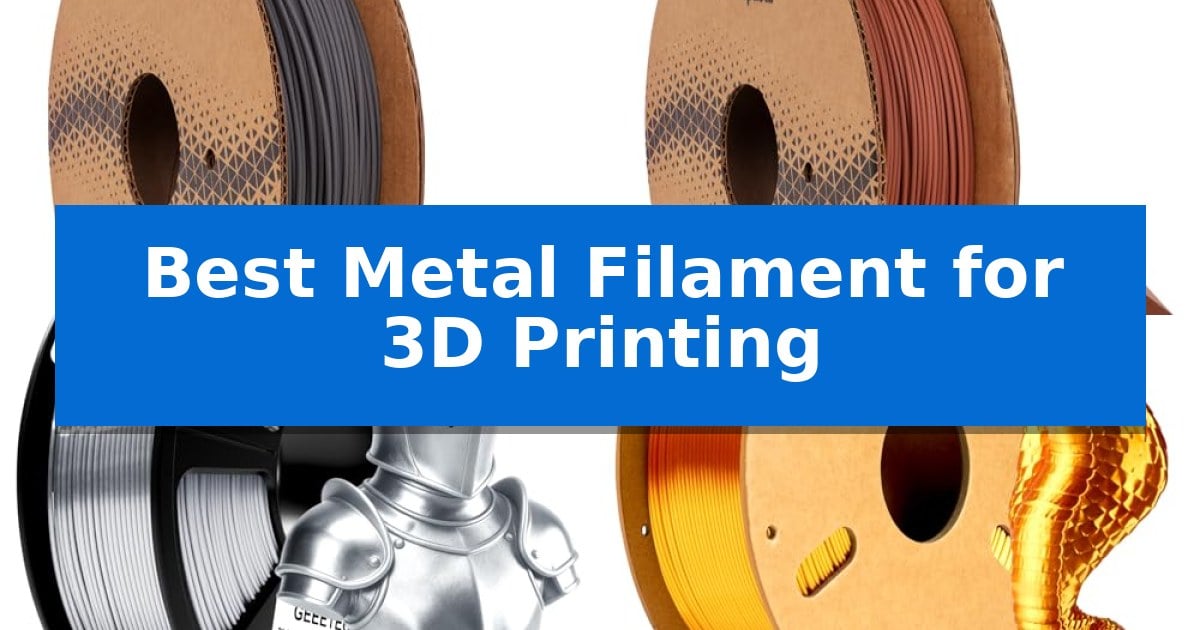
Finding the right material for your 3D printer can transform a standard plastic model into a convincing metallic replica. Whether you are creating intricate tabletop miniatures, functional tools, or decorative prototypes, selecting the Best Metal Filament for 3D Printing requires balancing aesthetic goals with your printer's specific extrusion capabilities.
The market offers two distinct paths: composite filaments infused with actual metal powder for authentic weight and patina, or silk-style plastics designed for high-gloss, reflective surfaces. Understanding the trade-offs between these materials is essential for achieving the professional results you desire without risking nozzle clogs or extrusion failures.
You may also want to compare Best Metal CNC Router, Best Metal CNC Machines, and Best Metal CNC Engraving and Cutting Machines.
Best Metal Filament for 3D Printing
Quick Comparison
| Product | Best For | Key Strength | Score |
|---|---|---|---|
| Protopasta Stainless Steel PLA Filament | Best Overall | High metal content with 60% stainless steel powder by weight. | 4.9 |
| Protopasta Copper PLA Filament | Polishable for authentic finish | 60% copper powder content for a realistic metal look and feel. | 4.3 |
| Geeetech Silk Silver PLA Filament | High-gloss metallic surface | High-gloss metallic finish for superior visual aesthetics. | 4.6 |
| ERYONE Silk Liquid Gold PLA Filament | Luxurious shimmering effect | Luxurious metallic finish provides a high-quality appearance without sanding or painting. | 4.5 |
| UJOY3D Metallic PLA Filament | Supports high-speed printing | Authentic metal-like sheen without added metal powders. | 4.7 |
How We Chose
- Material Composition: Assessing whether the filament uses real metal powder for weight and patina or specialized polymers for a glossy silk effect.
- Printer Compatibility: Evaluating the requirements for nozzle diameter, temperature stability, and the risk of clogging during long print jobs.
- Post-Processing Potential: Determining if the material can be sanded, polished, or chemically treated to enhance its metallic appearance.
- Dimensional Accuracy: Checking the tolerance levels to ensure consistent extrusion and reliable layer adhesion.
- Visual Fidelity: Comparing the depth of luster, light reflection, and overall realism of the printed surface.
1 Protopasta Stainless Steel PLA Filament — Real metal powder for patina
Achieving a realistic metallic aesthetic in 3D printed models requires more than just shiny plastic; it demands a material with genuine density and composition. The Protopasta Stainless Steel PLA Filament addresses this by incorporating 60% by weight stainless steel powder into a standard PLA base, resulting in a composite material that is twice as dense as traditional filament.
This 1.75mm metallic composite filament is engineered for versatility, allowing users to polish or apply a patina to finished prints to enhance their metallic appearance. Because it is designed to print smoothly on most consumer-grade machines—including Prusa, Bambu, Creality, and Ender models—it offers a practical way to produce tools, miniatures, and decorative accessories that look and feel like metal.
The material is manufactured in the USA by ProtoPlant, a company recognized for its history of experimenting with unique composites and recyclable spools. By maintaining a high-quality standard, the filament is formulated to prevent common printing issues like clogs or bubbles, ensuring that the final output matches the user's design expectations.
When integrating this filament into a workflow, it is important to note that the high metal content creates a distinct printing experience compared to standard plastics. It is best suited for projects where the final aesthetic, such as the ability to develop a patina, is the primary goal, rather than high-speed functional prototyping.
Best for: Makers who want to create 3D printed models with a realistic, polishable metallic finish and added weight.
Skip if: Users who prioritize high-speed printing or standard PLA ease-of-use, as the metal-filled composite requires specific handling to avoid potential nozzle wear or clogs.
PROS
- High metal content with 60% stainless steel powder by weight.
- Polish and patina friendly for authentic metallic finishes.
- Compatible with most consumer printers including major brands like Prusa and Bambu.
- Twice the density of standard PLA for a realistic feel.
CONS
- Specialized composite material may require more careful printer maintenance than standard PLA.
2 Protopasta Copper PLA Filament — Polishable for authentic finish
Achieving a distinct metallic aesthetic in 3D printed models requires more than just standard plastic, and the Protopasta Copper PLA Filament offers a specialized solution by incorporating 60% copper powder by weight into its base PLA material. This high-density composite is engineered for users who want to move beyond the look of traditional plastic, providing a material that can be polished or treated with a patina to create a realistic, weathered metal appearance.
The Protopasta Copper PLA Filament is designed for versatility, making it suitable for printing intricate items like tabletop miniatures, decorative tools, or automotive accessories. Because it is a metal-filled composite, the filament is twice as dense as standard PLA, which contributes to a more substantial feel in the final print. The material is manufactured in the USA, reflecting a focus on quality control and consistent material composition.
Compatibility is a key consideration for this filament, as it is designed to work with common consumer 3D printers, including models from Prusa, Bambu, Creality, and Ender. The formulation is intended to print smoothly, reducing the likelihood of common issues like clogs or bubbles during the extrusion process. This allows for a more predictable workflow when working with specialized composite materials.
While this filament opens up new creative possibilities, it is important to note that it is a 500g spool of 1.75mm material. The ability to polish and patina the finished object is its primary advantage, though this process requires post-processing effort from the user to achieve the desired metallic finish. It serves as a specialized tool for those looking to enhance the visual and tactile quality of their 3D printed projects.
Best for: This filament is best for 3D printing enthusiasts who want to create models with a realistic, polishable metallic finish and added weight.
Skip if: Skip this product if you are looking for a standard, low-cost PLA filament for structural parts where metallic aesthetics and post-processing are not required.
PROS
- 60% copper powder content for a realistic metal look and feel.
- Polish and patina friendly for customizable surface finishes.
- High-density composite material provides twice the weight of standard PLA.
- Broad compatibility with major consumer 3D printer brands.
CONS
- Requires post-processing to achieve the full metallic aesthetic.
- Smaller 500g spool size compared to standard 1kg filament offerings.
3 Geeetech Silk Silver PLA Filament — High-gloss metallic surface
Achieving a high-gloss, metallic finish on 3D printed models requires a material that balances aesthetic quality with consistent extrusion. The Geeetech Silk Silver PLA Filament is engineered to provide a smooth, shiny surface that mimics the appearance of polished metal, making it a specialized choice for decorative projects, cosplay accessories, and gifts.
This filament is designed for broad compatibility with standard FDM 3D printers that accept 1.75mm diameter material. It maintains a dimensional accuracy of ±0.02mm, which supports reliable feeding through the extruder. To achieve optimal results, the manufacturer recommends a printing temperature range of 180-210°C and a heated bed temperature between 50-70°C, with a suggested printing speed of 40-60mm/s.
To ensure consistent performance, the material is formulated to be anti-warping and resistant to common extrusion issues like clogging or stringing. Each 1kg spool is delivered in vacuum-sealed packaging with an included desiccant bag, protecting the filament from moisture absorption that can degrade print quality over time.
While this filament excels at creating eye-catching, glossy surfaces, users should note that the silk-like finish is primarily aesthetic. It is best suited for visual components where surface texture is the priority rather than high-stress mechanical parts.
Best for: Creators and hobbyists looking to produce decorative 3D prints with a smooth, high-gloss metallic appearance.
Skip if: Users requiring high-strength, heat-resistant, or impact-resistant mechanical parts, as this silk-finish PLA is optimized for aesthetics rather than structural durability.
PROS
- High-gloss metallic finish for superior visual aesthetics.
- Tight dimensional accuracy of ±0.02mm for consistent extrusion.
- Vacuum-sealed packaging ensures the material remains dry and ready for use.
- Anti-warping formulation helps maintain print stability.
CONS
- Aesthetic-focused material may not provide the mechanical strength required for functional or load-bearing parts.
4 ERYONE Silk Liquid Gold PLA Filament — Luxurious shimmering effect
Achieving a high-end aesthetic for 3D printed models often requires specialized materials that eliminate the need for post-processing. The ERYONE Silk Liquid Gold PLA Filament provides a distinct, shimmering metallic finish directly from the print bed, making it a primary choice for decorative projects and high-visibility prototypes.
This filament is engineered with a strict ±0.03mm diameter tolerance, which is designed to promote smooth extrusion and reduce the likelihood of jams during long print jobs. It is compatible with most FDM printers, operating within a temperature range of 190°C to 220°C, and is formulated to be low-warp with minimal odor during the heating process.
To maintain material integrity, the filament arrives in vacuum-sealed packaging with included desiccant. This moisture-proof storage ensures the material is ready for use immediately upon opening, helping to maintain the consistency of the silk-like, metallic surface finish across complex geometries.
While the ERYONE Silk Liquid Gold PLA Filament excels at visual impact, users should note that silk-type PLAs often have different mechanical properties compared to standard matte or tough PLA variants. It is best suited for display pieces where the luxurious metallic shine is the priority over structural load-bearing applications.
Best for: Artists and hobbyists looking to create decorative, high-visibility prints with a smooth, metallic sheen without post-processing.
Skip if: Users requiring high-strength, functional mechanical parts, as silk-finish filaments often prioritize aesthetics over structural durability.
PROS
- Luxurious metallic finish provides a high-quality appearance without sanding or painting.
- Strict ±0.03mm diameter tolerance supports consistent extrusion and reliable performance.
- Vacuum-sealed packaging protects the filament from moisture before use.
- Low-warp formulation improves reliability on standard FDM printers.
CONS
- Silk-finish materials may have different mechanical characteristics than standard PLA.
- Aesthetic-focused design is less suited for heavy-duty structural components.
5 UJOY3D Metallic PLA Filament — Supports high-speed printing
Achieving a professional, high-gloss finish on 3D printed parts often requires extensive post-processing, but the UJOY3D Metallic PLA Filament simplifies this by integrating a pearlescent, metal-like sheen directly into the material. This filament is engineered to provide an authentic metallic aesthetic without the need for added metal powders, ensuring a smooth, satin luster straight from the printer bed.
Designed for versatility and performance, this 1.75mm filament is compatible with most FDM 3D printers and supports high-speed printing ranging from 200 to 400 mm/s. The material is formulated from 100% virgin raw material, which contributes to stable properties and a reliable printing experience by minimizing the risk of nozzle clogging or tangling during long, continuous print jobs.
To achieve the best visual results, the manufacturer recommends a nozzle temperature between 210–230°C and a heated bed set to 75–80°C. Users can further enhance the surface gloss by adjusting the outer wall speed. The filament is available in nine distinct shades, including Titanium Grey and Champagne Gold, making it a suitable choice for decorative props, mecha models, and intricate figurines.
Each 1kg spool is vacuum-sealed with desiccant to prevent moisture absorption during storage or transit, preserving the integrity of the material. By maintaining a diameter accuracy of ±0.03mm, the UJOY3D Metallic PLA Filament ensures consistent extrusion, providing a dependable option for hobbyists and professionals who require high-quality aesthetic output for their creative projects.
Best for: Users seeking a high-gloss, metallic aesthetic for decorative models and figurines without the need for post-processing.
Skip if: Users who require high-strength functional parts, as this material is a modified PLA and may not match the mechanical durability of specialized engineering filaments.
PROS
- Authentic metal-like sheen without added metal powders.
- Supports high-speed printing up to 400 mm/s.
- Vacuum-sealed packaging ensures moisture protection.
- High-purity 100% virgin raw material for consistent quality.
CONS
- Requires specific temperature settings and speed adjustments to maximize gloss.
Best Metal Filament for 3D Printing Buying Guide
Real Metal Powder vs. Silk Polymers
The most critical decision when choosing a metal-like filament is whether you need a composite material or a silk-finish plastic. Composite filaments, such as those infused with stainless steel or copper powder, contain actual metal particles. These materials are significantly denser than standard PLA and can be polished or oxidized to create a genuine patina, making them ideal for high-end display pieces or props.
Conversely, silk filaments rely on modified polymers to create a high-gloss, pearlescent sheen. These are generally much easier to print, requiring no special nozzle maintenance or post-processing. If your goal is a shiny, decorative surface that looks metallic from a distance, silk options are often the more practical and cost-effective choice.
Nozzle and Extrusion Considerations
Metal-filled filaments are abrasive. Because they contain high percentages of metal powder, they can wear down standard brass nozzles much faster than pure PLA. If you plan to print frequently with these composites, consider upgrading to a hardened steel nozzle to maintain consistent print quality over time.
Additionally, these filaments can be prone to clogging if your print settings are not optimized. Always check the manufacturer's recommended nozzle temperature and print speed ranges. Starting with a slightly larger nozzle diameter, such as 0.6mm, can often prevent the metal particles from causing flow restrictions.
Post-Processing for Realism
One of the primary benefits of using a metal-filled composite is the ability to perform post-processing. Because the surface contains actual metal, you can use fine-grit sandpaper to reveal the metallic sheen hidden beneath the plastic binder. This process, often called polishing, significantly improves the realism of your prints.
For even greater authenticity, some users apply chemical patinas to copper or steel-filled prints to simulate aging. This is a specialized technique that requires patience, but it can turn a simple printed part into a piece that looks like it was cast or machined from solid metal.
Dimensional Accuracy and Tolerance
Consistent filament diameter is vital for any 3D printing project, but it is especially important when working with metallic composites. Look for filaments with a tight diameter tolerance—typically ±0.03mm or better. This ensures that the extrusion rate remains steady, preventing under-extrusion or blobs that would ruin the metallic finish.
Always store your filament in a vacuum-sealed bag with desiccant when not in use. Metal-filled materials can be sensitive to moisture, which may lead to bubbling or poor layer adhesion during the printing process.
Speed and Print Settings
While some modern silk filaments are engineered for high-speed printing, metal-filled composites generally perform better at moderate speeds. Pushing the print speed too high can lead to inconsistent cooling and poor surface finish, which is particularly noticeable on reflective metallic parts.
Always run a temperature tower test when switching to a new metallic filament. Because these materials often contain additives that change their thermal properties, the optimal printing temperature might differ from your standard PLA settings.
Frequently Asked Questions
Do I need a special nozzle for metal-filled filament?
Yes, it is highly recommended to use a hardened steel nozzle. Metal-filled filaments are abrasive and will cause rapid wear on standard brass nozzles.
Can I print metal-filled filament on any FDM printer?
Most consumer FDM printers can handle these filaments, provided they can reach the required temperatures and you have a compatible nozzle installed.
How do I make my prints look more like real metal?
For composite filaments, you can sand the surface with fine-grit sandpaper to expose the metal particles and then buff it to a shine. Silk filaments do not require this, as they are designed for a glossy finish straight off the printer.
Does metal filament make the print heavier?
Yes, filaments infused with real metal powder are significantly denser than standard PLA, giving your finished models a more substantial, realistic weight.
Is silk filament the same as metal-filled filament?
No. Silk filament is a plastic that has been modified for a glossy, metallic-like sheen, while metal-filled filament contains actual metal powder.
Conclusion: Our Top Pick
For those seeking the most authentic metallic results, the Protopasta Stainless Steel PLA Filament stands out as the premier choice. Its high concentration of stainless steel powder allows for genuine polishing and patina effects that plastic-only alternatives simply cannot replicate.
While it requires a bit more care regarding nozzle maintenance due to its abrasive nature, the ability to create models with real metal weight and texture makes it the best investment for serious hobbyists. If you prioritize ease of use and high-gloss aesthetics for decorative items, our other listed silk options remain excellent alternatives.