
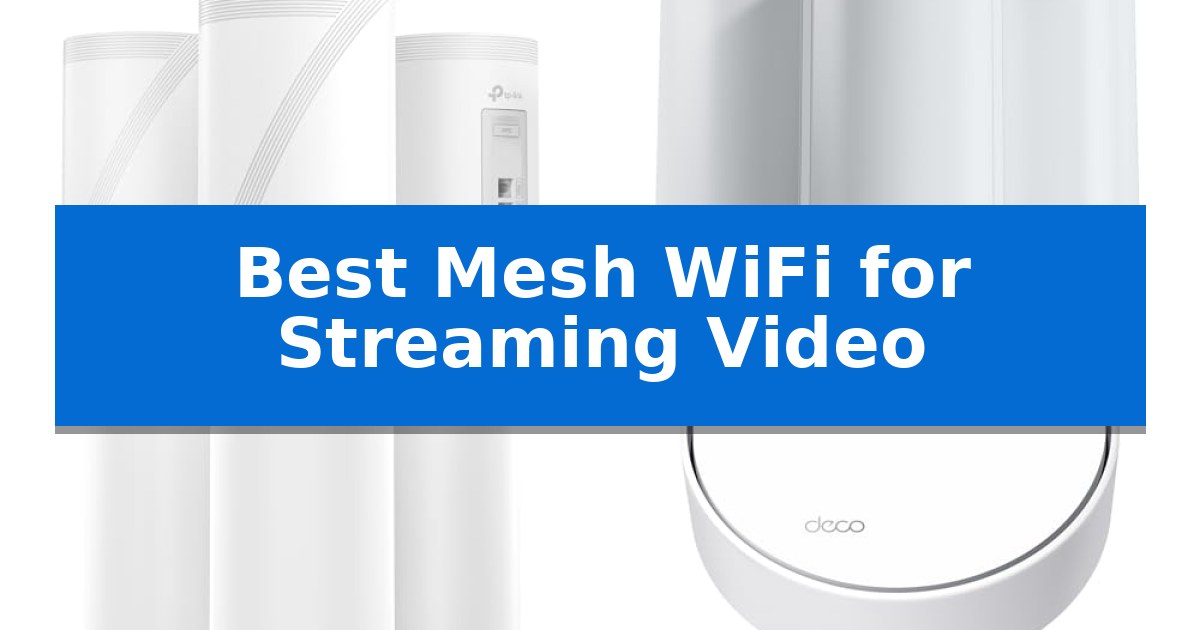
Buffering during a high-stakes movie climax or a live sports broadcast can ruin the experience. When your home network struggles to keep up with multiple devices, the Best Mesh WiFi for Streaming Video becomes the most critical component of your entertainment setup.
A reliable mesh system ensures that your high-bandwidth content reaches every room without interruption. By evaluating current standards like WiFi 7 and multi-gigabit connectivity, we help you identify the hardware capable of handling demanding 4K and 8K streams across your entire living space.
You may also want to compare Best Mesh WiFi for Streaming TV, Best Mesh WiFi for Streaming and Gaming, and Best Mesh WiFi for Smart Homes.

Best Mesh WiFi for Streaming Video
Quick Comparison
| Product | Best For | Key Strength | Score |
|---|---|---|---|
| TP-Link Deco 7 Pro Mesh System | Best Overall | Wi-Fi 7 technology with 8-stream tri-band support for maximum throughput. | 4.9 |
| NETGEAR Orbi 770 Mesh System | High-Capacity Multi-Device Streaming | WiFi 7 technology providing up to 11 Gbps speeds. | 4.9 |
| NETGEAR Orbi 370 Mesh System | Fast WiFi 7 Entry | WiFi 7 technology provides up to 5 Gbps for high-demand streaming. | 4.9 |
| TP-Link Deco X50-PoE Mesh WiFi | Flexible Ceiling-Mount Placement | 2.5 Gigabit Ethernet ports for high-performance wired backhaul. | 4.3 |
| DBIT AX1800 Mesh WiFi System | Budget-Friendly Streaming Coverage | WiFi 6 AX1800 technology for efficient bandwidth management. | 4.5 |
How We Chose
- Wireless Standards: Prioritizing WiFi 7 and WiFi 6 for increased throughput and reduced latency.
- Backhaul Capability: Evaluating wired and wireless backhaul options to ensure data remains stable between nodes.
- Device Capacity: Assessing how many concurrent high-bandwidth streams a system can manage without performance degradation.
- Port Versatility: Checking for multi-gigabit WAN/LAN ports to support high-speed internet plans.
- Coverage Efficiency: Reviewing the rated square footage and the ability of AI-driven roaming to maintain connections while moving.
1 TP-Link Deco 7 Pro Mesh System — Best for Ultra-HD Streaming
High-resolution video streaming and immersive gaming demand a network that can handle massive data throughput without stuttering. The TP-Link Deco 7 Pro Mesh System addresses this by leveraging Wi-Fi 7 technology, providing an 8-stream tri-band architecture that reaches speeds up to 14 Gbps. This system is engineered to maintain stable, high-speed connections for bandwidth-intensive tasks like 8K streaming and AR/VR applications across a wide footprint.
Designed to eliminate dead zones, the TP-Link Deco 7 Pro Mesh System offers coverage for up to 8,100 square feet while supporting over 200 devices simultaneously. It utilizes Multi-Link Operation (MLO) to combine multiple Wi-Fi bands into a single, powerful stream, ensuring that your devices receive a consistent signal even as you move through your home. The integration of AI-Roaming further refines this experience by automatically switching your device to the optimal Deco unit without manual intervention.
Connectivity is a standout feature, with each unit equipped with 10 Gbps, 2.5 Gbps, and 1 Gbps WAN/LAN ports. This multi-gigabit capability allows you to take full advantage of high-speed internet plans, while the 10 Gbps wired backhaul ensures that the communication between mesh nodes does not become a bottleneck. For added versatility, a built-in USB 3.0 port is included for extra connectivity options.
Security and management are handled through the Deco App, which provides a straightforward setup process compatible with major internet providers. TP-Link has prioritized network safety as a signatory of the CISA Secure-by-Design pledge, and the system includes TP-Link HomeShield for essential network security, Quality of Service (QoS), and parental controls. Additionally, the system supports VPN clients and servers, allowing devices to access remote networks without requiring individual software installations.
Best for: Users with multi-gigabit internet plans who require consistent, high-bandwidth connectivity for 4K/8K streaming and gaming across large homes.
Skip if: Users living in smaller apartments or those who do not have high-speed multi-gigabit internet plans may find the advanced port and bandwidth capabilities of this system exceed their actual requirements.
PROS
- Wi-Fi 7 technology with 8-stream tri-band support for maximum throughput.
- Multi-gigabit connectivity featuring 10 Gbps WAN/LAN ports.
- AI-Roaming and MLO for seamless, uninterrupted device switching.
- Advanced security features including CISA Secure-by-Design compliance and built-in VPN support.
CONS
- High-end hardware may be overkill for standard internet connections.
- Requires separate modem for internet service connectivity.
2 NETGEAR Orbi 770 Mesh System — High-Capacity Multi-Device Streaming
The NETGEAR Orbi 770 Mesh System leverages advanced WiFi 7 technology to provide a high-capacity network capable of handling up to 100 devices simultaneously. By utilizing Tri-Band technology with an Enhanced Backhaul, this system is engineered to maintain consistent connectivity for demanding tasks like 8K streaming, VR, and high-definition video calls across a coverage area of up to 8,000 square feet.
Designed for modern homes, the system includes a main router and two satellite extenders to eliminate dead zones from the basement to the rooftop. It supports speeds up to 11 Gbps, offering a significant jump in throughput compared to previous standards. The inclusion of a 2.5 Gig port ensures that the system is ready to interface with high-speed fiber or cable internet plans effectively.
Setup is managed through the Orbi app, which provides a guided, step-by-step process to get the mesh network operational. The hardware is built to be compatible with existing ISP equipment, allowing for a straightforward integration into your current home network setup. For security, the system comes with Advanced Router Protection and automatic firmware updates enabled out of the box, with an optional trial for NETGEAR Armor to provide additional protection against online threats.
This system is a practical choice for households that require reliable, multi-device performance without the frustration of network slowdowns. While it provides extensive coverage, users should note that the actual range can vary based on home layout and construction materials. It is a future-ready investment for those looking to upgrade their infrastructure to support the latest wireless standards.
Best for: Large households requiring high-capacity, multi-device connectivity for 8K streaming and intensive network use.
Skip if: Users living in smaller apartments or those who do not require the high throughput and broad coverage of a three-piece mesh system.
PROS
- WiFi 7 technology providing up to 11 Gbps speeds.
- Tri-Band connectivity with Enhanced Backhaul to prevent slowdowns.
- Extensive coverage of up to 8,000 sq. ft. with the included 3-pack.
- Integrated security features including Advanced Router Protection.
CONS
- Separate subscription required for full NETGEAR Armor security features.
- Coverage variability based on specific home layout and construction materials.
3 NETGEAR Orbi 370 Mesh System — Fast WiFi 7 Entry
Maintaining a consistent, high-bandwidth connection is essential for high-definition media consumption, and the NETGEAR Orbi 370 Mesh System addresses this by utilizing WiFi 7 technology to deliver speeds up to 5 Gbps. This system is designed to handle the demands of 8K streaming, VR, and simultaneous video calls across multiple devices without the bottlenecks often found in older networking hardware.
The 3-pack configuration provides extensive coverage for up to 6,000 sq. ft., effectively eliminating dead zones from the basement to the rooftop. By incorporating Dual-Band technology with Enhanced Backhaul, the system ensures that data traffic remains efficient, allowing up to 70 devices to stay connected simultaneously while maintaining the stability required for uninterrupted video playback.
Installation is streamlined through the Orbi app, which provides a guided setup process to get the network operational quickly. The hardware is compatible with existing cable or fiber modems and includes a 2.5 Gig port, ensuring it can maximize the potential of high-speed internet plans. For added peace of mind, the system comes with built-in security features and automatic firmware updates to protect the home network.
While the system is built for performance, it remains flexible for larger environments. Users can easily expand their network by adding additional Orbi 370 Series satellites if their home layout requires further reach. This modular approach, combined with the latest wireless standards, positions the system as a long-term solution for homes that prioritize heavy media usage.
Best for: Large homes requiring high-bandwidth, stable connectivity for multiple simultaneous 8K video streams and gaming sessions.
Skip if: Users with smaller living spaces or those who do not have high-speed internet plans exceeding standard WiFi 6 capabilities may find this system more than they require.
PROS
- WiFi 7 technology provides up to 5 Gbps for high-demand streaming.
- Extensive 6,000 sq. ft. coverage with a 3-pack configuration.
- Enhanced Backhaul maintains speed across multiple connected devices.
- 2.5 Gig port supports high-speed internet service provider plans.
CONS
- Requires separate subscription for full NETGEAR Armor security features.
- Performance dependent on the user's specific internet plan and device compatibility.
4 TP-Link Deco X50-PoE Mesh WiFi — Flexible Ceiling-Mount Placement
Achieving a stable, high-bandwidth connection for high-definition media requires hardware capable of managing heavy network traffic without bottlenecks. The TP-Link Deco X50-PoE Mesh WiFi is engineered to address this by offering 2.5 Gigabit Ethernet ports, ensuring that your wired backhaul or high-speed internet input is not restricted by standard gigabit limitations.
Designed for versatility, this unit supports Power over Ethernet (PoE+), allowing for flexible installation on ceilings or walls where traditional power outlets may be unavailable. This placement capability helps optimize signal distribution throughout a home, which is critical for maintaining the consistent throughput necessary for uninterrupted video streaming and large file downloads.
The system utilizes AX3000 Dual-Band WiFi 6 technology, providing combined speeds of up to 2402 Mbps on the 5 GHz band and 574 Mbps on the 2.4 GHz band. To manage varying network demands, the AI-Driven Mesh feature intelligently monitors traffic loads, allowing connected devices to transition between nodes seamlessly for the most reliable connection path.
Security and management are integrated through the TP-Link HomeShield suite, which includes parental controls and network security reporting. The system is also designed to be compatible with all other Deco models, allowing users to expand their existing mesh network coverage as needed without replacing current hardware.
Best for: Users requiring high-speed wired backhaul via 2.5G ports and flexible ceiling-mount installation for optimal signal coverage.
Skip if: Users who do not have a PoE+ switch or injector and prefer a standard plug-in power solution without the complexity of ceiling mounting.
PROS
- 2.5 Gigabit Ethernet ports for high-performance wired backhaul.
- PoE+ support enables flexible ceiling or wall-mount placement.
- AI-Driven Mesh technology optimizes device connections automatically.
- Full compatibility with all existing Deco mesh models.
CONS
- PoE+ switch required for power over ethernet functionality.
- Single-pack configuration may require additional units for larger home coverage.
5 DBIT AX1800 Mesh WiFi System — Budget-Friendly Streaming Coverage
Maintaining a consistent, high-bandwidth connection throughout a large home is essential for uninterrupted 4K streaming and low-latency gaming. The DBIT AX1800 Mesh WiFi System utilizes WiFi 6 technology to deliver a combined speed of up to 1.8 Gbps, specifically engineered to manage high-demand tasks like video streaming across multiple devices simultaneously.
This 3-pack system provides coverage for up to 6,500 sq. ft., utilizing seamless roaming to ensure your devices stay connected as you move between rooms. By replacing standard extenders with a unified mesh network, the system eliminates dead zones and supports 150+ connected devices through advanced OFDMA and MU-MIMO bandwidth allocation.
Each unit is equipped with two Gigabit Ethernet ports, totaling six ports across the set, which allows for stable wired backhaul configurations. The setup process is managed via an intuitive mobile app, which also provides access to parental controls, guest network management, and WPA3 encryption for enhanced network security.
The DBIT AX1800 Mesh WiFi System offers flexible expansion options, allowing users to add additional nodes via the app or a dedicated physical Mesh button. It is designed for universal compatibility, functioning with any cable or fiber modem to provide a streamlined, whole-home networking solution.
Best for: Large homes requiring stable, high-speed coverage for multiple simultaneous 4K video streams and smart home devices.
Skip if: Users living in small apartments or those who require tri-band performance for extremely high-density, multi-gigabit wired environments.
PROS
- WiFi 6 AX1800 technology for efficient bandwidth management.
- 6,500 sq. ft. of coverage with seamless roaming.
- Six total Gigabit Ethernet ports for stable wired backhaul.
- WPA3 encryption and integrated parental controls.
CONS
- Dual-band architecture may face higher congestion compared to tri-band systems in extremely busy environments.
Best Mesh WiFi for Streaming Video Buying Guide
Understanding WiFi Standards
The transition to WiFi 7 represents a significant leap for streaming, offering wider channels and Multi-Link Operation (MLO). These features allow devices to aggregate bands, which is essential for maintaining high bitrates during 8K video playback.
While WiFi 6 remains highly capable for most households, upgrading to newer standards is recommended if you have a high-speed fiber plan or a large number of smart home devices competing for bandwidth.
The Importance of Backhaul
Backhaul refers to the connection between your main router and the satellite nodes. A wired backhaul using Ethernet cables is always the most stable method for streaming, as it bypasses wireless interference entirely.
If you cannot run cables, look for systems with dedicated tri-band wireless backhaul. This creates a separate lane for data to travel between nodes, preventing your streaming traffic from slowing down.
Coverage and Placement
Mesh systems are designed to eliminate dead zones, but placement is key. Nodes should be positioned in open areas, ideally with a clear line of sight between them to maximize signal strength.
Consider the layout of your home when choosing a system. Multi-story homes often benefit from systems that support ceiling or wall mounting, which can improve signal propagation across floors.
Multi-Gigabit Connectivity
As internet service providers roll out plans exceeding 1 Gbps, your router's port configuration becomes a potential bottleneck. Systems featuring 2.5 Gbps or 10 Gbps ports ensure that your network can actually deliver the speeds you are paying for.
Always verify that your modem and the cables you use are also rated for these higher speeds to avoid limiting your network's potential at the entry point.
Security and Network Management
Modern mesh systems offer integrated security suites like TP-Link HomeShield or NETGEAR Armor. These tools provide essential protection against threats and allow for granular control over network traffic.
Quality of Service (QoS) settings are particularly useful for streamers, as they allow you to prioritize video traffic over background tasks like file downloads or system updates.
Frequently Asked Questions
Do I need WiFi 7 for streaming 4K video?
While WiFi 6 is sufficient for most 4K streams, WiFi 7 provides better stability and lower latency, which is beneficial if you have many devices streaming simultaneously.
Can I mix different mesh brands?
Generally, no. Mesh systems rely on proprietary protocols to communicate between nodes, so you should stick to a single ecosystem for the best performance.
How many nodes do I need for a 3,000 sq. ft. home?
A 2-pack or 3-pack is typically sufficient, but the exact number depends on your home's construction materials and the layout of your rooms.
What is the benefit of a 10 Gbps port?
It allows you to take full advantage of ultra-fast fiber internet plans, preventing the router from becoming a bottleneck for your entire home network.
Does mesh WiFi reduce my internet speed?
Wireless mesh nodes may experience a slight drop in speed compared to a direct wired connection, but high-quality systems with dedicated backhaul minimize this loss significantly.
Conclusion: Our Top Pick
For those seeking the most robust performance for high-definition media, the TP-Link Deco 7 Pro Mesh System stands out as the premier choice. Its combination of WiFi 7 technology, massive device capacity, and 10 Gbps port support makes it exceptionally well-suited for modern, high-bandwidth households.
While other systems offer great value for smaller setups, the Deco 7 Pro provides the necessary overhead to ensure that 4K and 8K streams remain smooth, even when the rest of your home is active. It is a future-ready investment for any serious streaming enthusiast.