
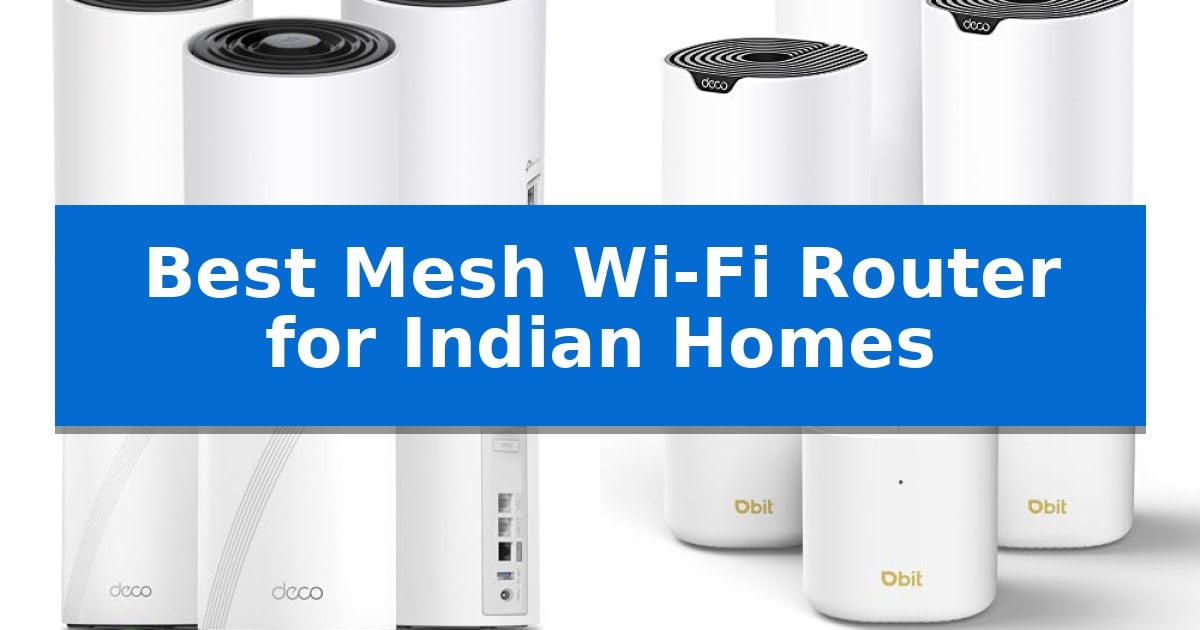
Finding the Best Mesh Wi-Fi Router for Indian Homes requires balancing thick concrete walls, varying floor plans, and the need for consistent, high-speed connectivity across multiple devices. Traditional single-router setups often struggle to penetrate multiple rooms, leading to frustrating dead zones and inconsistent streaming performance.
Mesh systems offer a more reliable alternative by creating a unified network that blankets your entire living space. By evaluating coverage area, Wi-Fi standards, and ease of management, we have identified the most effective solutions to ensure your home remains fully connected, regardless of its size or layout.
You may also want to compare Best Mesh Wi-Fi Router for 2-Story Houses, Best Mesh Wi-Fi Router and Network System, and Best Mesh Wi-Fi Router and Modem Combination for Long Range.
Best Mesh Wi-Fi Router for Indian Homes
Quick Comparison
| Product | Best For | Key Strength | Score |
|---|---|---|---|
| TP-Link Deco XE75 Mesh System | Best Overall | 6 GHz band support eliminates interference from legacy devices. | 4.9 |
| TP-Link Deco S4 Mesh System | Reliable Whole-Home Coverage | Unified network name eliminates the need for switching between extenders. | 4.8 |
| TP-Link Deco 7 Pro Mesh System | High-Speed Multi-Gig Performance | Tri-band Wi-Fi 7 with 8-stream performance for high-bandwidth tasks. | 4.9 |
| DBIT AX1800 Mesh System | Budget-Friendly Large Area Coverage | Extensive 6,500 sq. ft. coverage with a three-pack system. | 4.6 |
| Amazon eero 7 Mesh System | Seamless Wi-Fi 7 Integration | Supports internet plans up to 2.5 Gbps for high-speed throughput. | 4.9 |
How We Chose
- Coverage area capacity to ensure signal penetration through common wall materials.
- Support for modern Wi-Fi standards to handle high-bandwidth tasks like 4K streaming and gaming.
- Ease of setup and ongoing network management through intuitive mobile applications.
- Security features that protect connected devices and manage household internet access.
- Hardware versatility, including the presence of Gigabit ports for wired backhaul stability.
1 TP-Link Deco XE75 Mesh System — Best Future-Proof Tri-Band Pick
Maintaining a stable, high-speed connection across a large multi-story home requires hardware capable of navigating physical barriers and interference. The TP-Link Deco XE75 Mesh System addresses this by utilizing the 6 GHz band, which provides a dedicated frequency for high-performance traffic, effectively separating it from the congestion of legacy devices found in typical households.
This system features Wi-Fi 6E Tri-Band technology, allowing for a total aggregate speed of up to 5,400 Mbps across three bands. By leveraging the 6 GHz spectrum as a dedicated backhaul, the nodes maintain a robust connection to one another, ensuring that the 7,200 sq. ft. coverage remains consistent. The integration of AI-Driven Mesh technology allows the system to learn your home's specific layout and device usage patterns, automatically optimizing the signal path for connected clients.
Security and management are handled through the TP-Link HomeShield service, which provides network protection and IoT device identification. The system is built to comply with the CISA Secure-by-Design pledge, emphasizing advanced security as a core requirement. Setup is streamlined via the Deco app, which offers visual guidance, and the system maintains compatibility with major internet service providers, requiring only a standard modem to function.
While the TP-Link Deco XE75 Mesh System is designed for high-capacity environments, it is important to note that its full potential is realized most effectively with Wi-Fi 6E-compatible devices. For users who do not have 6E-capable hardware, the system still functions as a high-performance tri-band mesh network, though the specific advantages of the 6 GHz band will be limited to node-to-node communication.
Best for: Large homes requiring high-capacity, interference-free connectivity for numerous devices using the latest Wi-Fi 6E standard.
Skip if: Users who do not have Wi-Fi 6E compatible devices and are looking for a more budget-friendly, standard Wi-Fi 6 mesh solution.
PROS
- 6 GHz band support eliminates interference from legacy devices.
- Covers up to 7,200 sq. ft. with a 3-pack configuration.
- AI-Driven Mesh automatically optimizes network performance based on user behavior.
- Adheres to the CISA Secure-by-Design cybersecurity pledge.
CONS
- 6 GHz band benefits are primarily limited to 6E-compatible hardware.
- Requires an existing separate modem for internet connectivity.
2 TP-Link Deco S4 Mesh System — Reliable Whole-Home Coverage
Managing connectivity across a multi-room Indian home requires a system that eliminates dead zones without the complexity of traditional range extenders. The TP-Link Deco S4 Mesh System utilizes Deco Mesh technology to create a unified network, allowing devices to maintain a strong signal as you move throughout your living space.
This system operates on AC1900 Dual-Band Wi-Fi 5 speeds, providing up to 1300 Mbps on the 5 GHz band and 600 Mbps on the 2.4 GHz band. With the ability to support up to 100 devices simultaneously, it is built to handle the density of modern smart homes. The three-pack configuration is rated to cover up to 5,500 square feet, ensuring that even distant corners of a large residence receive consistent signal strength.
Usability is centered around the Deco app, which simplifies the initial setup process on both Android and iOS platforms. Beyond basic connectivity, the system includes robust parental controls that allow for the creation of unique profiles to limit online time and block specific websites. For those integrated into smart home ecosystems, the unit supports Alexa voice commands to toggle guest Wi-Fi access.
Each unit is equipped with 2 Gigabit Ethernet ports, providing the flexibility to use a wired backhaul for enhanced stability. While the system is universally compatible with major ISPs, users should note that a separate modem is required to establish the internet connection. The design is compact, measuring roughly 6.4 inches in height, making it easy to place on shelves or desks without occupying significant space.
Best for: Large Indian homes requiring seamless, whole-house Wi-Fi coverage for multiple devices and robust parental control features.
Skip if: Users who require the latest Wi-Fi 6 or Wi-Fi 7 standards for ultra-high-speed multi-gigabit internet plans.
PROS
- Unified network name eliminates the need for switching between extenders.
- Wide coverage area of up to 5,500 square feet with a three-unit setup.
- Gigabit Ethernet ports allow for stable wired backhaul connections.
- Comprehensive parental controls for managing family internet usage.
CONS
- Requires a separate modem from your ISP to function.
- Limited to Wi-Fi 5 speeds, which may not fully utilize ultra-fast fiber connections.
3 TP-Link Deco 7 Pro Mesh System — High-Speed Multi-Gig Performance
Maintaining a stable, high-speed network across a large Indian home requires hardware capable of handling dense device environments and thick walls. The TP-Link Deco 7 Pro Mesh System addresses this with its 8-stream tri-band Wi-Fi 7 architecture, providing a robust backbone for modern connectivity needs. By utilizing Multi-Link Operation (MLO) and 4K-QAM, this system ensures that bandwidth-heavy tasks like 8K streaming and low-latency gaming remain consistent even as you move between rooms.
Designed for versatility, the system offers 10 Gbps, 2.5 Gbps, and 1 Gbps WAN/LAN ports on each unit, allowing users to leverage multi-gig internet plans effectively. This wired flexibility is complemented by a 10 Gbps wired backhaul, which works in tandem with the wireless bands to maintain signal integrity across an expansive 8,100 sq. ft. coverage area. With support for over 200 devices, it is built to manage the growing number of smart home appliances, consoles, and mobile devices typical in a connected household.
The TP-Link Deco 7 Pro Mesh System simplifies network management through the Deco App, which provides step-by-step installation instructions. Security is prioritized through the CISA Secure-by-Design pledge and the inclusion of TP-Link HomeShield, which offers essential network security, quality of service, and parental controls. Additionally, the integrated VPN client and server support allows for secure remote access without needing individual software installations on every connected device.
While the system provides extensive coverage and high-speed potential, it is important to note that a separate modem is required for internet connectivity. The AI-Roaming technology ensures that devices are automatically handed off to the strongest node, creating a unified network name that eliminates the need for manual switching as you navigate your home.
Best for: Large homes requiring multi-gigabit speeds and support for a high density of simultaneous smart devices.
Skip if: Users with smaller apartments or those who do not have multi-gigabit internet plans may find the advanced port configurations and tri-band capacity more than they require.
PROS
- Tri-band Wi-Fi 7 with 8-stream performance for high-bandwidth tasks.
- 10 Gbps multi-gigabit ports for future-proof wired connectivity.
- AI-Roaming ensures seamless transitions between mesh nodes.
- Integrated VPN support for enhanced network-wide security.
CONS
- Requires a separate modem to function as an internet gateway.
- High-end feature set may be excessive for basic home internet setups.
4 DBIT AX1800 Mesh System — Budget-Friendly Large Area Coverage
Maintaining a stable network across expansive Indian homes requires a robust solution that eliminates dead zones without the complexity of traditional extenders. The DBIT AX1800 Mesh System addresses this by utilizing a three-unit setup designed to provide coverage for up to 6,500 sq. ft., ensuring consistent connectivity for high-demand environments.
Equipped with WiFi 6 technology, this system supports dual-band performance with speeds reaching 1.8 Gbps. The inclusion of OFDMA and MU-MIMO allows the network to manage up to 150 connected devices simultaneously, making it well-suited for households with numerous smart home gadgets and heavy streaming requirements.
Each unit features Gigabit Ethernet ports, facilitating stable wired backhaul for users who prioritize connection reliability. The setup process is managed through an intuitive mobile app, which also provides access to WPA3 encryption and parental controls, allowing for straightforward network administration and security monitoring.
The system offers flexible expansion options, enabling users to add nodes via the app or a dedicated mesh button. By replacing standard routers with this mesh architecture, users can achieve seamless roaming between rooms, effectively supporting multi-story layouts and complex home configurations.
Best for: Large Indian homes requiring wide-area coverage and support for a high volume of connected smart devices.
Skip if: Users living in small apartments where a single high-performance router would suffice without the need for a multi-node mesh system.
PROS
- Extensive 6,500 sq. ft. coverage with a three-pack system.
- WiFi 6 efficiency supporting up to 150 simultaneous devices.
- Gigabit Ethernet ports for stable wired backhaul.
- Seamless roaming across multiple nodes.
CONS
- Dual-band limitation compared to tri-band systems for extremely high-traffic environments.
5 Amazon eero 7 Mesh System — Seamless Wi-Fi 7 Integration
The Amazon eero 7 Mesh System utilizes advanced Wi-Fi 7 technology to provide a robust networking solution for expansive homes, supporting internet plans up to 2.5 Gbps. By incorporating two auto-sensing 2.5 GbE ports, this system ensures high-speed connectivity for bandwidth-intensive tasks across a 6,000 sq. ft. coverage area.
Engineered for reliability, the system features patented TrueMesh software alongside TrueRoam and TrueChannel technologies. These tools work in tandem to proactively manage connections, keeping devices on the most stable path available. With support for over 120 devices, the 3-pack configuration is designed to eliminate dead spots in larger living spaces.
The Amazon eero 7 Mesh System is built for modern versatility, offering backward compatibility with all previous eero generations and integration with select Amazon Echo devices via eero Built-in. Users can further enhance their network management through an optional eero Plus subscription, which adds digital security tools like ad blocking, parental controls, and VPN services.
Designed with a compact footprint, each unit measures 5.12 inches in height and length, making it easy to place throughout a home. The system is backed by a three-year warranty, providing long-term support for its Wi-Fi 7 capabilities, including multi-link operation (MLO) for improved performance.
Best for: Large homes requiring high-speed Wi-Fi 7 coverage for a high volume of connected devices.
Skip if: Users who do not have Wi-Fi 7 compatible hardware or internet plans exceeding 1 Gbps may find the advanced feature set unnecessary for their current needs.
PROS
- Supports internet plans up to 2.5 Gbps for high-speed throughput.
- Provides extensive 6,000 sq. ft. coverage with a 3-pack system.
- Includes backward compatibility with older eero devices.
- Features multi-link operation (MLO) for enhanced Wi-Fi 7 performance.
CONS
- Advanced security features require an optional eero Plus subscription.
Best Mesh Wi-Fi Router for Indian Homes Buying Guide
Understanding Mesh Wi-Fi Coverage
Mesh systems function by using multiple nodes that communicate with each other to create a single, seamless network. Unlike traditional range extenders, which often create separate networks and reduce bandwidth, mesh nodes maintain a consistent signal throughout your home.
When choosing a system, consider the total square footage of your home and the number of floors. Systems with tri-band capabilities often provide better performance in larger homes by dedicating one band specifically for communication between nodes, leaving the others free for your devices.
The Importance of Wi-Fi Standards
Wi-Fi 6 and Wi-Fi 7 represent significant leaps in network efficiency, especially in environments with many connected smart home devices. These standards allow routers to handle more concurrent traffic without slowing down, which is essential for modern households.
While older standards may suffice for basic browsing, investing in newer technology ensures your network remains capable as you add more devices. Always check if your current devices are compatible with the Wi-Fi standard of the router you intend to purchase.
Wired Backhaul and Ethernet Ports
While mesh systems are designed for wireless convenience, having Gigabit Ethernet ports on each node is a significant advantage. These ports allow you to connect stationary devices like gaming consoles or smart TVs directly to the network for maximum stability.
Furthermore, if your home is pre-wired with Ethernet cables, you can use them to create a wired backhaul. This connects the nodes physically, which significantly improves network speed and reliability by removing the need for wireless signal transmission between nodes.
Security and Parental Controls
Modern mesh routers often include built-in security suites that scan for vulnerabilities and protect your IoT devices from external threats. These features are increasingly important as the number of connected devices in the average home grows.
Parental controls allow you to manage screen time, filter content, and pause internet access for specific devices. Look for systems that offer these features through a user-friendly app, as this makes managing your household's digital habits much simpler.
Setup and Scalability
The best mesh systems are designed to be set up in minutes using a smartphone app. These apps provide visual guidance and help you place your nodes in the most effective locations for optimal coverage.
Scalability is another key benefit; if you move to a larger home or find a specific area still has weak signal, most systems allow you to add additional nodes easily. Ensure the system you choose supports the number of nodes you might need in the future.
Frequently Asked Questions
Do I need a modem with these mesh systems?
Yes, in most cases, these mesh systems act as routers and require a separate modem provided by your internet service provider to connect to the internet.
Can I mix and match different mesh brands?
Generally, no. Mesh systems are designed to work best when all nodes are from the same brand and series to ensure seamless roaming and configuration.
How many nodes do I need for a 2,000 sq. ft. home?
A 2-pack or 3-pack is usually sufficient for a 2,000 sq. ft. home, depending on the layout and the thickness of your walls.
Do these systems support older Wi-Fi devices?
Yes, all modern mesh systems are backward compatible with older Wi-Fi standards, allowing your legacy devices to connect without issues.
What is the benefit of a tri-band system?
A tri-band system adds an extra frequency band, which can be used as a dedicated backhaul for node communication, resulting in faster and more stable speeds for your connected devices.
Conclusion: Our Top Pick
For most users, the TP-Link Deco XE75 Mesh System stands out as the most balanced choice. Its tri-band technology and 6GHz band support provide a robust foundation for modern, high-bandwidth homes, effectively eliminating dead zones while maintaining high speeds for numerous devices.
While other options offer specific advantages like Wi-Fi 7 integration or budget-friendly coverage, the Deco XE75 delivers a combination of performance, security, and ease of use that makes it highly effective for the typical Indian home environment. It is a reliable, future-ready investment for anyone looking to stabilize their home network.