
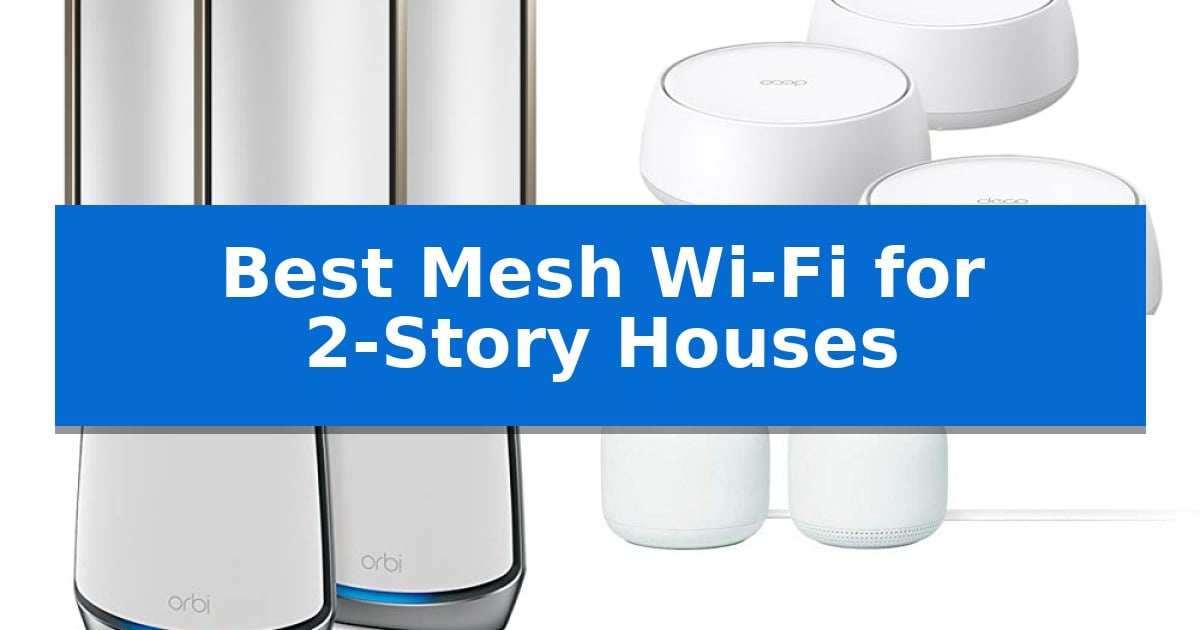
Maintaining a consistent internet connection across multiple levels can be a significant challenge, as walls and floors often obstruct wireless signals. Finding the Best Mesh Wi-Fi for 2-Story Houses requires a system that balances signal penetration with seamless roaming capabilities, ensuring your devices stay connected as you move between rooms.
Our evaluation focuses on systems that prioritize reliable coverage and ease of integration with your existing home network. By analyzing key technical specifications and connectivity features, we have identified solutions that address the specific signal-blocking issues common in multi-story residential layouts.
You may also want to compare Best Mesh Wi-Fi for 1 Gigabit Internet, Best Mesh Wi-Fi Extender, and Best Mesh Wi-Fi Access Points.
Best Mesh Wi-Fi for 2-Story Houses
Quick Comparison
| Product | Best For | Key Strength | Score |
|---|---|---|---|
| NETGEAR Orbi 970 Mesh System | Best Overall | Quad-Band technology with dedicated backhaul for consistent speeds. | 4.9 |
| TP-Link Deco BE25 Mesh System | Future-Proof WiFi 7 Performance | Wi-Fi 7 support for high-speed streaming and gaming. | 4.5 |
| NETGEAR Orbi AX6000 Mesh System | Reliable Tri-Band Coverage | Tri-band WiFi 6 for high-speed, stable performance. | 4.6 |
| Google Nest Wifi Mesh System | Seamless Whole-Home Connectivity | Extensive coverage of up to 4400 square feet with a two-pack system. | 4.5 |
| DBIT AX1800 Mesh System | Budget-Friendly Multi-Story Coverage | 6,500 sq. ft. coverage with three included units. | 4.8 |
How We Chose
- Signal coverage range and penetration capability through floors and walls.
- Backhaul technology and its impact on maintaining high speeds across satellite units.
- Compatibility with existing internet service provider equipment and modem requirements.
- Ease of setup and ongoing network management via mobile applications.
- Hardware connectivity options, including the number and speed of Ethernet ports.
1 NETGEAR Orbi 970 Mesh System — Ultimate Speed for Large Homes
Maintaining a consistent, high-speed connection across multiple levels requires hardware capable of managing heavy traffic without signal degradation. The NETGEAR Orbi 970 Mesh System addresses this by utilizing Quad-Band technology with an Enhanced Dedicated Backhaul, which reserves a specific lane for satellite communication to ensure that your primary WiFi remains fast and responsive, even when dozens of devices are active simultaneously.
Designed for expansive environments, this WiFi 7 system provides coverage for up to 10,000 square feet. It supports speeds up to 27 Gbps, making it suitable for bandwidth-intensive activities like 8K streaming, VR, and high-stakes gaming. The system is built to handle up to 200 devices, ensuring that your smart home ecosystem, laptops, and mobile devices stay connected without the performance bottlenecks often found in traditional single-router setups.
Connectivity is a major strength, featuring a 10 Gig internet port alongside a mix of 10 Gig and 2.5 Gig LAN ports. These wired options provide a reliable backbone for stationary high-performance devices like gaming PCs or NAS drives. Setup is streamlined through the Orbi app, which provides guided instructions to get your network operational quickly, regardless of whether you are using cable or fiber internet services.
Security is integrated directly into the hardware, featuring Advanced Router Protection and automatic firmware updates to defend against common network threats. While the system is robust out of the box, it also supports the optional NETGEAR Armor suite for additional layers of protection against malware and identity theft. For homes with challenging layouts, the system remains flexible, allowing for the addition of extra satellites to extend coverage further.
Best for: Large multi-story homes requiring high-bandwidth connectivity for a high density of smart devices and gaming hardware.
Skip if: Users living in smaller apartments or those who do not require multi-gigabit wired ports or the extensive coverage range of a three-unit mesh system.
PROS
- Quad-Band technology with dedicated backhaul for consistent speeds.
- Supports WiFi 7 with theoretical speeds up to 27 Gbps.
- Includes 10 Gig and 2.5 Gig ports for high-speed wired connections.
- Covers up to 10,000 square feet with the included three-pack.
CONS
- Requires a separate subscription for full NETGEAR Armor security features.
- Large physical footprint compared to standard routers.
2 TP-Link Deco BE25 Mesh System — Future-Proof WiFi 7 Performance
Maintaining a consistent, high-speed connection across multiple levels requires hardware that can intelligently manage traffic and signal distribution. The TP-Link Deco BE25 Mesh System addresses this by utilizing Wi-Fi 7 technology and 2.5G Ethernet ports to create a unified, high-performance network. Designed to cover up to 6,600 sq. ft., this system is specifically engineered to handle the demands of modern households with over 150 connected devices.
At the core of its performance is the simultaneous wired and wireless backhaul capability, which balances traffic between units to ensure stability. The inclusion of AI-Roaming technology allows the network to adapt through self-learning algorithms, providing seamless transitions as you move between floors. This ensures that streaming and gaming remain uninterrupted, regardless of your physical location within the home.
Usability is prioritized through the Deco App, which facilitates rapid setup and ongoing firmware management. Security is integrated via TP-Link HomeShield, offering basic network security, IoT device identification, and parental controls. Furthermore, the system supports VPN Client and Server functionality, allowing for enhanced security and flexibility for home devices without requiring individual software installations.
Compatibility is a key strength, as the TP-Link Deco BE25 Mesh System integrates with all existing Deco devices to expand coverage as needed. It remains backward compatible with all previous Wi-Fi generations, ensuring that older hardware continues to function alongside newer devices. While it requires a separate modem, its design and CISA Secure-by-Design commitment make it a robust choice for a multi-story home network.
Best for: Large households seeking a future-proof, high-capacity network that can handle over 150 devices across multiple floors.
Skip if: Users who do not have an existing modem or those who prefer a single-router setup rather than a multi-unit mesh system.
PROS
- Wi-Fi 7 support for high-speed streaming and gaming.
- 2.5G Ethernet ports for stable wired backhaul.
- AI-Roaming for seamless connectivity across large areas.
- Comprehensive security features via HomeShield and VPN support.
CONS
- Requires a separate modem for internet connectivity.
- Backhaul performance is dependent on using at least two units.
3 NETGEAR Orbi AX6000 Mesh System — Reliable Tri-Band Coverage
Maintaining consistent signal strength across multiple levels of a home requires a robust approach to wireless networking. The NETGEAR Orbi AX6000 Mesh System addresses this by utilizing WiFi 6 technology to provide AX6000 gigabit speeds, ensuring that high-bandwidth activities like HD gaming and web conferencing remain stable even when moving between floors.
This system is designed to handle demanding environments, offering coverage for up to 5,000 square feet and supporting up to 100 connected devices simultaneously. The tri-band architecture helps manage traffic efficiently, while the inclusion of 4 Gigabit Ethernet ports on both the router and the satellite allows for reliable, wired connections for stationary devices like consoles or desktop computers.
Ease of use is central to the design, with setup and ongoing management handled through the Orbi app. For those concerned about network security, the system includes NETGEAR Armor, a suite of tools providing protection against malware and identity theft. The hardware is compatible with any internet service provider offering speeds up to 2.5Gbps, making it a versatile choice for various fiber, cable, or DSL setups.
While this system offers extensive coverage, it is a substantial piece of hardware measuring 11.5 inches in length. Users should ensure they have adequate shelf or desk space to accommodate the units. The system is specifically intended for use within the U.S., which is an important consideration for regional compatibility.
Best for: Large homes requiring high-speed, multi-device connectivity across multiple floors.
Skip if: Users living outside the U.S. or those with very limited surface space for larger mesh hardware.
PROS
- Tri-band WiFi 6 for high-speed, stable performance.
- Extensive coverage up to 5,000 square feet.
- 4 Gigabit Ethernet ports per unit for wired device support.
- Integrated security features via NETGEAR Armor.
CONS
- Large physical footprint may require significant placement space.
- Region-locked for use in the U.S. only.
4 Google Nest Wifi Mesh System — Seamless Whole-Home Connectivity
Maintaining a consistent wireless signal across multiple floors often requires a system that can intelligently manage traffic without manual intervention. The Google Nest Wifi Mesh System addresses this by utilizing a two-unit setup designed to blanket up to 4400 square feet with reliable coverage, effectively eliminating dead zones that typically plague multi-story layouts.
This system functions as a scalable network where one router connects directly to your modem, while the second unit acts as an extender to maintain high-speed connectivity throughout the home. It is engineered to support up to 200 connected devices, providing enough bandwidth to handle simultaneous 4K video streams. Each unit includes integrated Ethernet ports, allowing for stable wired connections for stationary devices like gaming consoles or smart home hubs.
Usability is centered around the mobile app, which simplifies the initial setup and provides ongoing management tools. Users can create guest networks, prioritize specific devices for faster speeds, and manage screen time through built-in parental controls. The system operates autonomously, performing automatic updates to maintain network security and optimizing performance behind the scenes to ensure smooth transitions as you move between rooms.
While the system is designed for broad compatibility with most internet service providers, it is important to note that performance is contingent upon your existing modem and service plan. The compact, unobtrusive design allows the units to blend into various home environments without requiring complex installation, making it a practical choice for those seeking a straightforward, whole-home networking solution.
Best for: Best for homeowners seeking a simple, scalable mesh system to eliminate Wi-Fi dead zones across multiple floors.
Skip if: Skip if you require advanced manual configuration settings or specialized enterprise-grade networking features.
PROS
- Extensive coverage of up to 4400 square feet with a two-pack system.
- High device capacity, capable of managing up to 200 connected devices simultaneously.
- Automated network optimization and background updates for security and performance.
- User-friendly app for easy setup, guest access, and parental controls.
CONS
- Limited manual control for advanced users who prefer deep network customization.
- Performance dependency on the user's existing modem and internet service provider speed.
5 DBIT AX1800 Mesh System — Budget-Friendly Multi-Story Coverage
The DBIT AX1800 Mesh System addresses connectivity gaps in multi-story homes by utilizing a three-unit mesh configuration that provides coverage for up to 6,500 sq. ft. By replacing standard routers and extenders with this unified system, users can maintain a single network name while moving between floors or rooms, ensuring consistent signal stability.
Equipped with dual-band AX1800 technology, this system delivers speeds of 574Mbps on the 2.4GHz band and 1201Mbps on the 5GHz band. It incorporates OFDMA and MU-MIMO to optimize bandwidth allocation, allowing for the connection of up to 150 devices simultaneously without significant performance degradation during high-demand tasks like 4K streaming or gaming.
Each of the three units features two Gigabit Ethernet ports, totaling six ports across the system, which enables stable wired connections for stationary devices. The system is designed for broad compatibility, supporting various internet service providers and connection types including PPPoE, DHCP, and static IP.
Setup and management are centralized through a mobile app or web GUI, providing access to parental controls, guest network creation, and network monitoring. The hardware also supports WPA3 encryption and online firmware upgrades to maintain security, while the physical design includes a one-click mesh button for simple node expansion.
Best for: Large multi-story homes requiring consistent Wi-Fi coverage for up to 150 connected devices.
Skip if: Users who require multi-gigabit wired backhaul or advanced enterprise-grade networking features beyond standard mesh functionality.
PROS
- 6,500 sq. ft. coverage with three included units.
- 6 total Gigabit Ethernet ports for stable wired connections.
- MU-MIMO and OFDMA support for high-density device environments.
- WPA3 encryption for enhanced network security.
CONS
- Dual-band limitation compared to tri-band systems for heavy backhaul traffic.
- Fixed internal antenna design limits manual signal adjustment.
Best Mesh Wi-Fi for 2-Story Houses Buying Guide
Understanding Mesh Coverage
A mesh system consists of a main router and satellite units that work together to create a single, unified network. For a 2-story house, placing at least one satellite on the upper floor is essential to overcome the signal attenuation caused by floor joists and subflooring.
Unlike traditional range extenders, mesh systems use intelligent roaming to automatically hand off your device to the unit with the strongest signal. This prevents the common issue of devices clinging to a weak signal from the main router while you are in a distant room.
The Role of Backhaul
Backhaul refers to the communication channel between your mesh nodes. Systems with dedicated backhaul—either wireless or wired—are superior because they reserve a specific data lane for node-to-node traffic, leaving the other bands free for your devices.
If your home is pre-wired with Ethernet, opting for a system that supports wired backhaul can significantly improve performance. This configuration bypasses the signal degradation that can occur when nodes must communicate wirelessly through thick flooring.
Wi-Fi Standards and Speed
Modern systems now utilize Wi-Fi 7 or Wi-Fi 6 standards, which offer improved efficiency in handling multiple devices simultaneously. If you have a large number of smart home devices, prioritize systems that support high device counts to prevent network congestion.
While theoretical speed ratings are often marketed, your real-world performance will be limited by your internet service provider's plan. Focus on the Ethernet port speeds—such as 2.5 Gig or 10 Gig ports—if you require high-speed wired connections for gaming or home office setups.
Security and Management
Most mesh systems include integrated security features, such as automatic firmware updates and network scanning. These tools are vital for protecting your home network from unauthorized access and potential vulnerabilities in connected IoT devices.
User-friendly mobile apps are now the standard for network management. Look for systems that allow you to easily set up guest networks, implement parental controls, and monitor device usage without needing advanced technical knowledge.
Placement Strategy
Even the most powerful mesh system can struggle if nodes are placed too far apart or hidden inside cabinets. For optimal results in a 2-story home, place nodes in open areas and avoid locating them directly behind large metal objects or appliances.
The goal is to maintain a clear line of sight between nodes whenever possible. If you experience slow speeds on the second floor, try repositioning the satellite unit closer to the staircase or a central hallway to improve the signal path to the main router.
Frequently Asked Questions
Do I need a separate modem for these mesh systems?
Yes, all the mesh systems listed require a separate modem provided by your internet service provider to establish the initial internet connection.
Can I mix and match different mesh brands?
Generally, no. Mesh systems are designed to work within their own ecosystem. Mixing brands will prevent them from forming a unified mesh network.
How many nodes do I need for a 2-story house?
For most 2-story homes, a 2-pack or 3-pack is sufficient. The exact number depends on your home's square footage and the construction materials of your floors.
Will these systems work with my existing Wi-Fi devices?
Yes, all modern mesh systems are backward compatible with older Wi-Fi standards, meaning your existing phones, laptops, and smart devices will connect without issues.
What is the benefit of a tri-band or quad-band system?
These systems provide additional frequency bands, which helps reduce interference and congestion, leading to more stable speeds when many devices are connected at once.
Conclusion: Our Top Pick
Selecting the right mesh system depends on your specific home layout and bandwidth requirements. For those seeking the most robust performance, the NETGEAR Orbi 970 Mesh System stands out due to its quad-band technology and high-speed port options, making it a reliable choice for demanding multi-story environments.
While the initial investment is higher, the system's ability to handle up to 200 devices and provide extensive coverage ensures it remains a viable solution as your home network needs grow. Always ensure your internet plan can support the high throughput capabilities of this system to maximize your return on investment.