
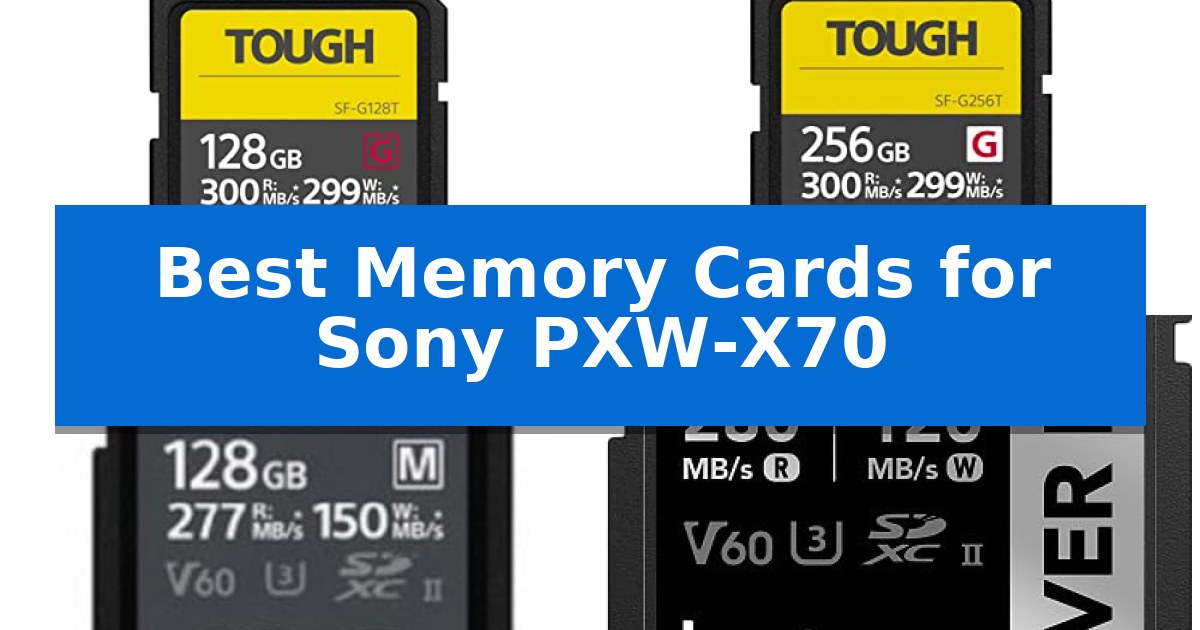
Capturing high-quality video with your camcorder requires storage media that can keep pace with demanding bitrates and environmental conditions. Finding the Best Memory Cards for Sony PXW-X70 involves balancing write speeds, capacity, and physical durability to ensure your footage is recorded without dropped frames or data corruption.
Whether you are shooting in controlled studio environments or challenging outdoor locations, the right card acts as a critical link in your production workflow. We have analyzed current storage options to help you select the most dependable media for your specific recording needs, focusing on UHS-II standards and rugged construction.
You may also want to compare Best Memory Cards for Sony DSC-WX9, Best Memory Cards for Sony Cyber-shot DSC-HX200V, and Best Memory Cards for Sony Cyber-shot DSC-HX100V.
Best Memory Cards for Sony PXW-X70
Quick Comparison
| Product | Best For | Key Strength | Score |
|---|---|---|---|
| Sony TOUGH-G Series SDXC Card | Best Overall | One-piece molded construction provides superior bend strength. | 4.9 |
| Sony Tough G Series SDXC UHS-II Memory Card 256GB | High Capacity for Extended Recording | TOUGH specification provides superior crush and shock resistance. | 4.3 |
| Sony TOUGH-M Series SDXC Card | Reliable Performance for 4K Video | 18x stronger than standard UHS-II cards for superior physical durability. | 4.8 |
| Lexar SILVER PRO SD Card | Fast Offloading for Tight Deadlines | High-speed data transfer up to 280MB/s read. | 4.6 |
| Sony E Series SDXC Card | Consistent Speeds for Daily Use | Rugged design with X-ray, dust, UV, drop, and waterproof protection. | 4.8 |
How We Chose
- Write speed consistency for sustained 4K video capture.
- UHS-II interface compatibility for faster file offloading.
- Physical durability ratings, including water, dust, and shock resistance.
- Capacity options suitable for extended recording sessions.
- Backward compatibility with existing UHS-I hardware.
1 Sony TOUGH-G Series SDXC Card — Maximum Durability for Pro Shoots
Reliability in the field is paramount when capturing high-bitrate footage, and the Sony TOUGH-G Series SDXC Card is engineered specifically to address the physical vulnerabilities of standard media. By utilizing a one-piece molded construction, this card achieves a level of bend strength 18 times greater than the standard SD specification, providing a robust solution for professionals who frequently swap cards in demanding environments.
Beyond its physical resilience, the card is designed for high-performance workflows. It supports UHS-II, Class 10, and U3 compliance, enabling transfer speeds up to 300 MB/s and write speeds up to 299 MB/s. These specifications ensure the card can handle the data demands of 4K recording and continuous burst mode shooting, making it a capable companion for the Sony PXW-X70.
The design philosophy prioritizes longevity by removing common failure points. It features a ribless, no write protection switch design, which eliminates parts that are prone to breaking or snapping off during repeated use. This structural integrity is further complemented by an IPX8 waterproof and IP6X dustproof rating, ensuring the internal components remain protected against the elements.
While the card is optimized for UHS-II equipment, it maintains backward compatibility with UHS-I devices. Users can expect reliable performance even when used in older hardware, though maximum data rates will be limited to UHS-I standards. With an operating temperature range of -13℉ to +185℉, this media is built to function across a wide variety of climates.
Best for: Professional videographers requiring maximum physical durability and high-speed write performance for 4K recording.
Skip if: Users who prioritize a physical write-protection switch or those who do not require UHS-II speeds for their specific recording formats.
PROS
- One-piece molded construction provides superior bend strength.
- Ribless, no-switch design removes common mechanical failure points.
- IPX8 waterproof and IP6X dustproof rating for environmental protection.
- High-speed performance supporting up to 299MB/s write speeds.
CONS
- Lack of a physical write-protection switch may be a drawback for users accustomed to manual locking.
- Premium pricing reflects the specialized ruggedized design.
2 Sony Tough G Series SDXC UHS-II Memory Card 256GB — High Capacity for Extended Recording
Reliability in the field is paramount when capturing high-resolution footage, and the Sony Tough G Series SDXC UHS-II Memory Card 256GB is engineered specifically to withstand demanding environments. Featuring a TOUGH specification with a crush and shock-proof design, this card provides a robust storage solution for the Sony PXW-X70, ensuring your data remains protected even in challenging conditions.
Beyond its physical durability, the card is built for high-performance workflows. It supports fastest write speeds of up to 299 MB/s, which is essential for burst shooting and capturing high-resolution video content without interruption. The UHS-II interface ensures that data transfer to your computer is efficient, minimizing downtime during post-production.
The design prioritizes longevity and ease of use through a rib-less and switchless construction. By eliminating these common points of failure, the card reduces the risk of physical breakage during frequent handling. Furthermore, it carries an IP68 rating, providing the highest level of dust and water proofing to safeguard your media against the elements.
For added peace of mind, the card is supported by Memory Card File Rescue data recovery software. This utility helps recover accidentally deleted or corrupted files, offering an extra layer of security for your critical projects. With its 256GB capacity, this card offers ample space for extended recording sessions, making it a dependable choice for professional video production.
Best for: Professional videographers requiring high-speed, durable storage for extended recording sessions in harsh environments.
Skip if: Users who do not require extreme physical durability or the high write speeds associated with UHS-II technology may find more cost-effective standard SD options.
PROS
- TOUGH specification provides superior crush and shock resistance.
- IP68 dust and water proofing ensures reliability in outdoor conditions.
- Fast write speeds up to 299 MB/s support high-resolution imaging.
- Rib-less and switchless design eliminates common physical failure points.
CONS
- Premium pricing compared to standard UHS-I memory cards.
3 Sony TOUGH-M Series SDXC Card — Reliable Performance for 4K Video
Reliable media storage is essential for maintaining the integrity of high-bitrate footage captured on the Sony PXW-X70. The Sony TOUGH-M Series SDXC Card is engineered to handle the demands of professional workflows, featuring a robust Toughness design that is rated 18x stronger than standard UHS-II cards. This physical durability provides peace of mind when operating in challenging environments, ensuring your data remains protected against accidental drops or bending.
Beyond its physical resilience, this card is built for performance, offering read speeds up to 277MB/s and write speeds up to 150MB/s. These specifications are well-suited for 4K video recording, allowing for smooth data throughput during long shooting sessions. The card is also IPX8 waterproof and IPX6 dustproof, making it a reliable choice for outdoor production where exposure to the elements is a constant concern.
Usability is enhanced by the card's compatibility with the UHS-II interface, which provides the necessary bandwidth for high-resolution video formats. With a 128GB capacity, it offers sufficient space for extended recording without frequent card swaps. The inclusion of a five-year limited warranty underscores the manufacturer's commitment to long-term reliability for professional users.
When selecting storage for your camera, balancing speed and durability is key. While some standard cards may offer similar capacity, the Sony TOUGH-M Series SDXC Card prioritizes structural integrity alongside high-speed performance. This makes it a practical investment for those who prioritize data security and consistent operation in the field.
Best for: Professional videographers requiring high-speed 4K recording and extreme physical durability for field production.
Skip if: Users who only require basic storage for casual, low-bitrate shooting and do not need the premium physical protection or high-speed UHS-II interface.
PROS
- 18x stronger than standard UHS-II cards for superior physical durability.
- IPX8 waterproof and IPX6 dustproof ratings for harsh environments.
- Supports high-bandwidth 4K video recording.
- Includes a five-year limited warranty.
CONS
- Premium pricing compared to standard UHS-II or UHS-I memory cards.
4 Lexar SILVER PRO SD Card — Fast Offloading for Tight Deadlines
The Lexar 128GB SILVER PRO SD Memory Card is engineered to support demanding high-resolution workflows, offering read speeds up to 280MB/s and write speeds up to 120MB/s. This performance profile is designed to minimize downtime when transferring large files to editing software, making it a functional choice for users managing high-capacity media.
Built to handle intensive recording tasks, this card supports 4K UHD and 1080p Full-HD capture. By maintaining consistent data throughput, it helps prevent dropped frames or buffering during video acquisition. The UHS-II interface ensures compatibility with modern camera systems while remaining backwards-compatible with UHS-I devices, providing versatility across various hardware setups.
Reliability is addressed through rigorous testing across multiple platforms, including camcorders and mirrorless cameras. The card includes a lifetime limited warranty and access to the Lexar Recovery Tool, providing a safety net for data management. Its high-capacity SDXC architecture is specifically tailored for professionals and enthusiasts who require consistent storage performance under pressure.
For those integrating this into a Sony PXW-X70 workflow, the card offers a balance of speed and capacity. While it excels in rapid offloading, users should ensure their specific camera firmware supports the full potential of UHS-II standards to maximize the efficiency of their shooting and post-production processes.
Best for: Professional videographers and photographers who require high-speed data offloading and reliable 4K recording capabilities.
Skip if: Users operating older equipment that does not support UHS-II speeds or high-capacity SDXC cards may not fully utilize the performance benefits of this model.
PROS
- High-speed data transfer up to 280MB/s read.
- Consistent 4K recording performance to prevent buffering.
- Lifetime limited warranty included for long-term support.
- Backwards compatibility with UHS-I devices.
CONS
- UHS-II performance requires compatible hardware to achieve maximum rated speeds.
5 Sony E Series SDXC Card — Consistent Speeds for Daily Use
The Sony 64GB E Series UHS-II SDXC Memory Card is engineered to provide a reliable storage solution for the Sony PXW-X70, featuring a built-in write-protect switch to prevent accidental data loss during busy production days. This card is built for durability, offering resistance to X-ray, dust, UV, drop, and water exposure, ensuring your footage remains secure in challenging field environments.
Designed to handle diverse recording requirements, this card supports Full HD, 3D, and 4K video capture. It utilizes the UHS-II interface and is rated V30, U3, and Class 10, providing the necessary sustained performance for consistent recording. With a minimum write speed of 30 MB/s, it maintains the stability required for high-bitrate video workflows.
The card offers a maximum read speed of 270 MB/s, which facilitates efficient file transfers to your workstation, reducing downtime between shoots. Its maximum write speed of 45 MB/s ensures that the card keeps pace with the camera's internal recording demands, making it a practical choice for videographers who prioritize reliability and consistent data handling.
Built to withstand extreme conditions, this memory card operates across a wide range of temperatures. Whether working in cold climates or high-heat environments, the Sony 64GB E Series UHS-II SDXC Memory Card maintains structural integrity, making it a dependable companion for the Sony PXW-X70 in varied professional settings.
Best for: Videographers requiring a durable, weather-resistant storage card for consistent Full HD and 4K recording in the field.
Skip if: Users who require high-speed burst photography or ultra-high-bitrate raw video recording that exceeds the V30 write speed rating.
PROS
- Rugged design with X-ray, dust, UV, drop, and waterproof protection.
- UHS-II interface with V30 speed class for stable 4K video recording.
- Fast 270 MB/s read speeds for quick file offloading.
- Built-in write-protect switch for added data security.
CONS
- 45 MB/s maximum write speed may limit performance for high-bandwidth professional formats.
Best Memory Cards for Sony PXW-X70 Buying Guide
Understanding UHS-II Standards
The UHS-II interface is a critical consideration for modern camcorders. This standard utilizes an additional row of pins to achieve significantly higher data transfer rates compared to legacy UHS-I cards. For users, this means faster offloading of large video files to computers, which is essential for maintaining a productive workflow.
While your device may support UHS-II, it is important to note that these cards are generally backward compatible with UHS-I equipment. However, you will only achieve the maximum rated speeds when using the card with a compatible UHS-II reader or camera slot.
The Importance of Write Speeds
For video recording, sustained write speed is more important than peak burst speed. If a card cannot maintain a steady write rate, the camera may stop recording or drop frames, leading to unusable footage. Look for cards with V60 or V90 ratings, which guarantee minimum sustained write speeds for high-resolution video.
High-bitrate 4K recording places significant demand on storage media. Choosing a card that exceeds the minimum requirements of your camera settings provides a safety margin, ensuring that even during complex scenes with high motion, your data is written reliably.
Durability and Environmental Protection
Professional field work often exposes gear to harsh conditions. Cards with rugged construction, such as one-piece molded designs, offer superior resistance to bending, shock, and impact. These designs often eliminate fragile parts like the write-protection switch, which can break off and cause issues.
Look for IPX8 or IP68 ratings if you frequently shoot in rain, near water, or in dusty environments. These certifications indicate that the card is sealed against moisture and particulate matter, protecting your valuable footage from environmental hazards.
Capacity Management
Selecting the right capacity depends on your typical recording duration and resolution settings. While 128GB is often sufficient for many projects, 256GB options are better suited for long-form interviews or events where swapping cards is inconvenient or risky.
Always consider the trade-off between capacity and risk. Using one massive card means all your footage is in one place, whereas using multiple smaller cards provides a form of redundancy. Evaluate your project needs to find the balance that works for your shooting style.
Data Recovery Tools
Even with the most reliable hardware, data loss can occur due to accidental deletion or formatting errors. Many manufacturers include or provide access to file recovery software as a value-added feature.
Having access to a dedicated recovery tool can be a lifesaver when dealing with corrupted files. Always check if your chosen card brand offers a free download of their recovery utility, as this can provide peace of mind during critical production days.
Frequently Asked Questions
Can I use a UHS-II card in a UHS-I camera?
Yes, UHS-II cards are backward compatible with UHS-I devices. You will be able to use the card, but you will be limited to the maximum speed capabilities of the UHS-I interface.
What does the V90 rating mean?
The V90 rating indicates a minimum sustained write speed of 90MB/s. This is generally required for high-bitrate 4K or 8K video recording to prevent frame drops.
Are ribless cards more durable?
Yes, ribless designs remove the thin plastic ridges between the pins that are prone to breaking. This design change significantly improves the physical longevity of the card.
How often should I format my memory card?
It is best practice to format your card in the camera before every major shoot. This ensures the file system is optimized for the specific device and helps prevent potential errors.
Does temperature affect memory card performance?
Yes, extreme temperatures can impact performance. High-quality cards are rated for specific operating temperature ranges, typically from -13°F to +185°F, ensuring reliability in diverse climates.
Conclusion: Our Top Pick
For professionals requiring the highest level of reliability and speed, the Sony TOUGH-G Series SDXC Card stands out as the premier choice. Its one-piece molded construction provides exceptional bend strength and environmental sealing, making it a robust solution for demanding field conditions.
While it sits at the higher end of the price spectrum, the peace of mind provided by its durability and high-speed performance makes it an essential investment for your Sony PXW-X70. If your workflow involves critical, one-take events, the added protection against physical damage and data loss is well worth the cost.