
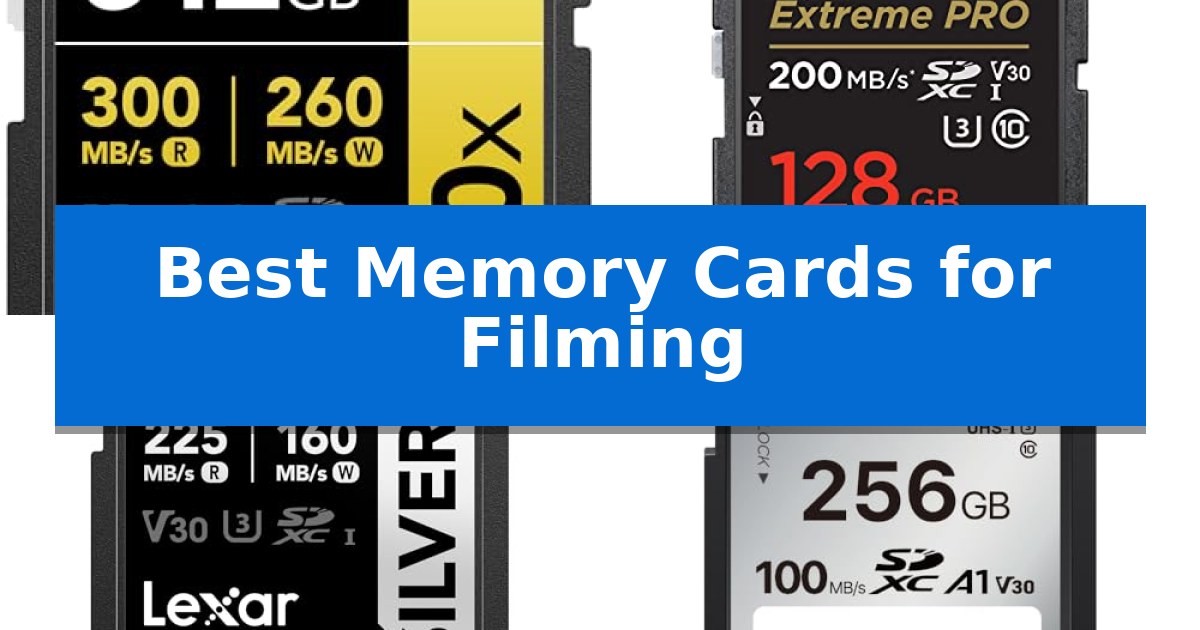
Selecting the right storage media is a critical step for any videographer, as the reliability of your footage depends entirely on the card's ability to handle high data rates. When you are on set, the last thing you want is a dropped frame or a buffer error that ruins a perfect take, making the choice of the Best Memory Cards for Filming a foundational decision for your production workflow.
Our guide evaluates current industry-standard options, focusing on sustained write speeds, interface compatibility, and durability. Whether you are capturing raw 8K cinema or high-bitrate 4K content, we break down which cards provide the necessary throughput and capacity to keep your camera running smoothly without interruption.
You may also want to compare Best Memory Cards for DSLR Cameras, Best Memory Cards for DJI Pocket 2, and Best Memory Cards for DJI Mini 3 Pro.
Best Memory Cards for Filming
Quick Comparison
| Product | Best For | Key Strength | Score |
|---|---|---|---|
| Lexar 2000x SD Memory Card | Best Overall | High-speed UHS-II interface for rapid data transfer and 8K video support. | 4.9 |
| SanDisk Extreme PRO SD Card | Fast Offloads for 4K Workflow | Sustained 30MB/s write performance for stable 4K UHD video capture. | 4.9 |
| Lexar Silver SD Memory Card | Reliable 4K 60FPS Recording | V30 speed class supports smooth 4K 60FPS video recording. | 4.9 |
| Gigastone 4K Camera Pro SD Card | Budget-Friendly 4K UHD Capture | V30 speed class ensures stable 4K UHD video recording. | 4.7 |
| SanDisk Extreme CompactFlash Card | Sustained Speeds for Pro Cameras | VPG-20 certification ensures a consistent, unbroken video stream. | 4.4 |
How We Chose
- Sustained write speed ratings to ensure continuous capture without dropped frames.
- Interface compatibility including UHS-II, UHS-I, and UDMA 7 standards.
- Video speed class certifications like V90 and V30 for guaranteed minimum performance.
- Physical durability features such as temperature, shock, and x-ray resistance.
- Capacity options to support extended recording times in high-resolution formats.
1 Lexar 2000x SD Memory Card — Professional Choice for 8K Cinema
Capturing cinema-quality footage requires a storage medium capable of handling high-bitrate data streams without interruption. The Lexar 512GB 2000x SD Memory Card is engineered specifically for these demanding environments, utilizing UHS-II technology to support the sustained write speeds necessary for recording 8K video.
Beyond its capacity for high-resolution video, this card features write speeds of up to 260MB/s, ensuring that high-quality images and extended video files are processed efficiently. For professionals managing large volumes of data, the card supports read transfer speeds up to 300MB/s when paired with a compatible UHS-II reader, significantly reducing the time spent offloading files during post-production.
The card is built for versatility and longevity, featuring a design focused on durability to withstand the rigors of field production. It maintains backwards compatibility with UHS-I devices, allowing it to function across a wider range of hardware, though the maximum speed benefits are realized in UHS-II enabled cameras.
With a substantial 512GB capacity, this card provides the storage headroom required for long-form filming projects. It is backed by a 10-year limited warranty, providing a clear expectation of support for the hardware over its operational lifespan.
Best for: Professional cinematographers and photographers requiring high-speed, high-capacity storage for 8K video and burst-mode photography.
Skip if: Users operating exclusively with older, low-bitrate cameras that do not benefit from the high-speed UHS-II interface or those who do not require large-capacity storage.
PROS
- High-speed UHS-II interface for rapid data transfer and 8K video support.
- Large 512GB capacity suitable for extended filming sessions.
- Backwards compatibility with existing UHS-I camera systems.
- 10-year limited warranty for long-term hardware assurance.
CONS
- Requires a UHS-II reader to achieve maximum 300MB/s read speeds.
2 SanDisk Extreme PRO SD Card — Fast Offloads for 4K Workflow
Reliable high-resolution video capture requires storage that keeps pace with modern camera sensors. The SanDisk 128GB Extreme PRO SD Memory Card is engineered to support demanding workflows, featuring UHS Speed Class 3 (U3) and Video Speed Class 30 (V30) ratings to ensure sustained write speeds of at least 30MB/s for real-time 4K UHD recording.
Beyond its recording capabilities, this card utilizes SanDisk QuickFlow Technology to optimize offloading times. When paired with a compatible reader, such as the SanDisk Professional PRO-READER, the card achieves read speeds of up to 200MB/s. This significantly reduces the time spent transferring large high-bitrate files to your workstation, allowing for a more efficient post-production process.
Designed for versatility, the card supports sequential burst mode photography alongside its video functions. With shot speeds up to 90MB/s, it provides the necessary headroom for capturing rapid-fire image sequences without the buffer bottlenecks often encountered with slower media. It remains a robust choice for creators who frequently switch between high-resolution stills and 4K video projects.
Compatibility is a key consideration for this storage medium. While it is built to exceed standard UHS-I 104MB/s limits, users should note that reaching the maximum 200MB/s read speed requires specific host devices and readers that support the proprietary technology. The card is backed by a lifetime limited manufacturer warranty, offering long-term peace of mind for professional field use.
Best for: Creators who require reliable 4K video recording and fast file offloading for high-resolution photography and video workflows.
Skip if: Users who require UHS-II or UHS-III interface speeds for ultra-high-bitrate cinema cameras or those whose host devices do not support the proprietary QuickFlow read speeds.
PROS
- Sustained 30MB/s write performance for stable 4K UHD video capture.
- Up to 200MB/s read speeds when used with compatible QuickFlow hardware.
- 90MB/s write speeds ideal for sequential burst photography.
- Lifetime limited manufacturer warranty included.
CONS
- Maximum read speeds are dependent on using specific compatible host devices and readers.
- V30 rating may be insufficient for extremely high-bitrate professional cinema codecs.
3 Lexar Silver SD Memory Card — Reliable 4K 60FPS Recording
Capturing high-resolution footage requires a storage medium that can keep pace with modern camera sensors. The Lexar 256GB Silver SD Memory Card is engineered to support demanding workflows, offering a V30 speed class rating that ensures stable 4K 60FPS video recording. This capability allows videographers to maintain smooth frame rates without the risk of dropped frames during critical takes.
Efficiency in post-production starts with how quickly you can move files from your camera to your workstation. With a 225MB/s maximum read speed, this card significantly reduces downtime when offloading large video files. When you are back in the field, the 160MB/s maximum write speed provides the necessary headroom to capture high-bitrate footage reliably.
Designed for versatility and resilience, the card features extensive compatibility across major camera systems, including Canon, Sony, and Nikon. Beyond its technical specifications, the hardware is built for challenging environments; it is wearproof, drop-proof, temperature-proof, x-ray-proof, shockproof, magnetic-proof, and vibration-resistant, providing peace of mind when shooting in unpredictable locations.
The Lexar 256GB Silver SD Memory Card balances high-speed performance with robust physical protection, making it a dependable choice for professionals and enthusiasts alike. By combining fast transfer rates with a durable build, it serves as a reliable foundation for long-term filming projects.
Best for: Professional videographers and enthusiasts who require reliable 4K 60FPS recording and fast file offloading for their Canon, Sony, or Nikon camera systems.
Skip if: Users who require higher-tier V60 or V90 speed classes for 8K video or high-speed burst photography will need a more specialized card.
PROS
- V30 speed class supports smooth 4K 60FPS video recording.
- 225MB/s read speed enables rapid file transfers to workstations.
- Comprehensive durability features protect against shocks, drops, and extreme temperatures.
- Extensive compatibility with major camera brands like Sony, Canon, and Nikon.
CONS
- UHS-I interface may limit performance compared to UHS-II cards in high-end cinema cameras.
4 Gigastone 4K Camera Pro SD Card — Budget-Friendly 4K UHD Capture
Reliable capture of high-resolution footage requires a storage medium capable of sustaining consistent write speeds, and the Gigastone 4K Camera Pro SD Card is engineered specifically to meet these demands. With its UHS-I A1 V30 rating, this card is built to handle the data throughput required for 4K Ultra HD video recording without dropping frames.
Designed for versatility, this full-sized SD card is compatible with a wide range of devices, including digital point-and-shoot cameras, HD camcorders, and DSLRs. It offers data transfer speeds of up to 170 MB/s, which helps reduce wait times when offloading large video files to a PC for post-production editing.
Durability is a core component of its design, as the card is waterproof, temperature-proof, x-ray-proof, shock-proof, and magnetic-proof. These protections provide peace of mind when filming in unpredictable outdoor environments. The package also includes a mini case for secure storage and transport.
To ensure long-term usability, the card is backed by a 5-year limited warranty. This support, combined with its robust construction, makes it a practical choice for creators who need a dependable storage solution for their primary filming equipment.
Best for: Videographers and photographers using DSLR or camcorder equipment who require reliable 4K video recording and durable storage.
Skip if: Users who require UHS-II or UHS-III speeds for high-bitrate professional cinema cameras or burst-heavy sports photography.
PROS
- V30 speed class ensures stable 4K UHD video recording.
- Comprehensive protection against water, shock, temperature, and magnets.
- 5-year limited warranty provides long-term support.
- High transfer speeds of up to 170 MB/s for efficient file management.
CONS
- UHS-I interface may limit performance in high-end professional cinema workflows.
5 SanDisk Extreme CompactFlash Card — Sustained Speeds for Pro Cameras
Reliable data management is the foundation of professional cinematography, and the SanDisk 64GB Extreme CompactFlash Memory Card is engineered specifically to handle the demands of high-bitrate video production. Utilizing the UDMA 7 interface, this card provides the necessary throughput for capturing detailed footage without the risk of dropped frames during critical takes.
This card distinguishes itself with VPG-20 (Video Performance Guarantee) certification, which ensures a sustained data recording rate of 20MB/s. This specific standard is essential for filmmakers who require an unbroken video stream, preventing the stuttering that can occur with lower-grade storage media. With read speeds up to 120MB/s and write speeds up to 85MB/s, it enables efficient offloading of large files to your workstation, reducing downtime between shoots.
Built for the realities of field production, the card features an RTV silicone coating designed to provide enhanced protection against shock and vibration. This durability is backed by rigorous testing, ensuring that your media remains secure even when working in unpredictable or high-motion environments. The 64GB capacity offers a practical balance for high-definition recording sessions, allowing for extended capture times without frequent card swaps.
When selecting storage for professional filming, compatibility with your camera's CompactFlash slot is the primary consideration. The SanDisk 64GB Extreme CompactFlash Memory Card offers a robust, industry-standard solution for those prioritizing sustained write performance and physical resilience in their workflow.
Best for: Professional filmmakers and photographers using CompactFlash-compatible cameras who require sustained write speeds for reliable video capture.
Skip if: Users requiring modern high-speed interfaces like CFexpress or SD UHS-II, or those using cameras that do not feature a CompactFlash card slot.
PROS
- VPG-20 certification ensures a consistent, unbroken video stream.
- RTV silicone coating provides added resistance to shock and vibration.
- UDMA 7 interface supports fast read speeds up to 120MB/s for quick file transfers.
- Professional-grade durability tested for demanding field environments.
CONS
- CompactFlash form factor is limited to specific legacy or professional cinema camera systems.
- 64GB capacity may require frequent card changes during long-form 4K or high-bitrate shoots.
Best Memory Cards for Filming Buying Guide
Understanding Speed Classes and Standards
The most important factor in selecting a card is matching its speed class to your camera's requirements. V90 and V30 ratings indicate the minimum sustained write speed in megabytes per second, which is vital for preventing recording failures during high-bitrate video capture.
Always check your camera's manual for the required UHS interface. While many modern cameras are backwards compatible, using a slower card than recommended can limit your recording options, such as disabling high-frame-rate modes or raw video formats.
Capacity and Data Management
Storage capacity should be balanced against your typical project length and resolution. Shooting in 8K or 4K at high frame rates consumes space rapidly, often requiring cards with 256GB or 512GB of storage to avoid frequent card swaps during a shoot.
Larger cards also help minimize the risk of physical damage caused by constant insertion and removal. However, ensure your card reader supports the specific transfer speeds of your media to avoid bottlenecks during the post-production offload process.
Durability for Field Work
Filming often takes place in unpredictable environments, making durability a non-negotiable feature. Look for cards that are rated as shockproof, temperature-proof, and vibration-resistant to protect your data from physical hazards.
Many professional-grade cards also include x-ray-proof and magnetic-proof certifications, providing an extra layer of security when traveling through airport security or working near electronic equipment.
Interface Compatibility
The physical interface, such as SD or CompactFlash, must match your camera's card slot exactly. Using an adapter is generally discouraged for professional video work, as it can introduce points of failure and reduce overall reliability.
For older professional cameras, UDMA 7 CompactFlash cards remain a standard. Ensure that your chosen card supports the specific VPG (Video Performance Guarantee) rating if your camera requires sustained data rates for specific professional codecs.
Optimizing Post-Production Workflow
The time spent transferring footage from your card to your computer is a significant part of the production cycle. High read speeds are essential for accelerating this process, especially when dealing with massive files from 8K cinema cameras.
Pairing your card with a compatible, high-speed card reader is just as important as the card itself. Using a reader that supports the card's maximum rated read speed can reduce offload times by several minutes per card.
Frequently Asked Questions
What does the V90 rating mean for my filming?
A V90 rating guarantees a minimum sustained write speed of 90MB/s, which is necessary for recording high-bitrate 8K video and professional-grade raw formats without dropping frames.
Can I use a UHS-II card in a UHS-I camera?
Yes, most UHS-II cards are backwards compatible with UHS-I devices, though you will be limited to the maximum speed of the UHS-I interface.
Is a faster read speed better for my camera?
A faster read speed does not affect your camera's recording performance, but it significantly reduces the time required to transfer your footage to a computer for editing.
Why do some cards have a VPG rating?
VPG (Video Performance Guarantee) ratings ensure a minimum sustained write speed specifically for video recording, which is critical for preventing errors in professional cinema cameras.
How often should I format my memory cards?
It is best practice to format your card in-camera before every major shoot to ensure the file system is optimized and to clear out any potential data fragmentation.
Conclusion: Our Top Pick
For videographers requiring the highest level of performance and reliability, the Lexar 2000x SD Memory Card stands out as the premier choice. Its V90 rating and high-speed throughput make it an ideal companion for 8K cinema cameras, ensuring that your data is captured securely and offloaded efficiently.
While it is a professional-grade investment, the durability and speed provided by the Lexar 2000x SD Memory Card offer peace of mind that is essential when working on high-stakes projects. Always verify your camera's specific compatibility requirements before purchase to ensure you are getting the full benefit of its advanced technical specifications.