
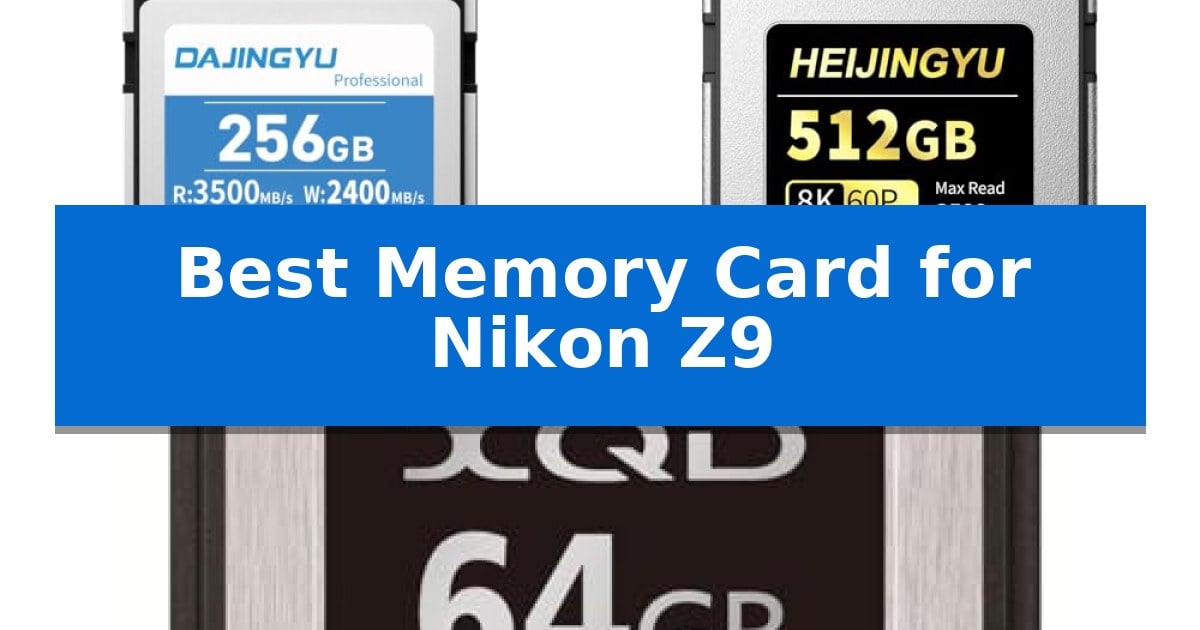
The Nikon Z9 is a powerhouse designed for high-bitrate 8K video and rapid-fire continuous shooting, but its performance is only as good as the storage media inside. If your card cannot keep up with the camera's massive data throughput, you risk dropped frames, buffer bottlenecks, and interrupted creative sessions.
Finding the Best Memory Card for Nikon Z9 requires balancing sustained write speeds with reliable capacity. Whether you are a professional videographer needing VPG400 certification or a photographer requiring fast buffer clearing, selecting the right card is essential for a seamless workflow.
You may also want to compare Best Memory Card for Nikon Z8, Best Memory Card for Nikon Z7II, and Best Memory Card for Nikon Z7.
Best Memory Card for Nikon Z9
Quick Comparison
| Product | Best For | Key Strength | Score |
|---|---|---|---|
| DAJINGYU CFexpress Type B Memory Card | Best Overall | VPG400 certification ensures stable, uninterrupted 8K video recording. | 4.9 |
| HEIJINGYU CFexpress Type B Memory Card | High-Speed RAW Workflow Support | 3500 MB/s read and write speeds for efficient data offloading. | 4.3 |
| Nikon XQD Memory Card | Reliable Legacy Format Support | High-speed data transfer with 440MB/s read and 400MB/s write capabilities. | 4.4 |
How We Chose
- Sustained write speed performance for 8K RAW video recording.
- Compatibility with the CFexpress Type B interface standard.
- Durability ratings including shock, temperature, and X-ray resistance.
- Capacity options to support high-resolution file sizes.
- Reliability certifications such as VPG400 for consistent frame rates.
1 DAJINGYU CFexpress Type B Memory Card — Professional 8K Video Performance
Capturing high-bitrate 8K video and rapid-fire RAW sequences requires a storage medium that can keep pace with the Nikon Z9's internal processing. The DAJINGYU CFexpress Type B Memory Card is engineered specifically for these high-demand workflows, utilizing the CFexpress 4.0 interface to provide the necessary bandwidth for professional imaging.
This card delivers read speeds of up to 3500 MB/s and write speeds of up to 2400 MB/s, ensuring that buffer clearing during continuous shooting is as efficient as possible. For videographers, the VPG400 certification is a critical inclusion, guaranteeing a minimum sustained write speed of 400 MB/s. This standard prevents dropped frames or recording interruptions when capturing demanding 4K or 8K video files.
Beyond raw speed, the card is built to handle the rigors of field production. It features a shockproof, temperature-resistant, and X-ray proof design, providing a layer of physical security for your data in varied environments. With a 5-year warranty, it offers a reliable storage solution for photographers and creators who frequently move between studio and location shoots.
Optimized for modern high-resolution cameras, this 256GB card integrates seamlessly into the Nikon Z9 ecosystem. Its technical architecture ensures that data transfer to workstations is rapid, minimizing downtime during post-production and allowing for a more fluid creative process.
Best for: Professional photographers and videographers requiring sustained high-speed write performance for 8K RAW recording and high-resolution burst photography.
Skip if: Casual users or those shooting primarily in low-bitrate formats who do not require the high-speed overhead of CFexpress 4.0 technology.
PROS
- VPG400 certification ensures stable, uninterrupted 8K video recording.
- High-speed CFexpress 4.0 interface supports rapid data offloading.
- Durable, shockproof, and temperature-resistant construction for field use.
- Includes a 5-year warranty for long-term reliability.
CONS
- Higher cost-per-gigabyte compared to slower, standard-speed memory cards.
2 HEIJINGYU CFexpress Type B Memory Card — High-Speed RAW Workflow Support
The HEIJINGYU 512GB Cfexpress 4.0 Type B Memory Card is engineered to handle the high-bandwidth demands of the Nikon Z9, specifically supporting 8.3K 50P N-RAW recording. By utilizing the CFexpress 4.0 Type B interface, this card provides the necessary throughput for professional workflows that require consistent, high-speed data capture without dropped frames.
Designed for versatility, this card features read and write speeds up to 3500 MB/s, which significantly reduces offloading times for large RAW video files and high-resolution photo bursts. Its power efficiency is a notable design choice; the card automatically adjusts consumption based on the camera's requirements, which helps manage thermal output and preserve battery life during extended shooting sessions.
Durability is integrated into the hardware, with the card being shock-resistant, temperature-resistant, and X-ray resistant. These physical protections ensure that data remains secure in varied environments, from studio settings to demanding outdoor locations. The card is also backed by a 5-year warranty, providing long-term support for professional use.
Compatibility extends beyond the Nikon Z9 to a wide range of professional cinema and mirrorless cameras, including the Canon EOS R5 and Fujifilm X-H2. This makes it a flexible storage solution for creators who manage multi-camera setups or frequently switch between different host devices.
Best for: Professional videographers and photographers using the Nikon Z9 who require high-speed, reliable storage for 8K RAW video and high-resolution burst photography.
Skip if: Users who do not require the extreme throughput of CFexpress 4.0 or those who primarily shoot in lower-resolution formats where standard SD cards provide sufficient performance.
PROS
- 3500 MB/s read and write speeds for efficient data offloading.
- Automatic power adjustment to optimize camera battery life.
- Rugged design featuring shock, temperature, and X-ray resistance.
- Broad compatibility across multiple professional camera systems.
CONS
- High-performance specifications may exceed the requirements of casual shooters.
3 Nikon XQD Memory Card — Reliable Legacy Format Support
The Nikon XQD 64GB Memory Card is engineered for professional imaging workflows, utilizing the PCI-Express 2.0 bus to handle the high-bandwidth requirements of high-resolution cameras. Its architecture supports rapid data processing, which is essential for photographers who rely on continuous burst shooting and large file management.
Designed specifically for compatibility with high-performance bodies like the Nikon Z6 and Z7, this card provides a reliable storage solution for demanding environments. It is built to operate across a wide temperature range, from -13 to 149 degrees F, ensuring that data remains secure even when shooting in harsh, unpredictable conditions.
With a maximum read speed of 440 MB/s and a write speed of 400 MB/s, the card minimizes downtime during file transfers. The 64GB capacity offers a balanced amount of space for extended projects, allowing users to capture extensive photo and video libraries without frequent card swaps.
Integrating this card into a professional setup ensures that the camera's internal buffer can be cleared efficiently. By leveraging the XQD format, users gain a robust interface that prioritizes data integrity and speed, making it a practical choice for those who require consistent performance during critical shooting sessions.
Best for: Professional photographers and videographers using compatible Nikon Z-series or D-series cameras who require high-speed, durable storage for demanding workflows.
Skip if: Users with cameras that do not feature an XQD-compatible card slot, or those who require higher storage capacities than 64GB for long-form 8K video production.
PROS
- High-speed data transfer with 440MB/s read and 400MB/s write capabilities.
- Robust temperature resistance for operation in extreme environments.
- Optimized compatibility with professional Nikon camera systems.
- Advanced PCI-Express 2.0 bus for efficient file handling.
CONS
- Fixed 64GB capacity may be limiting for extensive high-bitrate video recording.
- Proprietary XQD format limits use to specific camera models.
Best Memory Card for Nikon Z9 Buying Guide
Understanding CFexpress Type B Standards
The CFexpress Type B interface is the backbone of the Nikon Z9's performance. Unlike older formats, this interface utilizes PCIe bus technology to achieve the massive bandwidth required for 8K RAW video. It is critical to ensure your card is rated for the specific throughput your shooting mode demands.
When looking for the Best Memory Card for Nikon Z9, verify the sustained write speed. While peak speeds are often marketed, the sustained speed is what prevents the camera from stopping during long recording sessions or deep burst sequences.
The Importance of VPG400 Certification
The VPG400 (Video Performance Guarantee) certification is a vital metric for videographers. This standard guarantees a minimum sustained write speed of 400 MB/s, ensuring that your camera will not drop frames while capturing high-bitrate 4K or 8K footage.
For users who prioritize video, a card with this certification is a non-negotiable requirement. It provides the peace of mind that your storage media will keep pace with the camera's internal processing, regardless of the complexity of the scene.
Durability in Extreme Environments
Professional photography often takes place in unpredictable conditions. A robust memory card should be shockproof, temperature-resistant, and X-ray proof to protect your data from environmental hazards.
These physical protections ensure that your files remain intact whether you are shooting in freezing outdoor temperatures or high-heat studio environments. Always check the manufacturer's specifications for operating temperature ranges.
Capacity Requirements for High-Resolution Media
High-resolution files, especially 8K RAW, consume storage space rapidly. Choosing the right capacity is a balance between budget and the length of your shooting sessions.
While smaller capacities may suffice for short bursts, professional workflows typically benefit from 256GB or 512GB cards. This reduces the frequency of card swaps and minimizes the risk of losing data during a critical moment.
Compatibility and Legacy Support
While the Nikon Z9 is optimized for CFexpress Type B, some users may still rely on legacy XQD cards for less demanding tasks. However, XQD cards lack the speed necessary for the Z9's most advanced features.
Always ensure your card is explicitly listed as compatible with the Nikon Z9 to avoid firmware or recognition issues. Using the correct interface ensures that you are utilizing the full potential of your camera's hardware.
Frequently Asked Questions
Can I use an XQD card in my Nikon Z9?
Yes, the Nikon Z9 is backward compatible with XQD cards, but they will not support the high-speed requirements for 8K RAW video or maximum burst rates.
What does VPG400 mean for my video recording?
VPG400 guarantees a minimum sustained write speed of 400 MB/s, which is necessary to prevent dropped frames during high-bitrate 4K or 8K video recording.
How do I choose between 256GB and 512GB?
Choose based on your typical shooting volume. 512GB is better for long-form 8K video, while 256GB may be sufficient for photography-focused workflows.
Are these cards durable enough for outdoor use?
Most professional CFexpress Type B cards are engineered to be shockproof, temperature-resistant, and X-ray proof, making them suitable for demanding outdoor environments.
Why is my card not reaching the advertised speed?
Actual performance can vary based on the host device, file attributes, and usage conditions. Ensure your card reader and camera firmware are up to date.
Conclusion: Our Top Pick
Selecting the right storage is a critical step in optimizing your Nikon Z9 for professional work. For those who need consistent performance for high-resolution photography and 8K video, the DAJINGYU CFexpress Type B Memory Card stands out as the most capable choice due to its VPG400 certification and high-speed throughput.
While other options like the HEIJINGYU card offer excellent capacity and the Nikon XQD provides legacy support, the DAJINGYU card is specifically engineered to meet the rigorous demands of the Z9. Always ensure your chosen card matches your specific recording needs to maintain a reliable and efficient workflow.