
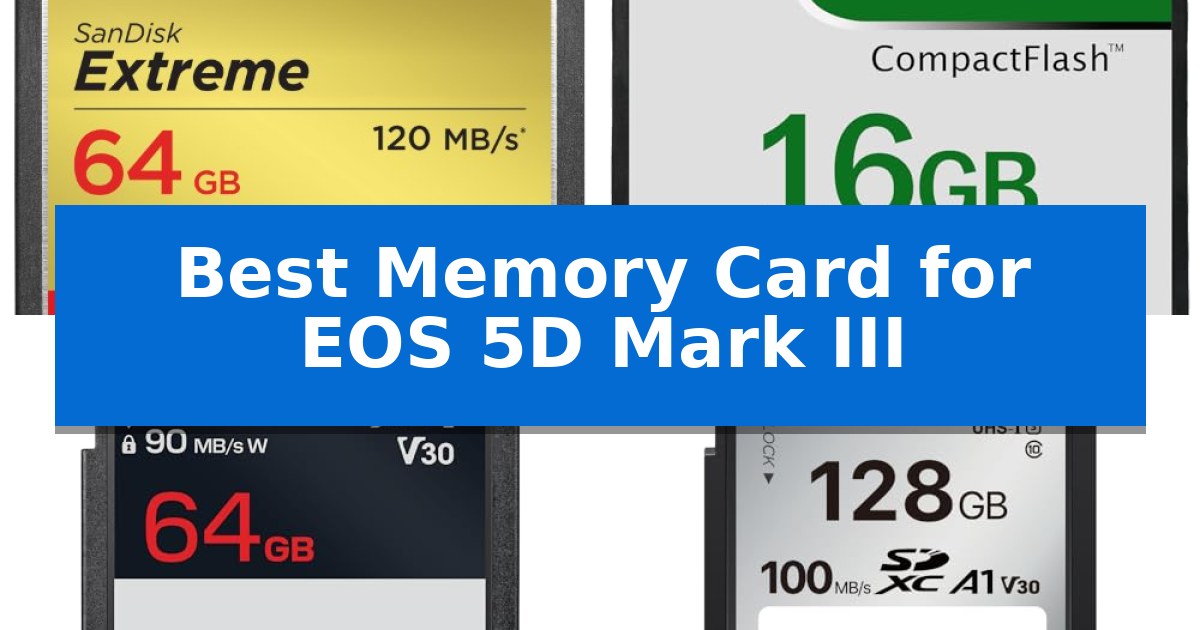
Selecting the right storage media for your camera is essential to ensure that every high-resolution image and video sequence is captured without interruption. Finding the Best Memory Card for EOS 5D Mark III requires balancing the camera's specific interface requirements with the need for consistent write speeds during demanding shooting sessions.
Whether you are a professional photographer needing reliable performance for long events or a hobbyist looking for a dependable secondary storage solution, the choice of card directly impacts your workflow. This guide evaluates several options to help you identify which card best aligns with your specific shooting habits and technical needs.
You may also want to compare Best Memory Card for Eken H9R, Best Memory Card for DSLR T5i, and Best Memory Card for DSLR Photography.
Best Memory Card for EOS 5D Mark III
Quick Comparison
| Product | Best For | Key Strength | Score |
|---|---|---|---|
| SanDisk Extreme CompactFlash Memory Card | Best Overall | UDMA 7 interface for fast data transfer. | 4.9 |
| Dane-Elec CompactFlash Memory Card | Essential Secondary Storage Option | Five-year warranty provides long-term support. | 4.7 |
| SanDisk Extreme PRO SD Memory Card | Reliable High Speed SD Performance | UHS-I, V30, and U3 speed class ratings for consistent performance. | 4.7 |
| Gigastone 4K Camera Pro SD Card | Includes Free Data Recovery | Rugged design featuring waterproof, shock-proof, and temperature-proof protection. | 4.5 |
| Gigastone 4K Camera Extreme SD Card | Fast Transfers for UHD Video | UHS-I U3 V30 rating for reliable 4K video support | 4.3 |
How We Chose
- Compatibility with the dual-slot architecture of the EOS 5D Mark III.
- Sustained write speeds to prevent buffer bottlenecks during continuous shooting.
- Durability ratings for protection against environmental factors like shock and temperature changes.
- Storage capacity options that accommodate high-resolution file sizes.
- Manufacturer-backed warranties and data recovery support features.
1 SanDisk Extreme CompactFlash Memory Card — Professional Grade UDMA 7 Speed
Reliable data management is critical when shooting with the Canon EOS 5D Mark III, particularly for high-resolution stills and sustained video recording. The SanDisk 64GB Extreme CompactFlash Memory Card addresses these demands by utilizing the UDMA 7 interface, which facilitates efficient data transfer and write operations essential for maintaining camera responsiveness during burst shooting.
Performance is anchored by read speeds of up to 120MB/s and write speeds of up to 85MB/s. These specifications allow the card to keep pace with the camera's buffer, reducing the time spent waiting for images to write to the storage medium. For videographers, the card features VPG-20 (Video Performance Guarantee), which ensures a sustained data recording rate of 20MB/s, preventing dropped frames during video capture.
Durability is a core design focus, as the card is engineered to withstand challenging environments. It undergoes rigorous stress, shock, and vibration testing to protect data integrity. Furthermore, the inclusion of an RTV silicone coating provides an additional layer of defense against physical impact, ensuring the card remains functional in demanding field conditions.
With a capacity of 64GB, this card provides a balance between storage volume and performance for professional workflows. It is a specialized tool designed for devices utilizing the CompactFlash form factor, ensuring compatibility with the specific hardware interface of the EOS 5D Mark III.
Best for: Professional photographers and videographers using the Canon EOS 5D Mark III who require high-speed write performance and reliable video recording.
Skip if: Users who do not own a camera with a CompactFlash card slot or those who require significantly higher storage capacities for long-duration 4K video projects.
PROS
- UDMA 7 interface for fast data transfer.
- VPG-20 certification for consistent video recording.
- RTV silicone coating for enhanced shock and vibration protection.
CONS
- Limited to CompactFlash compatible devices only.
2 Dane-Elec CompactFlash Memory Card — Essential Secondary Storage Option
Reliable image capture requires storage that can keep pace with your workflow, and the Dane-Elec CompactFlash Memory Card offers a dedicated 16GB capacity specifically designed for the Canon EOS 5D Mark III. This card provides a practical solution for photographers who need to store high-resolution still photos and Full HD video files securely.
Engineered for versatility, this card features a maximum read speed of 50MB/s, ensuring efficient data transfer when moving files from your camera to a computer. Its physical design is built to withstand extreme temperatures, providing peace of mind when shooting in challenging outdoor environments where hardware durability is essential.
The card is compact, measuring just 1.65 inches in length and 1.4 inches in width, allowing it to fit seamlessly into the camera's memory card slot without adding bulk. With a five-year warranty included, it serves as a dependable secondary storage option for your photography kit.
When selecting storage for your camera, consider your typical shooting volume. While 16GB is sufficient for many sessions, those who frequently record long-form video or shoot exclusively in RAW format may require higher capacities to avoid frequent card swaps during a shoot.
Best for: Photographers using the Canon EOS 5D Mark III who need a reliable, temperature-resistant storage card for daily still photography and Full HD video recording.
Skip if: Users who frequently shoot high-bitrate video or large volumes of RAW images may find the 16GB capacity limiting and should look for higher-capacity storage options.
PROS
- Five-year warranty provides long-term support.
- Extreme temperature resistance for outdoor reliability.
- Compact form factor designed for easy handling and storage.
CONS
- 16GB capacity may be insufficient for extensive high-resolution video projects.
3 SanDisk Extreme PRO SD Memory Card — Reliable High Speed SD Performance
Reliable high-speed performance is a necessity for the EOS 5D Mark III, and the SanDisk Extreme PRO SD Memory Card is engineered to meet these specific demands. With its UHS-I, V30, and U3 speed class ratings, this card is built to handle high-resolution stills and 4K UHD video recording without compromising data integrity. These ratings ensure that the card maintains the sustained write speeds required for consistent video capture, preventing dropped frames during extended recording sessions.
The card is designed for physical resilience, featuring a build that is engineered to perform in extreme conditions, including resistance to rough handling. This durability ensures that your captured media remains protected during field use or travel. For users who need to manage large volumes of content, the card supports the SanDisk Memory Zone desktop app, which simplifies the process of backing up, organizing, and transferring files from the card to a computer, whether you are using a dedicated card reader or an integrated slot.
With a capacity of 64GB, this memory card provides ample space for extended shooting sessions. It balances high-speed data throughput with the reliability required for professional-grade photography, making it a dependable choice for those who need to maintain a consistent workflow when working with the EOS 5D Mark III. The inclusion of a Lifetime Limited warranty offers long-term peace of mind for professionals who rely on their storage media for critical projects.
While the UHS-I interface provides reliable performance, it is important to note that it may act as a bottleneck for users who require the absolute fastest transfer speeds available in newer interface standards. However, for the specific requirements of the EOS 5D Mark III, this card provides a stable and efficient solution that aligns with the camera's operational capabilities.
Best for: Photographers and videographers using the EOS 5D Mark III who require reliable, high-speed storage for high-resolution stills and 4K video recording.
Skip if: Users who require specialized high-speed interfaces like UHS-II or CFexpress, which this UHS-I card does not support.
PROS
- UHS-I, V30, and U3 speed class ratings for consistent performance.
- Resilient design engineered to perform in extreme conditions.
- SanDisk Memory Zone app support for simplified content management.
- Lifetime Limited warranty providing long-term peace of mind.
CONS
- UHS-I interface may be a bottleneck for users requiring the absolute fastest transfer speeds available in newer standards.
4 Gigastone 4K Camera Pro SD Card — Includes Free Data Recovery
Reliability during long-form video capture is essential for the EOS 5D Mark III, and the Gigastone 4K Camera Pro SD Card provides a stable storage solution built to withstand demanding environments. This full-sized SD card is engineered to be waterproof, temperature-proof, x-ray-proof, shock-proof, and magnetic-proof, ensuring your captured footage remains protected against common environmental hazards.
Designed to support 4K Ultra HD video recording, this card features a UHS-I U3 Class 10 rating, which provides the sustained write performance necessary for high-bitrate video files. With a 150MB/s read speed and data transfer capabilities up to 100 MB/s, it allows for efficient offloading of large files to your computer, reducing downtime after a shoot.
The card includes a 5-year limited warranty, offering long-term support for your storage investment. It also comes with a convenient mini case for secure storage when the card is not in the camera, helping to prevent physical damage or loss during travel.
For photographers and videographers, this card balances high-resolution video compatibility with rugged durability. While it is optimized for 4K workflows, its full-sized SD form factor ensures seamless compatibility with the EOS 5D Mark III's card slot, making it a straightforward upgrade for your existing setup.
Best for: Photographers and videographers using the EOS 5D Mark III who require a rugged, 4K-compatible storage solution for reliable field work.
Skip if: Users who require ultra-high-speed UHS-II or V60/V90 performance for continuous high-speed burst shooting or 8K video workflows.
PROS
- Rugged design featuring waterproof, shock-proof, and temperature-proof protection.
- 4K UHD video compatibility with UHS-I U3 Class 10 performance.
- Includes a 5-year limited warranty for added peace of mind.
- Comes with a mini case for secure transport.
CONS
- UHS-I interface limits maximum transfer speeds compared to UHS-II alternatives.
5 Gigastone 4K Camera Extreme SD Card — Fast Transfers for UHD Video
The Gigastone 4K Camera Extreme SD Card provides a reliable storage solution for the EOS 5D Mark III, featuring a UHS-I A2 V30 U3 rating that supports 4K UHD video recording. This full-sized SD card measures 32mm by 24mm, ensuring a precise fit for the camera's dedicated card slot.
Designed for versatility and protection, this memory card is waterproof, temperature-proof, x-ray-proof, shock-proof, and magnetic-proof. These physical safeguards help protect data integrity during travel or in demanding field environments. Each unit also includes a convenient mini case for secure storage when the card is not in the camera.
With a rated data transfer speed of up to 160 MB/s, this card facilitates efficient file offloading to computers or external drives. The inclusion of a 5-year limited warranty provides long-term support for the hardware, reflecting the manufacturer's commitment to durability and performance standards.
For photographers and videographers using the EOS 5D Mark III, this card balances high-speed performance with essential environmental protections. It is a straightforward choice for those who require consistent write speeds for high-resolution stills and video capture without unnecessary complexity.
Best for: Photographers and videographers requiring a durable, high-speed storage solution for 4K video and high-resolution image capture.
Skip if: Users who require higher-tier UHS-II or V60/V90 speed classes for specialized high-bitrate cinema workflows.
PROS
- UHS-I U3 V30 rating for reliable 4K video support
- Comprehensive environmental protection against water, shock, and X-rays
- Generous 5-year limited warranty
- Includes a protective mini case for storage
CONS
- UHS-I interface limits maximum transfer speeds compared to UHS-II cards
Best Memory Card for EOS 5D Mark III Buying Guide
Understanding Memory Card Interfaces
The EOS 5D Mark III features a dual-slot design, supporting both CompactFlash (CF) and Secure Digital (SD) cards. Understanding the difference between these interfaces is vital; CF cards are generally preferred for their robust physical design and high-speed performance in professional environments, while SD cards offer a more compact and widely compatible alternative for general use.
When choosing between these formats, consider your primary workflow. If you frequently shoot in burst mode or record high-bitrate video, a high-speed CF card is often the more reliable choice. For secondary backups or less intensive shooting, a high-quality SD card can serve as a dependable secondary storage medium.
The Importance of Write Speeds
Write speed is the rate at which data is transferred from your camera's buffer to the memory card. For the EOS 5D Mark III, a card with insufficient write speeds will cause the camera to pause during long bursts, as it waits for the buffer to clear. This can result in missed shots during fast-paced action or sports photography.
Look for cards that specify sustained write speeds rather than just maximum burst speeds. Cards labeled with UDMA 7 or specific Video Speed Classes (like V30) provide a baseline for performance, ensuring that your camera can maintain its maximum frame rate without unexpected interruptions.
Durability and Environmental Protection
Professional photography often takes place in unpredictable environments. Memory cards are susceptible to damage from extreme temperatures, moisture, and physical impact. High-quality cards are engineered with protective coatings, such as RTV silicone, and undergo rigorous testing to ensure data integrity under stress.
Investing in a card with proven durability features provides peace of mind, especially when shooting in remote locations or harsh weather. Always check the manufacturer's specifications regarding shock, vibration, and temperature resistance to ensure the card can withstand the conditions you typically encounter.
Capacity Requirements
The capacity you need depends on your file format and shooting volume. Shooting in RAW format generates significantly larger files than JPEG, meaning you will fill a card much faster. A 64GB card is often a sweet spot for many photographers, offering a balance between storage space and the risk management of having multiple cards.
It is generally better to have two 64GB cards than one 128GB card. This strategy minimizes the impact of a potential card failure, ensuring that you do not lose all your work from a single shoot if a card becomes corrupted or physically damaged.
Data Recovery and Warranty
Even with the most reliable hardware, data corruption can occur. Many modern memory cards now include data recovery software or services as part of the purchase. This can be a lifesaver if you accidentally delete files or if a card encounters a file system error.
Always prioritize cards that come with a multi-year or lifetime limited warranty. A manufacturer's willingness to stand behind their product for several years is a strong indicator of the card's build quality and expected longevity in a professional environment.
Frequently Asked Questions
Can the EOS 5D Mark III use both CF and SD cards simultaneously?
Yes, the camera features dual slots. You can configure it to record to both cards simultaneously for redundancy, or use one as an overflow when the first card is full.
What does UDMA 7 mean for my CF card?
UDMA 7 is a high-speed interface standard for CompactFlash cards, allowing for faster data transfer rates that are necessary for the high-resolution files produced by the EOS 5D Mark III.
Do I need a V30 SD card for this camera?
While the EOS 5D Mark III predates the V30 standard, using a V30-rated card ensures that the card meets the minimum sustained write speed requirements for smooth video recording and rapid burst shooting.
How often should I format my memory cards?
It is recommended to format your memory cards in-camera before each major shoot. This ensures the file system is optimized for the camera and helps prevent potential data errors.
What should I do if my card is not recognized?
First, try cleaning the contacts gently with a soft, dry cloth. If the issue persists, try the card in a different device or card reader to determine if the problem is with the card or the camera slot.
Conclusion: Our Top Pick
For photographers requiring the most reliable performance from their EOS 5D Mark III, the SanDisk Extreme CompactFlash Memory Card stands out as the premier choice. Its UDMA 7 interface and professional-grade construction provide the sustained write speeds necessary to handle high-resolution bursts and demanding video capture without the risk of buffer bottlenecks.
While other options exist for secondary storage, this card's proven durability and consistent performance make it an essential tool for any serious workflow. By choosing this card, you ensure that your equipment is capable of keeping pace with your creative vision, providing the stability needed to protect your most important images.