
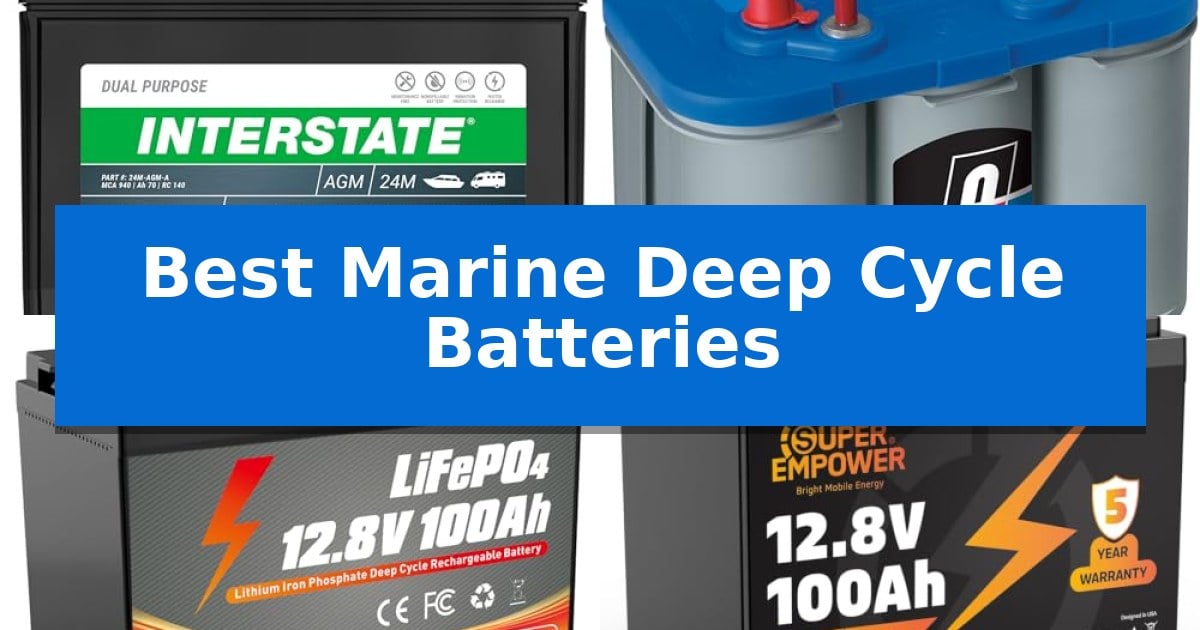
Selecting the right power source for your boat is essential for ensuring your electronics, trolling motors, and engine starters function reliably on the water. Whether you are navigating calm lakes or facing rough coastal conditions, having a dependable energy reserve prevents unexpected downtime and keeps your marine systems running smoothly.
In this guide, we evaluate the Best Marine Deep Cycle Batteries to help you distinguish between traditional AGM technology and modern lithium alternatives. By understanding the specific power requirements of your vessel, you can choose a battery that balances capacity, weight, and cycle life to support your time on the water.
You may also want to compare Best Marine Combination Padlock, Best Marine Cellular Signal Booster, and Best Marine Cell Phone Signal Booster.
Best Marine Deep Cycle Batteries
Quick Comparison
| Product | Best For | Key Strength | Score |
|---|---|---|---|
| Interstate Batteries Marine AGM Battery | Best Overall | Dual-purpose functionality for both engine starting and accessory power. | 4.9 |
| Optima BlueTop Dual Purpose Battery | Vibration-Resistant Spiralcell Design | SPIRALCELL TECHNOLOGY provides superior vibration resistance and durability. | 4.6 |
| Vemdia LiFePO4 Deep Cycle Battery | Lightweight High-Cycle Lithium Power | High cycle life of up to 15,000 cycles at 60% depth of discharge. | 4.3 |
| Super Empower LiFePO4 Marine Battery | Cold-Weather Charging Protection | Integrated low-temperature charging protection prevents damage in cold climates. | 4.3 |
| Interstate Batteries Group 31 AGM Battery | High-Capacity Accessory Power | Thick plate construction supports repeated deep-cycle discharging. | 4.7 |
How We Chose
- Battery Chemistry: Comparing the performance trade-offs between traditional lead-acid AGM and advanced LiFePO4 lithium technologies.
- Cycle Life: Evaluating the total number of charge-discharge cycles to estimate the long-term service life of each unit.
- Dual-Purpose Capability: Assessing whether a battery can reliably handle both high-amperage engine cranking and sustained deep-cycle accessory power.
- Safety and Protection: Reviewing built-in Battery Management System (BMS) features for temperature regulation and over-discharge prevention.
- Physical Dimensions: Ensuring compatibility with standard BCI group sizes for seamless installation in existing boat battery compartments.
1 Interstate Batteries Marine AGM Battery — Dual-Purpose Cranking and Trolling
Reliable power delivery on the water requires a balance between high-cranking capability for engine ignition and sustained energy for trolling motors. The Interstate Batteries Marine/RV Battery 12V 70Ah 750CCA Group 24 AGM addresses this dual-purpose requirement through a pure lead AGM design, engineered to handle both high-amperage starts and the continuous discharge cycles needed for onboard electronics and appliances.
Built with thick plates to support repeated deep-cycle discharge without compromising longevity, this battery is constructed to withstand rugged marine conditions. The AGM technology facilitates faster recharging compared to conventional flooded or alloy AGM alternatives, ensuring the power source remains ready for frequent use. Its design intent focuses on providing consistent voltage to essential systems, including lights, pumps, and televisions, while maintaining the 750CCA required for engine starting.
Maintenance and service life are key considerations for marine power. By utilizing pure lead construction, this battery is rated for a service life up to 2x longer than conventional alloy AGM batteries and 3x longer than standard flooded options. The unit is housed in a Group 24M form factor, measuring 11 inches in width and 8.98 inches in height, with a total weight of 44.6 pounds, making it a manageable addition to most vessel battery compartments.
Selecting the right marine battery involves matching the capacity and discharge profile to your vessel's specific electrical load. While this 70Ah unit offers a versatile 2-in-1 solution, users should verify that the 750CCA and capacity meet the specific starting and auxiliary requirements of their motor and accessory setup. With a 2-year free replacement warranty, it provides a structured support path for long-term operation.
Best for: Boaters and RV owners requiring a single, versatile battery capable of both engine cranking and powering auxiliary electronics.
Skip if: Users with high-draw electrical systems that exceed the 70Ah capacity or those needing a dedicated high-capacity house bank separate from their starting battery.
PROS
- Dual-purpose functionality for both engine starting and accessory power.
- Pure lead AGM construction provides faster recharging and extended service life.
- Thick plate design supports repeated deep-cycle discharges.
- Rugged build intended for demanding marine and RV environments.
CONS
- Fixed 70Ah capacity may be insufficient for vessels with extensive high-draw electrical loads.
- Weight of 44.6 pounds requires secure mounting in smaller watercraft.
2 Optima BlueTop Dual Purpose Battery — Vibration-Resistant Spiralcell Design
Marine environments demand equipment that can withstand constant motion and moisture, and the OPTIMA® Batteries D34M BLUETOP® is engineered specifically for these rigors. Featuring a unique SPIRALCELL TECHNOLOGY design with 99.99% pure lead, this battery provides a robust power source that consistently outperforms conventional flat-plate alternatives.
This dual-purpose unit is designed to handle both deep cycle requirements and engine starting, delivering 750 Cold Cranking Amps and 870 Marine Cranking Amps. Its internal construction makes it 15 times more resistant to vibration than standard flooded batteries, which is a critical advantage for boats and RVs frequently exposed to choppy water or uneven terrain.
Convenience is central to its design, as the unit is completely maintenance-free and features a versatile mounting capability. It includes dual SAE and 5/16" stainless steel stud posts to simplify connections. With a 120-minute reserve capacity, it ensures reliable performance for extended periods, while its faster charging capabilities help reduce downtime between trips.
Measuring 10.06" x 6.88" x 7.94" and weighing 43.5 pounds, this battery fits into standard marine compartments while offering a C20 capacity of 55 AH. Its sealed AGM construction prevents spills, allowing for flexible installation in tight spaces where traditional batteries might be impractical.
Best for: Boaters and RV owners who need a versatile, vibration-resistant battery capable of both engine starting and powering onboard electronics.
Skip if: Users requiring extremely high-capacity storage for massive off-grid power banks may find the 55 AH capacity insufficient compared to dedicated large-format deep cycle banks.
PROS
- SPIRALCELL TECHNOLOGY provides superior vibration resistance and durability.
- Dual-purpose design handles both starting and deep cycle applications effectively.
- Maintenance-free sealed AGM construction prevents spills and simplifies upkeep.
- Dual terminals offer flexible connection options for marine and RV setups.
CONS
- Weight of 43.5 pounds may be cumbersome for some manual installation scenarios.
- 55 AH capacity is optimized for versatility rather than maximum long-term energy storage.
3 Vemdia LiFePO4 Deep Cycle Battery — Lightweight High-Cycle Lithium Power
Reliable power for marine and off-grid applications often hinges on weight efficiency and cycle longevity, areas where the Vemdia LiFePO4 Deep Cycle Battery offers a distinct advantage. By utilizing lithium iron phosphate chemistry, this unit provides a significant reduction in mass compared to traditional lead-acid alternatives, making it a practical choice for installations where weight distribution is a priority.
The Vemdia LiFePO4 Deep Cycle Battery is engineered for durability, supporting between 4,000 and 15,000 deep cycles depending on the depth of discharge. With a built-in 100A BMS, the unit manages safety by protecting against over-charging, over-discharging, over-current, and overheating. This system ensures consistent performance across a wide operating temperature range, specifically 0 to 45°C for charging and -20 to 60°C for discharging.
Designed to fit standard BCI Group 31 battery boxes, this 12V 100Ah unit serves as a direct drop-in replacement for lead-acid setups. Its versatility is further enhanced by its modularity; users can connect multiple units in series or parallel—up to 4S or 4P—to scale capacity up to 400Ah or voltage up to 48V. This flexibility allows it to power diverse loads, from trolling motors to household backup systems.
Maintenance is simplified through the battery's chemistry, which eliminates the need for acid refilling or frequent upkeep. The unit supports three charging methods, including lithium-specific chargers, solar controllers, and alternators, offering adaptability for various energy environments. By maintaining a stable voltage output throughout its discharge, it avoids the power drop-off common in lead-acid batteries.
Best for: This battery is best for marine, RV, and off-grid solar users who require a lightweight, high-cycle-life power source that fits standard BCI Group 31 dimensions.
Skip if: Skip this product if your existing charging infrastructure is not compatible with LiFePO4 chemistry or if you require a battery with a different form factor than the BCI Group 31 standard.
PROS
- High cycle life of up to 15,000 cycles at 60% depth of discharge.
- Lightweight design that is 60% lighter than comparable lead-acid batteries.
- Integrated 100A BMS for comprehensive safety and performance management.
- Modular connectivity allowing for series or parallel expansion up to 4S or 4P.
CONS
- Specific charging requirements necessitate a compatible lithium iron phosphate charger for optimal performance.
- Initial investment cost is higher than traditional lead-acid battery technology.
4 Super Empower LiFePO4 Marine Battery — Cold-Weather Charging Protection
Reliable power management for marine and off-grid environments often hinges on the ability to handle temperature extremes, a capability central to the Super Empower LiFePO4 Marine Battery. This unit integrates a specialized low-temperature charging function that automatically pauses input below 32°F (0°C) and halts discharge at -20°C (-4°F), protecting the internal chemistry during cold-weather operation.
Engineered as a drop-in replacement for traditional lead-acid, AGM, or SLA batteries, this 12.8V 100Ah unit utilizes a BCI Group 24 form factor. Measuring 6.49"D x 10.24"W x 8.98"H and weighing 21.6 lbs, it is designed to fit into standard battery boxes without requiring modifications to existing marine or RV setups.
The battery features an integrated 100A BMS that manages cell balancing while providing protection against overcharge, over-discharge, overcurrent, and short circuits. For users requiring higher energy capacity, the system supports expandable energy configuration through a 4S4P arrangement, allowing for a maximum setup of 51.2V 400Ah or 20.48kWh.
To maintain performance, the manufacturer recommends using a dedicated 12V LiFePO4 charger with a CC/CV profile. While compatible with solar systems via MPPT or PWM controllers set to lithium mode, the battery is strictly intended for deep cycle energy storage and is not suitable for engine starting or cranking applications.
Best for: Marine, RV, and solar energy storage systems requiring cold-weather protection and expandable capacity.
Skip if: You require a battery specifically designed for high-amperage engine starting or cranking applications.
PROS
- Integrated low-temperature charging protection prevents damage in cold climates.
- Standard BCI Group 24 dimensions allow for easy drop-in replacement.
- Supports 4S4P expansion for scalable energy storage up to 20.48kWh.
- Built-in 100A BMS provides comprehensive safety monitoring.
CONS
- Not suitable for engine starting or high-cranking applications.
- Requires a dedicated LiFePO4 charger for optimal performance.
5 Interstate Batteries Group 31 AGM Battery — High-Capacity Accessory Power
Maintaining consistent power for marine electronics and trolling motors requires a robust energy solution capable of handling repeated discharge cycles. The Interstate Batteries Marine/RV Battery 12V 100Ah 925CCA 1110CA Group 31 AGM (31-AGM5) is engineered with thick internal plates specifically to support continuous power delivery, allowing it to be recharged multiple times without compromising its structural integrity or lifespan.
This pure lead AGM battery serves a dual-purpose role, providing both the high-cranking force necessary for engine starting and the steady, reliable discharge required for onboard accessories like fish locators, audio systems, and windlass motors. By utilizing advanced AGM technology, this unit is designed to offer an expected service life that is significantly longer than conventional flooded batteries or standard alloyed lead AGM alternatives.
Designed for the demanding marine environment, the Interstate Batteries Group 31 AGM Battery measures 13 inches in length and 9 inches in height, weighing approximately 60 pounds. Its construction focuses on durability and consistent performance, ensuring that boaters have a dependable power source for extended outings. The manufacturer emphasizes that this specific model is optimized for marine and RV deep-cycle applications and is not intended for automotive or mobility device use.
Interstate Batteries maintains a strong focus on sustainability, encouraging users to return spent units to their designated centers for recycling. This commitment to the product lifecycle ensures that the heavy-duty materials used in the 31-AGM5 are managed responsibly after their extended service life concludes.
Best for: Boaters and RV owners who require a high-capacity, dual-purpose battery capable of handling both engine cranking and sustained accessory power.
Skip if: Users seeking a lightweight battery or those requiring a specialized unit for automotive starting or mobility device applications.
PROS
- Thick plate construction supports repeated deep-cycle discharging.
- Dual-purpose design provides both high-cranking power and steady accessory output.
- Extended service life compared to conventional flooded and standard alloyed lead AGM batteries.
- Reliable performance for demanding marine electronics and trolling motors.
CONS
- Heavy physical weight of 60.02 pounds may require careful installation planning.
- Application specific and not suitable for automotive or mobility device use.
Best Marine Deep Cycle Batteries Buying Guide
Understanding Battery Chemistry
The choice between AGM (Absorbent Glass Mat) and LiFePO4 (Lithium Iron Phosphate) is the most significant decision for marine owners. AGM batteries are a mature, reliable technology that handles high-cranking demands effectively and is generally more affordable upfront. They are robust and do not require specialized charging equipment, making them a common choice for traditional marine setups.
Conversely, LiFePO4 batteries offer a significant weight advantage—often 50% to 60% lighter than lead-acid equivalents—and provide a much longer cycle life. While they require compatible charging systems and often include a BMS (Battery Management System) to prevent damage, their ability to maintain constant voltage throughout the discharge cycle makes them ideal for high-drain accessories like trolling motors.
Dual-Purpose vs. Dedicated Deep Cycle
A dual-purpose battery is engineered to provide the high burst of energy needed to start an outboard motor while also possessing the internal plate thickness required for deep-cycle discharge. This is an excellent space-saving solution for smaller boats where installing separate starting and house batteries is not feasible.
However, if your vessel has a high-draw electrical load, such as large fish finders, multiple live-well pumps, and a powerful trolling motor, a dedicated deep-cycle battery is often preferred. These units are optimized for slow, steady energy release and can be discharged to a lower percentage of their total capacity without suffering the same internal damage as a starting battery.
The Importance of BCI Group Sizes
Marine batteries are categorized by BCI Group sizes, which dictate the physical length, width, and height of the unit. Before purchasing, it is critical to measure your existing battery box or tray to ensure the new unit will fit securely. A battery that is too large will not fit, while one that is too small may shift during operation, potentially damaging connections.
Standard sizes like Group 24 and Group 31 are common in marine applications. While lithium batteries often come in these standard footprints to allow for a 'drop-in' replacement, their significantly lower weight means you may need to ensure your mounting hardware is tightened appropriately to account for the lack of mass.
Managing Charging and Temperature
Lead-acid AGM batteries are relatively forgiving regarding charging profiles, but lithium batteries are more sensitive. Using an incorrect charger can lead to premature failure or safety issues. Always verify that your onboard charger or alternator is compatible with the specific chemistry of your battery, especially when switching to lithium.
Temperature also plays a role in performance. Many modern lithium batteries include low-temperature charging protection, which prevents the battery from accepting a charge when the internal temperature is below freezing. This is a vital safety feature for boaters who operate in colder climates, as charging a frozen lithium battery can cause permanent internal damage.
Weight and Installation Considerations
Weight distribution is a key factor in boat handling and fuel efficiency. Replacing heavy lead-acid batteries with lithium units can shed dozens of pounds from your boat's stern, potentially improving performance. However, you should consider how this shift in weight might affect your boat's trim and overall balance on the water.
Installation should always prioritize secure connections and proper ventilation. Regardless of the chemistry, ensure that your terminals are clean and tightened to the manufacturer's torque specifications to prevent voltage drops and heat buildup during high-current operations.
Frequently Asked Questions
Can I mix lithium and AGM batteries on the same boat?
While it is technically possible to have both, they should not be connected in parallel because they have different charging requirements and voltage curves. It is best to keep them on separate circuits.
What does the BMS do in a lithium battery?
The Battery Management System (BMS) is an internal circuit that monitors the battery's health. It protects against overcharging, over-discharging, short circuits, and temperature extremes, ensuring the battery operates within safe parameters.
Do I need a special charger for AGM batteries?
AGM batteries generally work with standard marine chargers, but you should ensure the charger has an 'AGM' or 'Gel' setting to provide the correct voltage profile for optimal longevity.
How long do marine batteries typically last?
Lifespan depends on usage and maintenance. Conventional lead-acid batteries may last 2-3 years, while high-quality AGM batteries often last longer. LiFePO4 lithium batteries can provide thousands of cycles, potentially lasting 10 years or more.
Is a dual-purpose battery better than a dedicated deep cycle?
It depends on your boat's configuration. If you have limited space, a dual-purpose battery is more convenient. If you have a large boat with high electrical demands, dedicated batteries for starting and house power are usually superior.
Conclusion: Our Top Pick
For most boaters seeking a balance of reliability and performance, the Interstate Batteries Marine AGM Battery stands out as the most dependable choice. Its dual-purpose design allows it to handle both engine starting and accessory power, while the AGM construction provides a rugged, maintenance-free solution that is well-suited for the harsh marine environment.
While lithium options offer significant weight savings and longer cycle life, the Interstate Batteries Marine AGM Battery remains a versatile and proven performer for those who prefer the simplicity and compatibility of traditional lead-acid technology. Its ability to withstand rugged conditions makes it a solid investment for your vessel's electrical system.