
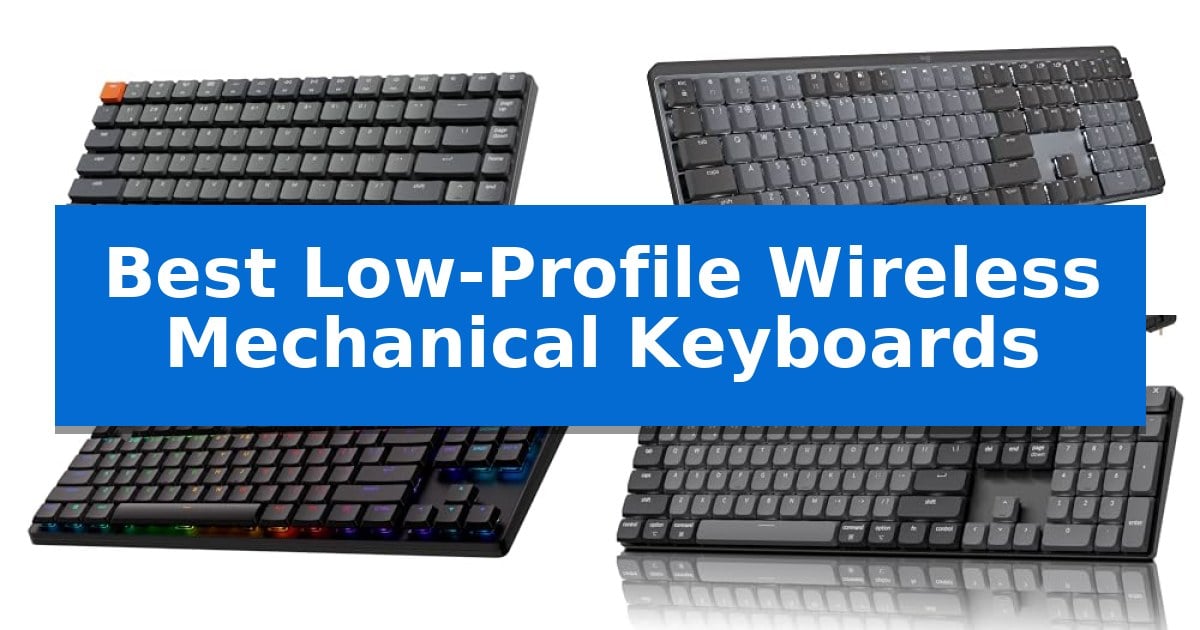
Finding the right typing experience often involves balancing desk space with tactile satisfaction. Best Low-Profile Wireless Mechanical Keyboards offer a solution by combining the slim, ergonomic profile of a laptop keyboard with the mechanical switches that enthusiasts prefer for speed and accuracy.
Whether you need a portable device for travel or a clean, minimalist aesthetic for your home office, these keyboards provide the wireless freedom and multi-device connectivity required for modern workflows. We have evaluated the latest options to help you choose the model that aligns with your specific layout and functional needs.
You may also want to compare Best Low-Profile Wireless Keyboards, Best Low-Profile Wireless Headphones, and Best Low-Profile Wireless Earbuds.
Best Low-Profile Wireless Mechanical Keyboards
Quick Comparison
| Product | Best For | Key Strength | Score |
|---|---|---|---|
| Keychron K3 Version 2 Wireless Keyboard | Best Overall | Ultra-slim profile measuring only 0.87 inches in height. | 4.9 |
| Logitech MX Mechanical Wireless Keyboard | Smart illumination for office work | Tactile Quiet mechanical switches provide satisfying feedback with reduced noise output. | 4.4 |
| Logitech G515 LIGHTSPEED TKL Keyboard | Pro-grade speed for gaming | Tri-mode connectivity including LIGHTSPEED wireless, Bluetooth, and wired options. | 4.3 |
| Keychron K5 Version 2 Wireless Keyboard | Full-size comfort with quiet switches | Full-size 100% layout in an ultra-slim profile. | 4.7 |
| NSYCA Air75 Wireless Mechanical Keyboard | Hot-swappable switches for customization | Tri-mode connectivity for seamless switching between four devices. | 4.9 |
How We Chose
- Connectivity versatility, including Bluetooth and 2.4GHz wireless performance.
- Switch type and tactile feedback characteristics for typing comfort.
- Layout efficiency and compatibility with macOS and Windows operating systems.
- Build quality, focusing on frame materials and keycap durability.
- Customization options, such as hot-swappable switches and programmable firmware.
1 Keychron K3 Version 2 Wireless Keyboard — Ultra-slim 75% layout for travel
Achieving a tactile, mechanical typing experience within a thin chassis is the primary challenge for portable setups. The Keychron K3 Version 2 Wireless Keyboard addresses this by utilizing low-profile mechanical switches housed in a reinforced aluminum body, resulting in a design that measures only 0.87 inches in height.
This keyboard is engineered for versatility, featuring a 75% layout that retains essential keys while maintaining a compact footprint. Users can connect up to three devices simultaneously via a stable Broadcom Bluetooth 5.1 chipset, allowing for seamless switching between laptops, tablets, and phones. For those requiring a wired connection, it also supports USB-C connectivity.
Customization is a core strength of this model, as it integrates with open-source QMK firmware. Through the Keychron Launcher web app, users can remap keys, create macros, and define shortcuts to suit their specific workflow. The inclusion of an AI assistant within the software further simplifies the configuration process for complex key assignments.
Designed with cross-platform compatibility in mind, the unit includes a unique Mac layout with dedicated multimedia keys, while also providing extra keycaps for Windows users. The aesthetic is rounded out by a white LED backlight and a floating keycap design, providing a clean, modern look that fits into various professional or personal environments.
Best for: Users who require a highly portable, compact mechanical keyboard that supports multi-device connectivity and deep software customization.
Skip if: Users who prefer a full-sized layout with a dedicated number pad or those who require hot-swappable switch functionality not explicitly detailed in the provided specifications.
PROS
- Ultra-slim profile measuring only 0.87 inches in height.
- Multi-device connectivity via Bluetooth 5.1 for up to 3 devices.
- Full QMK/VIA support for extensive key remapping and macros.
- Reinforced aluminum body for a balance of durability and portability.
CONS
- 75% layout lacks a dedicated number pad, which may impact data-entry intensive workflows.
- Plastic bottom frame construction despite the aluminum top plate.
2 Logitech MX Mechanical Wireless Keyboard — Smart illumination for office work
The Logitech MX Mechanical Wireless Keyboard centers its design around low-profile mechanical switches that provide a tactile bump for precise feedback while maintaining a quiet typing experience. This full-size keyboard is engineered for users who prioritize ergonomics and a streamlined desk aesthetic without sacrificing the mechanical feel.
Connectivity and workflow efficiency are core components of this device. It supports multi-device pairing for up to three systems via Bluetooth Low Energy or the included Logi Bolt receiver, allowing for seamless transitions between different operating systems. The integration with Logi Options+ software enables users to customize function keys and manage cross-computer control, which helps in streamlining complex productivity tasks.
The keyboard features smart illumination that detects hand proximity to activate backlighting, which then automatically adjusts to ambient light levels to conserve power. For charging, it utilizes a USB-C connection, offering up to 15 days of battery life with backlighting enabled, or up to 10 months if the lighting is turned off entirely.
Constructed with a focus on materials, the Graphite version incorporates 45% post-consumer recycled plastic. Its low-profile form factor is intended to reduce wrist strain, making it a practical choice for long-duration typing sessions where both comfort and mechanical precision are required.
Best for: Professionals and office users who require a quiet, low-profile mechanical typing experience with multi-device connectivity.
Skip if: Users who prefer a high-profile mechanical switch feel or those who require a compact, tenkeyless layout for limited desk space.
PROS
- Tactile Quiet mechanical switches provide satisfying feedback with reduced noise output.
- Smart backlighting automatically adjusts to ambient conditions and activates upon hand proximity.
- Multi-device support allows pairing with up to three devices across different operating systems.
- USB-C rechargeable battery offers extended usage times up to 10 months with backlighting off.
CONS
- Full-size form factor occupies more desk space compared to compact or tenkeyless alternatives.
- Battery life is significantly reduced when the smart backlighting feature is active.
3 Logitech G515 LIGHTSPEED TKL Keyboard — Pro-grade speed for gaming
The Logitech G515 LIGHTSPEED TKL Keyboard prioritizes a streamlined workspace by combining a thin, low-profile chassis with versatile tri-mode connectivity. This mechanical keyboard supports LIGHTSPEED wireless, Bluetooth, and wired data transfer, allowing for seamless integration into various desktop or mobile setups without the clutter of extra cables.
Performance is driven by factory-lubed GL tactile brown switches, which provide discernible bump feedback and fast actuation for responsive input. The inclusion of double-shot PBT keycaps ensures long-term durability and resistance to oil buildup, maintaining a consistent feel during extended use. These switches are housed within a tenkeyless design that maximizes desk space while retaining essential functionality.
Customization is a core focus, enabled by the KEYCONTROL feature. This allows users to program up to 15 distinct functions per key, effectively turning the compact layout into a personalized control center for specific workflows or gaming environments. The keyboard also features LIGHTSYNC RGB lighting to complement its aesthetic.
Power management is handled by an internal battery designed to provide up to 36 hours of continuous play on a single charge. While battery life can fluctuate based on usage conditions and lighting settings, the keyboard remains functional via wired connection when power is low, ensuring consistent availability.
Best for: Gamers and professionals seeking a compact, low-profile mechanical keyboard with extensive per-key programmability and flexible wireless connectivity.
Skip if: Users who require a dedicated number pad for data entry or those who prefer the deep travel distance of traditional full-height mechanical switches.
PROS
- Tri-mode connectivity including LIGHTSPEED wireless, Bluetooth, and wired options.
- KEYCONTROL functionality allows for up to 15 programmable functions per key.
- Factory-lubed GL tactile switches for smooth, fast actuation with bump feedback.
- Double-shot PBT keycaps provide high durability and an anti-oil surface.
CONS
- 36-hour battery life may require frequent recharging depending on usage intensity.
- Tenkeyless layout lacks a dedicated number pad, which may limit productivity for specific tasks.
4 Keychron K5 Version 2 Wireless Keyboard — Full-size comfort with quiet switches
Achieving a full-size typing experience within a compact, travel-friendly frame is the primary challenge for portable setups. The Keychron K5 Version 2 Wireless Keyboard addresses this by integrating a 100% layout into an ultra-slim, mechanical design that maintains the tactile responsiveness typically reserved for thicker desktop boards.
This keyboard utilizes Milk POM Banana switches to deliver a crisp, tactile stroke that balances desktop-grade performance with a low-profile aesthetic. To ensure a refined typing experience, the chassis is engineered with layered IXPE, EPDM, and latex acoustic foams, which work to dampen unwanted ping and stabilize the sound profile during intensive typing sessions.
Connectivity and customization are central to its utility. Users can pair up to three devices via Bluetooth 5.2 for seamless multitasking or switch to a USB-C wired connection to access a 1000 Hz polling rate when low-latency performance is required. Furthermore, the integration of QMK firmware and the Keychron Launcher web app allows for deep, open-source customization, including key remapping and layer creation.
Designed for versatility, the board features multi-OS support that mirrors media and function keys for both Mac and Windows environments. With a 2000 mAh battery providing up to 160 hours of use in lab tests, it offers the endurance necessary for long workdays without frequent charging, making it a robust choice for those who prioritize both ergonomics and workspace efficiency.
Best for: Professionals and travelers who require a full-size layout with mechanical tactile feedback in a slim, portable form factor.
Skip if: Users who prefer the deep travel distance of traditional high-profile mechanical switches or those who do not require a full-size numeric keypad.
PROS
- Full-size 100% layout in an ultra-slim profile.
- QMK/VIA open-source firmware for deep customization.
- Triple-device Bluetooth 5.2 connectivity.
- Tuned acoustic foam layers for a quieter typing experience.
CONS
- Low-profile design may not suit users accustomed to traditional high-profile mechanical switches.
5 NSYCA Air75 Wireless Mechanical Keyboard — Hot-swappable switches for customization
The NSYCA Air75 Wireless Mechanical Keyboard distinguishes itself with a signature inner-frame light ring that surrounds the entire deck, moving beyond standard per-key illumination to create a cohesive desktop aesthetic. This 75% layout keyboard balances a compact footprint with the inclusion of essential function and arrow keys, housed within a durable anodized aluminum frame.
Engineered for versatility, the device supports tri-mode connectivity via Bluetooth, 2.4GHz wireless, and USB-C, allowing users to switch between up to four devices seamlessly. It features a 1000Hz polling rate in 2.4GHz and wired modes, catering to both high-performance gaming and office productivity. The inclusion of double-shot PBT keycaps ensures long-term resistance to oil and fading, maintaining a clean, textured feel over time.
Customization is handled through a web-based driver that requires no software installation, enabling users to remap keys, manage macros, and save profiles to onboard memory. The PCB is fully hot-swappable, supporting 3-pin switches, and arrives with factory pre-lubed linear switches. Multi-layer sound dampening materials are integrated within the chassis to refine the acoustic profile and eliminate hollow resonance.
The keyboard is designed for cross-platform utility, offering dedicated modes for both macOS and Windows. Intelligent power management includes a customizable auto-sleep timer to preserve battery life. Each unit is backed by a 1-year hardware warranty, ensuring professional support for firmware and configuration needs.
Best for: Users requiring a compact, multi-device mechanical keyboard that balances gaming performance with professional customization and cross-platform compatibility.
Skip if: Users who require a full-sized layout with a dedicated number pad or those who prefer a non-low-profile typing experience.
PROS
- Tri-mode connectivity for seamless switching between four devices.
- Hot-swappable PCB allowing for easy switch upgrades without soldering.
- Double-shot PBT keycaps for superior durability and shine resistance.
- Web-based configuration eliminating the need for installed software.
CONS
- 75% compact layout lacks a dedicated number pad.
- Low-profile design may not suit users accustomed to traditional high-profile mechanical switches.
Best Low-Profile Wireless Mechanical Keyboards Buying Guide
Understanding Low-Profile Switches
Low-profile mechanical switches are designed with a shorter travel distance compared to traditional mechanical switches. This reduction in height allows for a thinner keyboard chassis, which can help reduce wrist strain by keeping your hands closer to the desk surface.
These switches are ideal for users transitioning from laptop keyboards who want a more ergonomic feel without the bulk of a full-height mechanical board. When selecting a switch, consider whether you prefer a linear feel for smooth, consistent presses or a tactile bump for clear actuation feedback.
Connectivity and Multi-Device Support
Wireless freedom is a core benefit of these keyboards, but the method of connection matters. Most modern low-profile boards utilize Bluetooth 5.1 or 5.2, which provides stable connections for tablets, phones, and laptops.
For users who require minimal latency, such as gamers, look for models that include a 2.4GHz wireless receiver. This connection type typically offers a faster, more reliable link than Bluetooth, ensuring your inputs are registered instantly during high-intensity tasks.
Layout and Portability
The layout of your keyboard dictates how much desk space you save. A 75% layout is a popular choice because it retains the function row and arrow keys while removing the number pad, making it highly portable for travel.
If your work involves heavy data entry, a full-size 100% layout is necessary to maintain productivity. Always verify that the keyboard supports your primary operating system, as some models offer specific keycaps or firmware modes for seamless switching between Mac and Windows.
Customization and Firmware
Advanced users often look for keyboards that support QMK or custom web-based drivers. These features allow you to remap keys, create complex macros, and save multiple profiles directly to the keyboard's onboard memory.
Hot-swappable PCB designs are another critical feature for longevity and personalization. This allows you to replace individual switches if they fail or if you decide to experiment with a different tactile feel without needing to purchase an entirely new keyboard.
Material Quality and Acoustics
The materials used in the frame and keycaps significantly impact the typing experience. Aluminum frames provide a rigid, premium feel, while double-shot PBT keycaps are preferred for their resistance to oil buildup and fading over time.
Acoustics are also important; many high-quality boards now include sound-dampening foam layers to reduce metallic ping and hollow sounds, resulting in a more refined and quiet typing experience suitable for shared office environments.
Frequently Asked Questions
Are low-profile mechanical keyboards better for ergonomics?
Yes, because they have a lower height, they often allow for a more natural wrist angle, which can reduce strain during long typing sessions compared to taller, traditional mechanical keyboards.
Can I use these keyboards with both Mac and Windows?
Most of the keyboards listed are designed to be compatible with both operating systems, often including dedicated keycaps and a physical switch or software setting to toggle between Mac and Windows layouts.
What does hot-swappable mean?
A hot-swappable keyboard allows you to remove and replace the mechanical switches without soldering. This makes it easy to repair a faulty switch or customize the typing feel of your board.
Is Bluetooth or 2.4GHz better for gaming?
For gaming, 2.4GHz wireless is generally superior because it offers lower latency and a more stable connection, reducing the risk of input lag during fast-paced play.
Do I need special software to customize my keyboard?
Many modern keyboards now use web-based launchers or drivers that do not require permanent software installation, making it easier to remap keys and update firmware on any computer.
Conclusion: Our Top Pick
When choosing the right hardware for your desk, the Keychron K3 Version 2 Wireless Keyboard stands out as the most versatile option for those who prioritize a balance of portability and professional-grade features. Its 75% layout is ideal for maintaining a clean workspace while providing the tactile feedback necessary for efficient typing.
With its robust Bluetooth connectivity and QMK firmware support, it offers a level of customization that is rare in such a slim form factor. For users who need a reliable, travel-friendly, and highly programmable daily driver, this keyboard provides the best overall experience among the current low-profile options.