
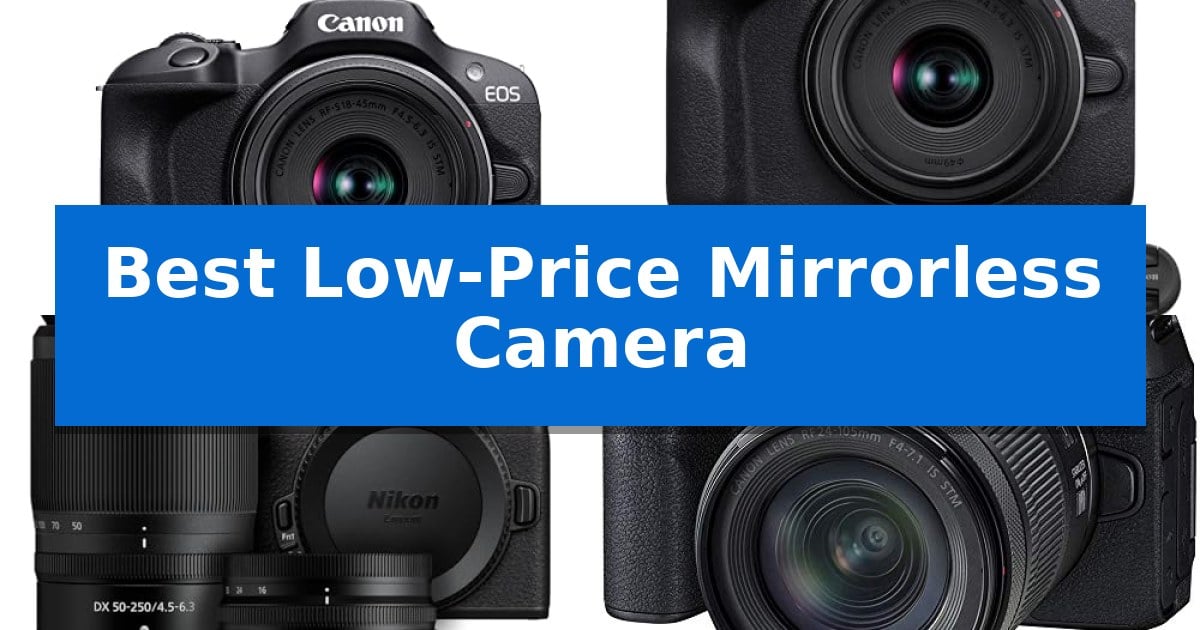
Finding the right gear without overspending is a common challenge for photographers and content creators starting their journey. A Best Low-Price Mirrorless Camera should offer a meaningful upgrade over smartphone photography while remaining portable enough for daily use.
We have analyzed the current market to identify models that provide essential features like interchangeable lenses, reliable autofocus, and high-resolution sensors. This guide focuses on accessible options that help you capture high-quality stills and video without the complexity of professional-grade systems.
You may also want to compare Best Low-Price Microphone Headset, Best Low-Price LED Monitors, and Best Low-Price LCD Monitors.
Best Low-Price Mirrorless Camera
Quick Comparison
| Product | Best For | Key Strength | Score |
|---|---|---|---|
| Canon EOS R100 Mirrorless Camera | Best Overall | Extremely compact and lightweight body for maximum portability. | 4.9 |
| Canon EOS R100 Mirrorless Camera Bundle | Complete starter kit for beginners | Compact and lightweight body for improved mobility. | 4.9 |
| Nikon Z50 II Mirrorless Camera | Modern features for creative shooters | Large 20.9-megapixel DX-format sensor for enhanced image quality. | 4.6 |
| Canon EOS RP Mirrorless Camera | Accessible full-frame entry point | Compact and lightweight design ideal for travel. | 4.9 |
How We Chose
- Sensor performance and resolution for clear, detailed imagery.
- Autofocus speed and subject tracking reliability for stills and video.
- Physical size and weight for portability and travel convenience.
- Lens system versatility and availability of compatible optics.
- Video resolution and frame rate capabilities for content creation.
1 Canon EOS R100 Mirrorless Camera — Most compact entry-level option
The Canon EOS R100 Mirrorless Camera distinguishes itself as the smallest and lightest body in the EOS R series, offering a streamlined entry point for those transitioning to an interchangeable lens system. Its compact footprint is designed for mobility, ensuring that high-resolution capture remains accessible without the bulk typically associated with larger mirrorless systems.
At the heart of this camera is a 24.1 megapixel CMOS (APS-C) sensor paired with the DIGIC 8 image processor. This combination provides the foundation for detailed imagery and enables 4K video recording at up to 24 frames per second. For those prioritizing fluid motion, the system also supports Full HD video at 60 fps and HD capture at 120 fps, catering to a variety of creative recording needs.
Usability is enhanced by the Dual Pixel CMOS AF system, which utilizes up to 143 zones for precise focusing. This technology includes human face and eye detection, as well as animal and vehicle detection, assisting in maintaining sharp focus on subjects. The camera supports continuous shooting at up to 6.5 shots per second in One-Shot AF mode, providing a functional balance for capturing stills.
Connectivity is integrated through built-in Wi-Fi and Bluetooth, facilitating the transfer of files. As part of the RF-S lens ecosystem, this kit includes the RF-S18-45mm F4.5-6.3 IS STM lens, providing a versatile focal range for everyday photography. While it offers a robust feature set for beginners, users should note that the fixed rear screen and specific video crop factors are trade-offs inherent to its compact, entry-level design.
Best for: Beginner photographers and creators seeking a highly portable, lightweight mirrorless camera with interchangeable lens capability.
Skip if: Users who require advanced video features like higher frame rate 4K recording or those who prefer a fully articulating touchscreen for complex framing angles.
PROS
- Extremely compact and lightweight body for maximum portability.
- Dual Pixel CMOS AF with advanced subject detection for stills and video.
- 24.1 Megapixel APS-C sensor for high-quality image detail.
- Integrated Wi-Fi and Bluetooth for convenient file management.
CONS
- 4K video recording is limited to 24 frames per second.
- Fixed rear screen design limits flexibility for certain shooting angles.
2 Canon EOS R100 Mirrorless Camera Bundle — Complete starter kit for beginners
Transitioning from smartphone photography to a dedicated system is streamlined by the Canon EOS R100 Mirrorless Camera Bundle, which provides a 24.1 megapixel APS-C CMOS sensor in a compact, lightweight body. This setup is designed for users who want to explore interchangeable lenses without the complexity of larger professional systems.
The camera utilizes the DIGIC 8 image processor to support both stills and video, including 4K video recording at 24 fps and Full HD at 60 fps. For action, it offers high-speed shooting capabilities, including 120 fps in HD and a continuous capture rate of up to 6.5 shots per second in One-Shot AF mode.
Focusing is handled by the Dual Pixel CMOS AF system, which features 143 zones and includes human face and eye detection, as well as animal and vehicle detection. This modern autofocus suite helps maintain sharpness across various subjects, whether shooting portraits or moving targets.
This bundle includes essential accessories to get started immediately, specifically a Lexar 64GB UHS-I SD Memory Card for storage and a Canon 200ES Shoulder Bag for protection and transport. The system is built for portability, representing the smallest and lightest body in the current EOS R series.
Best for: Beginners seeking a lightweight, all-in-one mirrorless starter kit for photography and video.
Skip if: Professional photographers requiring advanced features like in-body image stabilization or high-frame-rate 4K recording.
PROS
- Compact and lightweight body for improved mobility.
- Dual Pixel CMOS AF with advanced subject detection.
- Complete bundle including a memory card and shoulder bag.
- 24.1 megapixel APS-C sensor for detailed image capture.
CONS
- Limited 4K frame rate restricted to 24 fps.
- Entry-level feature set may lack advanced controls for experienced users.
3 Nikon Z50 II Mirrorless Camera — Modern features for creative shooters
Stepping away from smartphone photography requires a tool that balances portability with genuine optical capability, and the Nikon Z50 II Mirrorless Camera addresses this by pairing a large 20.9-megapixel DX-format sensor with a compact, travel-friendly design. This mirrorless system is built to provide significant improvements in color depth and detail over mobile devices, while remaining small enough to fit comfortably in a gear bag.
Creativity is managed through the dedicated Picture Control button, which offers 31 built-in presets for immediate aesthetic adjustments. Users can also download custom Cloud Picture Controls via the Nikon Imaging Cloud, allowing for real-time experimentation during the shooting process. For those focused on video, the camera supports 4K UHD/60p recording and includes a specialized product review mode, alongside built-in electronic vibration reduction to stabilize handheld footage.
Autofocus performance is supported by an intelligent detection system capable of tracking nine distinct subjects, including people, animals, and vehicles, with dedicated modes for birds and airplanes. The inclusion of a built-in flash provides a solution for balanced indoor lighting, while the Nikon SnapBridge app facilitates quick wireless photo and video sharing to mobile devices.
The package includes two versatile lenses: the NIKKOR Z DX 16-50mm f/3.5-6.3 VR and the NIKKOR Z DX 50-250mm f/4.5-6.3 VR. These lenses provide a wide focal range suitable for various scenarios, from wide-angle landscapes to telephoto shots, making this a comprehensive kit for those starting their mirrorless photography journey.
Best for: Photographers and content creators seeking a compact, versatile mirrorless system with advanced subject tracking and integrated wireless sharing.
Skip if: Users requiring a full-frame sensor or those who prefer a larger, more robust body for heavy-duty professional field work.
PROS
- Large 20.9-megapixel DX-format sensor for enhanced image quality.
- Advanced subject tracking for people, animals, and vehicles.
- Dual lens kit included covering a wide range of focal lengths.
- Integrated wireless sharing via the Nikon SnapBridge app.
CONS
- APS-C sensor size may not meet the needs of users specifically requiring full-frame performance.
- Compact form factor may feel less ergonomic for users with larger hands.
4 Canon EOS RP Mirrorless Camera — Accessible full-frame entry point
Transitioning to a full-frame sensor often involves significant investment, but the Canon EOS RP Mirrorless Camera provides an accessible entry point for photographers and content creators. This compact, lightweight body is designed to pair with the versatile RF 24-105mm lens, offering a flexible zoom range suitable for diverse shooting scenarios from travel landscapes to daily vlogging.
The system integrates Optical Image Stabilization rated for up to 5 stops of shake correction, which assists in maintaining clarity during handheld operation. For those focused on close-up work, the lens supports a maximum magnification of 0.4x in autofocus, with a minimum focusing distance of 0.66 feet. Engaging the Center Focus Macro mode further enhances this capability, pushing magnification to 0.5x with a closer 0.43-foot working distance.
Versatility extends beyond still photography into video production and digital communication. The camera supports 4K UHD 2160p video capture, and users can leverage the EOS Utility Webcam Beta Software on Mac or Windows to utilize the device as a high-quality webcam. Alternatively, a clean HDMI output is available for those integrating the camera into more complex streaming or recording setups.
Measuring approximately 5.2 inches in width and weighing about one pound, the camera maintains a portable form factor without sacrificing the benefits of a full-frame sensor. This balance of size and performance makes it a practical choice for users who prioritize mobility while requiring the depth and detail associated with larger sensor formats.
Best for: Photographers and vloggers seeking an entry-level, portable full-frame system for travel and content creation.
Skip if: Users who require professional-grade high-speed burst rates or advanced video features beyond 4K UHD.
PROS
- Compact and lightweight design ideal for travel.
- Versatile RF 24-105mm lens included for varied focal lengths.
- Integrated Optical Image Stabilization for steadier handheld shots.
- Flexible webcam functionality via software or HDMI output.
CONS
- Limited video resolution options compared to specialized cinema cameras.
- Lens aperture range of F4-7.1 may require higher ISO in low-light conditions.
Best Low-Price Mirrorless Camera Buying Guide
Sensor Size and Image Quality
The sensor is the heart of your camera, determining how much light it captures and the overall detail in your images. Most entry-level mirrorless models use APS-C sensors, which provide a significant surface area advantage over smartphone cameras, resulting in better low-light performance and natural background blur.
When choosing a camera, consider the megapixel count as a baseline for detail. While higher numbers allow for more cropping, the quality of the sensor and the image processor—such as the DIGIC 8—are equally important for color accuracy and noise reduction in varied lighting conditions.
Autofocus and Subject Tracking
Modern mirrorless cameras rely on sophisticated autofocus systems to keep subjects sharp, especially when they are moving. Look for cameras that offer face and eye detection, as these features significantly reduce the technical burden on beginners, ensuring your subjects remain in focus during portraits or video recording.
Advanced systems often include animal and vehicle detection, which can be a major benefit for wildlife or street photography. A camera with a wide autofocus coverage area allows you to compose shots creatively without worrying about the subject drifting out of the focus zone.
Portability and Ergonomics
A primary advantage of the mirrorless format is its compact and lightweight design. If you plan to travel or vlog, the physical dimensions and weight of the camera body are critical. A smaller footprint makes it easier to carry the camera daily, increasing the likelihood that you will actually use it.
Ergonomics also play a role in your shooting experience. Even in compact bodies, look for intuitive button placement and a comfortable grip. Some models are designed specifically to be the smallest and lightest in their series, which is ideal for those who prioritize mobility above all else.
Video Capabilities and Connectivity
For content creators, 4K video resolution has become a standard requirement. Beyond resolution, check the available frame rates; higher frame rates like 60 fps or 120 fps allow for smooth motion or slow-motion effects, which add a professional touch to your projects.
Connectivity features such as Wi-Fi and Bluetooth are essential for modern workflows. These allow you to quickly transfer photos and videos to your smartphone or tablet for editing and sharing, effectively bridging the gap between your camera and your social media presence.
Lens Ecosystem and Compatibility
The ability to swap lenses is what truly separates a mirrorless camera from a fixed-lens device. Ensure that the camera system you choose has a growing selection of interchangeable lenses available, as your needs will likely evolve from standard zoom lenses to specialized options like wide-angle or macro glass.
Consider the lens mount compatibility. Investing in a system with a robust roadmap of native lenses ensures that you can continue to expand your kit as your skills grow. Some kits include versatile zoom lenses that cover a wide range of focal lengths, providing a great starting point for most users.
Frequently Asked Questions
Is a mirrorless camera better than a DSLR for beginners?
Mirrorless cameras are generally more compact and offer modern features like electronic viewfinders and advanced eye-detection autofocus, which can make the learning process more intuitive for beginners.
Do I need a full-frame camera to get professional results?
While full-frame sensors offer advantages in extreme low light and depth-of-field control, APS-C sensor cameras are highly capable and often more portable and affordable, making them excellent for most photography and video needs.
Can I use my old lenses with a new mirrorless camera?
Compatibility depends on the lens mount. Many manufacturers offer adapters that allow you to use older lenses on newer mirrorless bodies, but it is best to check the specific mount compatibility for your chosen camera.
What is the benefit of a camera bundle?
Bundles often include essential accessories like memory cards and carrying bags, which provide a convenient and cost-effective way to get everything you need to start shooting immediately.
How important is 4K video for a beginner?
4K video provides higher detail and future-proofs your content. If you plan on creating videos for social media or personal projects, having 4K capability is a significant advantage for image quality.
Conclusion: Our Top Pick
Choosing the right camera depends on your specific goals, whether you are prioritizing extreme portability or looking for a full-frame entry point. For most beginners, the Canon EOS R100 Mirrorless Camera stands out as the most balanced option, offering a compact, lightweight body paired with a capable sensor that simplifies the transition to interchangeable lens photography.
While other models offer specific advantages like advanced color presets or full-frame sensors, the Canon EOS R100 provides the essential tools for high-quality stills and video in a highly accessible package. Its combination of autofocus performance and ease of use makes it a reliable foundation for any aspiring creator.