
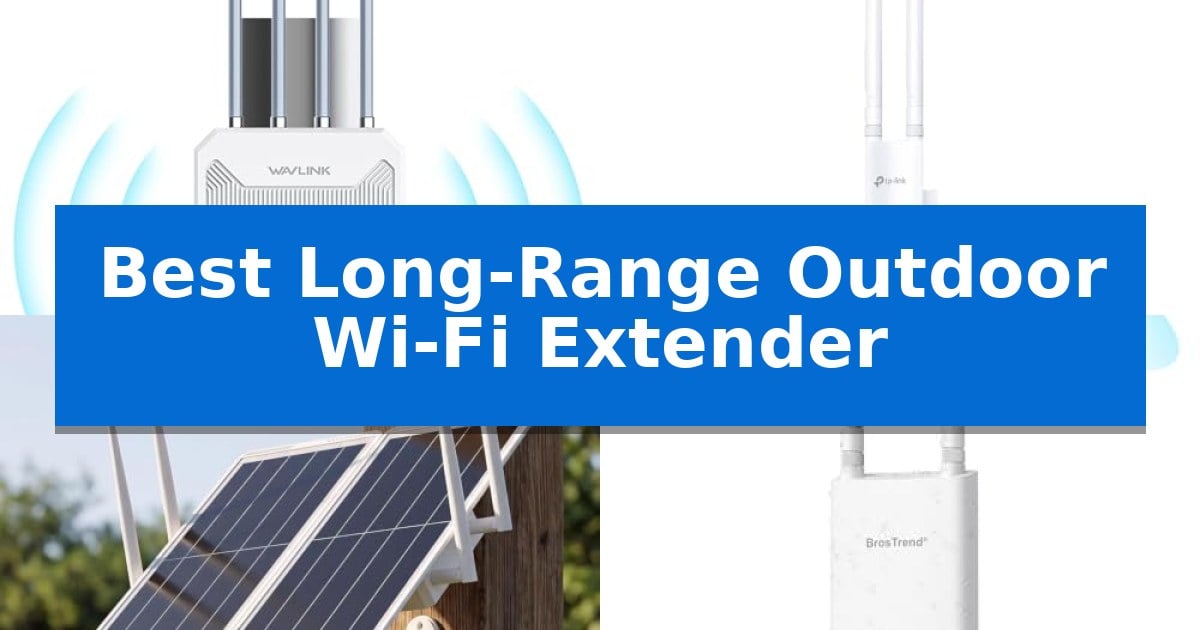
Expanding your network beyond the interior walls of your home or office often requires specialized hardware designed to withstand environmental elements. Finding the Best Long-Range Outdoor Wi-Fi Extender is essential for maintaining a stable connection in large yards, barns, or detached garages where standard indoor routers fail to reach.
These devices are engineered to bridge the gap between your primary internet source and your outdoor devices, such as security cameras or mobile equipment. By selecting the right hardware, you can ensure consistent signal strength across vast open spaces without compromising on speed or reliability.
You may also want to compare Best Long-Range Outdoor Wi-Fi Access Points, Best Long-Range Outdoor Security Cameras, and Best Long-Range Outdoor Bluetooth Speakers.
Best Long-Range Outdoor Wi-Fi Extender
Quick Comparison
| Product | Best For | Key Strength | Score |
|---|---|---|---|
| WAVLINK AX1800 Outdoor WiFi 6 Extender | Best Overall | IP67 weatherproof rating for reliable outdoor operation. | 4.9 |
| TP-Link Omada AC1200 Outdoor Access Point | Best for Centralized Network Management | IP65-rated weatherproof construction for reliable outdoor operation. | 4.5 |
| Tigerpai Solar WiFi Extender | Best for Off-Grid Remote Locations | Integrated 30W solar panel and 30,000mAh battery for 24/7 off-grid operation. | 4.3 |
| BrosTrend AC1200 Outdoor WiFi Extender | Reliable Weatherproof Signal Booster | IP65-rated weatherproof housing with lightning and ESD protection. | 4.9 |
| WAVLINK AX3000 Outdoor WiFi 6 Extender | Fastest Speeds for Outdoor Devices | IP67-rated waterproof enclosure for reliable outdoor durability. | 4.9 |
How We Chose
- Weatherproof Rating: We prioritized devices with IP65 or IP67 certifications to ensure resistance against rain, dust, and temperature fluctuations.
- Coverage Range: We assessed the antenna configurations and signal amplification technology to determine the effective radius for outdoor environments.
- Power Delivery: We examined support for Power over Ethernet (PoE) to allow for installation in locations lacking nearby electrical outlets.
- Network Standards: We verified the support for modern Wi-Fi standards, such as Wi-Fi 6, to ensure compatibility with high-bandwidth devices.
- Installation Versatility: We reviewed the available mounting options and operational modes to ensure the hardware fits diverse property layouts.
1 WAVLINK AX1800 Outdoor WiFi 6 Extender — Best for Large Outdoor Coverage
Outdoor connectivity often suffers from signal attenuation caused by exterior walls, but the WAVLINK AX1800 Outdoor WiFi 6 Extender addresses this by utilizing four high-gain 8dBi omni-directional detachable fiberglass antennas. This hardware configuration is designed to provide a stable wireless signal across open environments, reaching a radius of 200-300 meters in line-of-sight conditions.
Engineered for durability, the device features a fully sealed IP67 weatherproof casing that protects internal components from moisture, dust, and static shock. It is rated to operate within a temperature range of -20°C to 50°C, making it suitable for deployment in farms, garages, or RV parking areas where environmental exposure is a primary concern.
The unit supports WiFi 6 AX1800 speeds, delivering up to 1201 Mbps on the 5GHz band and 574 Mbps on the 2.4GHz band. It is compatible with Starlink Gen 2 and Gen 3 systems via an Ethernet adapter, providing a practical solution for extending internet access to remote or off-grid properties.
Installation is simplified through flexible PoE (Power over Ethernet) support, which allows the device to be powered via an 802.3 AF/AT active PoE switch or the included passive PoE adapter. This design enables placement in locations without nearby power outlets, provided the Ethernet cable run is under 100 meters.
Best for: Users needing to extend a high-speed wireless network across large, open outdoor spaces like farms or estates.
Skip if: Users who require a simple plug-and-play indoor extender or those who lack the ability to run Ethernet cabling for PoE installation.
PROS
- IP67 weatherproof rating for reliable outdoor operation.
- High-gain 8dBi antennas for extended signal range.
- Flexible PoE power options for installation in remote areas.
- WiFi 6 AX1800 performance for high-bandwidth tasks.
CONS
- Requires Ethernet cabling for power and data connectivity.
- PoE adapter is not waterproof and must be installed indoors.
2 TP-Link Omada AC1200 Outdoor Access Point — Best for Centralized Network Management
Expanding network coverage into outdoor environments requires hardware built for environmental resilience and consistent signal distribution. The TP-Link Omada AC1200 Outdoor Access Point addresses this with an IP65-rated weatherproof enclosure, designed to withstand rain, dust, and extreme temperature fluctuations ranging from -30 to 70 degrees Celsius.
Performance is driven by 802.11ac Wave 2 MU-MIMO technology, which facilitates simultaneous data streams to multiple devices, achieving speeds up to 1200 Mbps across dual bands. To maintain signal integrity over distance, the unit utilizes beamforming technology and supports Mesh WiFi for flexible, scalable deployments without the need for extensive cabling.
Integration into the Omada Software Defined Networking (SDN) platform allows for centralized management via hardware, software, or cloud-based controllers. This ecosystem enables administrators to oversee multiple sites from a single interface, utilizing features like seamless roaming, band steering, and airtime fairness to optimize traffic across the network.
Installation is simplified through support for 802.3af/at PoE and Passive PoE, providing power and data through a single cable. The device offers versatile configuration, including standalone mode for smaller setups or full SDN integration for enterprise-grade control, including support for up to 16 SSIDs.
Best for: Network administrators and property owners requiring centralized, scalable Wi-Fi management across large outdoor areas.
Skip if: Users who do not have an existing PoE-capable network infrastructure or those who prefer a simple plug-and-play consumer router without management software.
PROS
- IP65-rated weatherproof construction for reliable outdoor operation.
- Centralized management via the Omada SDN platform.
- Flexible power options including 802.3af/at and Passive PoE.
- MU-MIMO technology for efficient multi-device connectivity.
CONS
- Requires PoE infrastructure for power and data delivery.
- SDN features necessitate compatible Omada-managed hardware.
3 Tigerpai Solar WiFi Extender — Best for Off-Grid Remote Locations
Maintaining a reliable network in remote areas often requires equipment that operates independently of traditional power infrastructure. The Tigerpai Solar WiFi Extender addresses this by integrating a 30W high-efficiency solar panel and a 30,000mAh battery, allowing for continuous, off-grid operation in locations like farms, ranches, and gardens where standard power outlets are unavailable.
This device provides dual-band 1200Mbps performance across 2.4GHz and 5.8GHz frequencies, ensuring stable connectivity for streaming, security cameras, or remote work. It utilizes 4 high-gain antennas to broadcast a signal up to 984ft, with optimal performance typically found within a 530–550ft range. The system is designed to support up to 50 concurrent device connections without network congestion.
Engineered for durability, the unit features an IP65 waterproof and UV-resistant enclosure. This construction protects the internal components from rain, intense sunlight, and dust, making it suitable for deployment in harsh outdoor environments. Installation is flexible, supporting various mounting configurations and offering a Type-C charging port as a backup power option.
The Tigerpai Solar WiFi Extender serves as a robust solution for extending network coverage to hard-to-reach outdoor spaces. By combining solar energy harvesting with a large-capacity battery, it provides a self-sustaining networking solution that eliminates the need for complex wiring or proximity to indoor power sources.
Best for: The Tigerpai Solar WiFi Extender is best for users needing reliable, off-grid Wi-Fi coverage in remote outdoor locations like farms, barns, or large properties.
Skip if: Skip this product if you require high-speed gigabit wired backhaul or if your installation site lacks sufficient direct sunlight to maintain the solar battery charge.
PROS
- Integrated 30W solar panel and 30,000mAh battery for 24/7 off-grid operation.
- IP65 waterproof and UV-resistant housing for harsh weather durability.
- Dual-band 1200Mbps connectivity supporting up to 50 devices.
- 4 high-gain antennas providing up to 984ft of extended range.
CONS
- Performance relies on solar charging efficiency, which may vary based on local weather and sunlight availability.
- Maximum range of 984ft is subject to environmental interference and physical obstacles.
4 BrosTrend AC1200 Outdoor WiFi Extender — Reliable Weatherproof Signal Booster
Maintaining a reliable network connection across expansive outdoor spaces requires hardware capable of withstanding the elements while delivering consistent signal strength. The BrosTrend AC1200 Outdoor WiFi Extender addresses this with an IP65-rated waterproof and dustproof housing, ensuring it remains operational through rain and harsh weather. Its inclusion of 6kV lightning protection and 8kV ESD protection provides the necessary durability for permanent outdoor installation in gardens, farms, or near barns.
Engineered for range, this device transmits a signal up to 656 feet, making it a practical solution for extending home networks to detached structures or large yards. It utilizes AC1200 dual-band Wi-Fi, offering speeds of up to 867 Mbps on the 5 GHz band and 300 Mbps on the 2.4 GHz band. To further optimize performance, the unit features two adjustable 5dBi omni-directional antennas paired with Beamforming technology, which focuses the wireless signal directly toward connected devices for improved reliability.
Installation flexibility is a key design choice, as the extender is PoE-powered. By utilizing a single Ethernet cable for both power and data, users can mount the unit in locations without immediate access to a power outlet. The package includes a passive PoE injector for indoor use, supporting cable runs up to 164 feet. For the best results, the manufacturer specifies the use of shielded, UV-resistant, outdoor-rated Cat5e or higher Ethernet cables to ensure the system handles temperature fluctuations effectively.
This extender serves as a robust bridge for outdoor connectivity, particularly for users managing smart devices or requiring stable internet access in remote areas of their property. By focusing on weather-resistant construction and flexible power delivery, it provides a straightforward method to eliminate dead zones in outdoor environments.
Best for: Homeowners or property managers needing to extend reliable Wi-Fi coverage to large outdoor areas like yards, barns, or RV pads using a single cable installation.
Skip if: Users who require a simple plug-and-play indoor solution or those who lack the ability to run outdoor-rated Ethernet cabling for the required PoE setup.
PROS
- IP65-rated weatherproof housing with lightning and ESD protection.
- PoE-powered design allows for flexible placement without needing an outdoor power outlet.
- Beamforming technology and dual 5dBi antennas improve signal focus and reliability.
- Gigabit Ethernet port supports high-speed data transmission.
CONS
- Requires installation of shielded, outdoor-rated Ethernet cabling for optimal performance.
- PoE injector is for indoor use only, limiting placement options for the power source.
5 WAVLINK AX3000 Outdoor WiFi 6 Extender — Fastest Speeds for Outdoor Devices
Expanding your network coverage into challenging outdoor environments requires hardware built to withstand the elements while maintaining high data throughput. The WAVLINK AX3000 Outdoor WiFi 6 Extender addresses this with an IP67-rated waterproof enclosure, ensuring reliable operation through rain, snow, and wind. Its design focuses on durability and installation flexibility, making it a practical solution for extending connectivity to yards, farms, or remote structures.
Performance is driven by dual-band AX3000 WiFi 6 technology, which supports speeds up to 2402Mbps on the 5GHz band and 573Mbps on the 2.4GHz band. To maximize reach, the unit features four 8dBi omni-directional detachable fiberglass antennas paired with two built-in amplifiers, providing coverage in a 200-300m radius. This setup is engineered to support up to 256 simultaneous device connections, utilizing MU-MIMO and Beamforming to manage traffic efficiently.
Installation is simplified by the inclusion of 802.3AF/AT active PoE support, allowing both power and data to be delivered through a single Ethernet cable. This is particularly useful for outdoor mounting locations where electrical outlets are unavailable. The device offers versatile operational modes, including Mesh, AP, Router, and Repeater, allowing it to integrate into various network architectures. For security, it supports WPA2/WPA3-MIX encryption standards.
While the device offers robust outdoor performance, users should note that the PoE converter is not waterproof and must be housed in a protected area. Additionally, the Mesh mode is exclusive to other WAVLINK series products, which may limit seamless integration for those using routers from different manufacturers. The unit remains a highly capable choice for users needing a rugged, high-capacity outdoor wireless solution.
Best for: Users needing a rugged, weather-resistant WiFi 6 solution to extend high-speed network coverage across large outdoor areas.
Skip if: Users who require a seamless Mesh network integration with non-WAVLINK routers or those unable to manage a wired PoE installation.
PROS
- IP67-rated waterproof enclosure for reliable outdoor durability.
- AX3000 WiFi 6 speeds to reduce congestion and improve throughput.
- Active PoE support for flexible installation without local power outlets.
- High-capacity support for up to 256 connected devices.
CONS
- Non-waterproof PoE converter requires protected placement.
- Mesh mode compatibility is limited to WAVLINK series products.
Best Long-Range Outdoor Wi-Fi Extender Buying Guide
Understanding Weatherproofing Ratings
When selecting an outdoor networking device, the IP (Ingress Protection) rating is a critical specification. An IP65 rating indicates the device is protected against water jets, making it suitable for general outdoor exposure. An IP67 rating offers a higher level of protection, allowing the device to withstand temporary immersion in water.
Choosing the correct rating depends on your local climate. If you live in an area with heavy rainfall, snow, or extreme humidity, prioritizing an IP67-rated enclosure will provide better long-term protection for the internal electronics.
The Role of Power over Ethernet (PoE)
Installing networking equipment in remote areas like barns or garden sheds often presents a challenge regarding power access. PoE technology solves this by transmitting both data and electrical power through a single Ethernet cable.
This feature simplifies installation significantly, as you only need to run one cable to the device. Ensure that your chosen extender supports the specific PoE standard (such as 802.3af/at) required by your network switch or the included injector.
Antenna Design and Signal Range
The physical design of the antennas directly impacts how far your signal travels. Omni-directional antennas are designed to broadcast signal in a 360-degree pattern, which is ideal for covering a wide area like a yard or patio.
High-gain antennas, often measured in dBi, provide a stronger, more focused signal. When comparing models, look for detachable antennas, as these allow for future upgrades if you need to adjust your coverage pattern.
Wi-Fi Standards and Throughput
The transition to Wi-Fi 6 (802.11ax) offers significant improvements in handling multiple connected devices simultaneously compared to older Wi-Fi 5 (802.11ac) hardware. If you are connecting security cameras, smart home devices, and mobile phones, a Wi-Fi 6 extender will manage the traffic more efficiently.
Always consider the dual-band capabilities of the device. The 5GHz band provides faster speeds for streaming, while the 2.4GHz band offers better range and penetration through obstacles like trees or wooden structures.
Operational Modes for Flexibility
Most outdoor extenders offer multiple modes, including Access Point (AP), Repeater, and Mesh modes. An AP mode is typically best if you can run a wired Ethernet connection from your router to the outdoor location, as it provides the highest performance.
If running a cable is not possible, Repeater or Mesh modes allow the device to wirelessly extend your existing network. Note that Mesh mode often requires all devices to be from the same manufacturer for seamless roaming.
Frequently Asked Questions
Can I install these extenders without a wired Ethernet connection?
Yes, many models support Repeater or Mesh modes, which allow them to connect to your existing Wi-Fi signal wirelessly. However, for the best performance and stability, a wired connection via Ethernet is recommended.
Are the PoE injectors waterproof?
Generally, no. Most PoE injectors are designed for indoor use only. You should install the injector inside your home or a protected junction box and run the Ethernet cable to the outdoor unit.
How far can these extenders realistically reach?
Range depends heavily on line-of-sight and physical obstacles. While manufacturers may list theoretical maximums, real-world performance is typically best within a 200 to 300-meter radius in open environments.
Do these devices work with Starlink?
Yes, most outdoor extenders are compatible with Starlink systems. You will typically need the Starlink Ethernet Adapter to connect the extender to your Starlink router via a cable.
What is the difference between IP65 and IP67?
IP65 protects against water jets from any angle, while IP67 provides protection against the effects of temporary immersion in water. Both are suitable for outdoor use, but IP67 is more robust for harsh weather.
Conclusion: Our Top Pick
Selecting the right hardware for your outdoor space depends on your specific layout and power availability. For most users, balancing range and durability is the primary goal to ensure a reliable connection for all outdoor devices.
The WAVLINK AX1800 Outdoor WiFi 6 Extender stands out as our top recommendation due to its robust IP67-rated enclosure and support for Wi-Fi 6, which provides the necessary bandwidth for modern smart devices. Its flexible PoE power options and multiple operational modes make it a versatile choice for various outdoor environments, from large residential yards to remote farm setups.