
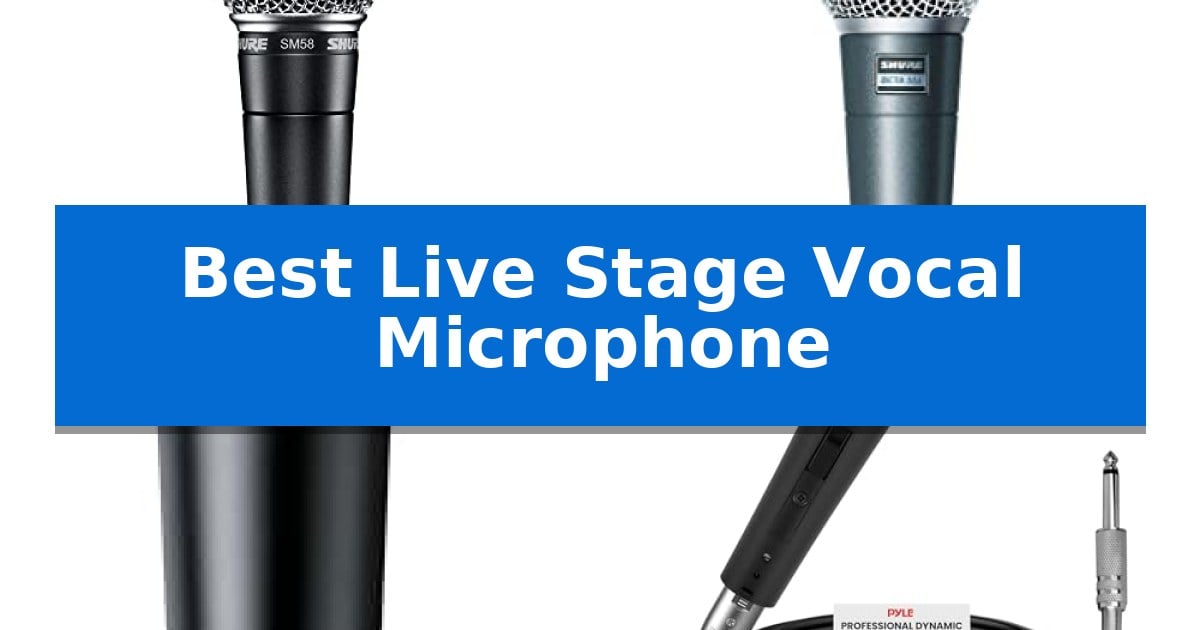
Finding the right microphone for live performance is about balancing vocal clarity with the harsh realities of a loud stage environment. Whether you are performing in a small club or a larger venue, your microphone needs to isolate your voice while resisting the feedback that can ruin a set.
Selecting the Best Live Stage Vocal Microphone requires understanding how different polar patterns and transducer designs interact with your specific voice and sound system. We have evaluated five distinct models to help you identify which tool best suits your performance needs and technical requirements.
You may also want to compare Best Live Stage Microphone, Best Live Speakers Under $100, and Best Live Speakers.
Best Live Stage Vocal Microphone
Quick Comparison
| Product | Best For | Key Strength | Score |
|---|---|---|---|
| Shure SM58 Dynamic Vocal Microphone | Best Overall | Rugged metal construction ensures long-term durability for touring. | 4.9 |
| Shure Beta 58A Dynamic Vocal Microphone | Superior Gain Before Feedback | Supercardioid polar pattern effectively minimizes feedback in high-volume settings. | 4.9 |
| Shure Nexadyne 8/S Dynamic Vocal Microphone | Advanced Dual-Engine Clarity | Revonic Dual-Engine Technology for natural vocal reproduction. | 4.8 |
| Pyle PDMIC59 Dynamic Vocal Microphone | Budget-Friendly Stage Essential | Rugged all-metal construction ensures long-term reliability. | 4.5 |
| FIFINE K6 Dynamic Vocal Microphone | Reliable Choice for Karaoke | Cardioid pickup pattern for effective noise cancellation and feedback reduction. | 4.6 |
How We Chose
- Polar pattern precision for feedback rejection and background noise isolation.
- Frequency response characteristics and their impact on vocal presence in a mix.
- Build quality and physical durability for consistent touring and stage use.
- Integrated handling of plosives and breath noise without external accessories.
- Compatibility with standard sound reinforcement equipment and connection interfaces.
1 Shure SM58 Dynamic Vocal Microphone — Industry Standard for Live Vocals
The Shure SM58 Pro XLR Dynamic Vocal Microphone is engineered with a finely tuned frequency response and a subtle midrange lift, providing the warm, articulate vocal reproduction that has become a staple for professional stages and studios. Its design prioritizes consistency, making it a reliable choice for performers who require a dependable audio signal across diverse live environments.
Built for demanding professional use, the microphone features rugged metal construction and a reinforced stand adapter to withstand the rigors of touring. The precision cardioid pickup pattern is specifically designed to focus on the sound source while effectively minimizing background noise and feedback, which is essential for maintaining clarity in high-volume settings.
Integrated design elements further enhance its utility, such as the refined spherical grille and built-in filter. These components work together to reduce plosives, breath, and wind noise without the need for external accessories, ensuring a balanced output. This focus on integrated protection helps maintain vocal integrity during live performances and recording sessions.
With its XLR connectivity and industry-standard build, this microphone provides a versatile solution for vocalists, podcasters, and broadcasters. It is backed by a 2-year warranty, reflecting its design for longevity and consistent performance in professional applications.
Best for: Professional vocalists and performers who require a durable, feedback-resistant microphone for consistent live stage and studio use.
Skip if: Users who require a condenser microphone for high-frequency detail or those needing built-in USB connectivity for direct-to-computer recording without an audio interface.
PROS
- Rugged metal construction ensures long-term durability for touring.
- Integrated pop filter effectively reduces plosives and wind noise.
- Precision cardioid pattern minimizes feedback in live environments.
- Finely tuned frequency response provides warm, articulate vocal clarity.
CONS
- XLR-only connectivity requires an external audio interface or mixer.
- Dynamic design may lack the extreme high-frequency sensitivity found in some condenser microphones.
2 Shure Beta 58A Dynamic Vocal Microphone — Superior Gain Before Feedback
Achieving a clean, professional sound on a busy stage requires a microphone that can isolate the performer's voice while resisting the chaos of surrounding instruments. The Shure Beta 58A Supercardioid Dynamic Vocal Microphone is engineered specifically for this challenge, utilizing a supercardioid polar pattern to maximize gain before feedback and ensure the vocalist remains the primary focus in any mix.
At the heart of this microphone is a neodymium magnet, which provides a high signal-to-noise ratio for clear, professional-quality output. The device features a tailored frequency response that delivers natural vocal reproduction, while a controlled bass rolloff effectively manages the proximity effect, preventing the low-end muddiness often encountered when a singer is close to the mic.
Durability is a core design priority for life on the road. The Shure Beta 58A is constructed with a hardened steel mesh grille and a rugged exterior to withstand the rigors of frequent transport and stage use. Internally, a pneumatic shock mount system is integrated to absorb vibrations and handling noise, ensuring that physical bumps do not translate into unwanted audio artifacts.
This microphone comes as a complete package for immediate deployment, including an A25D adjustable stand adapter, a 5/8" to 3/8" Euro thread adapter, and a zippered storage bag. With its consistent performance across varying load impedances, it offers reliable, predictable results from soundcheck to the final set.
Best for: Professional vocalists and working musicians who require high gain before feedback and rugged reliability in loud stage environments.
Skip if: Users who prefer a microphone with a wider cardioid pickup pattern for more room sound or those who do not require the proximity effect control provided by this specific supercardioid design.
PROS
- Supercardioid polar pattern effectively minimizes feedback in high-volume settings.
- Neodymium magnet ensures a strong, clear signal output.
- Pneumatic shock mount system reduces handling noise and vibrations.
- Hardened steel mesh grille provides long-term durability for touring.
CONS
- Supercardioid pattern requires more precise mic positioning compared to standard cardioid microphones.
3 Shure Nexadyne 8/S Dynamic Vocal Microphone — Advanced Dual-Engine Clarity
Achieving consistent vocal presence in a crowded live mix often requires hardware that can isolate the source while maintaining natural reproduction. The Shure Nexadyne 8/S Supercardioid Dynamic Vocal Microphone addresses this challenge through its proprietary Revonic Dual-Engine Technology, which utilizes two transducers to deliver a strong, clear output across a wide range of frequencies.
Designed specifically for the demands of stage performance, this microphone features a supercardioid polar pattern. This design choice is critical for performers who need to reduce background noise and stage bleed, ensuring that the vocal remains the primary focus even in dense acoustic environments. By providing this level of isolation, the microphone helps reduce the need for aggressive corrective equalization during sound checks.
The build quality reflects its intended use in professional touring and live settings. It features a rugged all-metal construction and a dent-resistant hardened grille, providing the durability necessary for frequent transport and stage use. Furthermore, the unit is compatible with interchangeable wireless microphone capsules, offering flexibility for performers who may transition between wired and wireless setups.
Weighing approximately one pound, the Shure Nexadyne 8/S is balanced for handheld use. Its technical design prioritizes consistent sound performance, making it a reliable tool for vocalists who require a microphone that can cut through a mix without sacrificing the natural character of their voice.
Best for: Professional vocalists and touring performers who need a durable, high-clarity microphone that isolates vocals in dense, loud live mixes.
Skip if: Users who require a standard cardioid polar pattern for wider stage coverage or those who do not need the specific dual-engine transducer design for their vocal style.
PROS
- Revonic Dual-Engine Technology for natural vocal reproduction.
- Supercardioid polar pattern effectively reduces stage bleed.
- Rugged all-metal construction ensures long-term durability.
- Interchangeable capsule compatibility for wireless system integration.
CONS
- Supercardioid design requires more precise mic technique compared to standard cardioid models.
4 Pyle PDMIC59 Dynamic Vocal Microphone — Budget-Friendly Stage Essential
Reliability on stage often comes down to the durability of your gear, and the Pyle PDMIC59 is built with a rugged, all-metal construction featuring a zinc die-cast case and a steel mesh windscreen. This design choice provides the necessary structural integrity to withstand the rigors of frequent transport and live performance environments.
Engineered as a dynamic, unidirectional microphone, this unit utilizes a cardioid pickup pattern to focus on the intended sound source while effectively shunning off-axis noise. This capability is essential for live vocal applications, as it helps minimize feedback and interference from nearby instruments or stage monitors, ensuring the primary signal remains clear.
The microphone offers an ultra-wide frequency response designed for transparent sound reproduction, complemented by an integrated pop filter and windscreen to mitigate breath and plosive noises. These features combine to provide a consistent audio profile suitable for both professional studio recording and live stage performances.
For immediate setup, the package includes a professional-grade 15-foot XLR-to-1/4-inch audio cable, allowing for direct connection to various sound systems. The inclusion of an on/off switch adds a layer of convenience for performers who need quick control over their audio signal during a set.
Best for: Performers and presenters seeking a durable, all-in-one dynamic microphone solution for live stage and studio use.
Skip if: Users requiring a condenser microphone for high-sensitivity studio recording or those who need a wireless connection.
PROS
- Rugged all-metal construction ensures long-term reliability.
- Cardioid pickup pattern effectively minimizes feedback and background noise.
- Included 15ft XLR cable provides immediate out-of-the-box compatibility.
- Integrated pop filter reduces unwanted breath and plosive sounds.
CONS
- Wired-only connection limits movement compared to wireless alternatives.
- Fixed cable interface may require adapters for specific professional audio equipment.
5 FIFINE K6 Dynamic Vocal Microphone — Reliable Choice for Karaoke
Achieving clear, reliable audio during a live performance requires equipment that can handle high sound pressure levels without sacrificing clarity. The FIFINE K6 Dynamic Vocal Microphone is engineered for these demanding environments, utilizing a cardioid pickup pattern that effectively isolates the performer's voice while minimizing background noise and feedback.
This dynamic microphone is built with a rugged metal construction, ensuring it can withstand the rigors of frequent use on stage or during events. It features a built-in pop filter to manage plosives, helping to maintain professional speech intelligibility. With an external on/off switch integrated directly into the handle, performers have immediate control over their audio output without needing to rely on a sound engineer.
Designed for simplicity and direct connectivity, the FIFINE K6 Dynamic Vocal Microphone includes a 14.8ft detachable cable with a 1/4-inch (6.35mm) plug. This makes it a straightforward solution for connecting directly to amplifiers, audio mixers, or karaoke machines. Because it is a dynamic design, it requires no external power, making it a versatile tool for various live applications, from solo performances to public speaking.
It is important to note that this microphone is specifically designed for 1/4-inch input jacks and is not compatible with 3.5mm connections, even when using an adapter. This focus on a dedicated professional-style interface ensures a stable, low-distortion signal path for those using compatible audio equipment.
Best for: Performers and speakers who need a reliable, plug-and-play dynamic microphone for use with 1/4-inch audio mixers, amplifiers, or karaoke systems.
Skip if: Users who require a 3.5mm connection for computers or standard consumer audio devices, as this microphone is not compatible with those ports.
PROS
- Cardioid pickup pattern for effective noise cancellation and feedback reduction.
- Rugged metal construction suitable for demanding live environments.
- No power requirement due to the dynamic design.
- 14.8ft detachable cable included for flexible movement on stage.
CONS
- Not compatible with 3.5mm ports, even with adapters.
- Limited to 1/4-inch connectivity only.
Best Live Stage Vocal Microphone Buying Guide
Understanding Polar Patterns
The polar pattern determines how a microphone captures sound from different directions. For live stages, cardioid and supercardioid patterns are the industry standards because they focus on the source directly in front of the capsule while rejecting sound from the sides and rear.
A supercardioid pattern offers a tighter pickup area, which is highly effective for isolating vocals in loud environments, though it requires the performer to stay more consistently on-axis to maintain a balanced sound.
Frequency Response and Vocal Presence
A microphone's frequency response dictates how it colors the sound. Many stage microphones feature a midrange lift or a presence peak, which helps vocals cut through dense mixes of instruments without needing heavy equalization.
Some models also include a bass rolloff to mitigate the proximity effect, which is the unnatural boost in low frequencies that occurs when a singer gets very close to the microphone grille.
Durability and Build Quality
Live microphones face constant handling, accidental drops, and exposure to moisture. A rugged metal construction and a hardened steel mesh grille are essential for protecting the internal transducer from the rigors of frequent transport and stage use.
Advanced models often incorporate pneumatic shock mount systems to reduce handling noise, ensuring that vibrations from the microphone stand or the performer's grip do not translate into audible thumps.
Connectivity and Signal Integrity
Most professional stage microphones utilize an XLR connection, which provides a balanced signal that is resistant to interference over long cable runs. This is the standard for connecting to mixing consoles and stage boxes.
Some entry-level or karaoke-focused models may use a 1/4-inch (6.35mm) plug, which is convenient for direct connection to powered speakers or amplifiers but lacks the noise-rejection benefits of a balanced XLR cable.
Pop Protection and Plosives
Plosives—the harsh 'p' and 'b' sounds—can cause unwanted distortion. High-quality stage microphones feature integrated pop filters or refined grille designs that diffuse these air blasts before they hit the diaphragm.
Choosing a microphone with built-in protection allows performers to move freely without needing to carry bulky external foam windscreens, keeping the setup clean and professional.
Frequently Asked Questions
What is the difference between a cardioid and supercardioid microphone?
A cardioid pattern captures sound in a heart-shaped area, providing wide coverage in front. A supercardioid pattern is narrower, offering better rejection of stage noise from the sides, which helps prevent feedback in loud settings.
Can I use a 1/4-inch microphone with an XLR mixer input?
While adapters exist, they do not convert an unbalanced signal to a balanced one. For the best sound quality and noise rejection, it is recommended to use a microphone with a native XLR connection for professional mixers.
Why do some microphones have a bass rolloff?
Bass rolloff helps counteract the proximity effect, where low frequencies become exaggerated when a singer is very close to the mic. This keeps the vocal sound natural and prevents it from becoming muddy.
Are dynamic microphones better than condenser microphones for live stages?
Dynamic microphones are generally preferred for live stages because they are more rugged and less sensitive to high-frequency feedback compared to condenser microphones, making them more reliable in loud, uncontrolled environments.
What does 'gain before feedback' mean?
Gain before feedback refers to how much you can amplify the microphone signal through the speakers before the system begins to howl or screech. Microphones with excellent off-axis rejection allow for higher gain before this occurs.
Conclusion: Our Top Pick
Selecting the right microphone depends heavily on your specific stage environment and vocal style. For most performers, a reliable, durable, and well-tuned dynamic microphone is the foundation of a great live sound.
The Shure SM58 Dynamic Vocal Microphone remains a top recommendation due to its proven frequency response and legendary durability in professional settings. Its ability to provide consistent vocal clarity while minimizing background noise makes it a versatile choice for a wide range of live applications.