
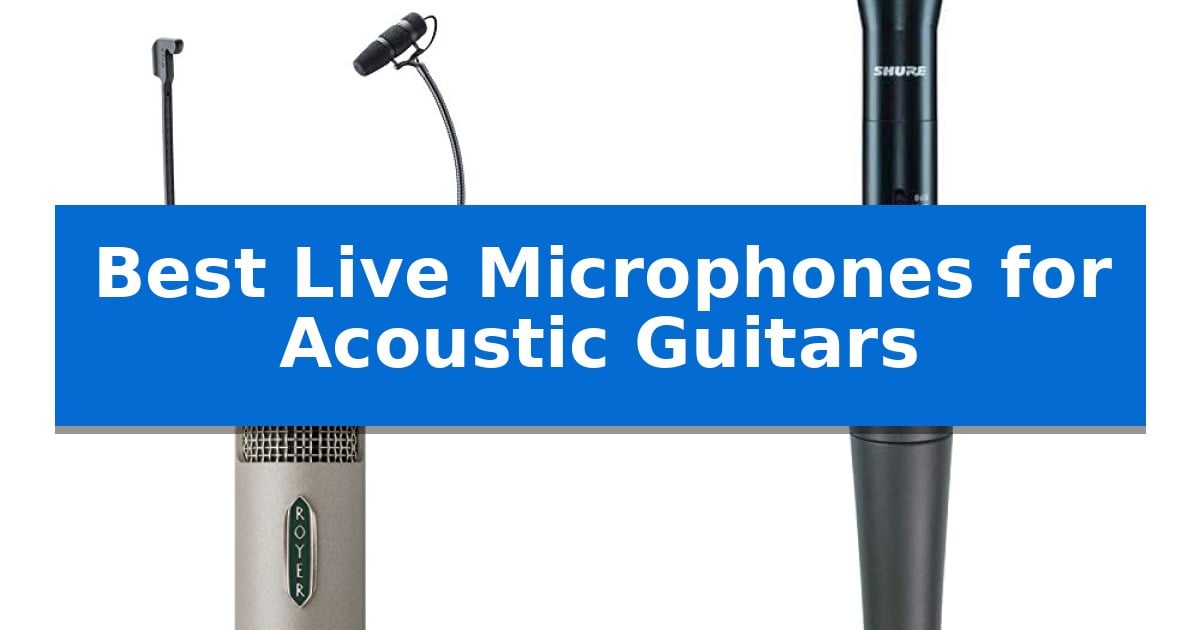
Capturing the authentic resonance of an acoustic guitar in a live setting requires more than just a standard pickup. Finding the Best Live Microphones for Acoustic Guitars involves balancing natural tonal reproduction with the practical realities of stage volume and feedback rejection.
Whether you are performing in an intimate coffee shop or a larger venue, the right microphone choice can transform your sound. We have analyzed current market offerings to help you identify which microphone best suits your specific performance environment and instrument setup.
You may also want to compare Best Live Microphone Under $200, Best Live Microphone Under $100, and Best Live Microphone for Vocals.
Best Live Microphones for Acoustic Guitars
Quick Comparison
| Product | Best For | Key Strength | Score |
|---|---|---|---|
| DPA D:Vote CORE 4099 Instrument Microphone | Best Overall | Supercardioid polar pattern effectively isolates the guitar from stage noise. | 4.9 |
| Shure SM137 Condenser Microphone | Flat Response for Accurate Capture | Ultra-thin diaphragm for precise high-frequency detail. | 4.3 |
| Royer Labs R10 Ribbon Microphone | Warmth for Acoustic Performances | Patented offset ribbon design allows for two distinct tonal responses based on orientation. | 4.9 |
| Shure SM57 Dynamic Instrument Microphone | Reliable Stage Standard | Contoured frequency response enhances instrument clarity and attack. | 4.9 |
| Behringer CB100 Condenser Gooseneck Microphone | Direct Mounting for Live Ease | Direct mounting system ensures consistent microphone placement. | 4.7 |
How We Chose
- Polar pattern effectiveness in isolating the guitar from stage noise.
- Mounting systems that ensure consistent capsule placement without damaging the instrument.
- Frequency response characteristics tailored to acoustic guitar harmonics.
- Durability and build quality for frequent transport and stage use.
- Compatibility with standard phantom power and mixing console interfaces.
1 DPA D:Vote CORE 4099 Instrument Microphone — Superior Natural Acoustic Detail
Capturing the nuanced resonance of an acoustic guitar requires a precise balance of sensitivity and isolation. The DPA D:Vote CORE 4099 Instrument Microphone addresses this through its specialized small-diaphragm supercardioid condenser design, which is engineered to focus strictly on the instrument while rejecting unwanted stage noise.
The system is built around a dedicated guitar mounting clip, allowing for stable, non-invasive placement directly on the instrument. This design ensures the microphone remains in a consistent position relative to the soundboard, providing a reliable signal path during live performances. The inclusion of a clip cable simplifies the connection process, maintaining a clean setup on stage.
Engineered for durability and consistent audio capture, this microphone utilizes CORE by DPA technology to deliver clear, natural sound reproduction. Its supercardioid polar pattern is a critical feature for live environments, as it helps minimize feedback and bleed from other instruments or stage monitors, ensuring the guitar remains prominent in the mix.
With a 2-year warranty included, the unit is designed for professional reliability. While it is a compact solution, users should note that the mounting system is specifically tailored for acoustic guitars, making it a dedicated tool rather than a general-purpose studio microphone.
Best for: Professional live performers who require high-fidelity, consistent acoustic guitar amplification with maximum feedback rejection.
Skip if: Users who prefer a permanent internal pickup system or those who require a multi-purpose microphone for vocal and instrument recording.
PROS
- Supercardioid polar pattern effectively isolates the guitar from stage noise.
- Dedicated guitar mounting clip ensures stable, consistent positioning.
- Compact small-diaphragm design minimizes visual impact on stage.
- CORE technology provides clear, natural sound reproduction.
CONS
- Specialized mounting system limits use to acoustic guitars.
- Requires phantom power to operate as a condenser microphone.
2 Shure SM137 Condenser Microphone — Flat Response for Accurate Capture
Achieving a natural, balanced capture of an acoustic guitar's resonance requires a microphone capable of handling both delicate fingerstyle nuances and high-volume performance. The Shure SM137 Cardioid Condenser Microphone addresses this through its ultra-thin diaphragm, which is specifically engineered to provide a smooth high-end response while maintaining a tight, controlled low end.
Designed as a versatile, flat-response probe microphone, the Shure SM137 utilizes transformerless preamplifier circuitry to ensure low self-noise. This technical foundation allows for clean, transparent signal capture, which is essential when working with the complex harmonic content of acoustic instruments. Its cardioid polar pattern further assists in isolating the guitar from ambient stage noise.
For scenarios where the instrument is amplified or played in high-SPL environments, the microphone includes a switchable 15dB pad. This feature provides performance consistency by preventing signal clipping, allowing the user to adapt the microphone to various volume levels without compromising the integrity of the source audio.
The package includes a swivel adapter and a zippered pouch, facilitating easier positioning and storage. With its XLR connectivity, the unit integrates directly into professional sound reinforcement setups, offering a reliable tool for those prioritizing accurate, uncolored sound reproduction in live settings.
Best for: Performers and sound engineers requiring a flat, transparent frequency response for accurate acoustic instrument capture in live environments.
Skip if: Users who prefer a microphone with a colored or vintage-style frequency boost, or those seeking a multi-pattern microphone for stereo recording techniques.
PROS
- Ultra-thin diaphragm for precise high-frequency detail.
- 15dB pad enables use with high-volume sound sources.
- Low self-noise circuitry ensures clean signal reproduction.
- Flat frequency response provides natural, uncolored sound.
CONS
- Fixed cardioid pattern limits versatility for complex stereo miking setups.
3 Royer Labs R10 Ribbon Microphone — Warmth for Acoustic Performances
Capturing the nuanced resonance of an acoustic guitar requires a transducer capable of handling delicate transients without introducing unwanted coloration. The Royer Labs R10 Ribbon Microphone addresses this through its patented offset ribbon design, which positions the ribbon element toward the front of the transducer. This specific configuration allows for high SPL handling on the front side, while providing the option of a brighter, more detailed response when recording lower SPL sound sources like acoustic guitars on the backside.
Engineered for versatility in both studio and live environments, the Royer Labs R10 Ribbon Microphone features an open grill design that minimizes standing waves and comb-filtering effects. This construction promotes phase linearity and a smooth frequency response, ensuring that the natural character of your instrument remains intact. The microphone is further protected by a David Royer custom-designed transformer, which provides a high overload threshold to minimize saturation even when exposed to high sound pressure levels.
Practicality for live performance is enhanced by the microphone's humbucking ribbon transducer, which is specifically wired to reduce noise interference. Its compact dimensions of 1.37 x 5.87 inches make it easy to position in tight stage setups. By utilizing a figure-8 polar pattern, the microphone allows performers to effectively isolate the acoustic guitar while rejecting sound from the sides, providing a focused capture of the instrument's output.
Choosing the right microphone for acoustic guitar involves balancing sensitivity with durability. The Royer Labs R10 Ribbon Microphone offers a robust solution that avoids the self-distortion often found in other formats. While its ribbon design provides a warm, natural sound profile, users should ensure their signal chain can accommodate the specific gain requirements typical of ribbon microphones to achieve the best results in a live mix.
Best for: The Royer Labs R10 Ribbon Microphone is best for acoustic guitarists and sound engineers seeking a warm, natural, and phase-accurate capture of acoustic instruments in live or studio settings.
Skip if: Skip this microphone if you require a high-output condenser or dynamic microphone that does not necessitate the specific gain staging or careful handling associated with ribbon transducer technology.
PROS
- Patented offset ribbon design allows for two distinct tonal responses based on orientation.
- Open grill design effectively minimizes standing waves and comb-filtering.
- Humbucking wiring significantly reduces noise for cleaner signal capture.
- High overload threshold prevents saturation during high-pressure acoustic performances.
CONS
- Ribbon transducer sensitivity requires careful handling compared to standard dynamic microphones.
- Figure-8 polar pattern necessitates precise placement to avoid unwanted stage bleed.
4 Shure SM57 Dynamic Instrument Microphone — Reliable Stage Standard
Capturing the nuance of an acoustic instrument in a live setting requires a microphone capable of isolating the sound source while maintaining tonal detail. The Shure SM57 Pro XLR Dynamic Instrument Microphone is engineered for this exact purpose, utilizing a contoured frequency response with a refined presence boost to ensure that acoustic instruments cut through a live mix with clarity and attack.
Designed as a true studio and stage staple, this microphone features a precise cardioid pickup pattern that excels at focused, low-bleed capture. By effectively rejecting off-axis background noise, it allows performers to isolate their acoustic guitar or other instruments even in complex, high-volume environments. This makes it a reliable choice for musicians who need consistent, professional-grade sound without the interference often associated with more sensitive equipment.
The Shure SM57 Pro XLR Dynamic Instrument Microphone is built to withstand the rigors of frequent transport and demanding performance schedules. Its legendary rugged construction ensures it can handle high sound pressure levels, providing dependable performance night after night. Whether used in a home studio or on a major stage, its versatile design makes it a practical, long-term solution for capturing the full character and energy of an acoustic performance.
While this microphone is highly effective for close-miking applications, users should note that as a dynamic microphone, it requires a stable XLR connection to an interface or mixer. Its design is optimized for proximity, meaning it performs best when positioned close to the sound source to take full advantage of its focused pickup pattern.
Best for: Musicians and sound engineers needing a durable, high-isolation microphone for close-miking acoustic instruments in live or studio environments.
Skip if: Users who require a high-sensitivity condenser microphone for capturing distant, ambient room sounds or extremely subtle acoustic nuances.
PROS
- Contoured frequency response enhances instrument clarity and attack.
- Precise cardioid pickup pattern minimizes background bleed.
- Legendary rugged construction ensures long-term durability.
- Versatile application across various instruments and amplifiers.
CONS
- Requires XLR connectivity and a compatible mixer or interface.
- Optimized for close-miking, which may limit use for ambient room recording.
5 Behringer CB100 Condenser Gooseneck Microphone — Direct Mounting for Live Ease
Achieving consistent audio capture during live performances requires a reliable mounting solution that maintains proximity to the instrument without hindering playability. The Behringer CB100 Condenser Gooseneck Microphone addresses this need by providing a dedicated Acoustic Guitar Mounting Kit, allowing for precise positioning directly on the instrument body.
This Gooseneck Condenser Instrument Microphone is engineered for versatility in live settings. It includes an XLR Phantom Power Adapter, which ensures compatibility with standard professional audio interfaces and mixing consoles. The flexible gooseneck design allows musicians to adjust the capsule angle to capture the specific tonal characteristics of their acoustic guitar.
Included with the microphone is a protective Case, which aids in transport and storage between venues. The unit is designed to be lightweight at 0.461 pounds, ensuring that the added hardware does not significantly alter the balance or feel of the instrument during use.
When integrating this microphone into a live setup, the primary trade-off involves the physical mounting process. Users should ensure their instrument finish is suitable for the mounting hardware provided. This system is best suited for performers who prioritize a consistent, fixed microphone position over the mobility of a traditional stand-mounted setup.
Best for: Performers seeking a consistent, fixed-position microphone setup that mounts directly to their acoustic guitar for live sound reinforcement.
Skip if: Musicians who prefer the flexibility of a traditional stand-mounted microphone or those concerned about attaching hardware directly to their instrument's finish.
PROS
- Direct mounting system ensures consistent microphone placement.
- Includes a protective case for secure transport.
- Features a flexible gooseneck for precise capsule positioning.
- Comes with an XLR phantom power adapter for broad compatibility.
CONS
- Requires physical attachment to the instrument body.
- Fixed mounting limits the ability to quickly switch between different instruments.
Best Live Microphones for Acoustic Guitars Buying Guide
Microphone Types for Live Acoustic
Condenser microphones are the standard for acoustic guitars because they capture high-frequency detail and transient response better than other types. They require phantom power and are highly sensitive, making them excellent for picking up the natural woodiness of the instrument.
Dynamic microphones offer a more rugged alternative, often used when stage volume is high and feedback is a major concern. While they may lack the extreme detail of a condenser, their cardioid patterns and robust construction make them reliable workhorses for loud environments.
Mounting and Placement
The placement of your microphone is as critical as the model you choose. Gooseneck mounting systems allow for precise positioning near the soundhole or bridge, ensuring a consistent sound throughout your performance without requiring a bulky external mic stand.
If you prefer a traditional setup, using a mic clip on a standard stand is effective but requires the performer to remain relatively stationary. This approach is often preferred when you want to capture the sound of the guitar body from a slightly greater distance.
Feedback Management
Feedback occurs when the microphone picks up its own amplified signal from the stage monitors. Using supercardioid or cardioid polar patterns helps isolate the guitar, as these patterns are designed to reject sound coming from the sides and rear.
Proper gain staging at your mixer is also essential. By keeping your gain levels optimized and using a 15dB pad if your microphone supports it, you can prevent signal clipping and maintain a cleaner, more controlled sound in high-SPL situations.
Frequency Response and Tone
A flat frequency response is ideal if you want to capture the true character of your guitar without added coloration. This allows you to use your mixing console's EQ to shape the sound specifically for the room you are playing in.
Some microphones, particularly ribbon models, offer a warmer, smoother high-end response that can tame overly bright-sounding guitars. Understanding your instrument's natural tone will help you decide if you need a neutral capture or a microphone that adds a touch of character.
Durability and Portability
Live performance gear is subjected to constant handling and transport. Look for microphones with rugged metal construction and secure connection points to ensure they survive the rigors of the road.
Consider the weight and size of the microphone and its accessories. A compact, lightweight design is easier to pack and less likely to interfere with your playing technique while mounted on the instrument.
Frequently Asked Questions
Do I need phantom power for all these microphones?
Most condenser microphones, like the DPA 4099 or Shure SM137, require 48V phantom power from your mixer or interface. Dynamic microphones like the Shure SM57 do not require phantom power.
What is the benefit of a gooseneck mount?
A gooseneck mount allows you to attach the microphone directly to the guitar, ensuring the capsule stays in the same position relative to the sound source even if you move around on stage.
Are ribbon microphones safe to use live?
Modern ribbon microphones like the Royer R10 are built to be more durable than vintage models, but they remain sensitive to high-velocity air blasts and should be handled with care during setup.
How do I prevent feedback with an acoustic guitar?
Use a microphone with a tight polar pattern, position your stage monitors to the sides of the microphone's null points, and avoid excessive gain levels.
Can I use a standard vocal mic for my guitar?
While you can, instrument-specific microphones are designed with frequency responses optimized for the complex harmonics of stringed instruments, often resulting in a more natural sound.
Conclusion: Our Top Pick
Choosing the right microphone for live acoustic performance depends on your specific needs for tone, feedback rejection, and mounting convenience. For those seeking the most natural sound with the flexibility of a dedicated instrument mount, the DPA D:Vote CORE 4099 Instrument Microphone stands out as a top choice.
Its supercardioid pattern provides excellent isolation, and the specialized guitar mounting clip ensures that your sound remains consistent throughout the entire performance. While it is a premium investment, its ability to capture superior natural acoustic detail makes it a reliable solution for professional live settings.