
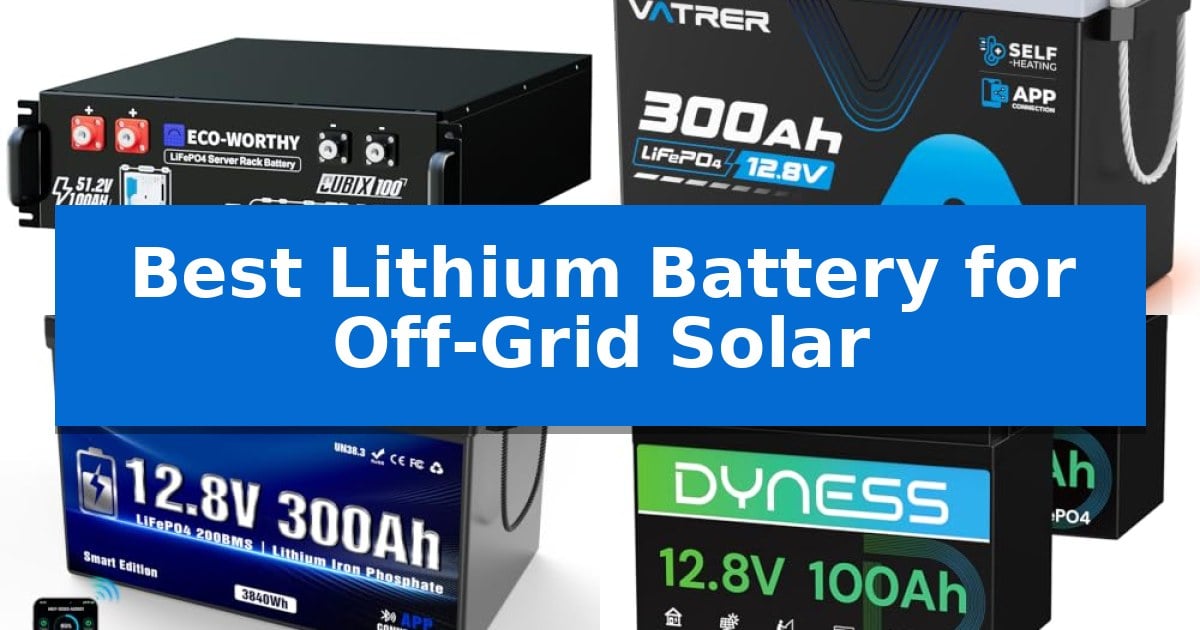
Transitioning to an independent power system requires a reliable energy reservoir that can withstand daily cycling and environmental challenges. Finding the Best Lithium Battery for Off-Grid Solar is the most critical step in ensuring your cabin, RV, or home backup system remains functional when the grid is unreachable.
Modern lithium iron phosphate (LiFePO4) technology has replaced traditional lead-acid alternatives by offering significantly higher energy density and a longer service life. Whether you need a compact solution for tight spaces or a scalable rack-mounted system for heavy loads, selecting the right chemistry and management system is essential for long-term power stability.
You may also want to compare Best Lithium Battery for Home Solar Systems, Best Lithium Battery for Cars, and Best Lithium Battery for Car.
Best Lithium Battery for Off-Grid Solar
Quick Comparison
| Product | Best For | Key Strength | Score |
|---|---|---|---|
| ECO-WORTHY Cubix100 Server Rack Battery | Best Overall | Comprehensive safety certifications including UL9540 and UL1973. | 4.9 |
| VATRER POWER 12V 300Ah Lithium Battery | Features Active Self-Heating | Integrated self-heating for reliable charging in sub-zero temperatures. | 4.5 |
| MEYULMOL 12V 300Ah Lithium Battery | Smart App-Enabled Monitoring | 4S4P expansion allows for seamless system scaling. | 4.8 |
| Dyness 12V 100Ah Lithium Battery | Compact Choice for Tight Spaces | Low-temperature charging protection prevents damage in cold climates. | 4.8 |
| LiTime 24V 100Ah Lithium Battery | Efficient High-Voltage Configuration | Long-term durability with 4000+ cycles at 100% depth of discharge. | 4.8 |
How We Chose
- Safety and Certification: Prioritizing models with verified standards like UL9540 or UL1973 to ensure thermal stability.
- Scalability and Expansion: Assessing the ability to connect multiple units in series or parallel to grow with your energy needs.
- Battery Management System (BMS) Intelligence: Evaluating the sophistication of the internal BMS for protection against over-voltage, short circuits, and temperature extremes.
- Monitoring and Connectivity: Checking for integrated Bluetooth, WiFi, or communication protocols like CAN/RS485 for real-time system diagnostics.
- Environmental Resilience: Considering features like active self-heating or low-temperature cut-offs for reliable operation in varying climates.
1 ECO-WORTHY Cubix100 Server Rack Battery — Best for Scalable Home Storage
Reliable energy management for off-grid living requires robust hardware, and the ECO-WORTHY Cubix100 Server Rack Battery provides a specialized solution built with Grade A LiFePO4 cells. This unit is engineered for demanding environments, featuring UL9540, UL1973, and CEC listings that confirm its compliance with rigorous North American safety and thermal runaway management standards.
Designed for seamless integration into modern solar setups, this battery supports closed-loop communication via integrated CAN/RS485 interfaces. This allows the system to interface directly with leading solar inverters for intelligent energy distribution. Users can monitor performance metrics in real-time through built-in Bluetooth and WiFi connectivity using the dedicated ECO-WORTHY app.
The space-saving rack design allows for efficient vertical mounting, making it suitable for compact installations. Scalability is a core strength, as the system supports paralleling up to 32 units, enabling a total energy capacity of up to 163.8kWh. The package includes a complete plug-and-play kit with all necessary parallel, communication, and grounding cables for immediate deployment.
While the unit is built for performance, it is important to note its physical footprint and weight of 103 pounds, which necessitates a stable, dedicated server rack environment. The manufacturer provides a 10-year limited warranty, ensuring long-term support for off-grid energy storage needs.
Best for: Homeowners and off-grid cabin users requiring a scalable, rack-mounted energy storage system with smart monitoring capabilities.
Skip if: Users seeking a portable, lightweight power station or those without the infrastructure to accommodate a 103-pound server rack battery.
PROS
- Comprehensive safety certifications including UL9540 and UL1973.
- Scalable architecture allows paralleling up to 32 units for massive capacity.
- Integrated smart monitoring via Bluetooth and WiFi connectivity.
- Closed-loop communication support for intelligent inverter integration.
CONS
- Heavy 103-pound weight requires a sturdy, dedicated rack mount.
- Fixed server rack form factor is not suitable for mobile or portable applications.
2 VATRER POWER 12V 300Ah Lithium Battery — Features Active Self-Heating
Maintaining power in freezing temperatures is a common challenge for off-grid energy systems, but the VATRER POWER 12V 300Ah Lithium Battery addresses this with an integrated Self-Heating Feature. When connected to a charger, the system monitors internal temperatures and activates a heating film if conditions drop below 0°C (32°F), ensuring the battery remains operational in cold climates.
Beyond its thermal management, this unit features a built-in 200A BMS that provides comprehensive protection against overcharging, over-discharging, overcurrent, and short circuits. This management system also handles intelligent cell balancing to maintain long-term durability during both charging and discharging cycles.
For users who prioritize visibility, the APP Monitoring capability allows for real-time tracking of voltage, current, remaining capacity, and temperature directly from a mobile device. This transparency helps in managing power consumption for diverse applications, including RVs, marine vessels, and household backup systems.
The VATRER POWER 12V 300Ah Lithium Battery offers flexible energy replenishment, supporting charging via a 14.6V lithium charger, solar arrays, or a generator. With a high-capacity 300Ah rating, it is engineered to provide a steady 12V DC output for essential appliances like refrigerators and microwaves when paired with an appropriate inverter.
Best for: Off-grid solar setups and mobile living environments like RVs or marine vessels that require reliable power in fluctuating temperature conditions.
Skip if: Users planning to connect batteries in series for high-voltage applications like golf carts, as this model is not designed for that specific configuration.
PROS
- Integrated self-heating for reliable charging in sub-zero temperatures.
- Real-time APP monitoring for clear visibility of battery health and status.
- Robust 200A BMS providing essential safety protections and cell balancing.
- High-capacity 300Ah design suitable for long-duration power needs.
CONS
- Not suitable for series connections in golf cart applications.
- Requires specific charging current (exceeding 10A) to trigger the heating film.
3 MEYULMOL 12V 300Ah Lithium Battery — Smart App-Enabled Monitoring
Reliable power storage for off-grid environments requires a balance of longevity and intelligent management, which is exactly where the MEYULMOL 12V 300Ah Lithium Battery excels. By utilizing automotive-grade A-class cells, this unit delivers a significant leap in energy density and stability compared to traditional lead-acid alternatives, providing a robust solution for RVs, marine vessels, and remote cabins.
At the heart of this system is an upgraded 200A intelligent BMS, which provides comprehensive protection against overcharge, over-discharge, overcurrent, and short circuits. A standout feature for cold-weather operation is the precision 0°C (32°F) low-temperature cutoff, which prevents lithium plating during charging, while the system automatically pauses discharge below -4°F to preserve battery health.
Designed for scalability, the MEYULMOL 12V 300Ah Lithium Battery supports a 4S4P flexible expansion method. This allows users to start with a single unit and scale up to a 48V/1200Ah system as energy demands grow. Weighing only one-third of a comparable lead-acid battery, it offers a high-capacity, space-saving footprint that is ideal for mobile power stations.
With a rated service life exceeding 10 years and over 4000 charge cycles, this battery is engineered for long-term reliability. The inclusion of Smart APP monitoring provides users with real-time visibility into their power system, ensuring that off-grid energy management is both transparent and efficient.
Best for: Off-grid solar setups and mobile power stations requiring scalable, high-capacity storage with integrated smart monitoring and low-temperature protection.
Skip if: Users requiring a smaller, lower-capacity battery or those operating in environments that do not require the specific 200A BMS and cold-weather safety features.
PROS
- 4S4P expansion allows for seamless system scaling.
- Integrated 200A Smart BMS provides comprehensive safety and app-based monitoring.
- Low-temperature protection ensures safe operation in freezing conditions.
- Automotive-grade A-class cells offer high energy density and a 10+ year lifespan.
CONS
- Higher initial investment compared to standard lead-acid battery technology.
4 Dyness 12V 100Ah Lithium Battery — Compact Choice for Tight Spaces
Reliable power management in remote environments requires equipment that balances capacity with environmental resilience, such as the Dyness 12V 100Ah Lithium Battery. This unit is specifically engineered for off-grid solar and RV applications, featuring integrated low-temperature charging protection that automatically halts the charging process when temperatures drop below 32°F (0°C) to prevent internal damage.
The battery utilizes A+ Grade LiFePO4 cells, which support over 4000+ deep cycles, providing a significantly longer service life compared to traditional lead-acid alternatives. Its internal 100A Battery Management System (BMS) serves as an all-in-one safety shield, monitoring for overcharging, over-discharging, overcurrent, and short circuits while maintaining an IP65 waterproof rating for added durability in marine or outdoor settings.
Designed for space-constrained installations, the Dyness 12V 100Ah Lithium Battery weighs only 25.3 lbs and measures 13.0 x 6.77 x 8.43 inches. This compact form factor allows for flexible system expansion, as users can connect up to four units in series and four in parallel to achieve a total capacity of 20.48kWh.
To ensure optimal health and longevity, the manufacturer recommends using a LiFePO4-specific charger and maintaining a charging rate of 0.2C. This specialized approach helps maintain the integrity of the A-grade cells, ensuring the system remains a dependable energy source for home storage, boating, or mobile living setups.
Best for: Off-grid solar and RV users who require a compact, durable battery with built-in cold-weather protection.
Skip if: Users who need a battery for extreme sub-zero environments where charging must occur below -4°F (-20°C) or those requiring a different voltage architecture.
PROS
- Low-temperature charging protection prevents damage in cold climates.
- A+ Grade LiFePO4 cells provide 4000+ deep cycles.
- Integrated 100A BMS ensures comprehensive safety monitoring.
- Compact and lightweight design saves over 65% in weight compared to lead-acid.
CONS
- Requires a LiFePO4-specific charger for optimal performance.
- Charging is automatically disabled below 32°F (0°C) to protect the cells.
5 LiTime 24V 100Ah Lithium Battery — Efficient High-Voltage Configuration
Reliable power storage for off-grid environments requires a balance of capacity and safety, and the LiTime 24V 100Ah Lithium Battery provides a substantial 2.56kWh of energy in a compact, manageable form factor. Weighing 45.85 lbs, it offers a significant weight reduction compared to traditional lead-acid alternatives, making installation and handling more practical for mobile or remote solar setups.
Engineered with LiFePO4 chemistry, this battery is designed for thermal stability and long-term use, supporting over 4,000 cycles at 100% depth of discharge. The integrated 100A Battery Management System (BMS) provides essential protection against overcharging, over-discharging, overheating, and short circuits, ensuring consistent operation across a temperature range of -4℉ to 140℉.
For those requiring larger energy banks, the system is expandable, supporting 4P2S connections to scale up to a 20.48kWh system. While it is well-suited for RVs, marine applications, and solar storage, it is important to note that this model is not intended for engine starting or high-surge devices and does not include Bluetooth monitoring features.
The LiTime 24V 100Ah Lithium Battery is a robust choice for users prioritizing system longevity and safety in their solar power architecture. Its low self-discharge rate of 3% per month helps maintain charge retention during periods of inactivity, offering a durable solution for demanding off-grid energy requirements.
Best for: The LiTime 24V 100Ah Lithium Battery is best for off-grid solar, RV, and marine energy storage systems requiring a scalable, high-capacity 24V power solution.
Skip if: Skip this battery if you require Bluetooth monitoring capabilities or need a high-surge power source for engine starting applications.
PROS
- Long-term durability with 4000+ cycles at 100% depth of discharge.
- Integrated 100A BMS for comprehensive safety protection.
- Scalable design allowing for expansion up to 20.48kWh.
- Lightweight construction at approximately 1/3 the weight of lead-acid batteries.
CONS
- No Bluetooth monitoring functionality included.
- Not suitable for engine starting or high-surge devices.
Best Lithium Battery for Off-Grid Solar Buying Guide
Understanding Battery Chemistry and Longevity
The shift toward LiFePO4 (Lithium Iron Phosphate) chemistry is the industry standard for off-grid applications. Unlike older technologies, these batteries provide a stable discharge voltage and are inherently safer due to their chemical composition, which resists thermal runaway.
When evaluating longevity, look for the cycle life rating. High-quality cells often provide 4,000 to 5,000+ cycles at 100% depth of discharge, meaning the battery can last over a decade under normal usage conditions before reaching 80% of its original capacity.
The Role of the Battery Management System (BMS)
A robust BMS is the brain of your solar battery. It monitors individual cell voltages, current flow, and internal temperatures to prevent damage. A high-amperage BMS, such as a 200A system, allows for higher discharge rates, which is crucial if you plan to run power-hungry appliances like microwaves or pumps.
Advanced systems also include low-temperature protection. This is vital because charging lithium batteries in freezing conditions can cause permanent damage. A smart BMS will automatically disconnect the charging circuit when the temperature drops below 0°C (32°F).
Scalability and System Configuration
Off-grid needs often grow over time. Choosing a battery that supports parallel or series connections allows you to start with a modest setup and add more capacity as your energy demands increase. Server-rack style batteries are specifically designed for this, often supporting up to 32 units in parallel.
Always verify the communication protocols (such as CAN or RS485) if you are using an integrated solar inverter. Closed-loop communication allows the battery and inverter to 'talk' to each other, optimizing charging profiles for maximum efficiency.
Physical Dimensions and Mounting
Space is often limited in RVs or small off-grid cabins. While server-rack batteries offer high capacity, they require specific rack mounting. Conversely, 12V block batteries are more versatile for tight compartments but may require more complex wiring if you are building a large 48V bank.
Weight is another factor. Lithium batteries are typically one-third the weight of lead-acid equivalents, which is a major advantage for mobile applications where every pound counts toward fuel efficiency and suspension load.
Monitoring and Maintenance
Modern batteries often include Bluetooth or WiFi connectivity, allowing you to monitor your state of charge, voltage, and temperature directly from a smartphone app. This eliminates the need for external shunts in some configurations.
While lithium batteries are largely maintenance-free, keeping the terminals clean and ensuring the battery is stored in a ventilated area will help maintain optimal performance over its multi-year lifespan.
Frequently Asked Questions
Can I mix different brands of lithium batteries in my solar bank?
It is strongly recommended to use batteries of the same brand, model, and age. Mixing batteries can lead to uneven charging and discharging, which may trigger the BMS to shut down the system prematurely.
What is the benefit of a 48V system over a 12V system?
A 48V system requires less current to deliver the same amount of power as a 12V system. This allows for thinner cabling and reduces energy loss due to resistance, making it more efficient for larger off-grid solar setups.
Do I need a special charger for my LiFePO4 battery?
Yes, you should use a charger specifically designed for LiFePO4 chemistry. These chargers follow a specific constant-current/constant-voltage (CC/CV) profile that ensures the battery is charged safely and fully.
What happens if I charge my battery in freezing temperatures?
Charging lithium batteries below freezing can cause lithium plating, which permanently reduces capacity and can lead to internal shorts. Always choose a battery with an integrated low-temperature cut-off or active heating.
How do I know when my battery needs to be replaced?
Most lithium batteries are rated for thousands of cycles. You will know it is nearing the end of its life when the total runtime under a standard load becomes noticeably shorter, indicating the battery can no longer hold its rated capacity.
Conclusion: Our Top Pick
For those building a robust, long-term off-grid power system, the ECO-WORTHY Cubix100 Server Rack Battery stands out as the most reliable and scalable choice. Its combination of UL-certified safety, high-capacity 48V architecture, and intelligent communication protocols makes it ideal for both residential backup and remote cabin setups.
While other options like the VATRER POWER or MEYULMOL batteries offer excellent features for mobile or smaller 12V applications, the server-rack design of the ECO-WORTHY unit provides the best path for future expansion. By choosing a system with comprehensive safety testing and easy parallel integration, you ensure your off-grid energy remains consistent and secure for years to come.